NOTE: This review contains SPOILERS for the film (now playing widely in U.S. theaters).
Diane Ackerman’s non-fiction book was greatly inspired by the unpublished diary of Antonina Zabinska and Jan Zabinski, the director of the Warsaw Zoo in Poland. The book was published in 2007. While the real life events occurred in Warsaw, the movie was filmed entirely in Prague (w/ real baby lion cubs). This film also has a woman director (Niki Caro) and woman adapter (Angela Workman).
[1] It is still possible to find love and comfort in the darkest of times. Love is all around us. We must be the vessel through which hope and love spreads. Antonina believed this with her whole heart which is why she and Jan did what they did. There are brave people all around us: fighting for our rights, fighting for theirs, their family, their country – bravery comes in so many forms. This film reflects this: there is bravery in combat and ‘silent’ bravery. One is not greater than the other.
[2] One of the key messages seems to come from an early monologue delivered by Antonina where she compares the purity of animals (their eyes tell you everything) with the propensity to deceive and commonplace of ulterior motives in humans.
[3] Caro is able to reflect humanity, sincerity and earnestness in her films, which captivates and entangles the viewer. Caro’s directing prowess brings to mind the ideology of the male gaze vs. the female gaze in films… I feel as though I’m witnessing a life lived, purely, rather than someone’s perspective of that life.
-Excerpts from IMDB reviews
We first see Antonina (Jessica Chastain) as a happy figure riding her bike through a zoo with a young camel trotting beside her. She helps rescue a newborn elephant, interrupting a dinner party. But soon German bombs begin dropping on her city (Warsaw) and this zoo she runs w/ her zoologist husband, Jan (Belgian actor Johan Heldenbergh).
…she is undeniably captivating as the eponymous lead, channeling grit and vulnerability in equal measure as she fleshes out her character’s fears, anxieties and convictions. Among the supporting actors, Bruhl and Haas [the teenaged Israeli actress who plays a pivotal role] are the standouts, the former exercising admirable restraint in what could have been a traditionally villainous act, while the latter surprisingly nuanced in her portrayal…
-Excerpt from IMDB review
The scenes between Lutz Heck (Daniel Bruhl) and Antonina are tense; as he disarms her with his affinity/experience w/ of animals, BUT later scares her (and us) with his unwanted advances and desire to cross-breed animals in hopes of creating a new type of bison/bull (superior beast).
Set in NYC, this film stars Cary Grant as Johnny Case, a 30 y.o. businessman working at a “financial house.” While he takes a skiing holiday to Lake Placid, he meets Julia Seton (Nolan); the two fall in love (in ONLY 10 days). They get engaged!
Johnny Case (Cary Grant) is amazed by the size of the Seton family’s home.
It turns out that Julia comes from a VERY wealthy/influential family. Johnny is surprised and bemused, BUT then finds himself taken w/ Linda (Katharine Hepburn), Julia’s free-thinking/dramatic older sister and her little brother, Ned (Lew Ayres), a musically-gifted alcoholic. (Linda Seton was loosely based on Gertrude Sanford Legendre, a former débutante who left high society to become a big-game hunter and later spied for the OSS during WWII.)
Sisters Julia (Doris Nolan) and Linda Seton (Katharine Hepburn) surround Johnny (Cary Grant).
There are a lot of humorous little episodes. I tried to get Father to let me take a nursing course at a hospital. Oh yes, and I almost got arrested trying to help some strikers over in Jersey. Well, how was I to know that Father was on the board of directors at the company? You see, Case, the trouble with me is I never could decide whether I wanted to be Joan of Arc, Florence Nightingale, or John L. Lewis.-Linda talks about her past
It turns out that Julia is NOT that different from her father; at some point you wonder WHAT Johnny saw in her in the first place! Her siblings are discontented with being under their father’s thumb. Mr. Seton is NOT a bad guy, BUT has strong feelings about how things should be done to keep the family on the up and up.
You’ve got no faith in Johnny, have you, Julia? His little dream may fall flat, you think. Well, so it may, what if it should? There’ll be another. Oh, I’ve got all the faith in the world in Johnny. Whatever he does is all right with me. If he wants to dream for a while, he can dream for a while, and if he wants to come back and sell peanuts, oh, how I’ll believe in those peanuts! -Linda explains, revealing her true feelings for Johnny
Johnny (Cary Grant) with his friends, Professor Nick Potter (Edward Everett Horton) and his wife, Susan (Jean Dixon).
[Quoting an imaginary society column] ‘Miss Linda Seton – on New Year’s Eve – entertained a small group of Very Unimportant People.’ -Nick jokes
In the original play, Nick and Susan Potter are wealthy socialites. Due to the Depression, the plot was altered so that Johnny (“the common man”) would have more ordinary, down-to-earth friends. Johnny’s friends, the Potters, were intellectuals and funny- great combo. They added a LOT of fun to this film!
Johnny (Cary Grant) thinks about his future while his fiancee Julia (Doris Nolan) and her father (Henry Kolker) look on.
[1] Hepburn, clearly the star of this production, acts each scene with an emotion and charm that is almost unheard of in the mainstream cinema of the present. …I found myself becoming so endeared to her character that I probably would have been completely devastated if she didn’t get some sort of happiness in the end, probably one of the highest compliments that I can give to an actor’s performance… He [Grant] is such a fresh and passionate character…
[2] Cukor takes a lighthearted approach to this story, which keeps it upbeat and entertaining, and he laces it with warmth and humor that’ll give you some laughs and put a smile on your face. But beyond all that, Cukor shows some real insight into human nature and the ways of the world. And it makes this film timeless.
With a career spanning more than 7 decades, Kirk Douglas has long since earned his place in Hollywood history. December 9, 2016 was the iconic actor’s 100th birthday (WOW)! His is a real-life “up from nothing” story; Douglas is the son of Jewish immigrants (from modern-day Belarus) who settled in the Lower East Side of Manhattan. As a youngster, he was a good student and athlete (even wrestling competitively at St. Lawrence University). Douglas discovered an acting scholarship and was talented enough to get into the American Academy of Dramatic Arts.
After working on the New York stage (alongside good friend Lauren Bacall), he began his film career in the 1946 Barbara Stanwyck vehicle The Strange Loves of Martha Ivers, which was soon followed by memorable roles in Out of the Past, Joseph L. Mankiewicz’s A Letter to Three Wives, among others. Douglas also developed his own projects behind the camera, releasing the historical epic Spartacus through his own production company.
Movie Review: Ace in the Hole
[1] This movie fits nicely into the film noir genre, although it takes place largely under the hot, harsh glare of the New Mexico sun, highlighting the sweat and grime visible on the characters’ skin and creating a visual metaphor for the sorry state of their souls.
[2] Perhaps the cause of failure of this film [at the box office] is that there are no sympathetic characters here… The screenplay, and the lead performances are top class. The extensive location photography, and somewhat documentary look of the film makes the film feel more modern than most 1951 films.
[3] The world described here is so depressing, so disheartening that it takes drama to new limits. Not only Tatum is evil, but so are the miner’s wife and family who take advantage of the situation, regardless of any morals. So is the faceless crowd, who has a wild time, near a dying man. You and me, we could be part of this populace, and maybe we’ve already been!
–Excerpts from IMDB reviews
This film, featuring Douglas (who plays Chuck Tatum) as an antihero, is on Roger Ebert’s Great Movies list. I rented it on YouTube recently. Aside from the length (it could’ve used more editing), I thought it was pretty good. It was co-written by Billy Wilder, so you know the dialogue (esp. that for Chuck) will be fast, funny, and VERY interesting. Wilder’s wife, Audrey Young, came up with the funny, yet irreverent line spoken by Jan Sterling (Lorraine Minosa): “I don’t go to church. Kneeling bags my nylons.”
No chopped chicken liver! No garlic pickles. No Lindy’s. No Madison Square Garden. No Yogi Berra! -Chuck complains re: missing NYC
Chuck has been fired from a few different newspapers (drinking too much, chasing a publisher’s wife, etc.) He manages to get on the staff of an Albuquerque paper. Finally, Chuck learns re: Leo Minosa (Richard Benedict), a man who got trapped in a mine while digging for Indian (Native American) relics. Herbie Cook (Robert Arthur) is the wide-eyed young reporter who tags along w/ Chuck.
Human interest. You pick up the paper, you read about 84 men or 284, or a million men, like in a Chinese famine. You read it, but it doesn’t say with you. One man’s different, you want to know all about him. That’s human interest. -Chuck explains to Herbie
Leo is trapped inside a mine in the Mountain of the Seven Vultures. Chuck manipulates the (politically-ambitious) sheriff, the Army engineer running the rescue operation, and Leo’s wife, Lorraine. Chuck, with his wily words, manages to prolong the rescue efforts; what could’ve taken just twelve hours lasts six days. Leo’s story becomes known nationwide, making Tatum a star reporter (yet again), and creating a circus around the desert town.
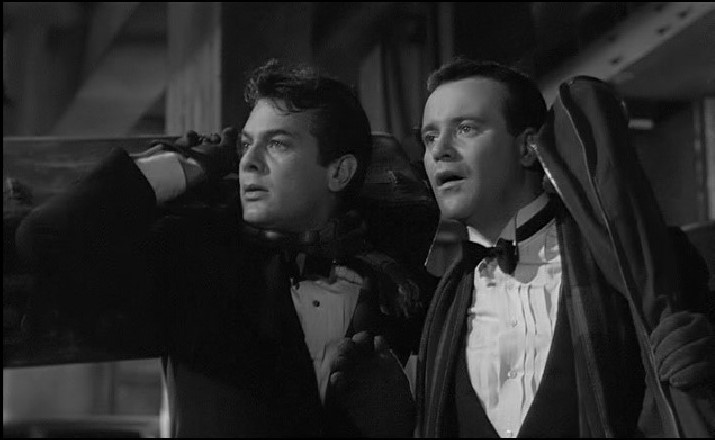
Musicians Joe (Tony Curtis) and Jerry (Jack Lemmon) witness a mob hit in Chicago.
When broke Chicago musicians, Joe (sax player) and Jerry (on bass), witness the St. Valentine’s Day massacre, they need to get away from the gangster responsible (Spats Colombo). They’re desperate to get a gig out of town, but the only job available is with an all-girl band heading to Florida. They show up at the train station as “brand new” girls-Josephine and Daphne. They really enjoy being around the troupe of young, pretty women (esp. Sugar Kane Kowalczyk, who sings/plays ukulele). Joe (a ladies man) sets out to woo Sugar. Jerry/Daphne is wooed by an eccentric/sweet millionaire, Osgood Fielding III. Mayhem ensues as the two pals try to keep their true identities hidden. Then Spats and his mafia men show up for a gathering with other crime bosses.
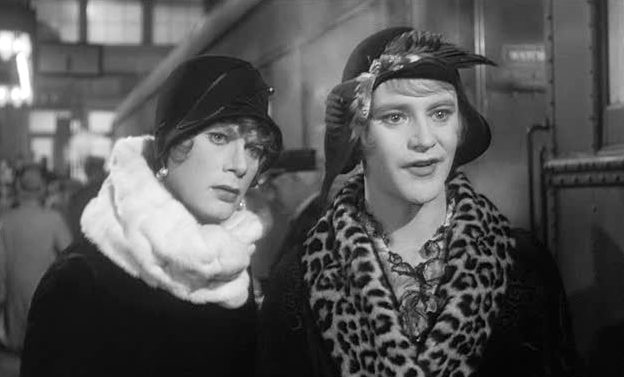
Joe and Jerry (in drag) admire the walk of a real woman (played by Marilyn Monroe).
This is one of my faves; if you need a laugh (or a dozen), definitely have a watch!I’ve seen the film several times on TCM; I also have it on DVD. Some Like It Hot was voted the 9th greatest film of all time by Entertainment Weekly magazine, and, is ranked on this list high enough to be the greatest comedy of all time.
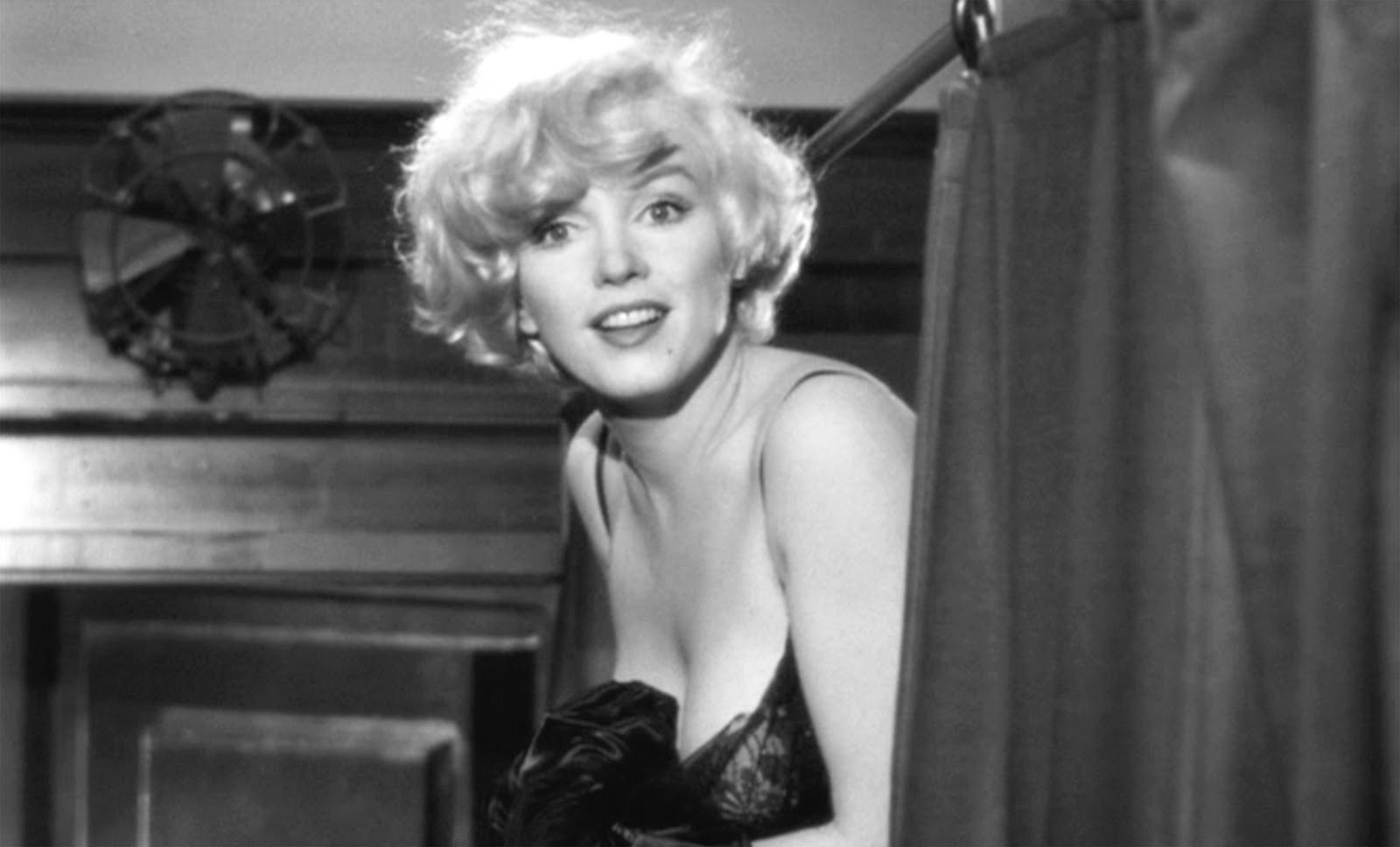
The costumes Monroe wears are simply stunning! One of the evening gowns is SO revealing that even modern viewers wondered (on Twitter) HOW it got past censors. When Curtis and Lemmon saw the costumes that would be created for Monroe, they wanted to have beautiful dresses, too. Monroe wanted the movie to be shot in color (her contract stipulated that all her films were to be in color), but Billy Wilder (the director/co-writer) convinced her to let it be shot in black and white after costume tests revealed that the makeup that Curtis and Lemmon wore gave their faces a green tinge.
The co-leads, though opposites w/ regards to acting education and personal backgrounds, make a GREAT comedy team! Lemmon’s Jerry has nervous energy and is a fast-talker, while Curtis’ Joe is self-assured and able to charm others easily. However, its actually Jerry’s idea for them to disguise themselves as women! When the actors first put on the female make-up and costumes, they walked around the Goldwyn Studios lot to see if they could “pass” as women. Then they tried using mirrors in public ladies rooms to fix their makeup, and when none of the women using it complained, they knew they could be convincing as women. There is a scene on the train recreating this moment.
Sugar Kane Kowalczyk (Marilyn Monroe) leans out of her bunk on the train.
I recently learned that Wilder, the actors, and crew had a VERY tough time on this movie b/c of Monroe’s behavior. She was heavily into drugs during this time, so kept forgetting her lines, and MANY takes had to be shot before she got even the simplest lines correct. There is something meta about Monroe’s performance as Sugar, who smuggles in alcohol (though she claims she can stop drinking anytime) and laments her pattern of falling for the wrong kind of men (particularly sax players).
Lemmon got along with Monroe and forgave her eccentricities. He believed she simply couldn’t go in front of the camera until she was absolutely ready. “She knew she was limited and goddamned well knew what was right for Marilyn,” he said. “She wasn’t about to do anything else.” He also said that although Monroe may not have been the greatest actor or singer or comedienne, she used more of her talent, brought more of her gifts to the screen than anyone he ever knew.
There is a party going on, but Daphne (Lemmon) wants to be alone with Sugar (Monroe).
One of the MOST hilarious scenes in the film involves Jerry/Daphne and Sugar in Daphne’s bunk. Jerry is SO excited about Sugar sidling up to him, but she sees him as Daphne. The expressions on Lemmon’s face are just priceless! They are soon interrupted by almost all of the other girls, who want to join in the fun. Jerry Lewis was offered the role of Jerry/Daphne but declined because he didn’t want to dress in drag. Lemmon received an Oscar nomination for the role (well-deserved).
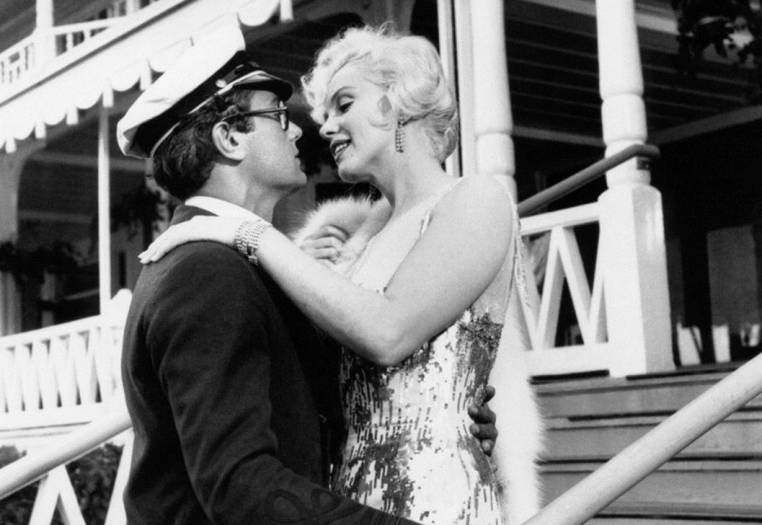
Joe/Shell Oil Jr. (Curtis) and Sugar (Monroe) embrace after their date on the yacht.
Another great thing about this film is the goofy accent that Joe (as Shell Oil Jr.) adopts to impress Sugar. Jerry exclaims:”Nobody talks like that!” Curtis said he asked the director if he could imitate Cary Grant; Wilder liked it and shot it that way. When Grant saw the parody of himself, he jokingly said: “I don’t talk like that.”
While Shell Oil Jr. and Sugar were making out on the yacht, Daphne and Osgood were dancing tango at a Cuban nightclub. They danced VERY well, too! The music used in the film contributes to its atmosphere; portions of the following tunes were used: Sweet Georgia Brown, By the Beautiful Sea, Randolph Street Rag, La Cumparsita and Park Avenue Fantasy (AKA Stairway to the Sky).
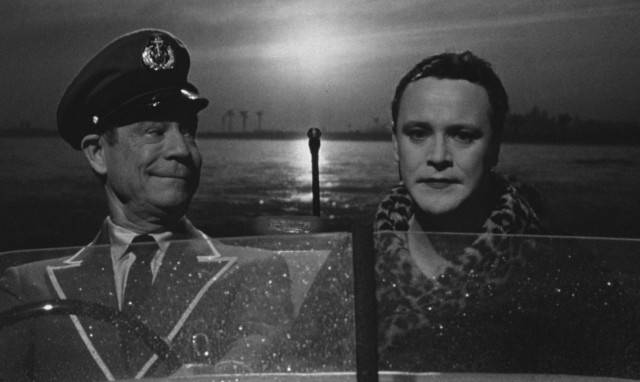
“Nobody’s perfect!” Osgood declares upon seeing that Daphne is a man.
Despite her gold-digging instincts, Monroe’s Sugar is cozy, vulnerable and altogether loveable, getting a lot of mileage too out of her solo singing spots, which include the kinetic “Running Wild,” the torchy “I’m Through With Love,” and her classic “boop-boop-a-doop” signature song, “I Wanna Be Loved by You.”
Lemmon really steals the movie here. He invests Daphne with such enthusiasm that we can understand why he’s falling for Osgood. He’s having way too much fun and it’s great to watch him.
Why a would man would want to marry another man? asks Tony Curtis. Security! Jack Lemmon replies without missing a beat. Clearly, he had put the question to himself before and had arrived to a perfectly sensible conclusion.
The movie’s surprisingly suggestive and risque content is at odds with the time frame of the movie, and even with the period of the movie’s creation. The many smart double-entendres and plays on words are very well-written, and alternate between low-brow and high-brow comedy,
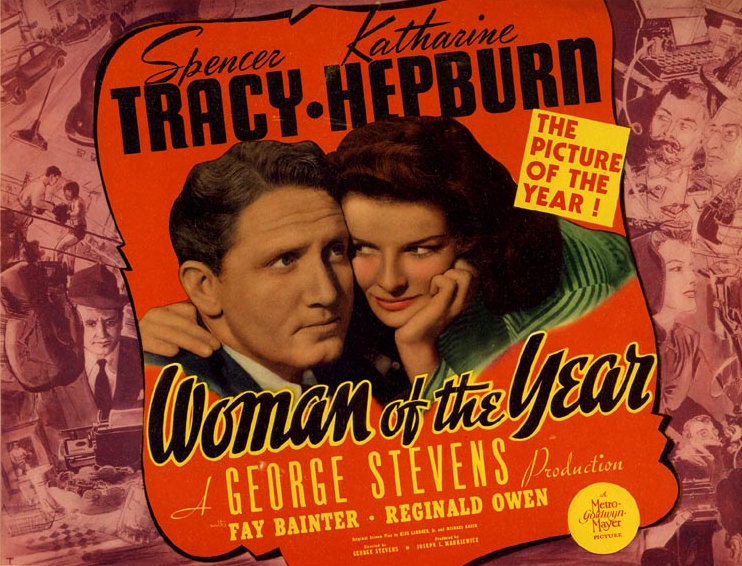
Reportedly, Katharine Hepburn’s first words to her costar were, “Mr. Tracy, I believe I am too tall for you” (FYI: Hepburn was 5’9″ and Tracy was 5’10½”). Director George Stevens said, “Don’t worry, honey. He’ll soon cut you down to size.” Like the actors themselves did in real life, this is a story of opposites attracting. Even their acting styles were different- Hepburn loved to rehearse; Tracy usually got it on the first or second take. In their scenes together here (their first film pairing), you see the magic (love) happen… and it’s REAL!
Tracy’s Sam Craig matched with Hepburn’s Tess Harding; his subtle, underplaying acting style with her stylized, personality-driven performance. It’s an acting tour de force, to be sure… In fact, their chemistry in this film is palpable. -Excerpt from IMDB review
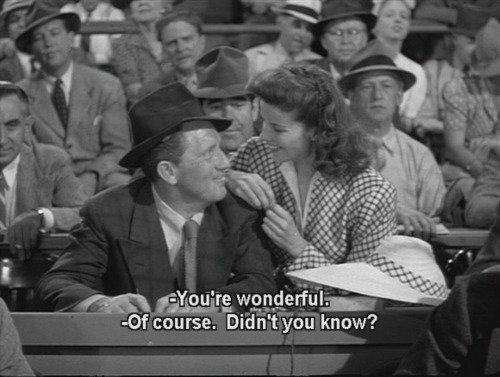
Sam takes Tess out to the ballgame (and she likes it)!
Are all these people unemployed? -Tess asks, surprised at the large crowd in the ballpark.
No, they’re all attending their grandmother’s funeral. -Sam replies.
After Tess Harding (Hepburn), a world-traveling journalist/commentator, makes some insensitive comments re: baseball on the radio, sports columnist Sam Craig (Tracy) criticizes her in his writing. A feud results, more papers get sold, and eventually, their editor brings them together to make peace. They see each other for the first time, sparks fly, and they go out to a ballgame. In a very short time, they fall deeply in love! Tess and Sam quickly marry and begin living together (in her apt.), BUT Sam soon discovers that his wife is so busy saving the world that she can’t make time for their relationship. After just a few months, Tess decides to take in Chris, a Greek refugee boy (w/o consulting Sam). This is the last straw for Sam, who decides to take drastic measures.
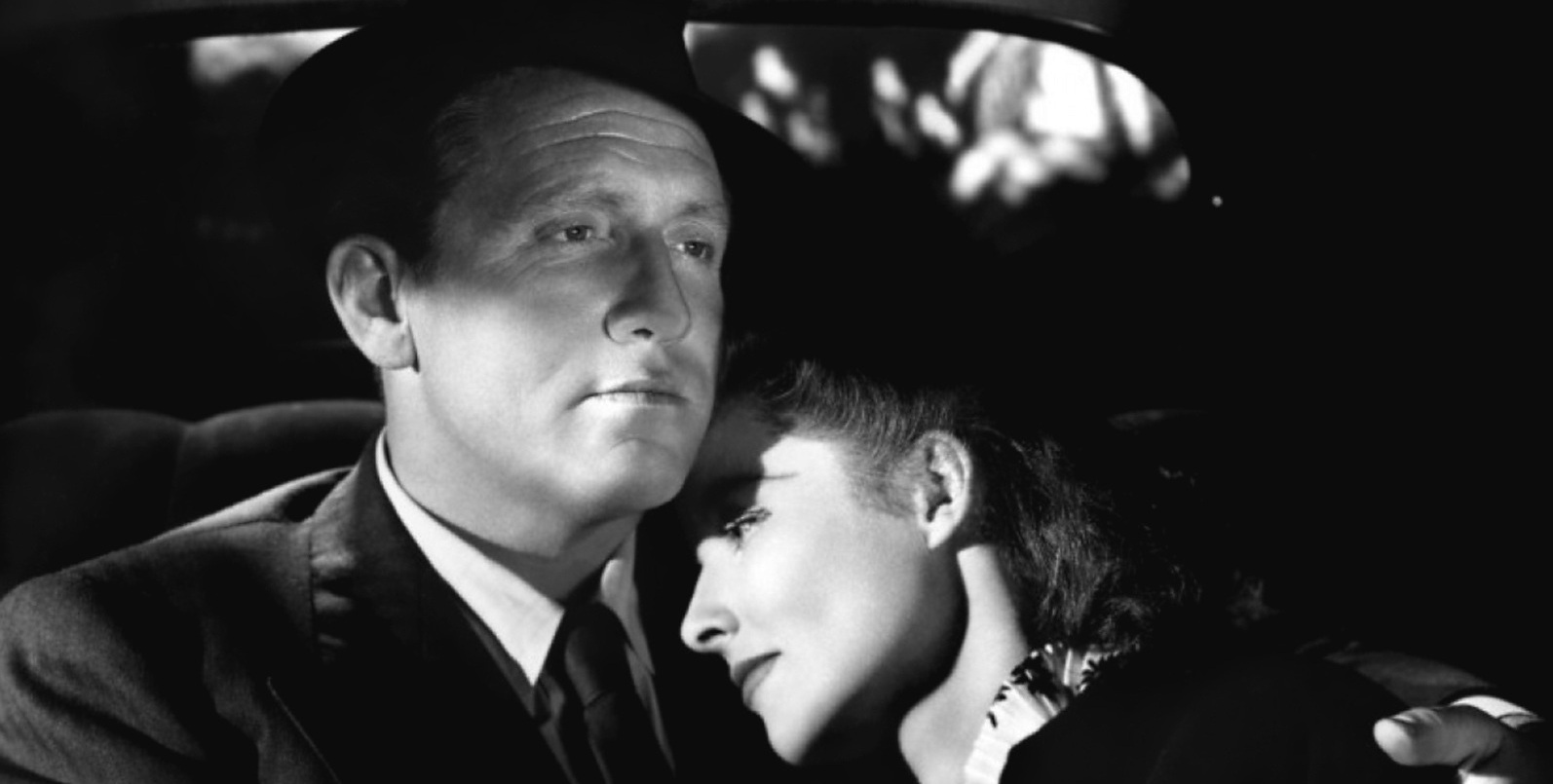
Sam and Tess embrace in the back of a taxi.
I’ve seen this film a FEW times over the years. What struck me during this viewing was how there was an imbalance in their jobs. Sure, they are BOTH smart, successful writers w/ respective fan followings. However, Tess is on another level (akin to Diane Sawyer in her prime). Her stories are usually on the front page of the paper. She speaks five languages (English, French, Russian, Spanish and Greek). Sam has a desk alongside a few other writers; Tess has a private office and a fastidious secretary, Gerald (a man). The subplot w/ Ellen (Tess’ maiden/feminist aunt) and her widowed father is a nice addition to the story.
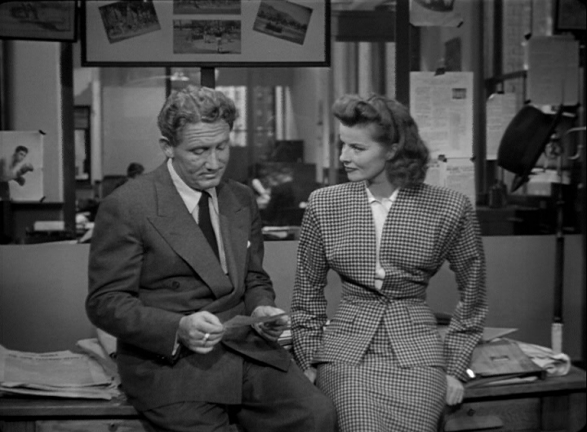
Sam and Tess in his office at the newspaper
Hepburn never appeared softer, more vulnerable, less mannered… I fall in love with her all over again every time I watch it… Tracy, the most honest actor who ever lived. But not just that: there was his ability to delve seemingly without effort into an infinite bag of gestures & expressions & tones & just plain old-fashioned but highly manifest wisdom & come up with the most richly nuanced guy ever depicted onscreen. -Excerpt from IMDB review
The ending (last 15 mins.) of this film will NOT suit modern viewers (esp. women)- it’s rather disappointing! Stevens decided (with Mankiewicz) that Tess Harding had to have her comeuppance for the average American housewife to relate to her character; this is noted in A Remarkable Woman: A Biography of Katharine Hepburn by Anne Edward. When Hepburn saw the changes, she commented that it was “sh*t.” Test audiences didn’t like the original ending, which showed BOTH Tess and Sam making compromises (NOT only Tess).