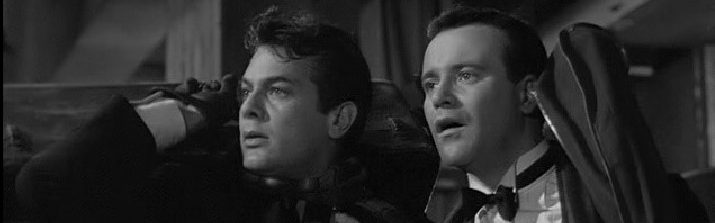
“Suddenly, Last Summer” (1959) starring Katharine Hepburn, Elizabeth Taylor, & Montgomery Clift

These are powers and passions without precedent in motion pictures! -A tagline for the film

A wealthy/powerful widow in late 1930s New Orleans, Violet Venable (Katharine Hepburn), attempts to bribe Dr. John Cukrowicz (Montgomery Clift), a psycho-surgeon at a mental hospital (desperately in need of funds), into lobotomizing her young niece, Catherine Holly (Elizabeth Taylor). Violet wants to prevent Catherine (diagnosed w/ schizophrenia) from “babbling” re: her son, (Sebastian) who died of a heart attack in Spain the previous Summer. Tennessee Williams’ sister (Rose) underwent a lobotomy to “cure” her anxiety; he never forgave his mother for allowing that to happen. The play was performed off-Broadway; it was a great success. The screenplay was written by Gore Vidal, who expanded from the original one act structure. He lost his chance for an Oscar nom after the Catholic Church attacked the film for its implications of homosexuality.

As some of y’all know, you need to be in a certain mood to watch a work written by Williams. This is NOT your “typical” movie; there are long monologues performed by Hepburn and Taylor. Though it deals w/ V serious subjects w/in a dysfunctional family, the story (lesser-known) is compelling! There is a mix of the Gothic w/ psychodrama and horror elements, which director Joseph Mankiewicz puts together expertly. He was known for getting strong performances out of female actresses; Mankiewicz directed A Letter to Three Wives (1949) and All About Eve (1950). If there is a weak link here, it’d (sadly) be Clift; alcoholism and prescription drug abuse took their toll on his acting. Taylor (looking fab- as usual) saved his job, as she would NOT play her role w/o her closest friend. Wow, she was a real one!

[1] …the film only alludes to Sebastian’s homosexuality, using rather graphic symbolism to bring across the dramatic tension of the situation. In this case, it works because it’s consistent with the Baroque style of the entire movie.

[2] Katharine Hepburn plays Violet and manages to chew the scenery and spit it out, it’s an elegant performance, but you really want more than we actually get!

[3] …it is lush and lurid, with gorgeous dialogue that is totally unbelievable coming out of the character’s mouths. It is a fun and entertaining movie to watch, with emotions running high and emoting even higher. Kate Hepburn and Liz Taylor are both mesmerizing...

-Excerpts from IMDb reviews

“The Mission” (1986) starring Robert De Niro & Jeremy Irons

Deep in the jungles of South America two men bring civilization to a native tribe. Now, after years of struggle together, they find themselves on opposite sides in a dramatic fight for the natives’ independence. One will trust in the power of prayer. One will believe in the might of the sword. -Taglines for the film

In the 1750s, an idealistic Spanish Jesuit, Father Gabriel (Jeremy Irons), goes high in the remote mountains of South America to build a mission, hoping to convert the native Indians. A Portuguese slave hunter, Capt. Rodrigo Mendoza (Robert De Niro), renounces his life of greed/violence and joins the mission; he eventually becomes a priest. Then, Spain sells this colony to Portugal, putting the freedom of the natives (and lives of the European priests) at risk! The film was released 4 yrs. after its (uncredited) source book- The Lost Cities of Paraguay– by Father C. J. McNaspy (an American Jesuit) was published. McNaspy was a historical consultant on the movie (loosely based on his work).

Gabriel: If might is right, then love has no place in the world. It may be so, it may be so. But I don’t have the strength to live in a world like that, Rodrigo.

The Mission was shot over 16 wks (mostly in Colombia), w/ 3 wks at the Iguazu Falls (Argentina). The Indian communities of Togorama, Burajon, Papayo, and Pangala (Choco, Colombia), esp. the tiny Guarani community (Iguazu, Argentina) contributed to its making. The Mission of San Carlos reconstructed for the movie was built on indigenous land w/ local materials and labor- wow! At Cannes (1987), it won both the C.S.T. Prize (the Technical Grand Prize) and the top award (the Palme d’Or), which were awarded to the director (Roland Joffé). The real draws here are its gorgeous cinematography and captivating musical score (by Ennio Morricone). Though it got 7 noms, the film won only one Oscar- Best Cinematography (awarded to Chris Menges).

Gabriel: If you die with blood on your hands, Rodrigo, you betray everything we’ve done. You promised your life to God. And God is love!

Like many viewers, I thought Irons did well; he shows a softer (gentler) side here than in some other roles. De Niro doesn’t seem V connected to this material; he looks good w/ longish/wavy hair and capable in the action scenes. When w/ the native kids, De Niro looks like he’s having a good time. The pacing is a major issue, aside from character development. There is only one (minor) female role; British theater actress (Cherie Lunghi) plays a noblewoman. We also see two tall/handsome (future) stars of Irish heritage: American actor Aidan Quinn (as Mendoza’s younger brother) and Irish actor Liam Neeson (as a priest- Fielding- using his own accent).

[1] The film is beautifully shot and features lush cinematography; however, the battle choreography of the film’s climax is somewhat ragged and unrealistic; the relative lack of character development adds to the “ho hum” feeling one gets while watching the Portuguese and the Guarani-Jesuit team fight it out on land and in kayaks.

The performances are decent though not spectacular. […] The dialogue, however, is such that none of the performances, except perhaps for Mr. Irons, are very memorable.

[2] Sadly, the story is never fully developed, and the inherent conflicts are not exploited. The movie becomes just a pastiche of related scenes lacking a strong narrative theme and supporting characters to tie them together. The story is subsumed by propaganda. Granted, these are extraordinarily beautiful scenes, but breathtaking scenery is not enough. It feels more like a History Channel lecture than a character-driven story.

[3] Jeremy Irons is well cast as Father Gabriel, ably encompassing a range of gentleness, sternness, and passionate devotion. Robert De Niro turns in a surprisingly weak performance… Anyone hoping that the scenes between Irons and De Niro would be exceptional will be disappointed. The real standout in the acting department is Ray McAnally as Cardinal Altamirano…

-Excerpts from IMDb reviews

Two Films of Luca Guadagnino: “I Am Love” (2009) & “A Bigger Splash” (2015)

I Am Love (2009) starring Tilda Swinton, Flavio Parenti, & Edoardo Gabbriellini

Emma (Tilda Swinton) left Russia to live with her husband in Italy. Now a member of a powerful industrial family, she is the respected mother of three, but feels unfulfilled. One day, Antonio (Edoardo Gabbriellini), a talented chef and her son’s friend, makes her senses kindle. -Synopsis

After watching Challengers this Spring, I decided to look up films that Luca Guadagnino directed in the past. For most (American) viewers, he became one to watch w/ I Am Love; Swinton has worked w/ him on many projects. This is a domestic drama w/ fine food, timeless fashion, and romance. The story is set in (modern-day) Milan, yet the visual style reminded me of a bygone era. The title is taken from the aria La mamma morta, part of the 1896 opera Andrea Chénier by Umberto Giordano; music is a major element here. Swinton learned both Italian and Russian for the part- wow! Swinton’s IRL daughter (Honor Swinton Byrne) played Emma as a child. As the idealistic heir of the biz, Flavio Parenti does a fine job (and looks gorgeous). Fans of Adam Driver (like me) will recognize Italian actress Alba Rohrwacher; they acted together in Hungry Hearts (2014). Here she plays Elisabetta, the artistic daughter of the (buttoned-up) Recchi family.

[1] Who is Mr. Guadagnino, the director? Where does he come from? He seems incredibly sure of himself. Costumes, interiors, landscapes are a visual feast. The score is also a very bold touch.

[2] While I was moved by much of the visual beauty of the film and the idea of breaking with tradition and listening to the voices within, I was infrequently emotionally involved with the characters and I Am Love felt distant and often contrived.

[3] Throughout the movie, it seemed that the food acted as a metaphor: Emma was starting to taste a whole side of her existence about which she’d never known.

-Excerpts from IMDb reviews

A Bigger Splash (2015) starring Ralph Fiennes, Dakota Johnson, Matthias Schoenaerts, & Tilda Swinton

The lives of a high-profile couple, a famous rock star (Tilda Swinton) and a filmmaker (Matthias Schoenaerts), vacationing and recovering on the idyllic sun-drenched and remote Italian island of Pantelleria, are disrupted by the unexpected visit of an old friend (Ralph Fiennes) and his daughter (Dakota Johnson), creating a whirlwind of jealousy, passion, and- ultimately- danger for everyone involved. —Synopsis (Fox Searchlight)

Swinton plays Marianne Lane, a British rock star (similar to Bowie) on an extended vacay on an island of Italy. Paul De Smedt (Matthias Schoenaerts) is her quiet/chill bf of several yrs. The happy couple is forced to host Marianne’s music producer/ex-bf, Harry Hawkes (Ralph Fiennes), when he drops in w/o warning. Adding to the disruption, Harry brought along a much younger/American woman, Penelope (Dakota Johnson), who turns out to be his daughter! As Marianne has recently injured her vocal cords, she speaks V little (and almost in a whisper). Harry (never at a loss for words) takes over the villa’s kitchen, invites his friends over, and does a (hilarious) dance! We start to wonder: What is his motivation to be here?

If you enjoyed The White Lotus, I think you may also like this film (which is a blend of comedy, drama, and mystery). The (natural) way that Guadagnino deals w/ nudity, sensuality, and intimate relationships is rare (esp. for those who don’t see a LOT of European films)! As one viewer wrote: “Guadagnino is a remarkable filmmaker with a retro eye and a futuristic sensibility.” There is a small side plot involving young men (refugees from North Africa); this felt superfluous to some viewers. At a Q&A session for this film, Guadagnino (now 52 y.o.) explained that his mother is Algerian (raised in Morocco) and a Muslim! However, when she married the director’s father, she was estranged from her family.

[1] The quartet core together concocts a palpable interplay between each of them, Ralph Fiennes is the MVP simply because he is all over the place and wondrous to behold under a fully liberated context, and at the same time his performance knowingly triggers a tint of abstruseness which belies the nature of every human soul…

[2] A Bigger Splash is a character development masterclass by Guadagnino. Over the first hour, the film gives everything to build up the intricacies of each character’s attributes so that every subsequent variation and elaboration feels exhilarating. This is a film about people and relationships; how different associations can sometimes coalesce, yet at other times grate, how secrets and history must awkwardly co-exist with the fantasies of perfection.

-Excerpts from IMDb reviews

“Fearless” (1993) starring Jeff Bridges, Isabella Rossellini, & Rosie Perez

After surviving a plane crash, a San Fran-based architect, Max Klein (Jeff Bridges), emerges a changed man. He’s unable to connect to his life w/ his wife Laura (Isabella Rossellini) and young son. Max feels like a god- nothing can hurt him! About 3 mos. later, psychologist Bill Perlman (John Turturro) convinces Max to meet w/ another survivor, Carla Rodrigo (Rosie Perez- who got an Oscar nom), who is racked w/ grief and guilt after losing her baby son in the crash. Carla’s husband, Manny, is played by a young Benicio del Toro. Max’s business partner/friend, Jeff, is played by John de Lancie (best known for Star Trek: TNG).

Dr. Perlman: He and your wife are the only survivors I can’t reach. She won’t talk and he won’t admit the crash was bad.

Manny: Is that right? He says it was good?

Dr. Perlman: Says it was the best thing that ever happened to him.

Hero (1992) was based around a similar subject matter and released a year before Fearless; about half a dozen cast/crew worked on both movies. The plane crash here was inspired by a real event from 1989.The source novel by Rafael Yglesias was published in 1993; Yglesias wrote the screenplay (which was his 1st one). Fearless may NOT an easy film to watch, esp. for those who lived through 9/11. This made me V emotional (I cried 3x), though the directing (by Peter Weir) is done in an unsentimental way. The music enhanced the movie V well.

Dr. Perlman: She won’t talk. Very Catholic. Old World, you know. Full of guilt, shame.

Max: I’m full of guilt and shame. How is that Old World?

This is a character-based drama w/ strong acting from the leads and supporting cast. Max is heroic (and called so in the media), BUT he is also a victim. Bridges (charming, relatable, yet troubled) and Perez (who has to carry a LOT of heaviness) have terrific chemistry together! As she a woman of color then relatively new to Hollywood, the studio was unsure re: Perez; Bridges and Weir both wanted her and pushed to get her hired (as she noted).

[1] This is deep introspective film making, as relevant as ever, with great performances from some truly great actors.

[2] Peter Weir is unique in his ability to convey the niceties of life with authenticity. Jeff Bridges is the master of the theatrical understatement.

[3] This movie definitely has flaws- the major one being that there are points when the story does not seem to be heading in any particular direction- but excellent acting, some intensely profound and uncommonly well-thought out character psychology (esp. for a Hollywood film) and the scariest/loveliest air plane crash ever dramatized makes this worth seeing.

-Excerpts from IMDb reviews