Noir City DC 2025: “Inferno” (1953) starring Robert Ryan, Rhonda Fleming, & William Lundigan

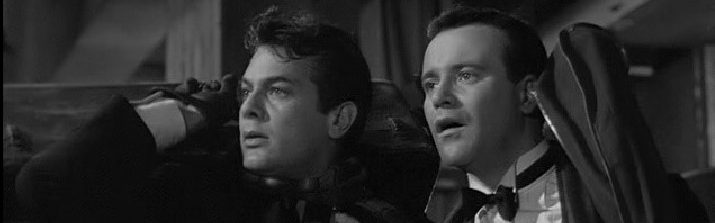
The studio (20th C. Fox) put a LOT into this noir: 3-D and stereophonic sound for the few theatres equipped for that sound system. The early ’50s was a time of 3-D craze, as film historians noted. The plot is simple: An ill-tempered/hard-drinking oil millionaire, Donald Whitley Carson III (Robert Ryan), breaks his leg falling off his horse in the desert. He is left to die by his cheating wife, Geraldine (Rhonda Fleming- w/ NOT much to do) and her lover, Joseph Duncan (William Lundigan). This film (directed by Roy Wood Baker) was distributed on a double bill w/ Rawhide (1951), a Western starring Tyrone Power and Susan Hayward.

Ryan though that his performance here was one of his finest. It must’ve been a challenge to be acting (mostly) alone in such a harsh environment; we hear (in voiceover) his inner thoughts/fears. The original script had Duncan walking off to Mexico, never to be seen again, and Carson picking up his wife and heading to divorce court. Studio head Darryl F. Zanuck wanted more action, so the fight scene btwn Carson and Duncan was added at the end. There a few moments where the 3-D does makes the movie a BIT exciting. It’s NOT going to wow modern audiences much- LOL!

[1] The fascination of the story was the way in which all the characteristics which, at the start, had made Ryan so unlikeable gradually became sympathetic and, after a while, we became identified with the tense struggle to survive of this man whom we had begun by disliking and despising…

This was some achievement by writer, director and actor… Identification is essential to suspense… You must care about the character to share his dangers, and suspense vanishes the moment the tiny thought enters your mind: “He deserves what he gets.”

[2] ... this is Ryan’s film, and he’s top-notch. His thoughts come over as voice-over, and you’re pulling for him every step of the way, despite everyone describing him as unpleasant.

-Excerpts from IMDb reviews

“Far from the Madding Crowd” (1967) starring Julie Christie, Peter Finch, Alan Bates, & Terence Stamp

A willful passionate girl and… the three men who want her! -Tagline

Making this film may have proved to be one of the last chances to film rural England as it looked in the middle of the 19th century. -Richard MacDonald (Production Designer)

Bathsheba is a young woman dealing w/ 3 different men, though NOT knowing what love really is; the audience is caught in the middle of her personal choice and their own thoughts of who’d be her right man. She ignores the shepherd next door, Gabriel Oak (Alan Bates), saying she’s NOT in love w/ him. He gave a good speech re: why she should marry him (and gifted her a baby lamb). Gabriel decides NOT to pursue things further, yet coincidence (common in Thomas Hardy’s works) brings him to the farm she soon inherites. The gentleman farmer, William Boldwood (Peter Finch), seems like a safe choice; he’s rich and devoted. The housemaid, Liddy, tells Bathsheba that Mr. Boldwood has been courted by “sixes and sevens” (a condition of confusion and disarray). He is NOT discouraged, even after Bathsheba tells him “no,” then to wait for her decision. As for the military man, Sgt. Troy (Terence Stamp), their attraction is more about lust than love.

The director (John Schlesinger) created a somewhat (unbalanced) movie. Many viewers (over the decades) commented that they wanted to see more of the Bathsheba/Gabriel’s (slow burn) interactions; however, Schlesinger chose to focus the bulk of the time on the Bathsheba/Troy (love-bombing) relationship. Some felt that Christie was miscast for this role; she didn’t show nuance or exhibit any changes. If you’re near my age (Gen X/Y), you may know Bates as the landlord/patriarch in Gosford Park; Stamp was the villain (Emperor Zod) in Superman II. You may know Christie from Doctor Zhivago and as Gertrude in Kenneth Branagh’s Hamlet. All three actors ended up having prolific careers.

[1] I personally really liked it, though I can see why people might not. It does have a couple of cliché moments and the film is overlong. On the other hand, the film looks gorgeous, the scenery is evocative and the cinematography positively shimmers. The music is hauntingly beautiful, the script is literate and thoughtful and the complex story unfolds slowly and deliberately, is faithful in detail and spirit to the book.

[2] The film is stolen for me though by Peter Finch, who begins a hat trick of devastating performances, here, in The Trials of Oscar Wilde and Sunday Bloody Sunday. His Boldwood is a remarkable creation, so eligible, so tragic, so lost and helpless. […]

The Boldwood plot has a darker outcome here than in the book, which I’m sure Hardy would have approved of.

[3] I just couldn’t believe that Julie Christie was this headstrong 19th century maiden. She looks far too contemporary for me; as she is just the perfect 60s icon in costume (same as in Doctor Zhivago). […]

I felt that Bathsheba didn’t evolve through the film. Julie Christie played the same way from start to finish, in spite of the ordeal she had to go through.

-Excerpts from IMDb reviews

Noir City DC 2025: “Tomorrow is Another Day” (1951) starring Steve Cochran & Ruth Roman


They take their lives in their hands… when they take each other in their arms! -Tagline

Prison Warden: Your generation grew up, married, raised families, went to war. But nothing happened to you, Bill. You just got older.

Bill Clark (Steve Cochran) leaves prison after 18 yrs; he has the thinking of an awkward teen (he was sentenced at age 13) and a grown man’s body. Feeling lonely, he visits a dance hall (Dream Land), where he meets a jaded/platinum blonde, Cathy Higgins (Ruth Roman). Taking pity on the earnest/persistent man, Cay shows Bill around town. After the sudden shooting of a police detective (her “sugar daddy”), the odd couple decides to hit the road. Along the the way, they hitch a ride w/ a family, Stella (Lurene Tuttle) and Henry Dawson (Ray Teal), and their young son who’re going to pick lettuce in California.

Cay: I came to New York from upstate. I was gonna be a dancer. I was a brunette. Started on my toes and wound up on my heels.

The amount ($222.35) that Bill receives from his warden would equal about $2,700 (2024). Less than 10 taxi dance halls existed in NYC (1951), compared to 100+ about 20 yrs earlier. Cay’s comment (quoted above) is a reference to an older slang term for a promiscuous woman (having round heels). Perhaps the censors let it go, b/c of the noir nature of the film. As critics have pointed out, this is the rare noir w/ a (male) virgin. I had NOT heard of this movie until I saw it at the film fest; it was well-made and kept me interested. Film scholars noted that WB tacked on the (happy) ending, BUT I didn’t mind it! This movie delves into issues we’re facing today (in a sometimes lonely/uncertain/disillusioned world): the need for autonomy, intimate/romantic connection, friendship/community, and a sense of purpose.

[1] I can’t think of any other film from the pre-Moon Is Blue period that deals with so many tough social issues (without, of course, QUITE breeching the Production Code): prostitution, rape, pimping, and even premarital sex.

[2] Roman’s the revelation; in her best-known role… Here she modulates persuasively from bottle-blonde taxi dancer to sacrificing wife and mother-to-be (and a brunette, to boot). Cochran’s almost as good, waffling between the suspicion of a wounded child and the explosive reactions of an under-socialized male.

[3] There’s a whole sub genre of noir that involves flights from big cities into the open spaces of America and how those open spaces are no longer safe; the decay of urban environments will follow relentlessly, and the open spaces are even more dangerous because there are fewer places to hide.

-Excerpts from IMDb reviews

“The History of Sound” (2025) starring Paul Mescal & Josh O’Connor

Lionel Worthing (Irish actor Paul Mescal) is a music prodigy from a humble Kentucky farming family who is able to visualize sound. Orphaned in adolescence, David White (British actor Josh O’Connor) is from a privileged background under his uncle’s guardianship in Newport, RI. Both become students at a music conservatory in Boston and meet at a bar in 1917. Their shared love of folk music brings them together; that bond soon becomes romantic. While the Great War (WWI) separates them, they’re brought back post-war when David (a researcher at an Augusta, Maine college) asks Lionel to accompany him on a trip to collect folk songs. Chris Cooper (the older version of Lionel) narrates the audiobook version of the short story on which the film is based.

Lionel: What happens to all the sound released into the world that is never captured?

The film was announced in October 2021, but due to challenges in aligning schedules of director Oliver Hermanus (who hails from South Africa and is a queer man of color), Mescal, and O’Connor, filming didn’t begin until FEB 2024. Mescal is one of the EPs, which marks the 1st time he has received a producing credit on a film. Mescal and O’Connor became close friends during the pandemic; both young actors shared the experience of becoming famous at the same time. Mescal co-starred in Normal People; O’Connor played Prince Charles in The Crown (S3 & S4). I was excited for this movie (being a fan of its leads), BUT was also somewhat hesitant. I was NOT a fan of the 2024 miniseries (Mary and George) that Hermanus directed. Though the story is centered around Lionel, David is the more interesting character. O’Connor’s gazes, micro-expressions, and (variety) of smiles draw the audience in. No wonder Lionel was under his spell and wanted to follow him wherever he went! The American accents are flawless and the singing was quite good, too.

[1] My favorite scenes were when Paul and Josh were together. They’re both great actors in my opinion, had amazing chemistry. I just wish we had gotten more! Having these two as your lead actors, the possibilities are endless. Perhaps my expectations were too high. That said, I loved the beginning and the last 30 minutes. Another positive is that it’s a beautiful film, with gorgeous shots!

[2] A love story is at the core of director Oliver Hermanus’ slow-moving 2025 period drama, but his introspective approach doesn’t generate enough heat to make it palpable beyond what is portrayed onscreen.

[3] The movie looks gorgeous. The American scenes in particular are reminiscent of the paintings of Andrew Wyeth. Art decoration and cinematography are beautifully detailed. The music is all based on American folk songs wonderfully augmented by evocative music composed by cellist Oliver Coates. […]

This movie is probably not for everybody, but those interested in folk music and American history will find it rewarding. I was tempted to add “gay studies,” but I think that would be somewhat misleading. That is, however, the central issue, even though it never takes center stage. I think that’s what makes the film so haunting.

-Excerpts from IMDb reviews

“In the Cut” (2003) starring Meg Ryan, Mark Ruffalo, & Jennifer Jason Leigh

Everything you know about desire is dead wrong. -Tagline

On the LES of NYC, Frannie Avery (Meg Ryan- age 41 and de-glamorized)- a college English teacher/writer- begins an affair w/ Det. Giovanni Malloy (Mark Ruffalo- age 35 w/ a mustache)- one of the cops investigating the murder of a young woman. Malloy’s partner, Det. Ritchie Rodriguez, is played by Nick Damici (who I haven’t seen in any other movies/shows). Malloy believes the murder is the work of a serial killer. Frannie continues her relationship w/ Malloy, even after catching him in a lie (which could be dangerous). This is the (controversial) film that tanked Ryan’s acting career and derailed that of director Jane Campion. Originally, Nicole Kidman (who served as a producer) wanted to play Frannie. She decided to drop out, as she was going through a (much publicized) divorce from Tom Cruise. Mickey Rourke was considered for a supporting role; however, he was allegedly vetoed by Kidman b/c of his hard-partying reputation. The film is based on a 1996 novel by Susanna Moore.

Frannie: I was at the Red Turtle with one of my students.

Det. Rodriguez: One of your students?

Frannie: Cornelius Webb, but it was early, three-thirty. I was there for a short time, then I went home.

Det. Malloy: Cornelius Webb. Is that with two B’s or not two B’s?

It’s rare to see an erotic thriller (or neo noir) from the POV of a (complicated/independent) woman, as many critics/podcasters/viewers have commented. Usually, the male cop is the central figure, as in Laura (1944) or Basic Instinct (1992). Ruffalo went undercover w/ NYPD officers to prepare for his role. Malloy is macho, rough-hewn, and uses the language of the streets. However, he can also be soft-spoken, compassionate, and witty. Pauline (Jennifer Jason Leigh- age 40) is Frannie’s slightly younger/half-sister; the women have a close/warm relationship. Pauline is a stylist who lives above a go-go (strip) bar; she’s self-aware, yet looking for love (in ALL the wrong places). The costumes were bought from the The Job (2001), a cancelled TV show, for only $400.

I think the scenes are really good though, I think they’re very honest. Jane didn’t want them to be coy, so I don’t think they are at all. And I love how much dialogue is in those scenes. That’s what makes them really intimate. -Meg Ryan re: the love scenes (at TIFF during film’s debut)

Warning: This film NOT for sensitive viewers (incl. those expecting the rom com version of Ryan); it’s gritty, bloody, w/ dark themes and nudity. I saw this movie (which has an R-rated and Unrated versions) many yrs ago; it’s now available to rent (Amazon Prime video). Last week, I came across a (new) pod review of it, so decided to take a (2nd) look. One common complaint from viewers was that characters don’t develop or change. They’re also unapologetic re: their desires. This may remind some of you of European films. One of the main notes Campion gave to Ruffalo was “never apologize.” The filmmakers create an undercurrent of foreboding, showing us how it’s like to be a (big city) woman who is being perceived by (potentially dangerous/deadly) men.

[1] Ryan has never been better than she is here. She plays Frannie almost as if she were one of the urban walking dead, just right for a modern woman who feels no real emotional connection with the world and the people around her.

Mark Ruffalo is excellent as the cop who may be more of a threat to Frannie than the killer who’s terrorizing the area.

[2] This is certainly one of the most unique films I have come across, but I don’t say that in an overly positive manner. It is a very good-looking film, and ignoring camera angles and editing techniques, it still looks very solid on a visual scope.

-Excerpts from IMDb reviews