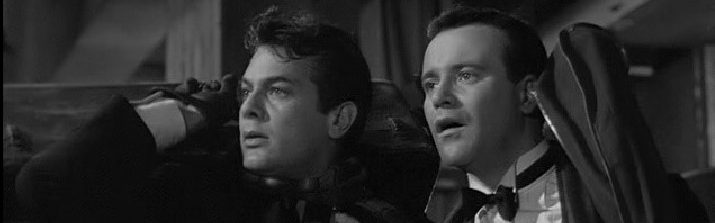
“Hamlet at Elsinore” (BBC: 1964) starring Christopher Plummer, Robert Shaw, & Michael Caine

[1] Plummer’s performance, it is a very sensitive and reflective one.

[2] Plummer gives us the complete Prince where others have given us parcels. He has looks, presence, breeding, charm, athleticism, wit and consummate grace.

[3] Christopher Plumber is always fascinating, and Robert Shaw was by far the best Claudius ever filmed… 

[4] Robert Shaw… the first Claudius I ever saw who was not only sonorous and regal, but violent, and sexy enough to seduce the Queen and make her agree to kill her husband.

-Excerpts from IMDB reviews

I’ve been on a theater kick lately, and I’m a really into Shakespeare. I saw this BBC TV movie on YouTube (it’s free, so the sound/picture quality weren’t perfect). This adaptation will not appeal to a mass audience, or someone who’s not a fan of Christopher Plummer (a fine and fine-looking Hamlet). He knows the words and also gives them feeling, but nothing feels overblown. Most viewers know Plummer from The Sound of Music (1965), but he had a long stage career before. Aside from a 1910 silent film, this is the only production to be filmed in Elsinore, Denmark. It’s refreshing to see a few outdoor scenes- Hamlet meets the players in Kronberg Castle’s courtyard and sees Fortinbras’ soldiers heading off to Poland. Shots of waves crashing upon rocks look back to Olivier’s Hamlet (1948).

Robert Shaw plays Claudius w/ a lot of presence (and gets several close-ups); he’s a character actor maybe best known for Jaws (1975). It’s cool to see (young/cute) Michael Caine; he plays Horatio w/ reserve and speaks softly (which works well). One viewer commented that Horatio isn’t well-developed, b/c Caine was working hard to suppress his (natural) Cockney accent. Well, I felt he did well w/ Shakespeare’s language; his role is primarily to listen. Horatio is (of course) emotional at Hamlet’s dying scene; he wants to drink from the poison cup himself! Today, there are UK-based actors (incl. people of color, immigrants, etc.) who use their natural accents and have a strong grasp of Shakespeare. I didn’t know what to make of Donald Sutherland’s accent for Fortinbras- LOL!

There are some odd editing cuts and misdirection. The “get thee to a nunnery” scene is filmed in the chapel w/ Hamlet standing above (and away from) Ophelia. Fans of the play may be puzzled by this; the scene isn’t done this way in the theater. The distance lessens the drama and their connection. “The Mousetrap” is seen as a “dumb show” (mime), so Gertrude’s “the lady doth protest too much” makes no sense! Ophelia doesn’t get her second mad scene (w/ the flowers). Hamlet is kind, quiet and clear-minded w/ Ophelia, so that her “O what a noble mind is here o’erthrown!” has little effect.

“Planet of the Apes” (1968) starring Charlton Heston, Roddy McDowell, Kim Hunter, & Maurice Evans

It raises a lot of questions about our modern day society without letting social commentaries get in the way of the drama and action.

The movie based on this book [La planet de singes by Pierre Boulle] is an “Americanized” adaptation of it. Rod Serling did the first drafts of the screenplay, simplifying the plot by fitting it into the mold of his “Twilight Zone” TV series and introducing an anti-nuclear war theme not present in the Boulle novel.

Pierre Boulle raises such issues as balance of power, racism, the role of government, and evolution… 

The film is philosophical, creative, absorbing and scary. Excellent commentary on religion and just about everything else.

-Excerpts from comments on IMDB

This movie tells the story of George Taylor (Charlton Heston), when he and his fellow astronauts find themselves stranded on a seemingly unknown planet. It seems to have no life. After travelling across a desert, they discover plenty of life (incl. apes that are human-like and humans that are ape-like). The (orange) orangutans are the leaders; the (grayish) chimpanzees are intellectuals and technicians; the (black) gorillas are guards/police (or do grunt work). Taylor is shot in the neck rendering him unable to speak. He is taken to a human-ape study lab, where he meets Zira (Kim Hunter), a chimpanzee scientist. She notices that Taylor’s intelligence goes far beyond that of any other human she has seen; she encourages him to speak. However, the orangutan leader, Dr. Zaius (Maurice Evans), sneers at Zira’s and her fiancé Cornelius’ (Roddy McDowall) belief in any human intelligence. He (and his council) won’t listen to reason. Despite Cornelius’ conflicted feelings towards Taylor, he agrees to help prove his intelligence.

As many critics and fans have noted, Heston basically played himself. This role is not unlike those he played before; he is often shirtless, tan, and bearded. Heston uses his physicality, as is needed for a action hero role. There are few moments (w/ Nova, the young woman who will be his “mate”) where his vulnerable side comes out. Zira and Cornelius are quite interesting characters. Hunter’s portrayal of Zira was considered very powerful by many viewers; she is the most developed character in the film. Hunter manages to make Zira what she was meant to be, more human then ape. The intelligent and curious Cornelius (Roddy McDowell) has a bit of a rivalry w/ Taylor (as they constantly challenge each other like males of any species).

Planet of the Apes is considered a pivotal work of American cinema. Modern viewers will be surprised (not only by the ending), but by the fine camera work, unique soundtrack (by Jerry Goldsmith), makeup (by John Chambers), and good performances. After the film’s success, there were sequels, a TV series, a remake and a prequel (2011). There were also toys/models, comics, cartoons, and T-shirts to sell. I think even those who avoid the sci-fi genre should check it out! The Simpsons (my younger brother was a big fan) did a parody of this film, so you know it left it’s mark on pop culture.