Movie Review: “American Graffiti”

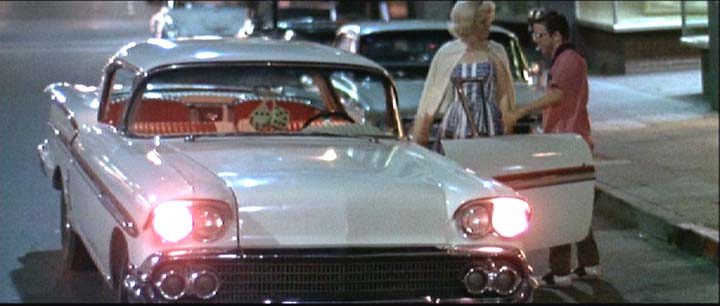
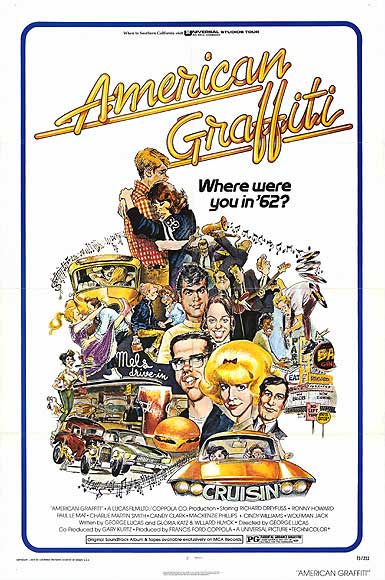
Are you feeling nostalgic about your high school days, glorious or not?  Do you think fondly back on your first car, bf/gf, or your old hometown?  Do you like classic rock ‘n roll music?  Then you’re in the right mood to check out American Graffiti, director George Lucas’ first “big” picture from 1973.  I can’t believe that such a fun, sweet, good quality film had a budget around $750,000!
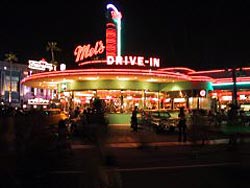
 

The actors including Ron Howard (just 18), Richard Dreyfuss, Charles Martin Smith, Cindy Williams, Paul Le Mat, Mackenzie Phillips (wow- only 12!)  and Harrison Ford, were all young/relatively little-known actors.  George Lucas filmed in a small California town not unlike the one he grew up in.  The characters are based on Lucas and kids/teens he grew up with.  He explains in the Bonus Features that 1962 (when the film is set) was an “age of innocence”- before Vietnam, before the death of JFK, etc.  The 4 main boys in the film are concerned about ordinary things: cars, girls, college/work, and (of course) beer.
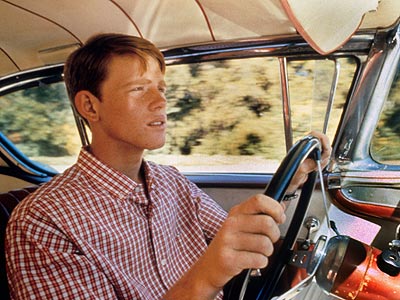
 

Steve (Howard) is your typical boy-next-door; he’s a HS senior who loves hanging at the drive-in (with gf/first love Laurie, played by Williams), is very careful re: his car, and looks forward to (maybe) going East to college.  
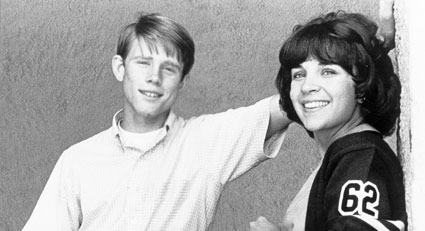


Laurie, a popular cheerleader, is worried about what may happen to their relationship if Steve goes away.  There is a great scene, with little dialogue, where the couple slow-dance.  You can see the characters’ emotions come through.  The actors relate very well to each other!
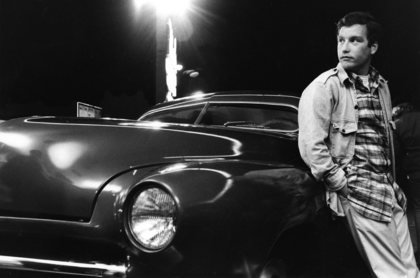
 

Laurie’s big bro Curt (Dreyfuss) has received a scholarship to college, but he’s not sure if he’ll go.  Steve tells him that this is what they’ve both been waiting for, so why is he suddenly scared?  Curt (who Lucas based on himself) is smart, funny, but a little anxious- he’s seeking something from life.  It’s really cool to see Dreyfuss as an young actor; even then, he was a little chubby.  I always enjoy his acting!     


 Curt sees his “dream girl” (Suzanne Somers) cruising along the strip, but she eludes him.   
 

John (Le Mat), a tall, blonde mechanic who goes to JC (junior college), also cruises about looking for girls.  Suddenly, he gets stuck with the little sis of a friend (played by Phillips) who wants to see some “action.”    They have good screen chemistry.  She’s a cute, eccentric character. 

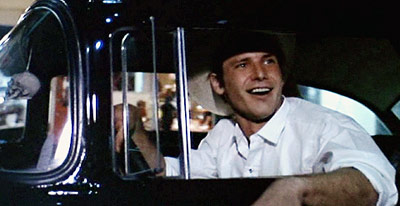
Later, John is challenged to a race by a newbie in town with a fancy car, Harrison Ford (then in his late 20s).  Before this film, Ford had been working (for several years) as a carpenter to support his 2 kids.  He wasn’t a carpenter before going to Hollywood, he taught himself after facing hard times getting roles.  Ford had many small roles, but American Graffiti got him more notice.  He wore a cowboy hat (see above pic) b/c he didn’t want to cut his hair too short (in case another acting job came up).  

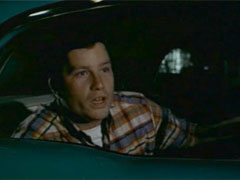
Another kid, Terry the Toad (Martin Smith), borrows Steve’s car and meets a beautiful, ditzy girl.  He’s a nerdy, short, but sweet guy.  Terry is also very nervous around girls; that creates funny moments.  I related with him and Curt the most while watching the film!

This film has a lot good acting- the actors did a lot of improv b/c Lucas encouraged it.  They all lived, dressed (no separate trailers!), and partied together during the 5 week filming.  Lucas is known to be a laid-back director on-set; he did most of the work in the editing room.  The movie has wall-to-wall great music reflecting the times; that was rare for Hollywood at the time.   
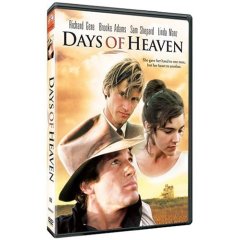


Movie Review: “Days of Heaven”

There is a pervading sadness to the movie, like a memory of something wonderful that could have been, that should have been, that almost was, and is all the more tragic because it was in your hands but slipped through your fingers. This is not a movie for everyone, but if you believe that film can be one of the highest forms of art, this is the film to see. 

–IMDB review

What is it really about?  Fleeting beauty. There aren’t any random shots in the film at all, each frame and edit is a word or period for thought and mood. What joys and disappointments to be found in life. The churning machines, the lighting, the chatter, the dialogue-free actions… 

–IMDB message board 


This is a very visually engaging and beautiful film that came out in 1978.  It was directed by Terrence Malick (mostly known for The Thin Red Line and The New World).  If you know his work, don’t worry, this movie is not overly long (only 94 minutes) and languorous!  The acting is subtle and the dialogue is simple, but you’ll be drawn in by the hopeful young characters and the natural beauty around them.  Oh, and the characters are beautiful, too!   

In the opening, Bill (Richard Gere- young and very striking), his girlfriend Abby (Brooke Adams- also youthful, but bright; wife of multi-talented Tony Shalhoub), and Bill’s pre-teen sister Linda (the narrator) are struggling to get by in pre-WWI Chicago. 
Bill, who has a short temper, gets into a fight (for no apparent reason) with an older man at his job; he unwittingly kills the man.  The self-made family travel (via train) to work on a wheat farm (during harvest time) in the Texas panhandle.  Bill and Abby, who are deeply in love and very comfortable with each other, pose as brother and sister in order to prevent “talk” about them.  

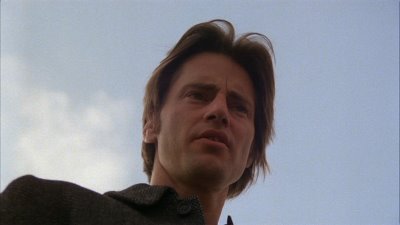
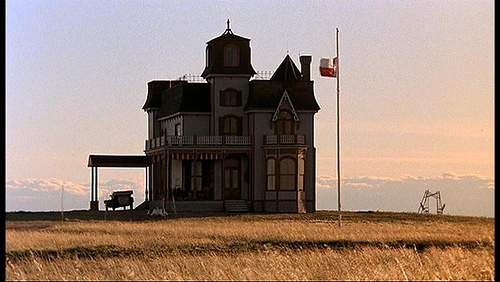
The Farmer (Sam Shepard- also a noted playwright; I think he resembled Viggo Mortensen as a young man) is wealthy, but looks sad and lives alone in his huge house (no relatives; single).  He becomes interested in Abby; Brooke Adams’ beauty is in her large expressive eyes.  The Farmer asks another employee about Abby, then one day, gathers up courage to speak to her.  After harvest, he suggests that she stay on to work on his farm.  The work would be easier, and it would be a more stable life.

When Abby mentions this idea to Bill, he doesn’t get jealous.  Bill overheard the doctor saying The Farmer doesn’t have long to live.  The family becomes friendly with the lonely man.  Very soon, we realize that The Farmer is in love with Abby.  The Farmer, who is kind and gentle, could give Abby a financially secure life.  But what will happen after she decides to marry The Farmer?  Will Bill be able to handle it?  (It’s not easy to be part of a love traingle!)  


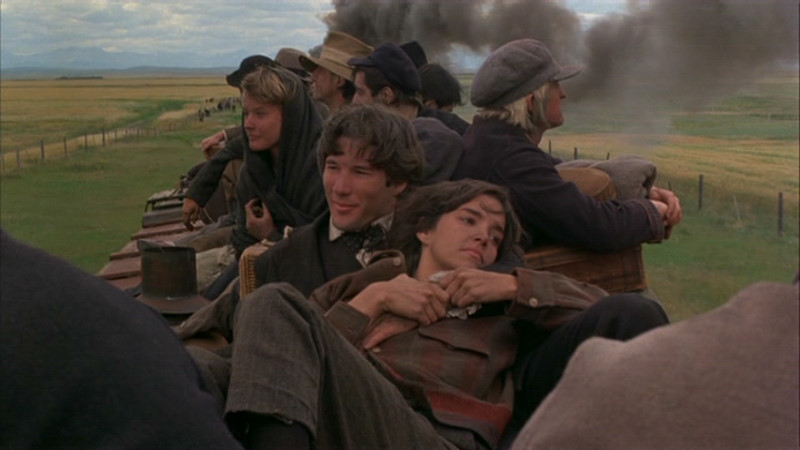
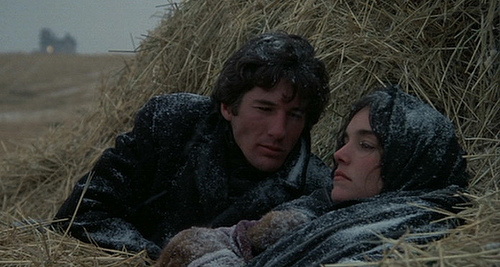
I really like the shot below because it shows the harshness of their lives, though they are beautiful and young. 

The last 30 minutes are very interesting; the action picks up a lot!  Sam Shepard suits the role of a farmer very well with his tall, lean build and shy, quiet demeanor.  His character is easy to sympathize with!  Brooke Adams and Richard Gere look comfortable doing the hard labor of farmwork.  Gere grew up on a small farm in upstate New York.  You can believe that Abby and Bill are a loving couple, but their relationship is not (totally) secure.  I found her to be a very watcheable character.  It’s too bad that there wasn’t more dialogue- that’s what I like best in films.  However, you could see the conflict in the characters’ eyes, faces, body language. 


Check out this film when you’re in a reflective mood, or looking for something different from the ordinary.   

Movie Review: “A Room with a View”


Enchanting from beginning to end. –Rogert Ebert

Overview

Merchant Ivory productions, one of the oldest indie film companies, has produced many smart, beautiful pictures on a small budget: Maurice, Howard’s End, The Mystic Masseur, The White Countess, etc.  My personal favorite is A Room with a View from 1985; it was shot in Florence, Italy and county Kent in England.  It is based on a book by E.M. Forster, regarded as one of England’s most tolerant, sensitive writers.  I have the 2 disc special edition DVD; the film was digitally re-mastered in 2003.  Helena Bonham Carter was an unknown actress before A Room with a View.  Sadly, James Ivory’s business (and life) partner, Ismail Merchant, passed away last year. 

Plot and Characterization

At the opening of the film, Lucy Honeychurch (Bonham Carter), a British upper-middle class young lady, is on vacation in Italy with her cautious/irritating single aunt, Charlotte Bartlett (Maggie Smith).  The ladies happen upon Lucy’s pastor from home, the Reverend Mr. Beebe (Simon Callow).  There is also a romance novelist, Eleanor Lavish (Judy Dench) at the hotel.  Lucy is especially struck by a very unorthodox father and son- Mr. Emerson (Denholm Elliott) and George (Julian Sands). 

Charlotte wants to stick to what the guidebooks say, but Ms. Lavish convinces her to be more independent.  Though the Emersons are British, they have their own way of looking at the world; they speak what they feel.  Lucy is surprised by, but also curious about the handsome, yet brooding George.  Through circumstances, or fate, Lucy and George are thrown together. 

When Lucy gets home to England, she gets engaged to wealthy, uptight Cecil Vyse (Daniel Day-Lewis).  You can suppose they had been courting for a long time.  Her family, including little brother Freddie (a very young Rupert Graves), think Lucy can do better.  Lucy is uncertain about her choice, too.  Into their quiet neighborhood come two new tenants- the Emersons!        


My Thoughts

I can’t believe this movie came out 23 years ago- it always looks fresh and new whenever I see it!  At first, it comes off as a simple love story.  But when you look deeper, you see the conflict between the natural (an individual’s true feelings/desires) and artificial (British society of the early 1900s).  Howard’s End (starring Emma Thompson, Anthony Hopkins, and Bonham Carter) and Maurice (starring the young Hugh Grant and James Wilby) also deal directly with this conflict.  The two men Lucy must choose between personify this conflict. 

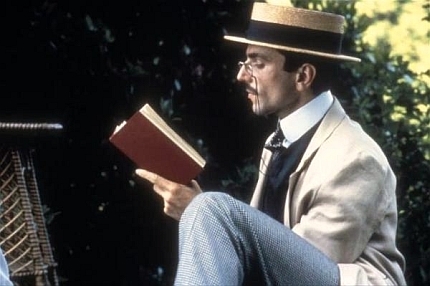
Cecil is a well-read young man, but he behaves like a stuck-up old man incapable of enjoying life.  Day-Lewis shows his character’s discomfort by doing every little thing very stiffly.  His costumes are very formal and tight-fitting, purposefully no doubt.  Mr. Beebe even suggests that Cecil is the type of man who will remain a bachelor.  Hmmm…

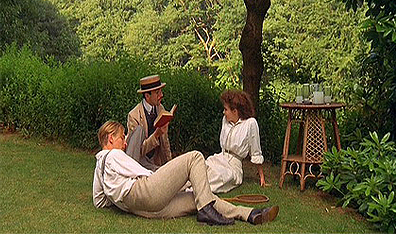
George is quiet and mysterious at first, but later we see he is full of life and very real.  He’s blunt in contrast to the other people Lucy is familiar with.  When he moves to Kent, he becomes a friend to Freddie.  In one hilarious scene the two young men (along with Mr. Beebe) go bathing naked in a pond.  George is comfortable in nature; he doesn’t know how to be not real, as his father points out to Lucy in a crucial scene.    

I really enjoyed the nuanced performances of Maggie Smith and Daniel Day-Lewis in this film.  They seem like the annoying “bad” guys at first glance, but they have moments where they get to show their complexity.  All the characters get their moments to shine in this film; I wouldn’t expect less from Merchant Ivory.  Bonham Carter is strong (as always); I don’t think I’ve ever seen a weak performance from her!  Here she gets to be a likeable “traditional” heroine, not a cheater or oddball- that’s interesting to see.  Check this film out ASAP!!!  

Movie Review: “Truly Madly Deeply”

Overview

This imaginative romantic comedy (released in 1991) was recently deceased director Anthony Minghella’s first film.  It is a terrific film, starring theatrically-trained actors: Juliet Stevenson, Alan Rickman, and Michael Maloney.  Minghella also did commentary for this film; he admits that he was a technical novice, but relied on a team of experts.  Most of this team continued on to work with the director on other films, including The English Patient and The Talented Mr. RipleyTruly Madly Deeply involves Minghella’s interests, friends, and sensibilities. 


Plot & Characterization

Nina (Juliet Stevenson- Mrs. Elton in Emma; Keira Knightley’s mom in Bend it Like Beckham) is a charming, intelligent woman (around 30) who works at a language institute in North London.  (Nina is fluent in Spanish.)  Her boss/friend (Scottish actor Bill Patterson; he’s in Amazing Grace) is worried about her because she’s “not having any fun” these days.   Her older sister is worried because Nina’s flat (or “apartment” as we say in the US) is falling apart and has a mouse (yikes!)  She shrugs off their concerns.


Nina meets regularly with a therapist because she is having a very difficult time getting over the recent death of her (cellist) husband, Jamie (Alan Rickman from Robin Hood– note the mustache- and Sense and Sensibility).  She is sad, but also angry, as is revealed in a very intense scene.  (Juliet Stevenson is not afraid to reveal messy emotions.)  Nina busies herself with repairs on her flat with help from a romantic Polish immigrant (Titus).  Then one day, Jamie appears in the living room! 


Jamie is not like other movie ghosts you may’ve seen.  He complains constantly about it being freezing cold in the flat; Alan Rickman chose to wear a long black overcoat the entire time.  He invites other ghosts (from various time periods) to watch classic films, play music, and redecorate Nina’s place. 


Getting off the bus one day, Nina runs into Mark (a man who she saw at a local restaurant).  She decides to go out with this (real life) man.  Check out Truly Madly Deeply to find out what happens next! 


My Thoughts

Visually, there are no tricks or bells, but the acting is superb!  Even the small parts are done very well.  Minghella points out that these actors aren’t the “typical romantic leads.”  Stevenson and Rickman (who worked together before) have the kind of chemistry and comfort with each other that can’t be faked.  Nina and Jamie seem like a real, passionate couple with a shared history.  From the moment he meets Nina, there is a twinkle in Maloney’s eyes- we know that Mark is interested in her.  I especially liked how the two men were quite different: Mark is positive and smiling, while Jamie is sullen and intense.  Will Nina choose to live life again or remain in the past?