NEW Movie Review: Oliver Stone’s “W”

poster_w1

Josh Brolin stars as George W. Bush in this Oliver Stone biopic that traces the head of state’s rise to power from a privileged alcoholic to a born-again Christian whose belief in religious destiny helped move him to the top ranks of political power.  -IMDB synopsis

hat_w

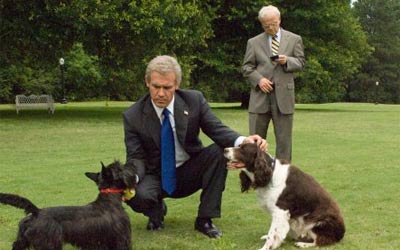
Before I saw Josh Brolin’s (quite respectable) performances in American Gangster and No Country for Old Men, I thought the best thing about him was his wife (the fabulous Diane Lane)!  In W, he gets to stretch his acting repertoire (with help from several veteran actors).  The accent, mannerisms, and mistakes of W are on display here.  But Oliver Stone doesn’t create a (overly) negative picture of the president.  My mom commented that the film made her feel “a little sorry for Bush.”

tx_w

The heart of this film is the father-son relationship; W never feels like he measures up to H.W. (played with great ease/conviction by James Cromwell).  The grande dame of the Bush family, Barbara (Ellen Burstyn), gets a couple of good moments in the film.  She’s great- I wanted to see more Barbara!  Jeb and other family members are barely there; I wanted to know more about the siblings.

ew_w

Believe it or not, W was called “elitist” and “Eastern” when he first ran for office in Midland, TX (his family’s adopted hometown)!  Laura Welch (Elizabeth Banks; she did a fine job in Seabiscuit) was a registered Democrat when she was introduced to Bush at a barbecue.  Laura is as we’d imagine her to be, but her character is not deeply explored.  She’s your typical sweet, supportive, pretty Southern girl.

dogs_w

Once Bush enters national politics, he’s supported by “Vice” Cheney (Richard Dreyfuss), Condi Rice (Thandie Newton), Colin Powell (Jeffrey Wright), Donald Rumsfeld (Scott Glenn), and “genius boy” Karl Rove (Toby Jones).  My mom wanted to see more of Condi.  I wanted to see more of Dreyfuss and Glenn; they are solid veteran actors, but under-used here.  That’s just sad!  Dimunitive Brit actor, Toby Jones, gets a few interesting moments with Brolin.  Jones has played sneaky political types many times in his acting career.

frat_w

I was surprised that the first 20 minutes of the film were so dull.  It showed Bush as a young man acting the fool.  He drinks too much, can’t keep a job, and so forth.  My mind wandered off to other things.  I really liked the two long-ish scenes Brolin had with Stacy Keach (who played an Evangelical pastor from Midland).  Brolin commented in an interview that quitting drinking was one of the things he admired about W.  Unfortunately, there isn’t much to admire about this film.  We already know a lot of the things this film covers!  This is a different Oliver Stone than the one who made Born on the Fourth of July and JFK.  Those movie stays in your mind, unlike this one.

The Duchess

duchess-closeup-21

A chronicle of the life of 18th century aristocrat Georgiana, Duchess of Devonshire, who reviled for her extravagant political and personal life. She is a vibrant beauty and celebrity of her time. But she is trapped in an unhappy triangle with her husband and his live-in mistress. She falls passionately in love with an ambitious young politician, and the affair causes a bitter conflict with her husband and threatens to erupt into a scandal.  -IMDB synopsis

duchess-runs

Is it me, or are the movies (in general) becoming too simple, predictable, and just plain dull?  I’m not feeling strongly about most of the (mainstream) movies these days.  Many people I know feel the same, too.  However, I went last weekend to see two new films: The Duchess (with a group of ladies from NYBAP) and W (by myself; my mom saw it before me, and said it was interesting).  Though I wasn’t “wowed” by either of these movies, I recommend you see them (when they come out on DVD).  Below is a review of The Duchess; I will soon write about W as well. 

duchess-wed

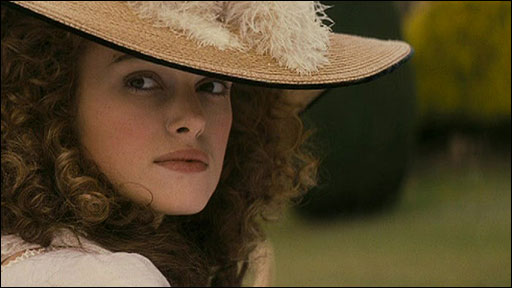
There is no denying that Keira Knightley has a strikingly beautiful face; she reminds you of Brooke Shields as a very young woman.  She has gotten a lot of exposure, and grown as an actress since making a big splash as a teen tomboy in the Bend it like Beckham.  Not all the projects she’s chosen haven been hits, but I’m sure she’s learned a lot from them.  In The Duchess (based on actual events), Keira plays Georgiana, an independent-minded young lady who becomes the Duchess of Devonshire in 18th century England.  Her husband, the Duke, is played by Ralph Fiennes (his family is distantly related to British royalty).  He is always interesting to watch, both as a hero and villain.  Unfortunately, in the first half of the movie, he comes across as a rather cartoonish villain.  Subtlety is one of the main things missing from modern pictures!         

duchess-grp

G (as she is called by family and friends) goes from being a bubbly teen girl to a troubled married woman before you can say “corset.”  Her husband is nothing like a girl expects- he’s distant, uncommunicative, and has many affairs.  He becomes even colder when G fails to provide a (male) heir.  Her mother, played very well by Charlotte Rampling, says that women must bear many burdens.  (Divorce was very rare at that time.)

duchess-eliz1

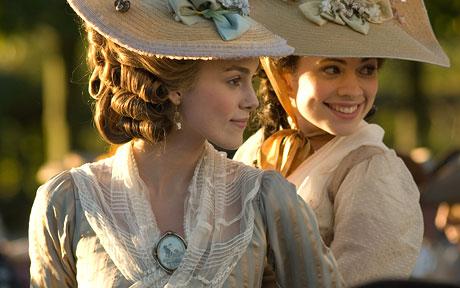
G’s closest friend, Lady Elizabeth Eshton, is one of the bright spots in her life.  Hayley Atwell, who plays Lady Elizabeth, is a well-developed character who brings (much-needed) depth to this film.  She’s a “woman of the world” who has lived through many trials; she cares deeply for her friend.  While Keira is thin and light on her feet, Hayley is very curvaceous and earthy.  G is a wide-eyed “people-pleaser”; Lady Elizabeth is tougher.  She observes others closely with her small, dark, curious eyes.

duchess-lover

G, though unloved by her husband, becomes a popular fashion icon.  The hairdos, costumes, and (especially) jewels in this film are gorgeous.  She also gets involved in politics, supporting men like Lord Fox (who spoke against slavery, among other injustices).  A young lawyer, played by Dominic West, from G’s girlhood is Fox’s right-hand man.  He has strong feelings for G, even after several years apart.  G is torn between her duty (as wife, mother, high society figurehead, etc.) and desire to experience real love. 

duchess-hubby1

This film does a good job of re-creating 18th century high society and laying down the (often unspoken) rules of the day.  If you are familiar with that stuff (like me), then it won’t be a biggie to you.  (You’ll be bored, honestly!)  I felt sorry for Ralph Fiennes because he’s (obviously) capable of more subtle acting.  He was too much of a baddie in The Duchess; I don’t think many husbands of that day acted like the Duke.  (I won’t give it away, but he does some heinous stuff.)   There was an (obvious) lack of chemistry between Keira and Dominic; if you want to see real sparks of young love, check out Atonement.  Keira looks great with James McAvoy in that film; they feel like a real couple.  There are some bright moments here and there, like the (unusual) friendship between G and Lady Elizabeth.  The sets and scenery are fabulous, and there is a great moment of drama involving G and one of her children.  It wasn’t a great film, but it wasn’t a bad way to spend two hours.  

Movie Review: “Enemy at the Gates”

Action, friendship, romance- this film has it all!  This war/suspense drama (unfortunately) didn’t do well at the box office in 2001.  When you see it you’ll wonder:  Why the heck not!?  It has an all-star international cast, great cinematography, and a very compelling story (based on true events).  The setting is Stalingrad in Fall/Winter 1942.  Stalin and Hitler are no longer buddies.  The German army has been mounting a large scale attack on Stalingrad, but the Red Army will not give up so easily! 

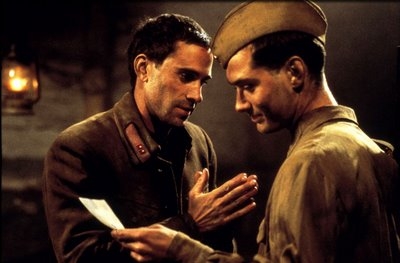
The film opens with the arrival of a group of rag-tag soldiers from all over Russia, including wide-eyed Vassili Zaitsev (Jude Law) to the big city.  We learn later that he is a shepherd from the Ural Mountains.  The soldiers traveling with Vassili are not all men- a young woman reading a book is in the same car as him.  He is struck by her beauty.

The action of this film comes at you from the start- huge crowds, gunshots, explosions, etc.   Many men fall around the newcomer, but when Vassili gets his hands on a rifle, he takes down 5 German officers!  Danilov (Joseph Fiennes), a political officer, is amazed by the young soldier’s skill.  They become fast friends.

The educated, idealistic Danilov makes Vassili into a larger-than-life war hero; he writes about his deeds in the army newspaper.  Soon, the quiet, simple man is promoted to the sniper division, meeting politicians like Krushchev (Bob Hoskins), and a legend in his own time.  

Danilov: “Here, the men’s only choice is between German bullets and ours. But there’s another way. The way of courage. The way of love of the Motherland. We must publish the army newspaper again. We must tell magnificent stories, stories that extol sacrifice, bravery. We must make them believe in the victory. We must give them hope, pride, a desire to fight. Yes… we need to make examples. But examples to follow. What we need… are heroes.”

Khrushchev: “Do you know any heroes around here?”

Danilov: “Yes, comrade. I know one.”


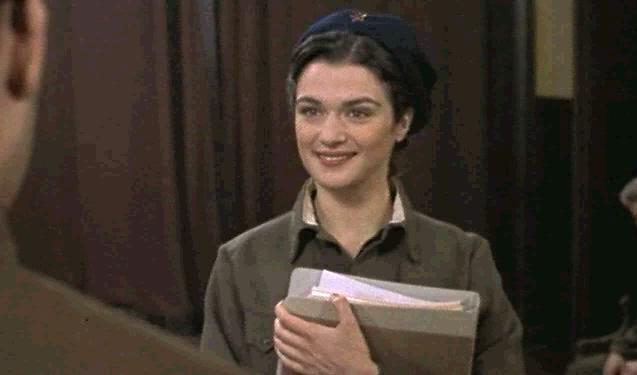
People write him letters, greet him warmly in the streets, and a local shoeshine boy, Sacha, invites Vassili home for dinner.  There he meets the boy’s mother and their close friend/neighbor, Tania (Rachel Weisz), the woman who captivated him on the train.  She was at university in Moscow recently; she volunteered to be part of the militia.  Danilov can’t keep his eyes off her.  But Tania is interested in Vassili; a love triangle is formed!


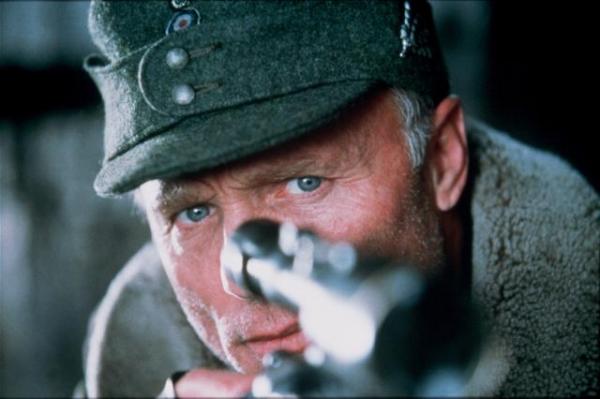
Vassili becomes so famous that the Germans send for their best sniper, the cool, aristocratic Major Konig (Ed Harris) to kill him.  This is the heart of Enemy at the Gates– a duel between two men (both with intense blue eyes) who are the best in their field.  The large-scale war is brought down to these two snipers- to the human level.  Vassili tells the adoring Sacha that you have to face a man to kill him, and that stays with you.

A battle between two nations became a conflict between two men.

Vassili: He [Konig] shot him [another expert sniper] on the run. It was an impossible shot.”

Danilov: “Vassili… ”

Vassili: “You’ve promised people a victory I can’t deliver. I don’t stand a chance against this man.” 

Will Vassili conquer his doubts and defeat Konig?  Which man will get the girl?  Find out for yourself!

Movie Review: “Becoming Jane”

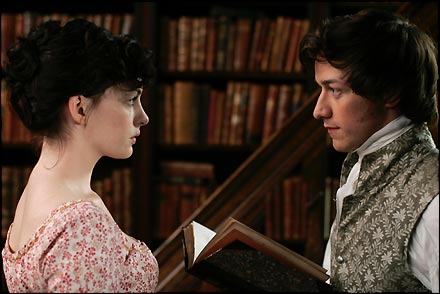
I first saw this movie (based on the biography of Jane Austen by Jon Spence) on You Tube.  I thought it was okay.  On first glance, I enjoyed the music and scenery (actually Ireland, not Hampshire).  I saw it again, and was very surprised by the superb acting, especially by the younger actors.  There were a few moments, involving Tom Lefroy’s wild behavior that seemed a bit extreme; aside from that, I have no complaints.  This is a beautiful, intelligent movie that I highly recommend to all JA fans!

Warning: My review has MAJOR spoilers!

Anne Hathaway plays the 20 year old Jane who, over one tumultuous summer, falls in love with charming lawyer-in-training Tom Lefroy (James McAvoy).  Tom was sent to the country to stay with his cousins by his uncle, a high court judge.  This uncle, upon whom Tom relied, disapproved of his wild behavior (gambling, boxing, carousing with women, etc.)  Tom is also a great pal of the eldest Austen son, Henry (Joe Anderson, a very cute/blonde young actor).

Did you know Anne did her senior thesis at Vassar on JA’s works?  She takes her role seriously here.  Anne’s take on Jane seems well-researched; she never looks out of place.  She learned to write and play paino like JA did!  Upon first meeting Tom, Jane is not impressed.  In a letter, she calls him “insolent, arrogant, impudent, insufferable, impertinent.”   He is bored with this new “rural” set of people, and thinks he’s above them.  Shades of Mr. Darcy!

The Austen parents, James Cromwell and Julie Walters, are grounded in life’s realities, but they married for love.

“That girl needs a husband. But who’s good enough? Nobody!” -Mrs. Austen laments

Father is more sensitive to Jane’s wishes; mother is more of a realist.

“Jane should have not the man who offers the best price, but the man she wants.” -Rev. Austen

I liked Cromwell very much in this role; it really suited him.  (He can currently be seen as George H. W. Bush in Oliver Stone’s biopic W.)

“I will not marry without affection, like my mother!” -Jane to Mrs. Austen

“Affection is desirable.  Money is absolutely indispensable!” -Mrs. Austen to Jane

Another great supporting character is Jane’s beloved older sister Cassandra (Anna Maxwell Martin).  She is the shy, sweet, obedient girl in the family.  But her fiancé, the young parson-to-be, Mr. Fowl, dies overseas of yellow fever.  Cassie, who feels very deeply, never thinks of another man.  (This would later become the impetus for Persuasion.)  Anna suits her role very well; she had been in many period dramas, including North & South and Bleak House.

Henry, who also has a sub-plot, is pursued by their elegant, widowed older cousin, a French countess by marriage.  Eliza is the voice of the experienced, worldly woman in Jane’s life.  The countess uses her beauty, charm, and (especially) money to gain Henry’s interest.

“Sometimes affection is a shy flower that takes time to blossom.” -Mr. Wisley to Jane

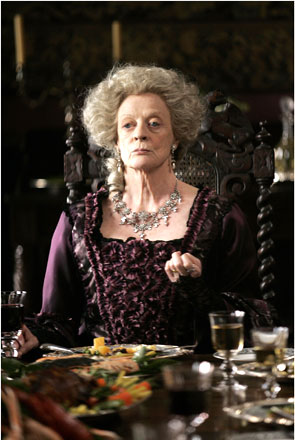
As you may know, Jane received a few marriage proposals over her short life.  One such offer comes from the tall, quiet, socially awkward Mr. Wisley (Laurence Fox) who will inherit the property of his childless, wealthy aunt, Lady Gresham (Maggie Smith).  (Wisley is loosely based on Harris Biggs, a man who proposed to the real JA when she was 27.)

Laurence Fox is the son of actor James Fox and cousin of the lovely Emilia Fox (who appeared as Miss Darcy in the popular Pride & Prejudice miniseries).  Laurence recently played Cecil in the new version of A Room With A View.  Mr. Wisley slowly grows to admire Jane’s independent spirit.  Lady Gresham brings to mind Lady Catherine from P&P, though she is a bit more humane.

Tom Lefroy was believed to be the one love of Jane’s life.  Below is a pic of the real Tom!

The young couple are ill-suited for each other, according to the prevailing thought of the day.  Though Tom seems like a free-wheeling, carefree guy, Tom is from a poor family in Limerick who depend upon him for support.  (His mother married his father for love, and they had many children.)  He’s the kind of young man who must marry for money, or wait until he has made some on his own.  But, like Jane, he has a non-conformist side.

Tom recommends that Jane read Tom Jones to learn more about the world of young men.  He never says anything negative about her desire to be a novelist.

“If you wish to practice the art of fiction, to be considered the equal of a masculine author, experience is vital.” -Tom advises

“I think that you, Miss Austen, consider yourself a cut above the company.” -Tom comments during a public assembly (dance).

“Me?” -Jane replies with surprise.

 “You, ma’am. Secretly.” -Tom observes wisely.

The main reasons to see this movie: James (and his very fine eyes- a great compliment in JA’s time), the terrific chemistry between him and Anne, and the gorgeous music.  James (the more I see of him, the more I want to see!) is full of energy, empathy, grace and style in this film.  He sinks seamlessly into his character, and these costumes look (especially) good on his frame.  He’s one of those (rare) young men who’s not afraid to look vulnerable.  His eyes are very expressive.  Anne calls him “a legend in the making” on the special features.  Check out Becoming Jane ASAP!

Extended Movie Review: ITV’s “Sense and Sensibility”

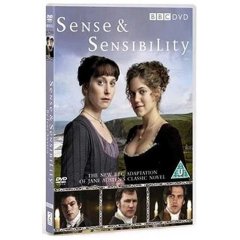
One of the DVD covers

I recommend that you don’t read my review until you’ve seen the movie.  But if you don’t mind spoilers, go right ahead.  I watched this (three-part) movie again because I was very impressed upon first viewing it on You Tube this past summer.  Then I saw it on Masterpiece Theater on PBS.  My mom really liked it too, especially the beautiful scenery and music (dramatic when it suited the moment). 


Mrs. Dashwood
Mrs. Dashwood


The newest film adaptation of Sense and Sensibility is a mix of Austen and Bronte, according to producer Anne Pivcevic.  The Dashwood ladies (middle-aged, widowed mother Mary, sensible/practical eldest daughter Elinor, passionate/opinionated middle daughter Marianne, and energetic pre-teen Margaret) actually live in a cottage very close to the sea in Devonshire.  Talk about being removed from “society!”  Most of the rain in the movie is real rain.  Pivcevic and screenwriter Andrew Davies (who adapted Emma starring Kate Beckinsale and the gorgeous Daniel Deronda among others) explain on the commentary track.  The family has fallen very far from the comfort of Norland, the viewer can see clearly.
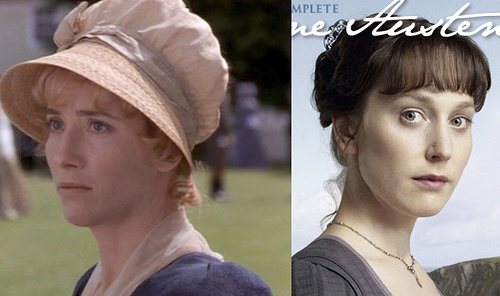


Two great interpretations of Elinor


I think it’s best not to hope too fervently for something that may never happen.

-Elinor Dashwood on her relationship with Edward


Aside from the great settings, I was struck my how well the actors (especially those under 30) performed.  Janet McTeer (Mrs. Dashwood) is a tall, elegant woman.  She brings softness to Mary, who had been a sheltered woman most of her life.  Upon her husband’s death, she is a bit lost, and Elinor (just 19 at the start of the tale) has to explain their financial situation to her.  One of my first thoughts was that Hattie Morahan (Elinor) has amazing skin!  But aside from that, her great posture and fine features seem to suit the time period to a tee.  I like her speaking voice; she sounds very elegant (and very similar to Emma Thompson).  I always imagined Elinor looking something like this- mature, dignified, and a natural beauty. 


Willoughby and Marianne (Ang Lee's film)
Willoughby & Marianne (Ang Lee)


The new Willoughby & Marianne


Elinor, I don’t care what those people think! –Marianne Dashwood


Just 17 when the story begins, Marianne (Charity Wakefield) is justifiably a little rebellious.  She gets upset with Fanny at the dinner table, embarrassed by Sir John and Mrs. Jennings’ jokes, and despairs of ever finding love.  Marianne has many different hairstyles to go along with her many moods; this reminded me of modern girls (who often color/re-fashion their hair).  The actress’ large blue eyes upon a small face are big assets.  As in Ang Lee’s wonderful big screen movie, the young Margaret (here nicknamed Meg) is a bubbly, smart, somewhat tomboyish girl.  She is observant, and often says the things that the grown-ups are thinking.  You can’t fool kids!      


Two VERY different Edwards!


I have no wish to be distinguished. –Edward Ferrars
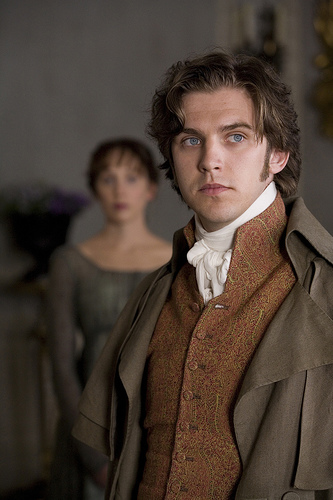
  

This Edwars is NOT plain...
NOT a plain guy at all…


I think we all have to find our own ways to be happy. –Edward Ferrars


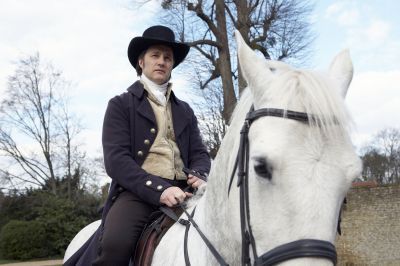
Davies says that he worked hard to punch up the male characters; he felt they were underdeveloped in the book (especially Edward).  I agree about Edward; in the book, he’s not a captivating guy at all.  In this movie, Edward Ferrars (Dan Stevens) is the best looking guy!  His clothes are a bit old-fashioned and faded, as he doesn’t seek fortune or fame (unlike the rest of his family).  Clothes reflect character sometimes, right?  Edward seems shy and awkward, but only briefly; some Austen fans commented that they didn’t like that.  This Edward is thoughtful, very honorable (like in the book), but also outgoing.  I thought the horse-riding scene with Meg was sweet; that (gorgeous black) horse was Colin Farrell’s in Alexander (Dan Stevens says on the commentary). He did a good job with this role; I liked the moments of youthful uncertainty he displayed.  The wet shirt/log chopping scene was a too much out of character.  However, I did like the sincere concern with which he said “You have very little help here.”  That revealed him as a true friend to the family!    


Bad boy
Bad boy

He is too rational for me- more to be admired than loved.

 –Willoughby on poet John Pope


Davies wanted more action for the men, so he expanded on events that were merely hinted at in the book (for example: the duel between Willoughby and Col. Brandon).  I didn’t think Willoughby (Dominic Cooper, who can currently be seen in The Duchess opposite Keira Knightley) was handsome at all.  However, he was very good at playing up the dark undercurrents of his character.  His big dark eyes, dark hair, and richly colored costumes (red, black, elaborately embroidered) helped portray him as someone (potentially) dangerous.  Remember that this guy seduced a very young girl (the ward of Col. Brandon) in the start of this version, then abandoned her pregnant.  Pivcevic points out that Marianne could also have been ruined by Willoughby because she lets her emotions overtake her judgment at times.  Wow, I’d never thought of that!  She only lets him have a kiss in this film.  Overall, having young actors really paid off!


What a CUTE horse!!!


…he’s the only one in the neighborhood one can have an intelligent conversation with!

-Marianne on Brandon         


I really enjoyed the parts of Brandon and Marianne becoming acquainted before Willoughby raced in.  David Morrissey looks boyish when he smiles; in his eyes, you can see his character’s hopes and fears.  After Brandon gives her the sheet music, note the expectation on his face as he mentions her someday trying his piano- good stuff!  She says she can talk with him.  Marianne wasn’t thinking about love though.  Pivcevic says that she needed to grow up more in order to appreciate a good man like the colonel.  


I shall be very sorry to see her injured. –Col. Brandon on Marianne


My favorite moment in the film is at the very end of Part 1.  Notice the look on the colonel’s face when he sees Willoughby paying his first call to Marianne (while her ankle is sprained).  The concern and sadness in his eyes as he walks away from the cottage reveal much about his character.  We can’t help but wonder if Brandon’s just sad for his loss of suit, or if he knows something not-so-nice regarding Willoughby.  Another nice moment is when the girls spot Edward (riding quite fast, I thought) toward the cottage; the look of triumphant happiness on Elinor’s face is very sweet.


Some comic relief
Some comic relief- the Steele sisters

Company, company, company!  Where would we be without company?

–Sir John


I thought that the smaller characters such as: Fanny, Mrs. Jennings, and Lucy’s hilarious sister (Anne) did a fine job.  I loved Anne’s constant chattering about “beaux.” The evil sister-in-law, Fanny, was tightly wound (including her hair), unfeeling, and vain.  Mrs. Jennings, besides being quite a busybody, was sweet and solicitous of the Elinor and Marianne (especially in London).  Lucy was very naïve about Edward’s family; she is a simple country girl after all.    Sir John was too gregarious in the beginning, but he had a twinkle in his eyes that told you he was a decent guy.


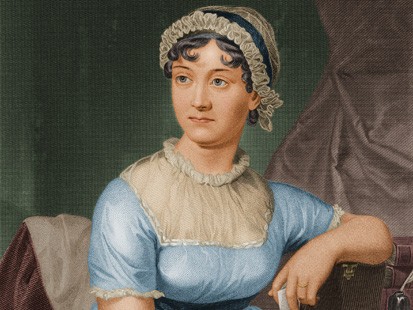
A painting of JA
A painting of JA


Austen makes a big point regarding money in her books, and Sense and Sensibility in no exception.  The girls deserve much more than what half-brother John offers; Fanny changes his mind (as she wears the pants in that family).  Willoughby, who falls in love with Marianne, chooses Ms. Grey “with her 50,000 pounds” after Lady Allen disowns him.  (Lady Allen did so because she found out about his affair with Brandon’s ward, we are told in the Ang Lee version.)  He’s used to the good life.  Edward, fearing his mother’s wrath and disownment, keeps the engagement to Lucy a secret for 4 years!  However, riches are not a big deal for Edward; he wants to become a country parson.


One of the main reasons Col. Brandon is seen as very eligible is his great wealth.   Oh, we realize that he has great manners, reads, and is knowledgeable about music.  But that doesn’t put food on the table!  Husbands with good livings (incomes) are very crucial because the girls’ dowries are so small.  Elinor is very aware of that fact, though her mother and Marianne choose not to dwell upon it.  But it all ends well, because respectable, amiable, and pretty girls in Austen’s books get their just rewards!   


Elinor nearly misses out on a (very compatible) match because she is too reserved- very aware of propriety.  When her mother wants to write to Edward, she tells her to “let him come in his own time.”  Marianne, on the other hand, risks ruining her reputation by revealing her preference for an (unworthy) man.  Notice how she laughs loudly while dancing with Willoughby; she refuses to dance with any other guy at a party.  This was not considered good manners in Austen’s time.  However, he is her first love, and that’s an age when people aren’t usually sticklers for rules.  I thought it was (a little) risky for her to go riding in the curricle for a few hours and visiting Allenham.  (I had the same thought when I saw the Ang Lee movie, too.)  What do you think?  Watch this new S&S adaptation and share your thoughts!