Three Controversial Films Directed by Paul Verhoeven

Basic Instinct (1991) starring Michael Douglas & Sharon Stone

A violent police detective investigates a brutal murder that might involve a manipulative and seductive novelist. -Synopsis

We ALL know the story here, BUT is it a good movie (IF we put aside the explicit scenes)? I’d say it kept my interest and is (mostly) watch-able. It could’ve been shorter; the run time is 2 hrs. 8 mins. On a recent rewatch, I really noticed (and liked) the music; it was composed by Jerry Goldsmith) and V effective in creating tension/setting moods. I enjoyed the natural scenery: the winding roads around San Fran, the ocean, and Catherine’s beach house (recently priced at $52M). Catherine (Stone- 34 y.o.) wears some great (timeless) outfits; the actress sinks her teeth into the role (and becomes a star). She wasn’t well known; Douglas (48 y.o.) was the bigger name then. You will find homages to Hitchcock’s Vertigo. The 1st 45 mins of the story is much stronger than the rest. I can’t believe that the screenplay (by Joe Eszterhas) sold for $3M – wow!

The acting is NOT natural, as many viewers noted; it’s often V melodramatic. There are V problematic elements, which viewers may NOT have noticed back in the early ’90s. Beth, the police psychologist (played by Jeanne Tripplehorn- her 1st role), is treated V roughly/badly by Nick (Douglas) and just a plot device. I learned that members of the LGBTQ community protested screenings in ’91; it turns out that the 3 main women (bisexual) are characterized as potentially homicidal! In her recent autobiography, Stone wrote that Verhoeven (who hails from the Netherands and doesn’t shy away from controversy) “tricked” her into baring herself (in the infamous interrogation scene); he said that “the white underwear was causing a glare on camera.” I can see why many people now avoid this movie. As Siskel and Ebert said: “it’s NOT really about anything, if you take away the sex and nudity.”

Showgirls (1995) starring Elizabeth Berkley, Kyle MacLachlan, & Gina Gershon

Carefree young drifter Nomi arrives in Las Vegas, Nevada to become a dancer and sets about clawing her way to the top of the Vegas showgirls. -Synopsis

Whoever called this movie “All About Eve, the trashy version” summed up the plot perfectly- LOL! This is a (notorious) movie which some call “so bad that it’s good.” Nope, this is a hot mess akin to a trainwreck (or under-baked cake). I saw it for the 1st time last week; I was surprised by how bad it was! To modern eyes, the nudity, steamy scenes, and baddie (unlikeable) characters won’t be anything TOO shocking. Eszterhas also wrote this screenplay; it’s NOT only bad writing, BUT often the story doesn’t make sense!

Nomi (Berkley- a former teen star from Saved by the Bell) is woman in her early 20s who’s hitchhiking to Vegas; she has dreams of becoming a showgirl. She is robbed by the young man who gave her a ride; in a parking lot, she (luckily) meets a young Black woman, Molly (Gina Rivera), who gets her food and offers her a place to live. Then we shift forward 6 wks; Molly is doing a fashion degree while working on costumes (BTS of a big show). Nomi is working at a popular strip club, yet NOT happy about it. Molly takes Nomi along one night to her job; Nomi is SO taken w/ the performance (and can’t wait for her chance). Soon, she gets an audition, and the story gets going.

Verhoeven makes some (weird) directorial choices and they don’t pay off. The tone is some scenes doesn’t fit the story; it’s quite jarring. Berkley’s overacting (“continuous thrashing”- as one of the hosts of The Bechdel Cast pod said) is V annoying! There is V little that can be called “hot” or “steamy” in this movie (esp. to modern eyes), though there is a LOT of nudity! If you’re bothered by the skin-baring on shows like HBO’s GoT, then this will be TOO much for you. I think the only actor who is effective is Gershon, who plays Cristal (the est. star of the show). Zach (Kyle MacLachhlan w/ a V sleazy hairstyle) is involved w/ Cristal and promotes the show; he also becomes interested in Nomi. Perhaps the worst thing here is how terribly Molly is treated (in the last act); it’s V violent and unnecessary! Just don’t watch it- you can thank me now.

Elle (2016) starring Isabelle Huppert

A successful businesswoman gets caught up in a game of cat and mouse as she tracks down the unknown man who raped her. -Synopsis

Michèle (Huppert) is a mature/Parisian woman who co-owns a video game company, specializing in games filled w/ sex/violence. After being raped in her home, she (calmly) cleans up the mess and orders sushi. Now, this is NOT how we expect a victim to behave (in the movies)! We soon see that she is NOT easy to like, BUT compelling to watch! Michele (tough/independent/says what she wants) has been greatly affected by her father; she doesn’t trust the police. The film explores NOT only Michèle’s relationship w/ her rapist (whose identity is est. about 2/3 of the way), BUT also her circle of family/friends. There’s her best friend, ex-husband, a jobless son w/ a pregnant gf, and a troubled employee, etc.

I almost couldn’t believe that the same director who made Showgirls also made this movie! It is based on a book. Though it is well-made w/ subtle (and dark) humor, it could be V disturbing to many viewers. Why does Michele react in the ways she does!? It’s almost like she’s inviting danger into her life. Huppert is known (internationally) as a fine actress; she doesn’t express many emotions here, BUT makes a big impression. What works in one country/culture will NOT always be embraced (or even tolerated) in another one. I learned that Verhoeven wanted to make this in the US, BUT he couldn’t get any American actress to tackle the lead role.
“The World, the Flesh, & the Devil” (1959) & “Z for Zachariah” (2015)

Introduction

Post-apocalyptic sci-fi is set in a world/civilization after nuclear war, plague, or some type of disaster. I found a V long list of movies (on IMDB); here are ones I’ve seen so far: Mad Max: Fury Road (2015), Children of Men (2006), Planet of the Apes (1968), The Matrix (1999), and The Handmaid’s Tale (1990). While dystopian fiction usually explores social or political struggle, society has NOT yet collapsed (BUT might be on the brink). In apocalyptic fiction, the focus is more on the characters or on man vs. nature.

The World, the Flesh, & the Devil (1959) starring Harry Belafonte, Inger Stevens, & Mel Ferrer

Ralph Burton (Harry Belafonte) is a miner trapped for several days after a cave-in somewhere in Pennsylvania. When he finally manages to dig himself out, it looks like civilization has been destroyed in a nuclear incident. He drives to NYC and finds it deserted. Making a life for himself in a luxury high-rise apt bldg, he’s shocked to eventually find another survivor, Sarah Crandall (Inger Stevens), a 21 y.o. blonde socialite. They start to rely on each other and form a close friendship. Some time later, they hear of another survivor who arrives via his small boat- Ben Thacker (Mel Ferrer). Ralph gives Ben an injection that saves his life; Sarah takes care of him while he recovers. In time, tensions start to rise as Ben and Ralph vie for Sarah.

Ben: I have nothing against negroes, Ralph.

Ralph: That’s white of you.

This unique/lesser-known movie showed up under recommendations on Amazon after I watched Z for Zachariah (see review below). The director here, Ranald McDougall, worked for Warner Bros. from 1944-50; he got an Oscar nom for his screenplay of the noir classic Mildred Pierce (1945) starring Joan Crawford. From the mid-’50s, he was primarily active in TV and worked on lower-budget films. Belafonte (who does sing a BIT here and looks gorgeous) was at the top of his career at this time. Though perhaps known more as a singer and civil rights activist, he acted in several V fine films and even had his own production company! So far, I’ve seen Belafonte in Carmen Jones (1954) w/ Dorothy Dandridge, Island in the Sun (1957)- which also contains a interracial love story, and the noir Odds Against Tomorrow (1959) w/ Robert Ryan.

The first 40 mins of the story is ALL about Ralph; we see a lonely (yet positive-minded) Belafonte navigate the empty/eerie streets of Manhattan. I hadn’t seen the acting of Stevens (a Swedish-American w/ a tragic life/early death) and Ferrer (Audrey Hepburn’s 1st husband; born to a Cuban father and American mother) before; they do fine in their roles. Race is a big issue here; a Black man and white woman wouldn’t be seen as equals or allowed be a romantic pair onscreen (in a segregated society). In one pivotal scene, we see the sexual frustration of both Ralph and Sarah as he gives her a haircut. Even on her birthday, Ralph doesn’t sit down to dinner w/ her, as Sarah wants, but provides the music and food. He acts like it’s OK when Ben and Sarah start to go out alone (on dates). The ending wasn’t quite what I expected, BUT it was intriguing! I think fans of classics will enjoy this movie.

[1] This movie will grab your interest and exercise your moral fiber. Race, prejudice and pride are but minor subplots in this excellent film. […] Black and white has never been so colorful.

[2] Belafonte is terrific especially in his early scenes and Miss Stevens registers quite strongly during their tense exchanges. Most of all, director Ranald MacDougall captures a barren, decimated-looking New York City to awesome, jaw-dropping effect.

[3] A very thought provoking movie that was not accepted at the time, but in retrospect, way way ahead of its time. In a racially charged world, it put forth the premise that race, in the final analysis, is superficial and meaningless. Once you strip away the layers of conditioning and socialization, you find, at the core, good and evil and the age old struggle as to which will prevail. A simple story, told directly and honestly.

-Excerpts from IMDb reviews

Z for Zachariah (2015) starring Chiwetel Ejiofor, Margot Robbie, & Chris Pine

After the end of the world she thought she was alone. She was wrong. -A tagline for the movie

A woman in her early 20s, Ann Burden (Margot Robbie- an Aussie), lives w/ her dog (Faro) on a farm in the Appalachian Mtns, sheltered from radioactivity by rocky hills and a clean underground water supply. After about a year of being alone, Ann encounters John Loomis (Chiwetel Ejiofor- a Brit), a research engineer who (aided by meds and a HAZMAT-type suit) walked from a govt bunker to her valley. Unknowingly, John bathes in a contaminated waterfall, so quickly gets V sick! He is nursed back to health by Ann in her house; she is a Christian and prays to God to save him (thinking he’s a good man). John regains his strength and starts to improve their lives w/ his ideas/skills. They become friends and- eventually- think of pursuing a romantic relationship. Before that can happen, about 42 mins in, Faro runs ahead of Ann to another survivor- Caleb (Chris Pine- an American)!

This movie is based on the sci-fi book Z for Zachariah (1974) by Robert C. O’Brien; after his death, his wife and daughter crafted it into a YA novel. The “love triangle” was added in by the screenwriter (Nissar Modi- a Brit); only Ann (a 16 y.o. farm girl) and Loomis (a middle-aged engineer) are protagonists in the novel. The books has many convos btwn the characters re: religion vs. science, as a few readers have noted. The director (Craig Zobel- an American) recently gained some attention for HBO’s Mare of Easttown (starring Kate Winslet). Tobey Maguire (who served as a producer) and Amanda Seyfried were originally cast in the lead roles, BUT both had to drop out. The title recalls a children’s book that John takes off a shelf: A is for Adam. As some viewers noted, Zachariah is the prophet murdered between the temple and the altar (the last of the prophets killed) in The Bible.

This movie was shot on location in New Zealand; the main set was about 40 mi. from the nearest town. Zobel commented that it “felt like a Summer camp” working w/ his small cast and crew. He and the 3 actors had a week of rehearsal; they did some improv while shooting (as I learned from watching a few interviews from Sundance film fest). Ejiofor (now in his mid-40s) is an actor I’ve admired since seeing his debut role in the indie Dirty Pretty Things (2002). He can express a LOT w/ little (or no) words; he has large/expressive eyes and was classically-trained (as many British actors). After Ejiofor was cast, one line was added in re: race (one of the funny moments). Speaking of great eyes… Pine (now in his early 40s) does quite well w/ his role here; Caleb knows how to use his sex appeal/charm on Ann. Robbie does well also: she (now just 31 y.o.) achieved a LOT of success at an early age. I learned that she just also started producing- V smart move. Check this movie out IF you’re looking for something thoughtful!

[1] Chiwetel Ejiofor gave a compelling performance. It was so real, I think the majority of us would understand what he’s going through. I was shocked by how outstanding Chris Pine was in this movie, just perfect. Margot Robbie was amazing as well, just a solid piece of acting by all.

It made for the perfect emotional love triangle. Even though only three people appear in this movie, it said so much about us as a society.

[2] This is probably the quietest and most understated post-apocalyptic movies you’ll ever see, but deep down, it is truly fascinating. With great performances, impressive directing and an intriguing plot, this film is massively engrossing and surprisingly simple to understand from start to finish.

…a fascinating study of humans in their most basic state: survival and animalistic desires, relating itself almost to Adam and Eve and biblical theory.

[3] Some films make you cry, some films make you laugh and some films just amaze you. Well, this one will make you think and digest information that you will see. Z for Zachariah may not be the most romantic film nor may it be an adventure, but hours after watching it, I was still thinking about what this film represents.

-Excepts from IMDb reviews

Cast interview with Rolling Stone
Cast and director interview with The Wrap

A Fresh Take on the Bard: “Royal Shakespeare Company: Othello” (2015)

addresses the character of Iago in a very different way, I think. Because suddenly, it heightens – for me anyway – the sense of betrayal. The sense of broken trust, the sense that you and I – as [Iago] says right at the beginning to Roderigo – we have fought in Rhodes, in Cyprus, on others’ grounds, Christian and heathen, we’ve seen war together, you and I, we are brothers. We’ve done it all together. But you went and chose that guy over me. -Lucian Msamati, actor

This is the first RSC production of Othello w/ a black Iago- and it really works! It’s also a modern adaptation featuring a diverse cast (who speak w/ a variety of accents) and live music (incl. from an oud). The director of this production, Iqbal Khan, is of Pakistani heritage. He grew up in inner-city Birmingham, England; his mother raised five sons after their father died young. Khan (who is now 50) was the first British Asian to direct a play in the West End. Iago (Lucian Msamati- born/raised in Zimbabwe of Tanzanian heritage) has an unique take on the famed villain. You may know Msamati as the charming pirate, Salladhor San, on HBO’s Game of Thrones. Othello (Hugh Quarshie- known for his stage work in the UK) is not as “noble” as we’re used to seeing.

Msamati’s excellent Iago is a stocky, tactically highly engaging figure who develops a cheeky rapport with the audience. His wounded racial pride can be heard, though, in the folk song he sings… -Paul Taylor (The Independent)

Desdemona (Joanna Vanderham- of Dutch heritage and raised in Scotland) is more spirited than usual; she was in the popular TV series- The Paradise. Despite the obvious age gap, this Othello and Desdemona have good chemistry. Roderigo (James Corrigan) is a Florentine and former suitor of Desdemona; he thinks he can still win her back. Iago knows just how to manipulate the younger man; Roderigo is like a puppet. Cassio (Jacob Fortune-Lloyd) is the Florentine lieutenant to Othello who can’t hold his liquor; he is untested in battle. Roderigo has a sense of entitlement, as does Cassio (who tries to rap in one scene). Emilia (Ayesha Dharkar- born/raised in India and known work in indie films) is Iago’s neglected wife and serves Desdemona. Dharkar speaks w/ her natural Indian accent. Iago suspects her of being unfaithful (w/ Othello); their relationship has become bitter, much to her disappointment.

…it reinforces the historic bond between Othello and Iago, and helps to explain the trust the former places in his ensign. By making Othello the commander of a multi-racial unit, Khan also exposes the unresolved tensions in the group: you can see exactly why Iago would detest a Caucasian Cassio who tries to show his kinship with the men by taking part in a rap contest… -Michael Billington (The Guardian)

Why does Othello trust Iago so much? Well, in this play, they are both black men in a society that is white-dominated. Othello had gone beyond the bounds by marrying a white woman; Desdemona’s father, Brabantio (Brian Protheroe), even accuses him of sorcery. Othello is of higher rank and more assimilated than Iago; most notably, Quarshie speaks w/ a British accent and Msamati uses one which is thicker than his natural one. We know this a play about jealousy, but it’s also about presentation. Othello won Desdemona b/c of his skill as a storyteller; Iago manipulated many w/ stories he created. You can watch the full play on Marquee TV; check out some videos below.

Director Iqbal Khan gives a brief synopsis of Othello.
Act 1, Scene 1 of the 2015 RSC production of Othello.
Act 3, Scene 3 of the 2015 RSC production of Othello.

Carol (2015) starring Cate Blanchett, Rooney Mara, Sarah Paulson, & Kyle Chandler

This film was an awards show darling a few years back, BUT I didn’t get around to seeing it until last week (on Netflix). The film (made for less than $12 million) received a 10 min. standing ovation at the 2015 Cannes Film Festival -WOW! The woman who wrote The Price of Salt– Patricia Highsmith (The Talented Mr. Ripley, The Two Faces of January, Strangers on a Train, etc.)- was a friend (later in life) to the screenwriter of Carol, Phyllis Nagy. The Price of Salt was inspired by a blonde woman in a mink coat who ordered a doll from Highsmith when she was working as a temporary salesgirl in the toy section of Bloomingdale’s in New York City during the 1948 Christmas season.

Director Todd Haynes (Far From Heaven; HBO’s miniseries Mildred Pierce) has a deep interest in stories w/ strong women and unlikely love. His style was inspired by Douglas Sirk, who was known for “women’s pictures” (Imitation of Life, Magnificent Obsession, All That Heaven Allows, etc.) Carol is quite an effective film w/ regard to its look: period costumes and hairdos (wigs), musical score (by Carter Burwell, frequent collaborator of the Coen brothers), beautiful cinematography (by Edward Lachman), and thoughtful directing style. Carol was shot on Super 16 mm film to resemble the look and feel of photographic film from the late ’40s/early ’50s. There is shooting through windows and using reflection.

What I found lacking was the dialogue; I found out that some other viewers felt the same. I expected more deep conversations between the two leading characters, 21 y.o. clerk, Terese Belivet (Rooney Mara- wide-eyed yet wise beyond her years), and 30-something housewife, Carol Aird (Cate Blanchett). However, it wasn’t hard to relate to Terese, who feels uneasy and unsophisticated when hanging out w/ Carol (w/ her fur coat, jewels, and manicured red nails). Terese wants to work as a photographer; she is more of an observer, letting life happen to her.

Carol is a BIT of a mystery to the viewer, as well as to Terese. It’s obvious to viewers that Carol deeply loves her young daughter, Rindy. The character of Carol was inspired by Virginia Kent Catherwood (1915-1966), a Philadelphia socialite 6 years older than Highsmith with whom she had a love affair in the ’40s. Catherwood lost custody of her daughter after a taped recording of a liaison she had in a hotel was used against her. Carol is risking much by falling in love with Terese, BUT she can’t help it, as she tells Abby (Sarah Paulson). The woman who seems to know Carol best, Abby had a much bigger role before the film was edited, Paulson said in interviews after the film was released. Abby is someone that I wanted to know more about; she isn’t afraid to assert herself in a male-dominated world.

The men in the story are NOT evil, BUT they are clueless. Terese’s long-time boyfriend, Richard (Jake Lacy), seems like a decent guy, though there isn’t much interest on her side. Richard is planning/saving for a big trip to Europe after they get married. I thought it spoke volumes when Terese gently refused to go to over to his family’s home on Christmas day. Danny (John Magaro), the young newspaper reporter who hits on Terese, turns out to be a supportive friend in time. Even Carol’s soon-to-be ex-husband, Harg (Kyle Chandler), is NOT painted as an all-out villain. I thought the actor did a fine job w/ the role, esp. in the more quiet moments (notice the pained expressions on his face). I think that Harg loved Carol, BUT he didn’t realize just how far she had gone from him (emotionally). When they were married, her life was all about him (as was expected of a housewife of Carol’s status).

Ali & Nino (2016)

Ali_and_Nino-intro
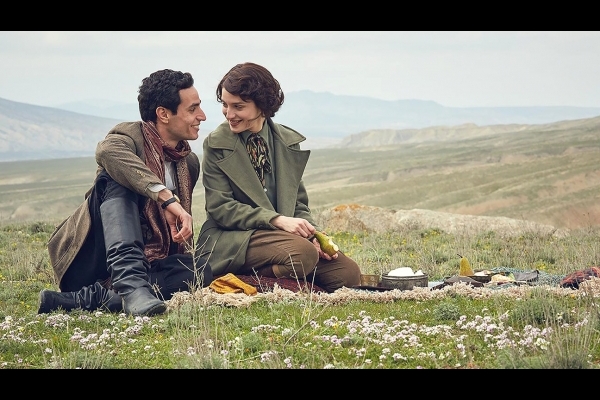
Ali (Adam Bakri) and Nino (Maria Valvarde) share a picnic on a hill.

[1] We get a rare glimpse into an era at the onset of the formation of the Soviet Union. Also, the interaction between two religions, Islam and Christianity, is carefully portrayed and interesting to observe for that time period and location.

[2] The culture of the East was well-depicted… revolution and fight for independence scenes, despite of low budget [$20 million], are well executed- impressive and tragic, as they should be. 

[3] My only concern is that movie is really short- only 1.5 hours. Way too little to show such a complicated time period of Azerbaijani history… You just cannot help but wish for story to slow down and take its time to show more details…

-Excerpts from IMDB reviews

Ali_and_Nino-leads-dir
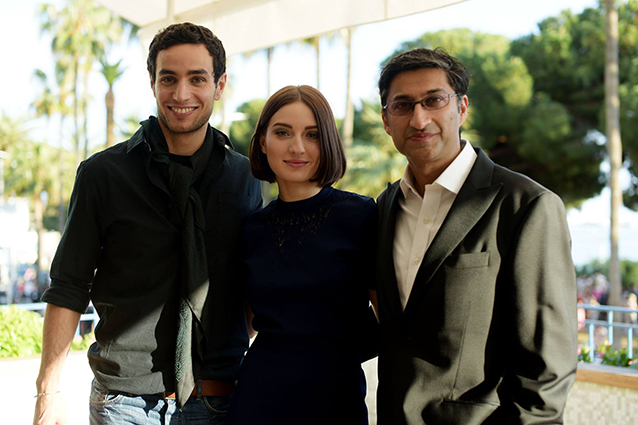
Bakri and Valvarde with director Asif Kapadia.

This little gem of a film is now streaming (Netflix). If you liked The Promise, or are interested in some of its themes, then you will enjoy this (smaller, yet well-done) love story. The director is British Asian (or South Asian, as we say in US) and a recent Oscar winner- Asif Kapadia. Amy premiered at the Cannes Film Festival in 2015; it focuses on the troubled life of singer/songwriter Amy Winehouse. The film was an international box office hit and is the highest grossing UK documentary of all time. 

There is only one word to describe the cinematography and music- AMAZING! The composer is Italian- Dario Marianelli; he worked on some very good films, including: V for Vendetta, Atonement, and Pride and Prejudice (2005 big screen version). The screenplay writer (Christopher Hampton) may also be familiar; he worked on Dangerous Liaisons (1988), The Quiet American, Atonement, and A Dangerous Method. Hampton adapted Kurban Said’s book Ali and Nino, which I had come across MANY years ago, BUT haven’t read. (There is a VERY interesting story re: the author of the book, too, if you want to look that up.)

hero_Ali-Nino-dance
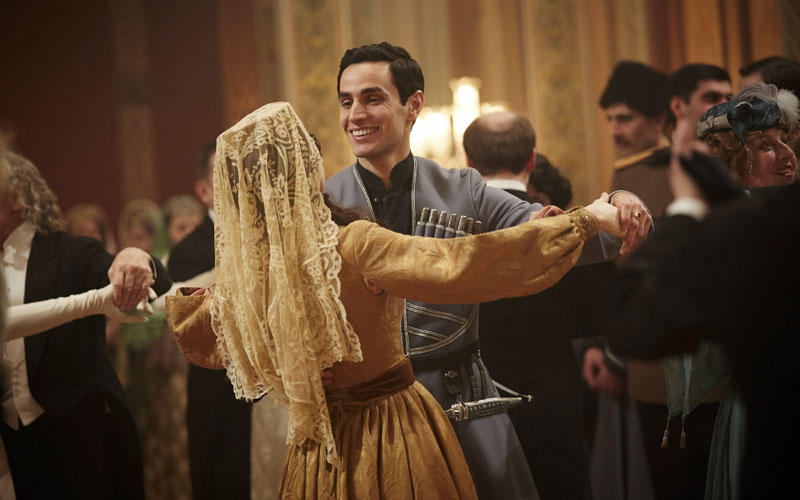
Ali (Bakri) and Nino (Valvarde) dancing at a ball after a graduation.

The desert doesn’t ask for anything, doesn’t give anything and doesn’t promise anything. -Ali explains why he loves the desert landscape 

The cast here is multi-national and multi-ethnic: Adam Bakri (who is a Palestinian Arab) plays Ali Khan (meaning: ruler) Shirvanshir, the handsome/cultured son of a Muslim nobleman. Maria Valverde (who hails from Spain) is Nino, the petite/wide-eyed princess from a Georgian Orthodox Christian family. Nino’s father is played by American film/stage actor Mandy Patinkin. Ali’s father is Iranian actor Homayoun Ershadi; he can be seen in The Kite Runner and The Queen. These veterans lend gravitas to the film, along w/ strong supporting characters (several of whom hail from Turkey, as does the cinematographer).

Ali’s father laments that though his family has been here for hundreds of years and is well-respected, they have no political authority (Russia was in charge). Though Ali and Nino have different religions and backgrounds, they move in the same small circle of upper-class society in Baku, Azerbaijan (an area rich w/ oil). Nino’s family is originally from Tblisi, Georgia; her father is in Baku on business.