Noir City DC 2025: “Tomorrow is Another Day” (1951) starring Steve Cochran & Ruth Roman


They take their lives in their hands… when they take each other in their arms! -Tagline

Prison Warden: Your generation grew up, married, raised families, went to war. But nothing happened to you, Bill. You just got older.

Bill Clark (Steve Cochran) leaves prison after 18 yrs; he has the thinking of an awkward teen (he was sentenced at age 13) and a grown man’s body. Feeling lonely, he visits a dance hall (Dream Land), where he meets a jaded/platinum blonde, Cathy Higgins (Ruth Roman). Taking pity on the earnest/persistent man, Cay shows Bill around town. After the sudden shooting of a police detective (her “sugar daddy”), the odd couple decides to hit the road. Along the the way, they hitch a ride w/ a family, Stella (Lurene Tuttle) and Henry Dawson (Ray Teal), and their young son who’re going to pick lettuce in California.

Cay: I came to New York from upstate. I was gonna be a dancer. I was a brunette. Started on my toes and wound up on my heels.

The amount ($222.35) that Bill receives from his warden would equal about $2,700 (2024). Less than 10 taxi dance halls existed in NYC (1951), compared to 100+ about 20 yrs earlier. Cay’s comment (quoted above) is a reference to an older slang term for a promiscuous woman (having round heels). Perhaps the censors let it go, b/c of the noir nature of the film. As critics have pointed out, this is the rare noir w/ a (male) virgin. I had NOT heard of this movie until I saw it at the film fest; it was well-made and kept me interested. Film scholars noted that WB tacked on the (happy) ending, BUT I didn’t mind it! This movie delves into issues we’re facing today (in a sometimes lonely/uncertain/disillusioned world): the need for autonomy, intimate/romantic connection, friendship/community, and a sense of purpose.

[1] I can’t think of any other film from the pre-Moon Is Blue period that deals with so many tough social issues (without, of course, QUITE breeching the Production Code): prostitution, rape, pimping, and even premarital sex.

[2] Roman’s the revelation; in her best-known role… Here she modulates persuasively from bottle-blonde taxi dancer to sacrificing wife and mother-to-be (and a brunette, to boot). Cochran’s almost as good, waffling between the suspicion of a wounded child and the explosive reactions of an under-socialized male.

[3] There’s a whole sub genre of noir that involves flights from big cities into the open spaces of America and how those open spaces are no longer safe; the decay of urban environments will follow relentlessly, and the open spaces are even more dangerous because there are fewer places to hide.

-Excerpts from IMDb reviews

“Border Incident” (1949) starring Ricardo Montalban & George Murphy

The Bracero Program (1942-1964) was a series of agreements btwn Mexico and the US that allowed millions of Mexican men to work (legally) in the U.S. on short-term agricultural/railroad contracts. It was created to address labor shortages during WWII; it was the largest guest worker program in U.S. history. However, braceros often faced exploitation (promised wages, housing, and working conditions NOT met by growers). This movie (available on Amazon Prime video) centers on federal agents trying to protect Mexican braceros (someone who works w/ their arms/hands) from being robbed/killed along the U.S.-Mexico border. Pablo Rodriguez (Ricardo Montalban; aged 29 and looking FAB in 1st MGM lead role) teams up w/ FBI agent, Jack Bearnes (George Murphy) to tackle illegal immigrant smuggling. This is one of the few roles where Montalban played a Mexican (his real ancestry)! Pablo goes undercover as a bracero; Jack poses as a criminal (who smuggles work permits). There is a documentary feel in the framing (beginning and end) scenes. This movie (filmed mostly on location: Mexicali, Mexico; Calexico and El Centro, CA) is a blend of noir and Western.

Border Incident (a courageous movie for its day) was directed by Anthony Mann (before his iconic Westerns starring James Stewart). The budget needed ($650K) would’ve been TOO high for the “Poverty Row” studios he’d toiled in for 7 yrs. Mann was invited to MGM studios, which was headed by Dore Schary, a liberal/Democrat committed to making meaningful movies. Schary had been a playwright, director, and producer (for the stage), before transitioning to screenwriter and producer of moving pictures. Mann was apolitical; his main focus was making quality films. The director insisted that his frequent collaborator, John Alton, be hired on as DP/cinematographer. Fans of noir consider Alton to be a master of B&W photography; as Eddie Muller (TCM) noted, he somehow made the (wide open) spaces of the desert look claustrophobic!

There is no femme fatale (as this is a world populated by men); instead, we meet a bevy of baddies of different looks and (unhinged) personalities! Rancher Howard Plakson is played by Howard Da Silva; noir-istas may recognize him from The Blue Dahlia (1944) and They Live by Night (1948). Alfonso Bedoya plays “Cuchillo” (knife); he was the Mexican bandit “Gold Hat” in The Treasure of the Sierra Madre (1948). He famously told Bogie: “We don’t need no stinking badges!” Zopilote is played by Howard Moss, a Shakespearean stage actor who had played many “ethnic” roles (due to his ambiguous looks). Mann creates tension and does NOT shy away from depicting racism and violence (based on real cases from the INS).

[1] If you’ve only known Mr. Montalban as Mr. Roarke on “Fantasy Island” or as Khan on the “Star Trek” episode “Space Seed” not to mention “Star Trek II: The Wrath of Khan” you’ll probably be wonderfully surprised by his heroic role here.

[2] The pic is often vicious, sadistic even, landing violent scenes in the conscious that refuse to move until it’s all over and the screen goes blank. Suspense is never far away in Border Incident, with a mostly on form cast… bringing the material to life as the dream team cloak it all in pictorial assertiveness.

[3] John Alton’s photography is worth seeing alone, even without the sound it’s so good, not that you would want to avoid the fantastic score by Andre Previn. And the direction by Anthony Mann at the peak of his intensity is sharp and beautifully controlled.

-Excerpts from IMDb reviews

“Until They Sail” (1957) starring Jean Simmons, Joan Fontaine, Paul Newman, & Piper Laurie

The genuine tugs at the heart are few and far between in this bittersweet but basically restrained chronicle. Robert Anderson’s adaptation… is honest and straightforward… Unfortunately there is a good deal of introspective soul-searching before this narrative arrives at its sad and happy endings. -Bosley Crowther (New York Times)

The film opens in a Christchurch, New Zealand courtroom, where testimony prompts Barbara Leslie (Jean Simmons) to flashback to the events that led to the trial. In 1939, Barbara and her sisters: Anne (Joan Fontaine), Delia (Piper Laurie), and Evelyn (Sandra Dee- just 14) live in a cottage in Christchurch. Most of the men, incl. their brother Kit and Barbara’s new husband Mark, are preparing to leave for WWII. Some time later, Delia announces her engagement to Phil “Shiner” Friskett (Wally Cassell); he is one of the city’s few remaining bachelors, though word of Kit’s death dampens the mood. Anne disapproves of the marriage, but Barbara defends Delia’s decision. Shiner is eventually drafted for war; Delia moves to Wellington to work for the navy. In 1942, several hundred U.S. Marines are shipped to New Zealand.

The film has moments of genuine tenderness and truth. -William K. Zinsser (New York Herald Tribune)

The screenplay was by Robert Anderson, based on a story by James A. Michener included in his 1951 anthology Return to Paradise. As fans of classics know, there are limits (and conventions) to the Hollywood studio system. The 1st thing you’ll need to ignore are the (wildly varied) accents of the sisters; we learn that Anne and Barbara attended school in England. The hairstyles and clothing worn by the women reflect the mid-1950s, NOT the early ’40s. There are a few scenes that come off as TOO melodramatic; others can drag on a BIT too long. However, the look of the film is lovely; it was shot in Cinemascope (or extra widescreen). The musical score by David Raksin suits the events V well.

This [pulls out a bottle of whiskey from glove compartment] is what I spend the night with… and no regrets. Oh, I get a gentlemanly hangover in the morning, but no regrets. And nobody gets hurt. -Jack explains to Barbara

U.S. servicemen married over 15,000 Australian and New Zealanders they met while stationed overseas in WWII. The War Brides Act of December 1945 required only proof of marriage to ensure legal migration to the US. Some modern sources est. the total war bride migration was one of the largest migrations to the country since the 1920s. Paul Newman (before fame; 3rd billed) accepted a supporting role only b/c Robert Wise was directing. I heard about this movie (via a Facebook post); I’d recommend it esp. to fans of Newman and Simmons. You can rent it on VOD; I saw it last week.

Newman plays Capt. Jack Harding, an alcohol-dependent/cynical/divorced Marine investigating prospective brides of soldiers. From the choices that Newman makes, you can see that acting is becoming more subtle in this time. As Barbara, Simmons is caring and empathetic to her sisters; she’s trying to live a “decent” life. One astute viewer noted that modern viewers (who’ve recently lived through the COVID-19 pandemic) may esp. relate to the loneliness experienced by the sisters in this movie. As Barbara tells Jack when they reconnect, her countrymen have been gone 3 yrs so far (1939-1942). I esp. liked how their connection grew (so it seems gradual/natural- NOT rushed); Newman and Simmons project intense chemistry!

[1] Not the best role of any of the principal actors’ careers, but definitely worth seeing, especially if you are drawn to WWII era dramas.

[2] Jean Simmons… is the counterpart for Paul Newman, who is the point man for the American presence (and the introduction to American men). […]

…even if this movie seems to follow some ordinary romantic path, you can’t help but feel, individually, for the four women wanting to not be alone. (It has some echo of “Little Women,” to me.) That’s the reason to hang in there. It takes time to get invested in the characters and their needs. Paul Newman is very good as usual, but more restrained than you might expect. Handsome, but without some kind of edge that made him bigger than life.

-Excerpts from IMDb reviews

Noir City DC 2024

Introduction

Hey y’all, how is this Winter going (so far)? It’s NOT fun for me; I’m recovering from a bad cough/cold (after Thanksgiving). I’m also way behind on blog posts. As DC area noir-istas know, my local (AFI) theater had a festival in OCT; Eddie Muller (TCM) came to introduce the movies during the opening wknd. This yr, the festival had double features (2 movies) which revolved around the same themes; 5 out of the 6 noirs I saw were new to me.

Thanks for reading!

-EMMA

***

Union Station (1950) starring William Holden, Nancy Olsen, & Barry Fitzgerald

A secretary traveling from Connecticut to NYC, Joyce Willecombe (Nancy Olsen), grows suspicious of 2 men boarding her train. She is referred to Bill Calhoun (William Holden), head of the Union Station police; the no-nonsense Calhoun is initially skeptical, BUT the men (who escape) prove to be involved in a kidnapping case. Calhoun calls in his boss/mentor, Inspector Donnelly (Barry Fitzgerald), BUT the ruthless kidnappers stay one step ahead of them. Most of the action centers around busy/fast-paced Union Station.

Holden and Olson also co-starred in Sunset Boulevard in the same year- 1950. Joyce plays Calhoun’s conscience, concerned that the interests of the victim don’t get overlooked in the hunt for the criminals. This is a (lesser-known/low budget) film noir; Holden was on the cusp of stardom. This was Lyle Bettger’s 3rd film; he played a LOT of baddies in his career. The platinum-blonde/wide-eyed Jan Sterling has a small role as his (TOO loyal) gf. Fitzgerald (who always played Irish cops or priests) brings in the humor. You can find this noir on streaming services (or rent on YT).

Cairo Station (1958)

Qinawi (Youssef Chahine), a physically-challenged peddler who makes his living selling newspapers in the central Cairo train station, is obsessed w/ Hanuma (Hind Rustum), a curvy/pretty young woman who sells drinks. Hanuma treats Qinawi kindly and flirts w/ him re: a possible relationship. However, she’s already engaged to Abu Siri, a burly/macho porter struggling to unionize his fellow workers to combat their boss’ exploitative treatment. The movie has a large cast (portraying Egyptians of disparate classes) and does NOT fall easily into one genre. Some viewers commented that the climactic scenes reminded them of Hitchcock! Chahine (an Egyptian of Christian heritage) also wrote the story and served as director. If you’re familiar w/ the characterization, visual style, and themes often seen in Bollywood, you should check it out.

[1] The work sometimes recalls Jean Renoir’s “La Bete Humaine,” but with more attention to detail. […]

Let’s underline the importance of the wide screen, which makes the director look like an entomologist watching an ant hill with a magnifying glass…

[2] It’s not hard to see why “Cairo Station” was banned for 20 years in Egypt. It gained much recognition in Berlin, being nominated for the Golden Bear…

-Excerpts from IMDb reviews

***

Le Samourai (1967)

In Paris, Jef Costello (Alain Delon) is a solitary hit man who works under contract. He’s hired to kill the owner of a club, and soon becomes the prime suspect of that murder. His gf (Jane), one of her clients (Wiener), and the Black singer of the club (Valerie) are questioned by the police. Jef is chased by henchmen (sent by the same man who hired him) and by cops. He seeks out who has hired him to get revenge. There is NOT much of a plot, characters have little development, and there isn’t much dialogue. I heard of this film yrs. ago, BUT this was my 1st time seeing it. As Gen Z may say, this movie is “all about vibes.” Sorry IF you’re a fan of thing kind of stuff, BUT I didn’t connect w/ it.

This Gun for Hire (1942)

Hit man Philip Raven (Alan Ladd), is kind to kids and feeds stray cats. He kills a blackmailer and is paid off by Willard Gates (Laird Cregar) in “hot” (marked) money. Meanwhile, a young/blonde entertainer, Ellen Graham (Veronica Lake), gf of police Lt. Michael Crane (Robert Preston) is enlisted by a Senator to help investigate Gates. Raven, while seeking Gates, meets Ellen on a train. Their relationship gradually evolves from that of killer and (potential) victim to an uneasy alliance against a common enemy. This is a well-known/low budget noir which I’ve seen before (on the small screen); it’s a quick/well-paced watch.

***

They Made Me a Fugitive (1947)

In this British noir (from Brazilian director Alberto Cavalcanti), a frustrated/cynical former RAF pilot, Clem Morgan (Trevor Howard), joins a criminal gang led by a nasty character nicknamed Narcy (Griffith Jones). On his 1st break-in job, the getaway car crashes and ends up killing a cop. Quickly, Clem is framed as the driver and sent to jail. Seeking revenge, he escapes prison and heads for London. Along the way, he breaks into a suburban home; a housewife named Mrs. Fenshaw (Veda Hope) helps him out, then asks him to murder her husband. Upon reaching London, Clem is sheltered by a blonde/petite dancer named Sally Connor (Sally Gray), who falls for him. He confronts Narcy and the gang in an abandoned warehouse.

[1] There is more attention to sound and camera-work than I’ve noticed in most British movies from the end of the war until about 1956 or so. Warner Brothers gets a huge credit at the start… So, it’s British, but it has American and continental style. […]

It’s scarier than the American gangster movies of the late forties.

[2] The general gloominess (a mainstay of thrillers emanating from the post-war era) is leavened somewhat by its constant flurry of hard-boiled dialogue courtesy of screenwriter Noel Langley. […]

Still, perhaps my favorite scene in the entire film is Howard’s surreal encounter with the zombie-like Vida Hope – in whose household he stumbles while on the run; she turns out to be deranged, and even tries to talk our hero into murdering her alcoholic husband (Maurice Denham)!

-Excerpts from IMDb reviews

Aimless Bullet (1961)

A couple of yrs. after the war in Seoul, a 30-something accountant’s salary is TOO small for him to even get his cavity fixed. He must somehow provide for his PTSD-affected mother, his pregnant wife, a younger brother (who can’t get work after serving in the army), a younger sister (who sneaks out at night to sell herself to American GIs), and 2 young children. This movie was banned in Korea b/c it was so realistically stark in it’s post- war depiction. You could tell that the locations were real; we see urban offices, outdoor cafes (for tea and drinking away sorrows), slums (located on the hilly areas near the city). The character development was V good, though the pacing felt a bit slow at times.

This film is depressing and it drives slowly towards its conclusion. On the other hand, compared to the often over-the-top melodrama present in other films I’ve seen from the era, Obaltan is a stark contrast. Owing more to Italian Neorealism than Hollywood, the film has many moments of mundaneness and potentially existentialist commentary. That Obaltan means “the aimless bullet” should give that away from the start.

-Excerpt from IMDb review
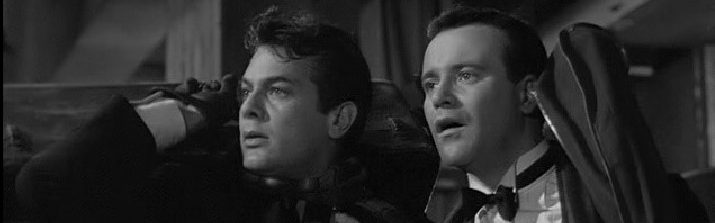
“The Best Years of Our Lives” (1946) starring Myrna Loy, Dana Andrews, Frederic March, Teresa Wright, Virginia Mayo, Cathy O’Donnell & Harold Russell

Filled with all the love and warmth and joy. . .the human heart can hold! -A tagline for the film

This iconic movie (helmed by one of Hollywood’s famed/respected directors- William Wyler) centers on the re-adjustment of 3 Americans to everyday life after serving nearly 3 yrs. in WWII. Each man is from a separate age group, rank, and class, BUT quickly become close friends. Each faces a crisis which is a microcosm of the experiences of many IRL American veterans. Al Stephenson (Frederic March: 46 y.o.) returns to his wife Milly (Myrna Loy) and 2 kids: Peggy (Teresa Wright)- a nurse- and Rob- a HS student. Wyler modeled the reunion scene on his own homecoming to his wife. As a banker, Al finds it hard to reconcile his loyalties to ex-servicemen w/ doing “business as usual.” Fred Derry (Dana Andrews: 36 y.o.)- from the working class- finds it difficult to find a job, though he was decorated for heroism as a pilot. Fred can’t relate to the woman he hastily married, Marie (Virginia Mayo), before shipping out. Having lost both hands in a training accident, Homer Parrish (Harold Russell: a non-professional actor/amputee) is unsure IF his fiancee, Wilma (Cathy O’Donnell) will still love (or pity) him. This couple grew up next door to each other, yet find it hard to communicate now.

Rob: We’ve been having lectures in atomic energy at school, and Mr. McLaughlin, he’s our physics teacher, he says that we’ve reached a point where the whole human race has either got to find a way to live together, or else uhm…
Al: [with grim finality] Or else.

Wyler (a major in the Army Air Force), incorporated his own experiences into the film. He flew in B-17s in combat over Germany; later, he shot footage for documentary films. His hearing was permanently damaged when an anti-aircraft shell exploded near his plane while on a bombing raid. Wyler (often noted as “an actor’s director”) sat beneath the camera w/ a large set of headphones connected to an amplifier. The story grew out of a Time (July 1944) story re: Marines taking a train back home to New York from San Diego, and growing more quiet/nervous the closer they got. The screenplay was written by Stewart E. Sherwood (Rebecca; The Bishop’s Wife) and MacKinlay Kantor (Gun Crazy). Wyler wanted an unglamorous look; costumes came off the rack and were worn by the cast before filming and sets were built smaller than life-size. Wyler modeled (fictional) Boone City after Cincinnati; as seen by such things as the taco stand, filming was obviously in SoCal. The add further to the authenticity, the crew (props, grips, mixers, etc.) were recruited from WWII veterans.

The Best Years of Our Lives? More like the best movie of our lives! -Comment by podcaster/movie critic

Loy has top billing here, b/c she was the most famous among the cast at that time. This was a breakout role for Andrews; he gets to show his range (esp. in the last act). In one argument, Mayo (who lobbied hard for her role) bitterly comments: “I gave up the best years of my life, and what have you done?” Each actor does well, whether their role is big or just in one scene. This is one of the Oscar winners which is truly a classic you can’t miss! It’s a slice of life from the ’40s that is still relatable; you can see it w/ all ages. I was emotional watching this film, esp. in the scene btwn Homer and Wilma while he’s getting ready for bed (revealing his vulnerability). This is streaming for free, so check it out for yourself.

[1] The film epitomized both the dream and the reality of the post-war world. This intimate engagement with the psychological facts of American life gave it an almost universal audience. But, unlike contemporary and preceding “message” pictures, it was not a preachment. It showed Americans as they are, presented their problems as they themselves see them, and provided only such solutions, partial, temporary, personal, as they themselves would accept. The picture’s values are the values of the people in it.

[2] To me, watching this movie is like opening up a time capsule. I think in many ways “The Best Years of Our Lives” is probably one of the more fascinating character studies and it holds up extremely well as a look at life in the US in the mid-1940s after WWII. […]

This movie still packs a wallop and I’m very happy to read in other posts other users feeling of a movie that will definitely stand the test of time.

[3]“Best Years” has an unbelievable number of scenes that bring a tear to the eye or a lump to the throat, with only a couple of those being the result of sadness, and with most being caused by beautiful depictions of love, loyalty, pride, patriotism, or the overcoming of personal adversity.

-Excerpts from IMDb reviews