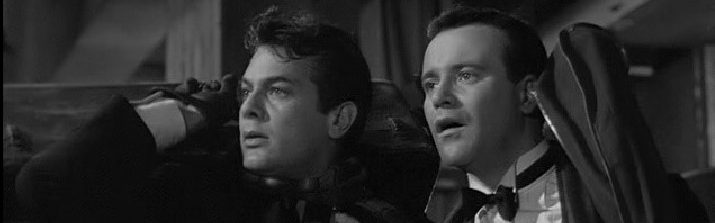
“Hollow Triumph” (1948) starring Paul Henreid & Joan Bennett

His scar marked them both!!! -A tagline for the film

John Muller (Paul Henreid) is an educated man-turned-criminal (he dropped out of med school yrs ago) who plans a holdup that goes wrong. Soon, he’s being followed by goons who work for a powerful/vindictive gambler (to whom he owes money). Hiding out, John stumbles onto a chance to assume a new identity, that of respected psychiatrist Victor Bartok, who happens to be his virtual double (aside from a scar on the left cheek). John gets close to Bartok’s secretary, Evelyn Hahn (Joan Bennett), in order to learn more about her employer.

[regaining her composure after mistakenly kissing Muller, thinking he was Dr. Bartok]

Evelyn: What can I do for you?

John: What more could any reasonable man ask?

I learned about this movie on the film noir pod- Out of the Podcast. This is a “Poverty Row” production; this is a slang term used to refer to Hollywood films produced from the 1920s-1950s by small B movie studios (as my noir-istas will know). While some Poverty Row studios had a brief existence, releasing ONLY a few films, others operated on more-or-less the same terms as- if on a smaller scales from- major film studios (MGM, Warner Bros, and Paramount). Though Steve Sekely is credited as the director, Henreid (uncredited) ended up directing the film mostly on his own! Director of Photography John Alton had a prolific career; he wrote one of the 1st book on cinematography. Alton worked on many noir films, incl: He Walked by Night, Witness to Murder, and The Big Combo. He collaborated w/ Spencer Tracy on several films: Father of the Bride, Father’s Little Dividend, and (most notably) The People Against O’Hara.

John: What happened? Did he hurt you?

Evelyn: Do I look hurt?

John: I should say you do.

Evelyn: Well, don’t fool yourself. You don’t get hurt these days.

John: No?

Evelyn: No. It’s very simple. You never expect anything, so you’re never disappointed.

John: You’re a bitter little lady.

Evelyn: It’s a bitter little world full of sad surprises, and you don’t go around letting people hurt you.

When you imagine film noir villain, Paul Henreid is probably NOT in your list -LOL! Henreid (blonde, 6’2″ tall, and best known for Casablanca) decided to produce this film himself, so that he could play a bad guy for once. As my classic film fans will know, Henreid was an immigrant to the US who became a success in Hollywood; he was born in the Austro-Hungarian empire (now a part of northern Italy). I recently learned that his father was an aristocratic banker of Jewish heritage; he changed their last name from “Hirsch” to “Hernreid.” I was skeptical, BUT he makes a compelling character. Henreid (looking posh in his suits) reveals a cold/dangerous side, BUT also keeps some charm/sophistication. You can watch this movie free on YouTube, as it is now in the public domain; the alternative title is The Scar.

Jerry [to John at the garage re: his dream to become a ballroom dancer]: My height, right? Being short isn’t as insuperable a handicap as you might think. If your personality is powerful, you can project the illusion of height.

[1] This is a well-directed, sometimes brutal, atmospheric thriller which is something of a lost classic. It is now available on DVD under its alternative title of ‘The Scar’… Joan Bennett was really made for these films, as she proved in ‘The Woman in the Window’ and ‘Scarlet Street’ for instance. There is something ambiguous about her, something hard that is soft, you can’t quite figure her. That’s just right for noir. You should never be able to figure noir, everything should stay in the shadows where it belongs.

[2] …it sure does raise my opinion of Henreid, who I’ve seen to somewhat underwhelming effect in “Of Human Bondage,” “Casablanca,” and “Meet Me in Las Vegas.” I’ve always felt like he’s just eye candy for the ladies, but in this film he really carries the story with a lot of screen presence and authority. He’s in a very different role from some of those milquetoasts- here he’s a daring, ruthless criminal who steals another man’s identity after a botched casino robbery…

-Excerpts from IMDb reviews

“Born to Be Bad” (1950) starring Joan Fontaine, Robert Ryan, Zachary Scott, Joan Leslie, & Mel Ferrer

Baby-faced Savage in a jungle of intrigue! -A tagline for the movie (featured on the poster)

Donna Foster (Joan Leslie), assistant to publisher John Caine, has agreed that his niece/small-town gal, Christabel Caine (Joan Fontaine), can stay in her apt while she attends business school in San Fran. Donna won’t need the place much longer; she and her philanthropist fiance, Curtis Carey (Zachary Scott), will soon be married. Also, Mr. Caine is preparing Christabel for Donna’s current job. While living w/ Donna, Christabel befriends NOT only Donna and Curtis, but two of her artist pals- struggling painter, Gabriel “Gobby” Broome (Mel Ferrer), and aspiring writer, Nick Bradley (Robert Ryan), who lives next door.

Christabel: You don’t care very much for women, do you?

Gobby: My dear girl, apart from painting my major occupation is convincing women’s husbands that I’m harmless.

RKO had originally scheduled this film to be made 2x previously. This film (directed by Nicholas Ray) was shot in 1949, BUT released a year later. Now, I’m NOT a fan of Fontaine (though my mom likes her in certain roles); I prefer her sister (Olivia de Havilland). I decided to watch this b/c it had Ryan (an actor I’ve admired from several fine noir films). Jeff Bridges said that Ryan was his fave actor- wow! Fontaine isn’t a femme fatale, BUT a conniver who projects the persona of a humble, soft-spoken, guile-less woman. As one astute viewer commented: “she’s reminiscent in her way of a non-show biz Eve Harrington” (All About Eve). Unlike Donna (the hard-working career gal), Christabel has zero interest in work; she quits business school (much to her uncle’s disappointment). Just how bad is she though!?

Nick: [to Gobby, as they both look at Gobby’s painting of Christabel] Looks like a cross between Lucrezia Borgia and Peg o’ My Heart. Even with two heads you couldn’t look like this – or do you know something I don’t?

What does this (above) comment mean? I looked up the references. Lucrezia Borgia (1480–1519) was a Spanish-Italian noblewoman of the House of Borgia who was the daughter of Pope Alexander VI and Vannozza dei Cattanei. According to Mandell Creighton in History of the Papacy, “Lucrezia… was personally popular through her beauty and her affability. Her long golden hair, her sweet childish face, her pleasant expression and her graceful ways, seem to have struck all who saw her.” Lucrezia was known for her cunning and became notorious for suspicious deaths and political intrigue in 16th c. Italy. Peg o’ My Heart was a 1933 Pre-Code film adaptation (there are earlier versions also) of a play by J. Hartley Manners. Marion Davies plays a poor/orphan/Irish girl who stands to inherit a fortune from her wealthy English relatives, if she satisfies certain conditions.

Donna: [to Christabel] I can just hear you, being so helpful – and so helpless. Helping to mess up people’s lives for your own selfish purposes. And just about as “helpless” as a wildcat. Somebody should have told the birds and bees about YOU!

The other reason to see this film (aside from Ryan) is the terrific dialogue; the best (and sometimes biting) lines are given to Gobby (the observer) and Nick. This movie was considered controversial; Gobby is (subtly) characterized as gay and there are (obvious) hints at extramarital sex. Ann Parrish wrote the source novel, All Kneeling, which was adapted by Charles Schnee. The screenplay was by Edith Sommar w/ additional dialogue contributed by Robert Soderberg and George Oppenheimer (who had a prolific writing career in movies/TV shows).

Robert Ryan was an actor first, a star second. He could play the good guy. He could play the bad guy. You name it, he could play it. That’s what good acting is all about. -Ernest Borgnine, co-star of Ryan in 3 movies (TCM tribute)

Nick: [to Christabel] You little fake. Don’t you know what you really want? Make up your mind, and make it up now, because I’m a restless guy.

I liked ALL the scenes between Fontaine (about 5’3″ tall w/ slight build) and Ryan (6’4″/former collegiate boxer), though physically they make an unlikely couple. In the “meet cute” in Donna’s kitchen, Nick jokes w/ Christabel, BUT she’s a little intimidated. At Donna’s party later that night, he’s eager to get to know her and puts on the charm, BUT she doesn’t stay by his side too long. Notice how Ryan’s hand totally swallows up Fontaine’s? Some time passes and Christabel (finally) goes to have dinner at Nick’s place. Ryan’s chest is heaving as they talk just before their 1st kiss. As the romance begins to sour, we see the undercurrent of danger emerge from Ryan (perhaps his trademark). Nick is the one man that Christabel can’t fool!

There is nothing exceptional re: the directing, though Nicholas Ray went to work on some big movies. Though it is set in San Fran, we don’t get many exterior shots of the city or its landmarks (too bad). I liked most of dresses worn by Fontaine and Leslie. One viewer commented: “Ray must’ve had a sense of humor,” as BOTH Nick and Curtis tightly hold and kiss Christabel in the same way- LOL! Much is done w/ sly/knowing looks, though a few viewers commented that they found Fontaine “campy.” The story moved along at a good pace. I got a big kick out of seeing Ryan in domestic settings, being a friend, and esp. – a love interest. Though he gets to play romance in Clash by Night (1952), Nick here is a more fun/intelligent/sophisticated character. However, the romance (w/ Stanwyck) is darker/hotter in the other film. There was another ending shot by Ray for this movie, but the studio rejected it based on moral grounds. You can rent this movie on Amazon Prime.

“Daughters Courageous” (1939) starring John Garfield & Claude Rains

As they have done for many summers, San Fran-based fashion designer, Nan Masters (Fay Bainter), her 4 single/young adult daughters, Cora (Gale Page), Tinka (Rosemary Lane), Linda (Lola Lane), and Buff (Priscilla Lane), and their long-time/sassy/elderly housekeeper, Penny (May Robson), are spending time in Carmel, renting the house of a local businessman, Sam Sloane (Donald Crisp). ALL the daughters are at various stages of courtship w/ a local man. The highlight of this summer is Buff’s aspiring playwright bf, Johnny Heming (Jeffrey Lynn), mounting a community play, w/ a small role for Cora (an aspiring actress). Suddenly, Nan makes the announcement that she plans imminently to marry Sam- ONLY w/ her daughters’ blessing, which they provide! Sam is the opposite of the girls’ father, the charming/outgoing Jim Masters (Claude Rains), who abandoned the family 20 yrs ago. On this same day that the Masters welcome Sam into their family, telling him to sit at the head of the table for dinner, Jim returns! He is wanting to resume his place in the family after traveling the world. Buff becomes interested in Gabriel, a young con, the son of Manuel Lopez (George Humbert), an immigrant/fisherman.

Penny: [as Tinka, who along with her sisters is giving Sam a shave, dips a towel into the kitchen sink filled with hot water] Hey, hey, hey! That hot water’s for my dishes.

Tinka: This towel is for Sam’s face.

Penny: These dishes have been in the family much longer than Sam’s face!

After Garfield made a FAB debut in Four Daughters the previous year, there was a LOT of demand for a sequel; sadly, his character (Mickey) had died at the end. Jack Warner (studio head) remedied that w/ acquiring a play by Dorothy Bennett that ran 247 performances during the 1935 season on Broadway- Fly Away Home. It’s the story of a family on the eve of the matriarch’s (2nd) marriage to a businessman. Out of the blue, her 1st husband shows up, and wants to be part of the family. This film is often (mistakenly) considered a sequel to Four Daughters (1938), as it has the same primary cast (in somewhat similar roles), most specifically Page and the Lanes portraying 4 sisters to Raines’ father) and the same director, Michael Curtiz. However, the actors play different characters in this film than in the earlier film. Four Wives (1939) and Four Mothers (1941) are 2 sequels to Four Daughters.

Nan: [after the Judge and Nan have dealt with the problem that is Gabriel Lopez] I’m very sorry, Henry. Could you come to dinner tomorrow night?

Judge Hornsby: I’m afraid not. I’m contemplating having a stroke.

Does the fact that Gabriel is Hispanic have an impact here? I’d have to say NOT too much, aside from adding to his “outsider” status. His father acts humble, is V hard-working, so seems to have gained respect in the community. Gabriel acts sassy to Judge Hornsby, though he’s NOT wrong- LOL! Afterwards, Manual exclaims to his son: “I try to make you a gentleman and this is how you repay me?” He is echoing the frustration of immigrants who want better for their (American-born) children than they had themselves. Since Garfield was playing a Mexican general in Juarez (1939) when Julius J. Epstein and Philip G. Epstein were writing the screenplay to this movie, they made his character Hispanic (as a joke). Manuel (when V upset) speaks in Italian; Humbert is an immigrant from Sicily. The vendor (down the road from the courthouse) chastises Gabriel (also in Italian) when he grabs 2 bags of peanuts from the cart w/o paying.

Penny: [sternly] When are you going to stop sliding down the banister?

Buff: [excitedly] When they stop making ’em.

This is a much more interesting story than Four Daughters; there are serious themes underneath. Though the cast is quite large, each character gets a chance to add to the story. Priscilla Lane and Garfield continue to have good romantic chemistry; it’s a case of opposites attracting (yet again). He convinces her to hang out w/ him; she ends up paying for beer and food. Some viewers felt that Gabriel was TOO cynical; they preferred Mickey (Four Daughters) instead. Though he tries to make an easy buck, Gabriel is NOT really a bad guy; he’s restless to see the world (beyond his small town experience). The scenes between Garfield and Rains are standouts; Gabriel and Jim have great (potential friend) chemistry. When they first meet, the young man strolls into the house, playing the accordion, and looking for a girl (NOT recalling Buff’s name- oops)! If you’re a fan of these actors or just want something relaxing to watch (like a Hallmark movie), then check this out.

[1] Garfield, just as he did in the earlier film, jumps off the screen with a charisma and sexuality the other performers just can’t match. He and Claude Rains, whose character from the first film undergoes the greatest change, strike up a good rapport as two wandering spirits.

[2] As the Bainter character herself comments, the dialogue does tend to be flip, – it is often amusing, but it is hard to take it seriously. The superlative photography, especially the location scenes (between the trees overlooking the water) which have a real lyrical quality, and the music score are major assets, as is the skilled film editing. The direction is not especially striking, but has confidence and assured craftsmanship.

[3] This is a an enjoyable, though somewhat dated film, enlivened by the masterful presence of Claude Rains. He completely steals the film, even when surrounded by a solid supporting cast… But the production code of the era demanded that any character who was “morally tainted” would be made to pay for it, eventually, in the movie. Warner Bros. made no exception here, even though the ending is plausible and frankly, ludicrous.

-Excerpts from IMDb reviews

John Garfield’s 1st Movie: “Four Daughters” (1938)

Adam Lemp (Claude Rains), the Dean of the Briarwood Music Foundation in upstate NY, has passed on his love of music to his 4 young adult daughters – Thea (Lola Lane), Emma (Gale Page), Kay (Rosemary Lane) and Ann (Priscilla Lane)- who live w/ him and his maiden sister, Aunt Etta (May Robson), in their loving/cozy family home. Thea plays the piano, Emma plays the harp, and Ann plays the violin. It’s Kay who shows the greatest promise- she’s the singer. The girls exasperate their father w/ their love of popular music, since he loves classics (esp. Beethoven). The sisters support each other and share clothes. Each girl is an individual w/ her own distinct personality and wants, incl. the type of man each wants as a husband. Emma (practical, but secretly romantic) has been courted by their next door neighbor/shy florist- Ernest Talbot (Dick Foran). Thea (who calls herself “the clever one”) wants to marry Ben Crowley (Frank McHugh), a middle-aged/upwardly-mobile banker. The youngest sister, Ann, thinks she doesn’t want to get married. Their lives change when 2 new men come into their lives. The first is Adam’s old friend’s son, popular music composer, Felix Deitz (Jeffrey Lynn), quickly gets a job at the foundation using his natural charm/enthusiasm. The second is a scruffy/cynical musician from NYC, Mickey Borden (25 y.o. John Garfield in his big screen debut/1st Oscar nom), who Felix hires to orchestrate a new composition.

It took me some time, BUT I realized that I’d seen a version of this story before! My parents used to re-watch the 1954 musical remake (Young at Heart); Mickey was played by Frank Sinatra and Ann was played by Doris Day. Four Daughters was to be a big-budget production starring Errol Flynn (fresh from his success on The Adventures of Robin Hood), BUT was re-worked into a modest domestic drama. It was designed as a vehicle for Priscilla Lane, which also happened to have roles for her sisters- Lola and Rosemary. Warner Bros. gave this movie to director Michael Curtiz as a small assignment to tide him over as Angels with Dirty Faces (1938) was coming together. Surprisingly, Curtiz delivered a film that was critically acclaimed and a box office success, earning 5 Academy Award noms!

Mickey [telling his life story to Ann]: They’ve been at me now nearly a quarter of a century. No let-up. First they said, “Let him do without parents. He’ll get along.” Then they decided, “He doesn’t need any education. That’s for sissies.” Then right at the beginning, they tossed a coin. “Heads he’s poor, tails he’s rich.” So they tossed a coin… with two heads. Then, for a finale, they got together on talent. “Sure,” they said, “let him have talent. Not enough to let him do anything on his own, anything good or great. Just enough to let him help other people. It’s all he deserves.” Well, you put all this together and you get Michael Bolgar.

Mickey was originally written w/ actor Van Heflin in mind; he could’ve done a good job. Garfield (who’d been studying the craft of acting since HS) based Mickey on his friend/musician- Oscar Levant; to see them together, check out Humoresque (1946). When Lynn did his screen test to play Felix, he was also shown Garfield’s screen test; he predicted that the newcomer would steal the show. Looking at this film w/ our (modern) sensibilities, it doesn’t take long to realize who is the real star. In any other case, the (tall/slim/conventionally handsome) Lynn would be the draw. Next to the (naturalistic, yet dynamic) performance of Garfield, he doesn’t stand a chance! As one astute viewer commented: “Mickey shows up loaded with bruised charisma to burn and pulling the focus of the story to him without even trying.” Check this movie out- you may enjoy it!

[1] The role was superbly played by John Garfield, and it brought him not only stardom but also, and perhaps more important, won for him his place in cinema history as the screen’s first rebel hero.

[2] Unlike some actors who appear in several films before their screen image gels, Garfield established his immediately, with a cigarette hanging out of his mouth and talk of the fates being against him.

[3] How opposites attract is part of the ploy for touching the quick of the viewer’s imagination. Ann is the eternal optimist, even when she and Mickey are down and out. She always looks on the bright side and like so many caught in the pliers of the Great Depression in those days, she saw prosperity just around the corner. Mickey recites an entire list of bad things that have happened to him seeking company in his misery from Ann, which Ann refuses to do. Mickey expects to go out with a bolt of lightning striking him dead as he rounds the corner of life. Mickey has meager talent as a composer; Ann has talent to spare as a singer and musician. Ann is big on beauty; Mickey is big on personality in a warped sense of a way.

-Excerpts from IMDb reviews

“Force of Evil” (1948) starring John Garfield, Thomas Gomez, & Marie Windsor

Harvard-educated lawyer, Joe Morse (John Garfield), wants to consolidate the small-time numbers-racket (gambling) operators into one (big/powerful) operation, on behalf of his (racketeer) boss, Ben Tucker (Roy Roberts). However, Joe’s older brother (nearly 50 y.o. w/ heart issues), Leo (Thomas Gomez), is one of the small-time operators who wants to stay that way, preferring NOT to deal w/ the gangsters who dominate the big time. These brothers share a volatile/guilt-ridden relationship; Leo raised Joe for some years after their parents died. To complicate matters, Tucker’s bored/unhappy wife, Edna (Marie Windsor- in the femme fatale role), has her eyes on Joe. Leo is concerned for those who work for him, esp. secretary, Doris Lowery (Beatrice Pearson; in her 1st/sole film role at age 28), who is the “good girl.”

Edna: You’re wide open, Joe. I can see into you without looking.

Joe: Don’t bother; besides it’s not nice to do.

Edna: More interesting than when you have a rock for a husband like mine. He’s a stone, that man. Whole world are rocks and stones to him.

Joe: Why tell me? Tell him.

Edna: Never tell him anything. Makes me feel unnecessary.

Joe: If I make you feel NECESSARY then I’m making a mistake.

Force of Evil was selected to the National Film Registry at the Library of Congress in 1994. It is included among AFIs 1998 list of the 400 movies nominated for the Top 100 Greatest American Movies. This film is predicts the legalization of the numbers racket into state-run lotteries. It also involves wiretapping technology- innovative at that time. Critic Thom Andersen identified this as an example of film gris, a suggested sub-category of film noir incorporating a left-wing narrative. Force of Evil was a major influence on Martin Scorsese; it was the 1st movie he remembers having watched as a boy. Scorsese explained that it showed NYC the way he knew it to look in real life. As a young filmmaker, he studied it frame-by-frame; Scorsese said that you can see the influence in Mean Streets, Raging Bull, and Goodfellas.

Edna: A man could spend the rest of his life trying to remember what he shouldn’t have said.

This film is a tour de force for Garfield; it was released by MGM, but produced by Enterprise Productions (co-founded in 1946 by the actor and producers David L. Loew and Charles Einfeld). After Garfield’s contract w/ Warner Bros. ended, he wanted more creative control over his films. The (1st time) director and noted screenwriter is a childhood pal of Garfield’s- Abraham Polonsky. He collaborated w/ Ira Wolfert, the author of the source novel- Tucker’s People. In order to show cinematographer George Barnes how he wanted the film to look, Polonsky gave him a book of Edward Hopper’s Third Avenue paintings. The art director (AKA production designer) was Richard Day; he worked on Dodsworth, The Grapes of Wrath, and How Green Was My Valley. The musical score is by the David Raskin (Laura) and suits the movie well. Below are some lines from my fave scene; this dialogue is gold!

Joe: If you need a broken man to love, break your husband. I’m not a nickel, I don’t spend my life in a telephone! If that’s what you want for love, you can’t use me.

Edna: You’re not strong or weak enough.

“The force of evil here is capitalism itself, according to the author- Polonsky,” as Eddie Muller (TCM) commented. I saw this movie (free on YouTube) this week; the run time is only 79 mins. You may have to see it 2x, b/c they pack in a LOT at a fast pace. There are MANY character actors who add flavor to the story. As one astute viewer wrote: “see for a slightly more polished and sophisticated view of the noir world.” Though he comes from “the slums” and grew up poor, Joe now wears fancy 3-piece suits and has a spacious office. He admits to Doris that he decided to work for Tucker for the money.

Joe [to Doris]: I didn’t have enough strength to resist corruption, but I was strong enough to fight for a piece of it.

Have you seen actors in person? I’ve seen a few (esp. when commuting/walking in my NYC days); they’re usually a BIT shorter/slimmer than they appear onscreen. Garfield (5’7″) stood on an apple box for a scene between him and Windsor; the curvy/statuesque actress was several inches taller. Windsor said he had no ego about it though. Of course, she couldn’t wear high heels- LOL! Notice how they bend and shift so they’re usually sitting near each other, NOT standing. I wanted to see a BIT more of Windsor; she gets to wear some great outfits. Check this movie out!

…one of the most audacious and subversive movies of its era. […] In the cab, when Joe gives Doris a ride, Polonsky gives free range to an extraordinary flow of dialogue- unnatural language that seems to emerge straight from the character’s subconscious. From this scene, Force of Evil is unique, each scene coming at the viewer from slightly left-of-center, both artistically and politically. -Eddie Muller, host of Noir Alley (TCM)

[1] Of course the fact that the film was shot totally on location in scintillating black and white noir in New York City, gave it a dimension that no other noir films have, save possibly Night and the City, which was also shot on location (in London).

[2] There are many more levels to this complex film and discussion of them all could fill many pages. Above all, it is a beautiful movie, expertly directed with tremendous black and white imagery. The dialogue combines snappy patter with almost poetic sensibility. And the performances of all concerned are top notch. This is truly a treasure of cinematic art. Be prepared to think deeply when you watch it.

-Excerpts from IMDb reviews