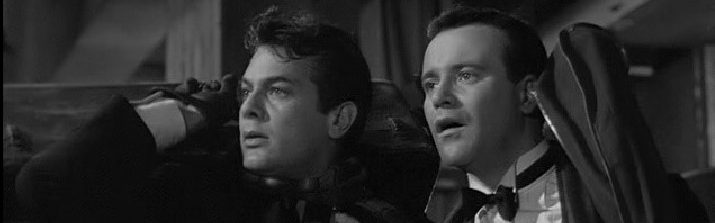
Hitchcock’s “Saboteur” (1942) starring Priscilla Lane & Robert Cummings

[Philip, a blind man, explains to Patricia why he believes Barry is innocent]

Phillip: Don’t you know I can see a great deal farther than you can? I can see intangible things. For example, innocence.

A young L.A. aircraft worker, Barry Kane (Robert Cummings- who later co-starred in Dial M for Murder) evades arrest after he is unfairly accused of sabotage. Following leads, he travels cross-country and ends up in NYC, trying to clear his name by exposing fascists hiding behind money/respectability. Along the way, he meets a young model, Pat Martin (Priscilla Lane), as well as some quirky/colorful characters. There are brief appearances by Sir Alfred Hitchcock (in front of drugstore) and Robert Mitchum (on stairs in the factory).

Pat: If it had been any other sort of crime, if a man had stolen because he was starving, even if a man had committed murder to defend himself, maybe I wouldn’t tell the police. But there’s only one reason why men commit sabotage, and that’s worse than murder.

Hitchcock wanted Gary Cooper or Joel McCrea for the lead; Cooper wasn’t interested in a thriller and McCrea was busy. The director thought that Cummings was “a competent performer,” but found his performance, and the movie, suffered because he “belongs to the light-comedy class of actors” and had “an amusing face, so that even when he’s in desperate straits, his features don’t convey any anguish.” Hitch thought Lane “simply wasn’t the right type” for his picture; he preferred Margaret Sullavan or Barbara Stanwyck. Hitch was esp. upset re: not getting the villain he wanted. To convey the sense of the homegrown fascists being regular people, the ones you’d least likely suspect, he wanted former silent movie actor/Western star- Harry Carey. Although the script was originally written w/ Germans in mind as the villains, he decided not to mention “Germans” at all.

Charles Tobin: When you think about it, Mr. Kane, the competence of totalitarian nations is much higher than ours. They get things done.

Saboteur is one of Hitch’s “wrong man” films, where the protagonist is falsely accused of a crime. It’s similar to one of his earlier British films, The 39 Steps (1935), as many viewers have noted. We find Hitchcock feeling his way around America (literally); there are elaborate sets in this film. The ranch house of Charles Tobin (Otto Kruger) was later used as the home of the Brenner’s on The Birds (1963). The special effects crew took pics of the Statue of Liberty’s raised hand, her torch, and the ledge beneath it; these were re-created to scale on a Universal soundstage.

[1] The opening fire is filmed in a very stylish manner with black smoke slowly engulfing the screen; the set-piece with the circus troupe is quirky with memorable characters… there’s also a great sequence in a cinema… but best of all is the final set-piece atop the Statue of Liberty, it’s exciting stuff with excellent set design too.

[2] The darker elements of the narrative and the sharp wit of literary maven Dorothy Parker (during her brief stint in Hollywood…) who co-authored the script were a perfect match for Hitchcock’s sensibilities.

[3] I like Priscilla Lane because her character is a more involved in the action than Madeline Carroll in “The 39 Steps” and Ruth Roman in “Strangers on a Train.” …Otto Kruger steals the show as the villain.

-Excerpts from IMDB reviews

“3:10 to Yuma” (1957) starring Glenn Ford & Van Heflin

Alice: It seems terrible that something bad can happen and all anybody can do is stand by and watch.

Dan Evans: Lots of things happen where all you can do is stand by and watch.

After a stagecoach robbery/shootout, notorious outlaw Ben Wade (Glenn Ford) is captured in a small town by a sheriff and few locals. One of them is a struggling rancher/family man, Dan Evans (Van Heflin), who volunteers to escort Wade to the nearest town w/ a railway station. Dan desperately needs the $200 which the stagecoach company’s owner offered as a reward. Once the two men are holed up in the hotel to await the 3:10 to Yuma, a battle of wills ensues. All the while, Ben’s gang is gathering to break him out.

Emmy: Funny, some men you see every day for ten years and you never notice; some men you see once and they’re with you for the rest of your life.

Even if you’re not a big fan of Westerns, you’ll find a lot to enjoy in this must-see film! The screenplay (which includes sly moments of humor) was adapted from a story by Elmore Leonard. There are gorgeous shots of the desert, intimate close-ups, music, exciting action sequences w/ horses and guns. Although most Westerns by this time were being produced in color, director (Delmer Daves) and cinematographer (Charles Lawton Jr.) chose to shoot in black and white.

I thought all the actors (including the supporting ones and two boys) hit the right notes. Ford was originally offered the role of Dan Evans; he refused and suggested himself for the role of Ben Wade. This is one of Ford’s (rare) bad guy roles; he’s still charming and likable. Heflin (who worked on many Westerns) and Ford play off each other very well. Ford has sparkling chemistry w/ Felicia Farr (the beautiful/lonely barmaid, Emmy). There are touching scenes between Heflin and Leora Dana (his devoted/refined wife, Alice).

Ben Wade: I mean, I don’t go around just shootin’ people down… I work quiet, like you.

Dan Evans: All right, so you’re quiet like me. Well then, shut up like me.

The scenes of Contention City were shot in Old Tucson, which is not far from where I grew up. Some critics/viewers consider this a film of a man reclaiming his masculinity. I also see it as a community struggling to do the right thing, though under enormous threat. This film, along w/ High Noon (1952), was a deciding factor in Howard Hawks deciding to make Rio Bravo (1959), a return to more optimistic Westerns. This is one of Patton Oswalt’s favorite movies; he introduced it on TCM several years ago.


“Beyond a Reasonable Doubt” (1956) starring Dana Andrews & Joan Fontaine

Tom Garrett (Dana Andrews) is a reporter on leave from his newspaper to write his second book. Since he has writer’s block, his publisher/friend, Austin Spencer (Sidney Blackmer), suggests an idea for a non-fiction book on capital punishment. Austin thinks the local DA, Roy Thompson (Philip Bourneuf), is using the death penalty in the hopes of getting into the governor’s mansion. Tom and Austin decide to frame Tom for a murder he didn’t commit, in the hopes of showing how easily a man could be found guilty (w/ only circumstantial evidence). They decide to keep Tom’s fiancee/Austin’s daughter, Susan (Joan Fontaine), out of the loop.

Austin: You get engaged to my daughter, and all you can think about is capital punishment?

This was the last American film made by Fritz Lang (an iconic noir director) before returning to his native Germany; he fled in 1934 b/c of the rise of the Nazis (being Jewish). Lang chafed against the Hollywood studio system when producers wanted to impose their ideas on his vision. This film (shot in only 20 days- wow) is a legal drama and noir rolled into one. Instead of a cop, we follow a journalist (which was common for the noir genre). Though it’s not in Lang’s usual style, I thought it was riveting from the start. Some viewers said the movie looked more like a TV show; TV was on the verge of becoming big in the mid-1950s. The dialogue is smart, pacing well-done, and the acting is good (down to the small roles).

Dolly: This guy’s got a lot of class.

Terry: Yeah? If he’s got so much class, what’s he doin’ with you?

Andrews and Fontaine make an elegant couple; they’re also fine actors who understand subtlety. Fontaine gets some classy outfits to wear, too. I think she looked more interesting in her 30s and somewhat baby-faced in her 20s. I wish she had more to do. One of the burlesque dancers, Dolly Moore (Barbara Nichols), brings some humor to the story. Moore looks/acts like a taller a and more streetwise version of Marilyn Monroe; she was in Sweet Smell of Success (1957) opposite Tony Curtis and Burt Lancaster.


[1] The main strengths of this movie… its lively pace, its wonderfully bizarre plot and the unexpected twists which make it so intriguing and enjoyable to watch.

[2] Andrews and Fontaine are not a bad pair—both are matched in calm and sophistication, and beauty, even, though Fontaine seems like an accessory until the very end. Andrews rules the plot, which makes him out to be a writer desperate for a new story.

[3] This is perhaps Lang’s best assault on the American justice system; he has created a story that is interesting and very plausible and it works a treat in that it gets you thinking about the fact that with this kind of law; someone really could be killed for something they didn’t do.

It is efficient story telling at it’s best and this is one of the highlights of the film noir era.

-Excerpts from IMDB reviews

“Deadline – USA” (1952) starring Humphrey Bogart, Ethel Barrymore, & Kim Hunter

Ed Hutcheson, the editor of a crusading NYC newspaper- The Day– finds that the late owner’s daughters will soon be selling it to a rival (which focuses more on sensationalism). At first, he sees impending unemployment as a chance to win back the ex-wife he still loves, Nora (Kim Hunter). Then, a reporter pursuing a lead on a racketeer, Tomas Rienzi (Martin Gabel), is badly beaten. Hutcheson goes into fighting mode, trying to connect Rienzi to a young woman’s murder… and maybe even saving the paper (and the jobs of his co-workers)!

Ed Hutcheson: A free press, like a free life, sir, is always in danger.

The story is based on the closing of the The Sun, founded by Benjamin Day, in 1950. The Sun was sold to the Scripps Howard chain and merged into The World-Telegram. Location shooting took place both in the newsroom and the printing plant of The New York Daily News, w/ real pressmen playing themselves. There was also a reproduction of a newsroom on a Hollywood soundstage.

Alice: [After her mother announces she’s buying back the paper] What changed your mind?

Mrs. Garrison: Have you seen today’s paper? And yesterday’s? Loyalty changed my mind. A principle evidently lacking in today’s generation.

There are unpredictable scenes, many fine supporting actors, and a very strong script. The writer/director, Richard Brooks, worked on The Brothers Karamazov (1958) and Cat on a Hot Tin Roof (1958), and Elmer Gantry (1960). He had 6 Oscar noms during his film career- wow! Bogie (over 50, yet still going strong) gives an energetic and powerful performance, though it never seems over-the-top. Each line comes across as if he’d thought it up himself at the moment! Ethel Barrymore lends even more gravitas to the story w/ her portrayal of Margaret Garrison, the widow of the paper’s respected founder.

[1] …a realistic look at the life of a big city paper in days gone by. It’s a gritty piece of nostalgia, as timely in its day as The Front Page was in the Twenties. Cast members like Paul Stewart, Jim Backus, and Ed Begley look and feel right at home at their jobs.

[2] Kim Hunter excels also as the Bogart ex. Martin Gabel eerily predicts the Tony Soprano performance of today as an underworld Kingpin shown with his perfect domestic arrangement.

[3] …surprisingly up to date in its concern with how the public often doesn’t really care about the news, and that a lot of what’s packaged as news is just entertainment.

-Excerpts from IMDB reviews

“Caught” (1949) starring James Mason, Barbara Bel Geddes, & Robert Ryan

Maxine: [Persuading Leonora to attend a charm school] You’re not going just to get a better job. A charm school is like college and finishing school combined.

Leonora Eames: I can read, Maxine.

Maxine: Well, all I can say is, without a social education, you’re never gonna’ meet a real man.

Though she is struggling to pay bills in SoCal, an idealistic waitress from Iowa, Leonora Eames (Barbara Bel Geddes), decides to spend on a 6-wk. course at a charm school. She soon becomes a department store model like her friend/roomie (Maxine). Leonora gets noticed by a man at the perfume counter (as she’d imagined); he invites her to a party on a yacht owned by bachelor/millionaire Smith Ohlrig (Robert Ryan). Thinking that she’s in love, Leonora marries Smith, and begins her life on his Long Island estate. It turns out that Smith is a workaholic; he’s also a cold-hearted/controlling husband. After a year of (miserable) married life, Leonora leaves him. She answers an ad for a receptionist for a doctors’ office on the Lower East Side. One of the doctors is an obstetrician; the other, Larry Quinada (James Mason), is a pediatrician.

How do I wish to be remembered, if at all? I think perhaps just as a fairly desirable sort of character actor. -James Mason

Some classic film fans may realize that Smith is based on (another difficult millionaire) Howard Hughes. The 1992 restoration of this film at UCLA was financed by Scorsese, who later directed The Aviator (2004). For his American film debut, Mason (then 40 y.o.) was first cast as Smith; he asked to play the other male role, as he wanted to change his (villainous) screen image. The director (Max Ophuls) brings an European (German to be exact) sensibility to the melodrama/noir. The angles, lighting, and movement of the camera help in creating an unique, yet unsettling film showing the dark side of “The American Dream.” Bel Geddes does fine, but she’s not a very nuanced actress; she is known best as Ellie Ewing (matriarch) on Dallas. Ryan and Mason are the ones who shine here. They are filmed and lit in different ways; Ryan looks threatening/dangerous (shot from below or farther away) and Mason comes across as relatable/comforting (shot more close-up at eye-level). I’d like to check out more of this director’s English-language films.

[1] … it was brilliant casting: Ryan was a superb actor. He was tall and intense. …the character he plays here is withdrawn, well-spoken, and even a bit effete. It’s an exceptionally good performance that today would win an actor all sorts of awards.

[2] The messages about the state of that world are strong, indeed almost totally lacking in any subtlety… all of which starkly inform the viewer that the price of excessive wealth and social nihilism combined is so close to madness it’s not worth chasing; far better, instead, to reject such excesses and concentrate on being a valuable member of society.

Some great camera work and all in lovely black and white makes this movie a worthwhile addition to the film-noir genre.

-Excerpts from IMDB reviews