“The Tarnished Angels” (1957) starring Rock Hudson, Robert Stack, & Dorothy Malone

In 1930, a former WWI hero, Roger Schumann (Robert Stack), has resorted to flying in (potentially dangerous) air shows. His wife/assistant, LaVerne (Dorothy Malone), young son Jack, and friend/mechanic Jiggs (Jack Carson) come on the road w/ Roger, as he pursues his passion. Burke Devlin (Rock Hudson) is a New Orleans reporter who wants to do an article on Roger when the group come to perform at a local circus. Burke is soon drawn to LaVerne, whose story he finds more fascinating than Roger’s! This is a (lesser-known) film directed by Douglas Sirk (known for his Technicolor melodramas AKA “women’s pictures”). This was shot in B&W and reunites 3 actors from Written on the Wind (1956); I found it more interesting than that movie.

There is little glamor to be found in The Tarnished Angels (based on a novel by William Faulkner), as these characters are disillusioned by their pasts and barely making a living. The themes here MAY remind some of the noir genre. Malone (an underrated talent) wears clothing from the late ’50s, NOT the ’30s Depression era (which doesn’t detract from the film). Hudson (known for his “hunk” status) is somewhat disheveled; he wears rough-hewn blazers and baggy cardigans. Hudson stretches himself as an actor; Sirk was the director that made him a big star. The flying scenes are tense and exciting- even to modern eyes!

[1] Taking as its subject the uncommon lifestyles of the participants in the popular flying-circus entertainments of the 20’s and 30’s, it’s not long before the familiar Sirk themes of conflicting passions, human weakness and sacrifice raise their heads above the parapet.

[2]…mostly watch it for Rock Hudson’s intelligent performance.

[3] I found the film to be solid, and would rank it among the very best of Sirk’s work. Truly a must-see. Not quite a noir, but still on the edges of that world.

-Excerpts from IMDb reviews

“Last Train from Gun Hill” (1959) starring Kirk Douglas & Anthony Quinn

The (Native American) wife of marshal Matt Morgan (Kirk Douglas) is raped/murdered by two young/white men while on a ride w/ their 7 y.o. son. The killers leave behind a saddle w/ the initials “CR” on it; Matt recognizes this as property of Craig Belden (Anthony Quinn), his old friend. Craig (now a cattle baron in the town of Gun Hill) is sympathetic to Morgan’s situation, until he realizes that one of the murderers is his own son, Rick (Earl Holliman). Craig refuses to hand over his son to Matt, but the lawman is determined to capture Rick and his friend (Lee) by the 9PM train. Soon, Matt learns that the townspeople (incl. the sheriff) won’t cooperate; Craig’s henchmen are looking to kill him! He finds ally in Linda (Carolyn Jones), a single woman he met on the train.

Sheriff Bartlett: Far as I’m concerned, you can go out on the street and get yourself killed anytime you want to, but, you know something, 40 years from now the weeds’ll grow just as pretty on my grave as they will on yours. Nobody’ll even remember that I was yellow and you died like a fool. That’s your long view, son. Always take the long view.
Marshal Matt Morgan: I’ve got two warrants, and I’m gonna serve them. I’m leavin’ town with two men, and the long view is this: don’t try to stop me!

This drama (directed by John Sturges- best remembered for his Westerns) has dark/realistic elements; as this was made in the late ’50s, Hollywood was opening up more. The movie (which is available to stream for free) starts w/ a (tense/harrowing) chase which results in a wife/mother being attached; her young son is able to ride away. Later on, Linda breaks up w/ Craig, revealing that it was his (physical) abuse which resulted in her hospitalization. It’s rare to see such a woman character in the Western genre!

[1] …something of a coup having two heavyweight stars of the period like Kirk Douglas and Anthony Quinn playing the central roles. […]

With more than a nod to Delmer Daves’ “3.10 To Yuma” (1957), LAST TRAIN FROM GUN HILL is a splendid well structured dramatic western with equally splendid performances from Douglas and Quinn. The supporting cast are good too! […] Adding greatly to this taut western drama is Dimitri Tiomkin’s outstanding music.

[2] Earl Holliman showed great promise in an early role as the spoiled rotten son of Mr. Belden. I’m surprised that he did not become a bigger star as a character actor throughout his career. And the late Carolyn Jones turned in a strong performance as Linda. Definitely up there in the same ranking of great classic westerns and one of the best efforts of John Sturges.

[3] …impressive in the script, and through John Sturges’ steadfast professionalism, is how there’s the tension between law and the personal, the immediate draw of a gun draw to solve anything, and the bitterness of real vengeance…

-Excerpts from IMDb reviews

“Suddenly, Last Summer” (1959) starring Katharine Hepburn, Elizabeth Taylor, & Montgomery Clift

These are powers and passions without precedent in motion pictures! -A tagline for the film

A wealthy/powerful widow in late 1930s New Orleans, Violet Venable (Katharine Hepburn), attempts to bribe Dr. John Cukrowicz (Montgomery Clift), a psycho-surgeon at a mental hospital (desperately in need of funds), into lobotomizing her young niece, Catherine Holly (Elizabeth Taylor). Violet wants to prevent Catherine (diagnosed w/ schizophrenia) from “babbling” re: her son, (Sebastian) who died of a heart attack in Spain the previous Summer. Tennessee Williams’ sister (Rose) underwent a lobotomy to “cure” her anxiety; he never forgave his mother for allowing that to happen. The play was performed off-Broadway; it was a great success. The screenplay was written by Gore Vidal, who expanded from the original one act structure. He lost his chance for an Oscar nom after the Catholic Church attacked the film for its implications of homosexuality.

As some of y’all know, you need to be in a certain mood to watch a work written by Williams. This is NOT your “typical” movie; there are long monologues performed by Hepburn and Taylor. Though it deals w/ V serious subjects w/in a dysfunctional family, the story (lesser-known) is compelling! There is a mix of the Gothic w/ psychodrama and horror elements, which director Joseph Mankiewicz puts together expertly. He was known for getting strong performances out of female actresses; Mankiewicz directed A Letter to Three Wives (1949) and All About Eve (1950). If there is a weak link here, it’d (sadly) be Clift; alcoholism and prescription drug abuse took their toll on his acting. Taylor (looking fab- as usual) saved his job, as she would NOT play her role w/o her closest friend. Wow, she was a real one!

[1] …the film only alludes to Sebastian’s homosexuality, using rather graphic symbolism to bring across the dramatic tension of the situation. In this case, it works because it’s consistent with the Baroque style of the entire movie.

[2] Katharine Hepburn plays Violet and manages to chew the scenery and spit it out, it’s an elegant performance, but you really want more than we actually get!

[3] …it is lush and lurid, with gorgeous dialogue that is totally unbelievable coming out of the character’s mouths. It is a fun and entertaining movie to watch, with emotions running high and emoting even higher. Kate Hepburn and Liz Taylor are both mesmerizing...

-Excerpts from IMDb reviews

“Written on the Wind” (1956) starring Rock Hudson, Lauren Bacall, Robert Stack, & Dorothy Malone

It was a masterpiece of suds. -Lauren Bacall, in an 2000 interview

In the Fall of 1955, a geologist working for Hadley Oil, Mitch Wayne (Rock Hudson), meets an executive secretary, Lucy Moore (Lauren Bacall), in their company’s office in NYC. He invites her to a lunch meeting at 21 Club w/ his best friend/famed playboy, Kyle Hadley (Robert Stack). Mitch and Kyle both fall hard for Lucy! Later that day, Kyle flies them all down (in his plane) to Miami; they check into a luxury hotel by the beach. Whoa, talk about love bombing! Kye shows Lucy her private suite, complete w/ glam clothes and accessories. However, none of this impresses her, so books a flight back to NYC. Kyle races to the airport, revealing his love for Lucy. They get married the next morning and travel to Acapulco; Kyle even gives up alcohol. Meanwhile, Kyle’s sister, Marylee (Dorothy Malone), is raising hell in their hometown (Hadley, TX). She loves Mitch desperately (though goes after other men), he sees Marylee as a sister.

Almost any other actor I know in the business… would have gone up to the head of the studio and said, “Hey, look, man, I’m the star – you cut this guy down or something.” But he never did. I never forgot that. -Robert Stack re: working w/ Rock Hudson

Rock gave me that sense of security whenever I worked with him. -Dorothy Malone (who won Best Supporting Actress Oscar in 1956 for her role) on her bond w/ Hudson

The source novel was based on the death of tobacco heir Zachary “Smith” Reynolds. Though Humphrey Bogart (husband of Bacall) didn’t like it, many modern critics consider Written on the Wind to be director Douglas Sirk’s best. Here we have an exploration of love, betrayal, and social status. The Village Voice referred to the film as “the original Technicolor noir” (OCT 1987). Sirk (born Hans Detlef Sierck; a native of Germany) is called “the master of melodrama;” he used bright colors in the visuals, lavish sets, and sweeping music. Without these types of movies, we perhaps wouldn’t have the soap operas of the ’80s (Dallas; Dynasty). The director and Hudson collaborated earlier on Magnificent Obsession (1954) and All that Heaven Allows (1955). Sirk stated that Kyle had homosexual leanings towards Mitch; this could NOT be mentioned (due to the Hays Code). The implication was so strong that 1956 audiences could read it either way; to today’s viewers, the subtext may be TOO obvious.

I just went and used my imagination, and I was doing DTs and madness and the six stages of drunkenness, and it was a good chance to truly prove that I could either do something pretty good or completely fall on my face. -Stack re: preparation for his role

Bacall and Hudson are an (unlikely) screen pair; she has the (rare) meek/underwritten role. Bacall later said she felt too old to play Lucy. Stack and Malone have the flashier roles; they’re undisciplined, insecure, and shameless siblings. It’s obvious that old/frail Mr. Hadley (Robert Keith) respects/depends on Mitch (unlike his son). Mitch wants to extricate himself from the (dysfunctional) Hadley family; he isn’t always strong. A clever viewer felt that the different cars reflected the personality of the characters. Kyle drives a yellow sports car- Allard J2X Le Mans- representing caution/potential danger. Marylee drives a red convertible-1955 Woodhall Wildfire Roadster- representing passion. In contrast to his flashy friends, Mitch drives a 1956 Plymouth convertible.

[1] WRITTEN ON THE WIND could be considered Sirk’s epic soap opera; indeed, it is so rife with human vulnerability and neurosis as depicted among the very rich that it is as compelling to watch as any real life domestic squabble among the rich and famous, perhaps more so.

[2] It is ironic that during the ’50s, when Douglas Sirk was at his most successful in terms of audience appeal, he was virtually ignored by the critics. He is now seen, however, as a director of formidable intellect who achieved his best work in melodrama.

[3] …the delivery is everything and the film succeeds in making the story and characters engaging. It is hard to describe well, but the story doesn’t really happen in reality, but rather in a sort of melodrama world of high emotions, and I didn’t expect it to draw me in.

-Excerpts from IMDb reviews
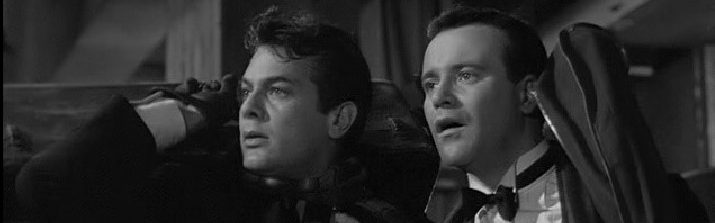
“The Caine Mutiny” (1954) starring Humphrey Bogart, Jose Ferrer, Van Johnson, & Fred MacMurray

When a U.S. Naval captain shows signs of mental instability that jeopardizes the ship, the first officer is urged to consider relieving him of command. -Synopsis

During WWII, the crew of a ship in the Pacific fleet experiences something unlike any event experienced by the US Navy before. The ship’s captain, Lt. Cmdr. Queeg (Humphrey Bogart), is removed from command by his Executive Officer, Lt. Maryk (Van Johnson), in an act of mutiny. As the trial of the mutineers unfolds, we realize that Queeg is mentally unstable. The Navy must decide: Was the Caine mutiny a criminal act, or was it an act of courage to save a ship from destruction? If you’re a fan of A Few Good Men (1992) and/or Crimson Tide (1995), then you should check out this classic film.

As one viewer noted: “in the 1950’s, films about the problems that you encounter during wartime (that have nothing to do with the enemy itself) began to appear.” WWII threw all kinds of people together; here we find career Navy, along w/ the other men drafted into the service b/c of war (disrupting their plans, BUT they had to make the best of it). Queeg is a petty jerk everybody ends up hating; he’s a compulsive authoritarian who sticks to the minute details of the rules (to the detriment of the ship). This film received 7 Oscar noms, incl. one for Bogie. His performance in the (climactic) courtroom scene even captivated the crew; after filming was done, they burst into applause!

A romantic subplot which frames the story w/ a young couple (played by newbies Robert Francis and May Wynn) distracts attention from the real story. I’m sure this was written to appeal to women and younger viewers; too bad it wasn’t effective. Sadly, Francis (who plays college grad/pampered son- Ensign Keith) had an untimely death about a year after this movie was released! I’m usually NOT impressed by Johnson, BUT this role suits him V well. I recently learned that Johnson was one of the (closeted) gay stars from the “golden age of Hollywood.” The actor I most enjoyed watching (aside from Bogie) was MacMurray; he plays Lt. Keefer (a writer in civilian life/reluctant naval officer). As the defendant’s assigned lawyer, Lt. Greenwald (Ferrer), gets to show his stuff in the last 30 mins. of the film; being recently injured, he is (finally) able to practice law. Lt. Cmdr. Challee (E.G Marshall- a prolific character actor) is a worthy counterpoint for Greenwald, as he is an experienced lawyer/no-nonsense proponent of Naval protocol.

[1] Having served in the U.S. Navy for 32 years, I can accurately state that many of the characters and situations depicted in Wouk’s book and in the film are all very real...

[2] The Caine Mutiny works well on so many levels. It is a great insight into navy life, a first rate legal drama, and an unforgettable character study. […]

Bogart spectacularly conveys the sheer complexity of his character: the quirks, the devotion to duty, the demand for perfection, the refusal to accept his own fallibility. 

[3] Bogart is brilliant, giving the greatest performance of his career, his quirky mannerisms and tortured demeanor contrasting starkly with his usual roles. MacMurray is superb as the glib slippery novelist who must eventually deal with his own cowardice, more damning than Queeg’s because of his intelligence and insight.

-Excerpts from IMDb reviews