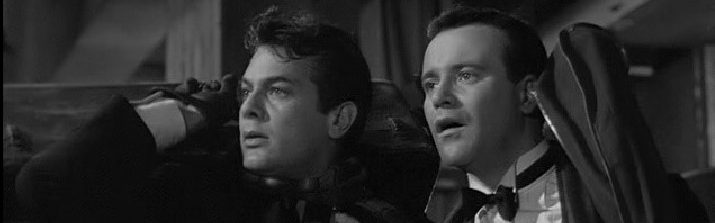
Two Early Films of Stanley Kubrick: “The Killing” (1956) & “Paths of Glory” (1957)

The Killing (1956) starring Sterling Hayden, Vince Edwards, Jay C. Flippen, Marie Windsor, Elisha Cook Jr, Joe Sawyer, Timothy Carey, & Coleen Gray

None of these men are criminals in the usual sense. They’ve all got jobs. They all live seemingly normal, decent lives. But, they’ve got their problems and they’ve all got a little larceny in ’em. -Johnny explains re: his team

After being released from a 5 yr. stint in prison, Johnny Clay (Hayden), has assembled a five man team, incl. two insiders, to carry out a $2M heist at Lansdowne Racetrack. Besides Johnny, none of the men are criminals in the usual sense. He has also hired two men (external to the team) for a flat fee; these men won’t know re: the bigger plan. Each of the five men has a specific reason for wanting his share of the money. Johnny wants to marry his long-time girlfriend Fay (Gray). Mike (Sawyer), a bartender, wants better healthcare for his sick wife. A cashier- George (Cook Jr.)- wants to make his cold/sarcastic wife- Sherry (Windsor)- happy.

I know you like a book. You’re a no good, nosy little tramp. You’d sell out your own mother for a piece of fudge; but, you’re smart along with it. Smart enough to know when to sail and when to sit tight and you know you better sit tight in this case. …You got great big dollar sign there, where most women have a heart. -Johnny sizes up Sherry

The total budget for the film was only $320,000; United Artists provided $200,000 and the rest was raised by producer James B. Harris. Initial test screenings were poor; the non-linear structure was the main problem, so Kubrick (just 27 y.o.) edited the film in a linear fashion (making the film even more confusing). In the end, it was released in its original form, and is often cited as being an influence on Quentin Tarantino and Christopher Nolan. Kubrick wrote a script outline, then asked Jim Thompson to add the dialogue. The narration was added by the studio; Kubrick hated the idea. The film wasn’t marketed much by United Artists, premiering as the second half of a double feature. However, Kubrick (working for the first time w/ a professional crew) impressed Kirk Douglas  (who soon hired him for Paths of Glory).

I read praise re: this movie recently (on Twitter and Facebook); it’s notable in the genre of film noir. The pacing and editing are very well-done. This is one of the first films to use natural lighting (EX: lamps) instead of studio lights, adding to its realism. There are no good/moral/heroic characters- quite rare for a ’50s film. The film had themes and characters identifiable (and recognizable) w/ any period. The supporting characters are almost as interesting as the lead.

Paths of Glory (1957) starring Kirk Douglas, Ralph Meeker, Adolphe Menjou, George Macready, Wayne Morris, Joe Turkel, & Timothy Carey

After refusing to attack an enemy position, a general accuses the soldiers of cowardice and their commanding officer must defend them. -Synopsis

Patriotism is the last refuge of the scoundrel. -Col. Dax describes Gen. Mireau’s (a line attributed to Samuel Johnson)

[1] It will really make you question things about our troubled, convoluted world and how things are to often immorally and inhumanly run all in the sick name of greed and destructive power. Not too lovely, for the director pulls no punches. This film really has grown more profound (and currently pertinent) since its initial release.

[2] Menjou and Macready portray two different military types. The arrogant Macready as vs. the very sly Menjou. Not very admirable either of them. Menjou was not very popular at this time in Hollywood because of the blacklist. He favored it very much, his politics were of the extreme right wing. Nevertheless he was a brilliant actor and never better than in this film, one of his last.

-Excerpts from IMDB reviews

Kubrick (then only 28 y.o.) purchased the film rights to Humphrey Cobb’s novel for $10,000. He approached Douglas with the script who fell in love with it, saying: “Stanley, I don’t think this picture will ever make a nickel, but we have to make it.” The film was not a success at the box office. The young director, who became known for his perfectionism, made Menjou (a veteran actor), do the same scene 17 times! Six hundred German policemen were hired as extras to play the French troops, while six cameras tracked the attack, recording their deaths. You see Kubrick’s trademark- the attention to the composition of shots (reflecting his background as a photographer).

The film is set in WWI amidst the incredibly destructive and futile trench warfare between France and Germany. Colonel Dax (Douglas) is ordered to make an impossible assault on a heavily-fortified enemy position. The only reason this charge is being made is that Gen. Mireau (Macready) believes that capturing the position will earn him a promotion. When the assault doesn’t happen b/c of heavy enemy bombardment, Gen. Mireau is infuriated and demands that three men be arbitrarily chosen to stand trial for cowardice (punishable by death). Col. Dax defends these men at their court-martial.

One memorable scene is where a soldier is nervously rambling to his buddy: “Most guys say that if they got shot they’d want to die quick. So what does that tell you? It means there not afraid of getting killed, they’re afraid of getting hurt. I think if you’re gonna get shot and live, it’s best to get shot in the rear than in the head. Why? Because in the rear its just meat, but the head, that’s pure bone. Can you imagine what it’s like for a bullet to rip through pure bone?” This dark humor helps show the insanity of their situation.

There is great use of irony in the film. The title comes from a poem by Thomas Gray called Elegy In a Country Churchyard where he noted that the paths of glory lead but to the grave. In the end, no one finds glory; Col. Dax loses the fight and turns down a promotion (b/c of his disgust for the army). Gen. Mireau is found out and court-marshalled. Churchill said that the film was a highly accurate depiction of trench warfare and the sometimes misguided workings of the military mind.

“Seventh Heaven” (1937) starring James Stewart & Simone Simon

James Stewart is superb as Chico. He’s awkward, gruff, reluctant to get involved with other people…

It’s as if Stewart’s star quality is irrepressible. It’s as if his personal good character comes across better than the script can tell...

-Excerpts from IMDB reviews

This was James Stewart’s first film in 1937; he was loaned out from MGM (the studio to which he was contracted) to 20th Century Fox. This is a remake of a silent classic that starred Charles Farrell and Janet Gaynor (who won the first Best Actress Oscar). It was based on a play by Austin Strong that ran for 704 performances on Broadway (1922-1924). Some are going to think it’s odd that Stewart is playing a Frenchman, but it was common for American actors then not to attempt accents when playing foreign parts. I came across this movie on YouTube; it’s in the public domain.

In pre-WWI Paris, Chico (a late 20s Stewart) is sewer worker and atheist b/c his prayers were not answered. He wanted a better job and a beautiful, golden-haired wife. Though disappointed w/ his lot, Chico continues to do the right thing, but wonders why. A young woman, Diane (Simone Simon), is working for her abusive sister (a madam) in a small tavern (until she throws wine at a customer who violently kissed her). When that customer threatens to have the police close the tavern, Diane’s sister beats her all the way out to the street! Chico pops out of the sewer and saves her; he even claims that she is his wife when a policeman comes by. Several colorful characters join in the film w/ this pair, as they pretend to be married while waiting for the police to verify their claim. Chico’s flat is on the 7th (top) floor of the apt. building, hence the title.

In the late 30’s to early 40’s, Simon was a wanted actress by the studios. She’s petite, bouncy-haired, and adorable (reminding me of a more mature Shirley Temple). In 1936, Darryl F. Zanuck signed Simon to a contract at 20th Century Fox. She was launched with an expensive publicity campaign which accentuated her European allure, esp. her pout. Problems surfaced re: her command of English and also her limited singing skills. Dissatisfied w/ the roles she was given, she returned to France for a time. During the production of the cult classic Cat People (1942), Simon was under FBI surveillance (b/c of her relationship w/ a Russian MI-5 spy)!

“The Strange Woman” (1946) starring Hedy Lamarr

Bored with being a film star, Hedy became an accomplished amateur scientist, designing in the early 1940’s the basics of spread spectrum and frequency hopping for radio waves – a concept embodied in every wi-fi and cell phone in use today.

…I feel like the writers read Jane Eyre and Gone with the Wind in the same sitting and said “let’s combine the two”. FYI “Strange” was the term used for “adulteress women” back in the day.

I really see this movie as about a woman who learns that she can “pretend” her way into being a better person. She may seem sociopathic or narcissistic to some, but she is desperate to survive and thrive in a world where she has no education, no money, and only her looks and charm in a rough land.

-Excerpts from reviews on Amazon

I came across this film from a Facebook group; it is in the public domain (as are most films directed by Edgar G. Ulmer). It has a mix of historical melodrama, film noir, and feminism. In 1824 in the port city of Bangor, Maine, Jenny Hagar grows up w/o the love and guidance of her mother (who left her and her drunken/violent father). As a girl, she tries to drown her friend, Ephraim, but then saves him (while other kids look on in wonder). A wealthy local man, Judge Saladine, stops his carriage upon seeing this commotion. His young daughter, Meg, asks if Jenny can go to boarding school w/ her; the judge considers it for a moment, then says Jenny can come work/live in his household. Jenny’s father, Tim (Dennis Hoey), admits that he’s not equipped to raise a child properly. However, Jenny turns down the offer. She demonstrates both her anger at the inequity of her circumstances and her determination to rise by her bootstraps. Jenny tells her father not to worry, b/c “I’ll grow up to be beautiful!” Douglas Sirk (uncredited) directed the opening sequence.

Men like me… and it’s men that have the money in this world! -Jenny declares to her father

After her father hears of Jenny (Hedy Lamarr) walking out w/ a young sailor, he beats her so roughly that she runs to the richest man in town. The owner of several businesses, Isaiah Poster (Gene Lockhart), sent Ephraim (his son) away to college to keep him away from Jenny. After Jenny is cleaned up by his housekeeper, Mr. Poster marries Jenny that same night! He discussed the matter of her safety w/ Judge Saladine (Alan Napier) and the town pastor, Rev. Thatcher (Moroni Olson). Napier would later become famous as Alfred the Butler, in the 1960s series- Batman.

It wasn’t by knowing how to set a table that Cleopatra got along. -Jenny comments to her friend Meg

Jenny pledges a generous amount to the church, earning the respect of her neighbors. She starts doing charity work in the community, visiting those in need w/ food and kind words. Jenny remembers where she came from and she means to do something about those she left behind. When Epraim (Louis Hayward) returns home, he’s still deeply in love w/ Jenny, and she encourages his attentions. Mr. Poster is eager to have his son gone. After her husband falls ill, Jenny nurses him herself. Mr. Poster recovers and other town leaders come to him for help w/ a violent riot. Jenny is so concerned for her older friend, Lena (June Storey), that she takes her in after her tavern is burned down. Unlike Scarlett in Gone With the Wind, Jenny doesn’t care for propriety; she despises it, recognizing that its standards are applied far more strictly to women than men. Some of Mr. Poster’s lumbermen are called in from the hills to serve as a police force. Jenny becomes infatuated w/ one of the men; he is Meg’s (Hillary Brooke) fiance, John Evered (George Sanders).

There are similarities between Jenny Hager and Scarlett O’Hara, but Jenny’s intentions and the root of her flaws are much darker and more mysterious.

So often in films, femme fatales are portrayed to have no conscience, no sense of compassion for others, and yet Jenny does.

…Ulmer has crafted a moody and daring picture that strikes devilish notes without banging the drum too loudly. Striking scenes and imagery are many…

-Excerpts from IMDB reviews

“Spartacus” (1960) starring Kirk Douglas, Laurence Olivier, Charles Laughton, Peter Ustinov, Jean Simmons, & Tony Curtis

There is so much cool BTS info (trivia) re: this film! Kirk Douglas (who died at age 103 this month) wanted to play the title hero in Ben-Hur (1959), but director William Wyler wanted Charlton Heston in the role. Douglas was offered the antagonist role of Messala, which was eventually given to Stephen Boyd; he didn’t want to play second banana. Later, Douglas admitted that he made Spartacus to show Wyler and his company that he could make a Roman epic also: “That was what spurred me to do it in a childish way, the ‘I’ll show them’ sort of thing.”

In order to get the large number of big stars in supporting roles, actor/co-producer Douglas showed each a different script (written by the blacklisted Dalton Trumbo) in which their character was emphasized. Stanley Kubrick (known for his perfectionism, vision, and difficult personality) was brought in as director after Douglas (a real-life tough guy) had a falling out w/ the original director, Anthony Mann. According to actor Sir Peter Ustinov, the salt mines sequence was the only footage shot by Mann. In his autobiography, Douglas wrote that he replaced Mann b/c he felt he was “too docile,” esp. for the powerful actors dominating the cast. “He seemed scared of the scope of the picture.”

Kubrick (then only 31 y.o.) felt the script was full of moralizing; he wanted more focus on the Romans. He also complained to Trumbo and that the character Spartacus had no faults nor quirks, so was interchangeable w/ any other gladiator. Kubrick thought the “I am Spartacus” scene was “a stupid idea”(and said so in front of cast/crew)! Douglas promptly chewed Kubrick out. The disagreements between Kubrick and Douglas got so bad that the men reportedly went into therapy together.

Kubrick was a professional photographer who had shot some of his previous movies by himself. He did the majority of the cinematography work on Spartacus. When you see the way that Kubrick shot the battle sequences, you’ll be impressed! All the battle scenes were filmed near Madrid w/ 8,000 trained troops from the Spanish army (serving as Roman infantry). Kubrick directed the armies from the top of specially constructed towers. He later cut all but one of the gory battle scenes (b/c of negative reactions at previews).

A good body with a dull brain is as cheap as life itself. -Batiatus explains while examining the slaves in the salt mines

Kubrick spent $40,000 on the 10+ acre gladiator camp set. On the side of the set that bordered the freeway, a 125-foot asbestos curtain was erected in order to film the burning of the camp, which was organized w/ collaboration from the LAPD and Fire Department. 5,000 uniforms and seven tons of armor were borrowed from Italian museums, and every one of Hollywood’s 187 stuntmen was trained in the gladiatorial rituals of combat to the death. Modern sources note that this production used 10,500 people- wow! Richard Farnsworth (who moved into acting after 30+ yrs as a stuntman) and five other stuntmen worked for the entire filming; they doubled as salt mine slaves, gladiators, and generals in the slave army.

Gladiators don’t make friends. If we’re ever matched in the arena together, I have to kill you. -Draba tells Spartacus when he first arrives at the gladiator school run by Batiatus

This movie parallels ’50s American history, particularly the House Un-American Activities Committee (HUAC) hearings, where witnesses were ordered to “name names” of supposed Communist sympathizers. This closely resembles the climactic (“I am Spartacus”) scene; Howard Fast was jailed for his refusal to testify and wrote the novel (Spartacus) while in prison. This film also has something to say re: race/segregation/civil rights, as I noticed on this viewing. The best fighter owned by Batiatus (Peter Ustinov)- Draba (Woody Strode, who is black)- sacrifices himself by choosing to attack Crassus (Laurence Olivier), rather than kill Spartacus. Not only is Draba the tallest and most handsome warrior, he projects a lot of dignity in his few scenes. There is no differentiation between the slaves of different races who train w/in the gladiator school and- later- serve in the army of Spartacus.

Who wants to fight? An animal can learn to fight. But to say beautiful things, and to make people believe them… -Spartacus tells Varinia (after listening to a story told by Antoninus)

Ingrid Bergman was one of several actresses who rejected the role of Varinia. Sabine Bethmann was then cast, but when Kubrick arrived, he fired her and offered the part to Jean Simmons. In the 1988 interview on NPR’s Fresh Air, Douglas explained to host Terry Gross that he was reluctant (at first) to have Simmons (who is English) portray Spartacus’ love interest. He had cast the English actors as aristocratic Romans, b/c he felt they “had a more elegant pattern of speech.” He explained: “All the slaves, like myself, were Americans… it’s just that Americans have a rougher speech pattern.” During the long shoot, Curtis allegedly asked Simmons, “Who do I have to f*ck to get off this film?” Simmons may have shouted back, “When you find out, let me know.”

I thought Simmons and Douglas had strong chemistry, so you can believe them as a couple. As w/ great actors of any time/place, the acting comes from the eyes; you don’t need dialogue to express yourself. As slaves who fall in love, Varinia and Sparticus don’t have the luxury of speech or much time alone. Others in the household notice that they care for each other, so try to put a stop to it. When they are suddenly reunited, they laugh (w/ a lot of joy) and embrace as free individuals. Of course, their relationship made me think of how life might’ve been like in the time of slavery in US.

My taste includes both snails and oysters. -Crassus tells Antoninus

Sir Laurence Olivier gave Tony Curtis tips on acting to improve his performance; Curtis gave Olivier tips on bodybuilding to improve his physique. The original version included a scene where Crassus attempts to seduce his body slave, the young Sicilian- Antoninus (Curtis). The Production Code Administration and the Legion of Decency both objected to the “oysters or snails” scene seen in the 1991 restoration. Since the soundtrack had been lost, the dialogue had to be dubbed. Curtis was able to redo his lines, but Olivier had died. Dame Joan Plowright, Olivier’s widow, remembered that Sir Anthony Hopkins could do a dead-on impression of her husband. Hopkins agreed to voice Olivier’s lines in that scene (and it’s seamless); he is thanked in the credits for the restored version.

You and I have a tendency towards corpulence. Corpulence makes a man reasonable, pleasant and phlegmatic. Have you noticed the nastiest of tyrants are invariably thin? – Gracchus comments to Batiatus

I liked seeing the evil side of Olivier; Crassus was very convincing as a powerful/tough/smart villain w/ a hint of insecurity. You buy him as a senator and as a soldier, unlike his wimpy brother-in-law Glabrus (John Dall). He is best-known as the villain in Hitchcock’s Rope; here Dall portrays an inept leader of the Roman forces. A lot of the light/humorous moments were given to Batiatus (Ustinov), the wimpy slave peddler who is a follower of the powerful senator, Gracchus (Charles Laughton). When Crassus and his family come for a visit, Batiatus rushes to cover up the bust of Gracchus. As w/ Olivier, Laughton gives gravitas to his character, but also humor. When Batiatus comments on the many beautiful women in Gracchus’ household, the older man laughs and comments: “Since when are women a vice?” Gracchus is considered eccentric (for that time/society), b/c he is a lifelong bachelor; he explains that away by saying he “holds the institution of marriage in too high a regard.” I almost forgot that the (also very handsome) John Gavin portrays Julius Caesar; he doesn’t get as much of a role as Curtis. Both Gavin and Curtis have shirtless scenes- why not!? Gavin co-starred in Hitchcock’s Psycho (also released in 1960).

“Planet of the Apes” (1968) starring Charlton Heston, Roddy McDowell, Kim Hunter, & Maurice Evans

It raises a lot of questions about our modern day society without letting social commentaries get in the way of the drama and action.

The movie based on this book [La planet de singes by Pierre Boulle] is an “Americanized” adaptation of it. Rod Serling did the first drafts of the screenplay, simplifying the plot by fitting it into the mold of his “Twilight Zone” TV series and introducing an anti-nuclear war theme not present in the Boulle novel.

Pierre Boulle raises such issues as balance of power, racism, the role of government, and evolution… 

The film is philosophical, creative, absorbing and scary. Excellent commentary on religion and just about everything else.

-Excerpts from comments on IMDB

This movie tells the story of George Taylor (Charlton Heston), when he and his fellow astronauts find themselves stranded on a seemingly unknown planet. It seems to have no life. After travelling across a desert, they discover plenty of life (incl. apes that are human-like and humans that are ape-like). The (orange) orangutans are the leaders; the (grayish) chimpanzees are intellectuals and technicians; the (black) gorillas are guards/police (or do grunt work). Taylor is shot in the neck rendering him unable to speak. He is taken to a human-ape study lab, where he meets Zira (Kim Hunter), a chimpanzee scientist. She notices that Taylor’s intelligence goes far beyond that of any other human she has seen; she encourages him to speak. However, the orangutan leader, Dr. Zaius (Maurice Evans), sneers at Zira’s and her fiancé Cornelius’ (Roddy McDowall) belief in any human intelligence. He (and his council) won’t listen to reason. Despite Cornelius’ conflicted feelings towards Taylor, he agrees to help prove his intelligence.

As many critics and fans have noted, Heston basically played himself. This role is not unlike those he played before; he is often shirtless, tan, and bearded. Heston uses his physicality, as is needed for a action hero role. There are few moments (w/ Nova, the young woman who will be his “mate”) where his vulnerable side comes out. Zira and Cornelius are quite interesting characters. Hunter’s portrayal of Zira was considered very powerful by many viewers; she is the most developed character in the film. Hunter manages to make Zira what she was meant to be, more human then ape. The intelligent and curious Cornelius (Roddy McDowell) has a bit of a rivalry w/ Taylor (as they constantly challenge each other like males of any species).

Planet of the Apes is considered a pivotal work of American cinema. Modern viewers will be surprised (not only by the ending), but by the fine camera work, unique soundtrack (by Jerry Goldsmith), makeup (by John Chambers), and good performances. After the film’s success, there were sequels, a TV series, a remake and a prequel (2011). There were also toys/models, comics, cartoons, and T-shirts to sell. I think even those who avoid the sci-fi genre should check it out! The Simpsons (my younger brother was a big fan) did a parody of this film, so you know it left it’s mark on pop culture.