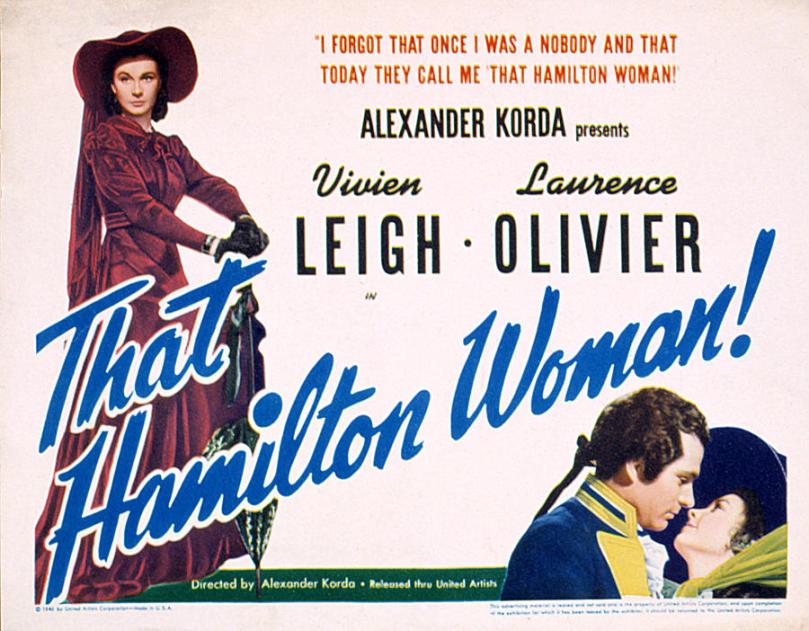
That Hamilton Woman (1941) starring Vivien Leigh & Laurence Olivier

that-hamilton-woman-poster.jpg
A promotional poster for the film

Indeed, it’s difficult to separate the “real Olivier” and the “real Leigh” from their parts here—and the parts that had made them who they now were: he the more conservative and guilt-ridden son of a parson, she the reckless flibbertigibbet who nevertheless had a shrewd eye for power and manipulation. 

-Molly Haskell, The Criterion Collection

That-Hamilton-Woman-1941-closeup
Closeup of Emma (Vivien Leigh) and Nelson (Laurence Olivier)

It was 1940, Britain was in peril. Hoping to enlist the Americans in the fight against Hitler, producer/director Alexander Korda hatched the idea for this film. Cables went back and forth between London and Hollywood (where the soon-to-be Mr. and Mrs. Olivier were living temporarily, awaiting the finalization of their respective divorces). Korda had both actors under contract; he offered them bonuses, as well as the opportunity to recoup some of the money lost after their failed stage production of Romeo and Juliet. The production had to be done quickly- five weeks. Churchill would later say that it was his favorite movie.

So, your nephew sent me to you with his paintings and the bric-à-brac because he’s broke! -Emma exclaims to Sir William Hamilton 

A housemaid turned wannabe fiance to one British gentleman, Emma Hart (Leigh), is suddenly shipped off to Sir William Hamilton (Alan Mowbray). He is a middle-aged widower, even-tempered, and a collector of great works of art. Sir William admires beauty. As he wishes, Emma learns languages, singing, dancing, etc. Her doting mother, Mrs. Cardogan-Lyon (Sara Allgood), is her loyal companion through it all. In time, Sir William marries Emma (making an honest woman out of her); they live in a palatial seaside home in Naples, since he is Ambassador to Italy. Though she could not be presented at court in England, the clever/vivacious Emma becomes a close confidante of the Queen of Naples. 

That Hamilton Woman_1st_mtg.png
Nelson (Olivier) and Emma (Leigh) meet for the first time

One day, a British battleship arrives in Naples, and Cmdr. Horatio Nelson (Olivier) meets with Sir William re: docking and affairs of state. Emma bursts in on them, worried about a party she is planning. Her husband doesn’t mind, BUT Nelson insists on speaking to the ambassador in private. Emma starts to wonder if her life of is frivolous.

That-Hamilton-Woma_court.jpg
Emma (Leigh) and Nelson (Olivier) at the opera

They told us of your victories but not of the price you paid! -Emma exclaims to Nelson (after seeing his wounds)

Five years later, Emma meets Nelson (now a lord, thanks to his MANY victories in the Napoleonic Wars) again. She is glad to see him alive, BUT also shocked by the fact that he has lost the sight in one eye and an arm. Emma wants to help, she tells Nelson, and uses her influence w/ the queen to get more troops for the war. They talk, plan, attend plays, and become close friends. Rumors start to spread…

[1] …when it comes to the cinema, her acting technique on screen is every bit as expert as Laurence Olivier’s. (In fact, Olivier himself admitted this when he saw her as Scarlett O’Hara.)

[2] Vivien Leigh and Laurence Olivier make a terrific pair and of course have great chemistry together, which really complements this true story. The actors give great performances, and I think the film really tries hard not judge the actions of Lady Hamilton and Lord Nelson which caused a tremendous scandal in their own time. Anyone who likes historical drama and wants to escape into another world for a few hours is bound to enjoy.

[3] Although the film was made by Hollywood, it is British to its core and fiercely patriotic. It was intended as an anti-Nazi propaganda piece… The Nazi allegory is most clearly seen in the scene when Sir William explains to his wife that the British Empire is periodically attacked by military adventurers, in Nelson’s line “We are alone but unafraid” and his speech denouncing the idea of negotiating with dictators… I imagine that it was quite a stirring film for the Britons of the day. 


-Various excerpts from IMDB reviews

The Night of the Hunter (1955) starring Robert Mitchum, Shelley Winters, & Lillian Gish


The_Night_of_the_Hunter_poster
A poster of the film

[1] Great art transcends time, but The Night of the Hunter has not lost an iota of relevance (or quality).

[2] Whoa. Lighting, framing, performances, all so unsettling…

[3] Robert Mitchum is fantastic, but Lilian Gish steals it for me.

#TCMParty (from recent live-tweeting session)

nightofthehunter
Harry Powell (Robert Mitchum)

A good tree cannot bring forth evil fruit. Neither can a corrupt tree bring forth good fruit. Wherefore by their fruits, ye shall know them. -Rachel Cooper (in the prologue to the film)

I saw this VERY effective (and a BIT scary, even for adults) film for the first time recently on TCM. It was directed by actor Charles Laughton, who hit it out of the ballpark on his first (and only) try. It was a box office failure, perhaps b/c it seems way ahead of its time (as several critics/viewers have written). 

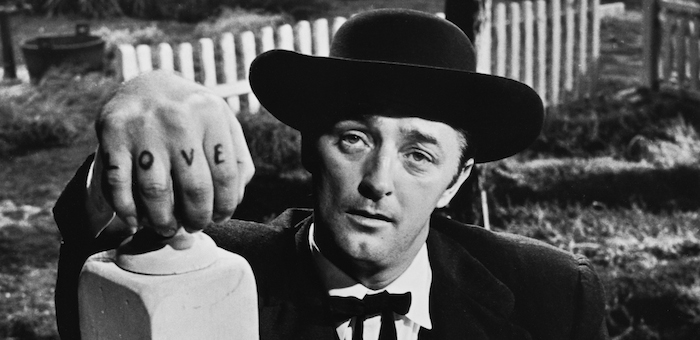
Spike Lee paid homage to this film, which is one of his faves, in Do The Right Thing; Radio Raheem wears love-hate on his knuckles. 

lovehate-dorightthing
Radio Raheem (Do The Right Thing)

[1] Mitchum is tremendous in the title role, his role is larger than life and was also slightly playing with fire in it’s portrayal as a reverend as corrupt or evil. Chapin is really wonderful as young John and has a much better character than some of the others in the cast. Winters is good in her performance.

Lillian Gish is another luminous presence in the film because she projects no-nonsense kindness and sweetness toward the children she takes into her home.

-Excerpt from IMDB review

Later on in life, Mitchum said that Laughton was his favorite director and this was his favorite role. Laughton originally offered the role of Harry Powell to Gary Cooper, who turned it down as being possibly detrimental to his career.

Night-of-the-Hunter-Courting
Harry (Mitchum) talks with Willa (Shelley Winters)

In this parable of good and evil, Harry Powell is the ultimate boogeyman – a relentless, nightmarish force who preys on children and it is even suggested by John that he doesn’t even sleep. …he often casts imposing shadows and is sometimes seen as a lone figure in the fog, almost a mythical force of terror.

-Excerpt from blog post (Plain, Simple Tom Reviews) 

It’s the time of the Great Depression somewhere in the Midwestern U.S. In the process of robbing a bank of $10,000, Ben Harper (Peter Graves) kills two people. Before he is captured, he is able to convince his son, John, and very young daughter, Pearl, not to tell anyone, including their mother, Willa (Shelley Winters), where he hid the money (inside Pearl’s cloth doll). Ben is captured, tried and convicted. Before he is executed, Ben is put in the state penitentiary with a cellmate, Harry Powell (Robert Mitchum), who calls himself a preacher (and dresses as such). However, he is really a con man and murderer, swindling rich/lonely widows before killing them. Harry does whatever he can to find out the location of the $10,000 from Ben, but is unsuccessful. After Ben’s execution, Harry decides that Willa will be his next mark, figuring that someone in the family knows where the money is hidden. Despite vowing not to remarry, Willa ends up being easy prey for Harry’s outward charms. Her gullible older friends/neighbors (The Spoons) help convince her that a husband is a MUST to help raise kids.


Detective Story (1951) starring Kirk Douglas & Eleanor Parker

[1] The writing is a bit too well-structured, almost like clockwork, the characters are a bit too symbolic and easy to categorise. The comic relief kicks in just on schedule. The psychological diagnosis is too precise. And yet, this is one of the greatest films ever made. It has a sense of respect for the totality of life, and makes tragedy almost poetic. 

[2] Kirk Douglas carries the burden of McLeod and makes the tormented policeman painfully believable–it is almost a nonstop, swirling performance… 

[3] The abortion angle of the original play was taken to the screen, partly because of censorship, and partly because the close-up, immediacy of the camera requires rage to be clearly more explained than on the stage…

-Excerpts from various reviews (Amazon & IMDB)

detective story poster.jpg
A poster for the film

Evil’s got a smell of its own. A child could spot it. -McLeod says, before giving some info re: his father/parents’ relationship

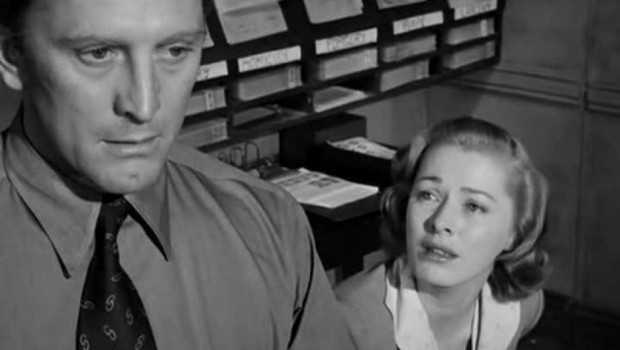
In this film, abortion is sinful, criminal, horrifying (personally and socially)- a tragedy. It appears from different angles: the Dutch abortion doctor (w/ his clever lawyer), the detective’s wife, her ex-boyfriend (who got her pregnant), and eventually, the detective. When Mary (Eleanor Parker) finally tells her husband (Kirk Douglas) about it, his worldview is too black and white to handle it. He calls her a “tramp”- she’s wasn’t expecting that reaction. All that matters is that she was intimate with someone before being married to him. She says she’s leaving him forever. He doesn’t go after her, as his fellow detectives urge. Mary gets her freedom.

detective4-620x350.jpg

Mary (Eleanor Parker) begs and cries, but McCleod (Kirk Douglas) doesn’t see her virtues.

This may be one of the early “typical day” genre- several different stories occurring over one day in the same location, but melded into a whole (as on the TV shows, Hill Street Blues and Barney Miller). A key ongoing side plot involves an unlikely/lovelorn first offender and the younger sister of his former girlfriend. He stole from his employer to win back his (model) girlfriend who has moved on to a different circle. McCleod’s partner, Det. Brody (William Bendix) is more gentle/understanding; this man reminds him of his dead (WWII hero) son.

Oscar nominations were given out for William Wyler’s direction, the screenplay, and for Parker and Lee Grant, lead and supporting actresses respectively. At a little over 20 minutes, Parker’s performance in this movie is the shortest to ever be nominated for a Best Actress Oscar.

I built my whole life on hating my father. All the time he was inside me, laughing. -McLeod finally realizes the truth about his personality 

Since it was impossible to film the movie without portraying the killing of Detective McLeod, so this movie resulted in another amendment to the Production Code. From December 20, 1938 to March 27, 1951, there was a rule forbidding the display of law enforcement officers (EX: detectives, security guards, etc.) dying at the hands of criminals. From March 27, 1951 onward, the Production Code allowed such portrayals, if they were “absolutely necessary to the development of the plot” (as noted in the book The Dame in the Kimono by Leonard Jeff and Jerold Simmons).

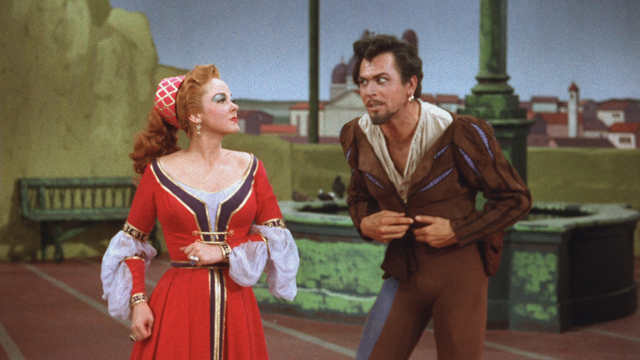
Kiss Me Kate (1953)

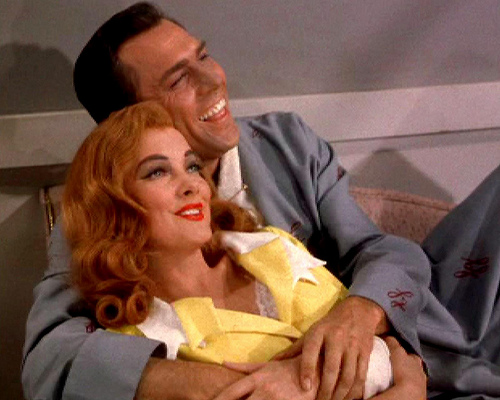
KissMeKate_dressingrm
Lilli (Kathryn Grayson) and Fred (Howard Keel) talk about their past marriage and work in her dressing room.

[1] This is my favorite musical, not for the dancing alone, but it is the best. The dancers, not just Ann Miller and Rall, but Bob Fosse, Bobby Van, and Carol Haney!! What more could any dance fan want? There is always something new to see, no matter how many times you have watched it. The lyrics are magnificent, tricky and intriguing. I will admit that the music is great, but folks, catch the dancing!

[2] Keel, with his big big voice and untrained natural talent, fills the screen (and his tights!) with his masculine presence. He struts, swaggers, and yet shows his vulnerable side believably enough to make us *like* his character, ego or no ego. Grayson… really comes into her own here–she’s excellent as Lilli, swooning at the right moments, strident during the rest, and actually bites out ‘I Hate Men’ with conviction…  I’m also partial to Tommy Rall, whose soaring athletic ability just crackles off the screen. It’s such a thrill to see Miller get matched with someone who can dance circles around most everyone else alongside her. They make the cutest couple in their two numbers together, with the energetic, exuberant dance to ‘Why Can’t You Behave?’ definitely making one of my favourite film dance routines of all time.

-Excerpts from IMDB reviews
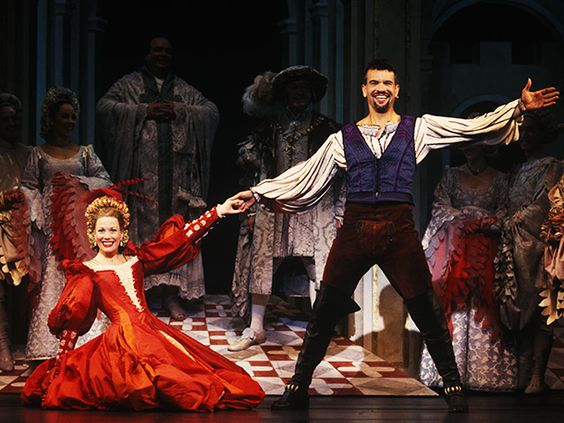
I became a fan of this musical after seeing a version of it on Great Performances (PBS) several years ago; it stars Brian Stokes Mitchell and Marin Mazzie, two VERY well-respected Broadway veterans. I bought the soundtrack (released in 2006). Seriously, WHO can resist Stokes’ voice!? 

KissMeKate_Bdwy_2006.jpg
Marin Mazzie (Lilli/Katharine) and Brian Stokes Mitchell (Fred/Petruchio)

I saw this movie on TCM two weeks ago; it was pretty fun, though NOT as fabulous as the Broadway version. Fred Graham (Howard Keel) and Lilli Vanessi (Kathryn Grayson) are a divorced pair of actors who are brought together by Cole Porter, who has written a musical version of The Taming of the Shrew. Lilli, recently engaged to a Texas oilman, is reluctant to act w/ Fred, who is involved w/ Lois Lane (Ann Miller). It’s obvious that the tap dancing ingenue (Lois) and more mature leading lady (Lilli) resent each other. 

KissMeKate_fight.jpg
Katharine (Kathryn Grayson) and Petruchio (Howard Keel) fighting during the play.

We soon seen that Fred and Lilli act a LOT like the mismatched lovers they play, Petruchio and Katharine. A fight between them on opening night threatens the production. Also, two thugs w/ thick New York accents (who are BIG fans of the theater) think that Fred owes their boss a LOT of money, so insist on staying next to him ALL night. Lois (who is cast as Bianca) is in love w/ another of her co-stars, Bill Calhoun (Tommy Rall), who forged that IOU. 

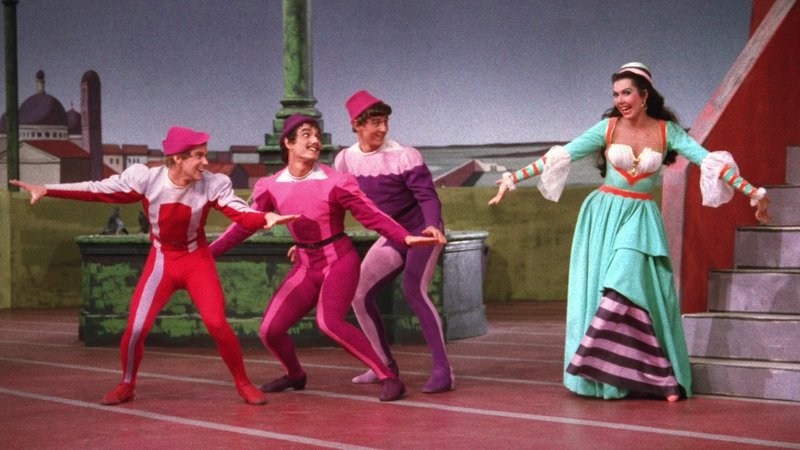
KissMeKate_Bianca_suitors
Three suitors woo Bianca (Ann Miller) during the Tom, Dick, or Harry number.

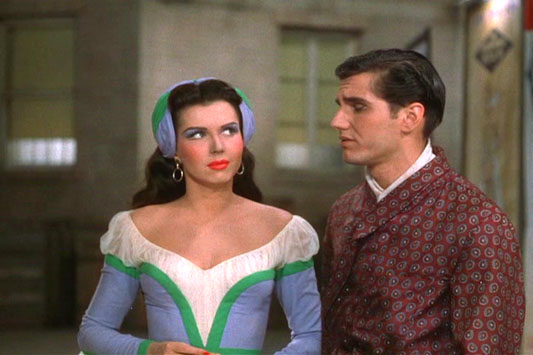
KissMeKate_Bianca_bf
Bianca/Lois (Ann Miller) and Bill (Tommy Rall) talk in the theater’s alley.

…Keenan Wynn and James Whitmore, who get into the play and later get to sing one of Cole Porter’s best satirical numbers and a personal favorite of mine, ‘Brush Up Your Shakespeare.’ It’s their own ode to their theatrical experience and also advice to the lovelorn that if you want to win the mate of your choice, learn the classics so you can wow them with rhetoric. Wynn and Whitmore are priceless.

Excerpt from IMDB review

If you’re a big fan of The Bard, you will definitely enjoy the thugs’ song (Brush Up Your Shakespeare); it’s a combo of high culture and naughty wordplay.

I esp. like Lois’ signature song Always True To You (In My Fashion). Here is the (updated) song from the 2006 Broadway play, sung by Amy Spanger.


Holiday (1938) starring Cary Grant & Katharine Hepburn

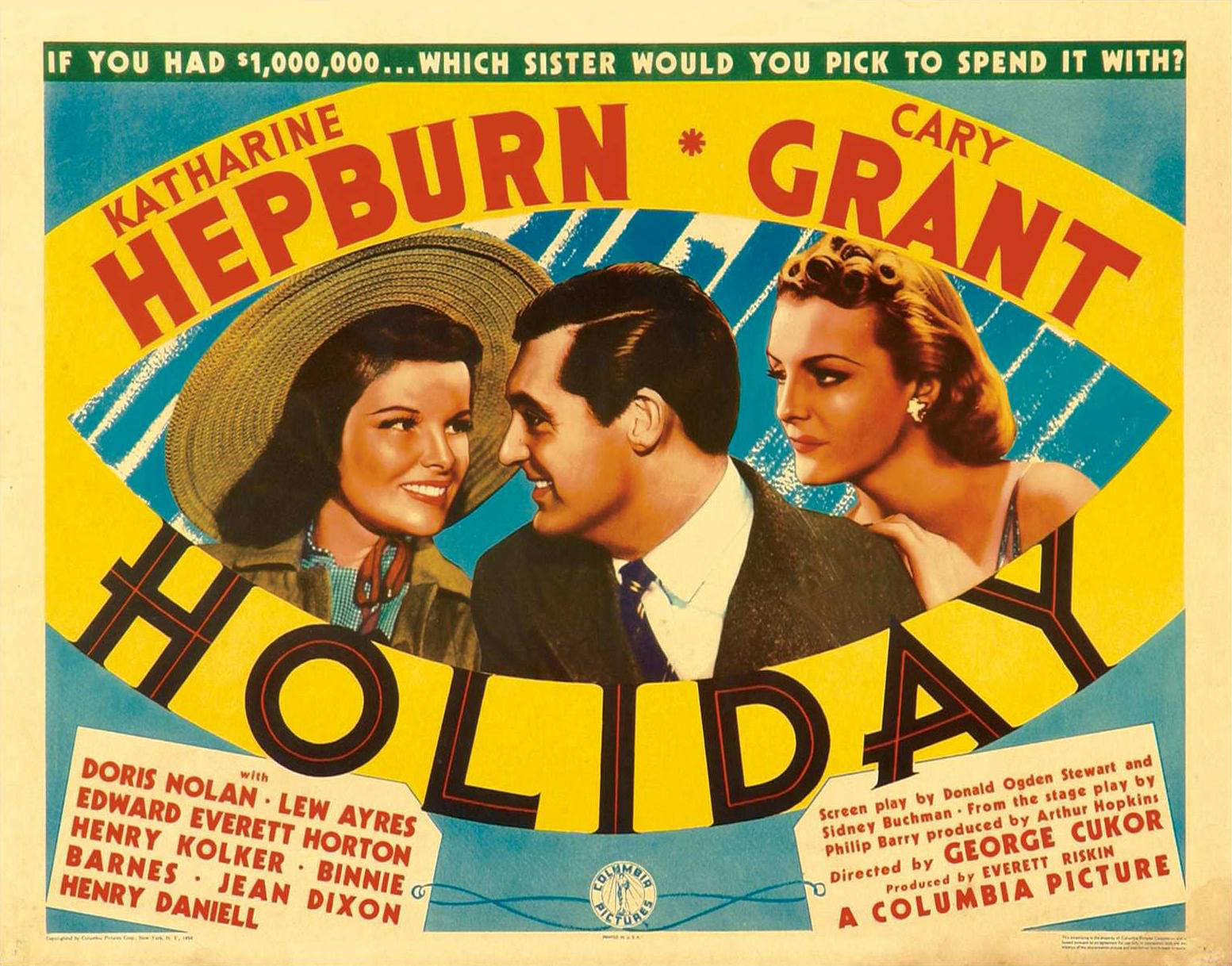
holiday-quad
A poster for the movie.

Set in NYC, this film stars Cary Grant as Johnny Case, a 30 y.o. businessman working at a “financial house.” While he takes a skiing holiday to Lake Placid, he meets Julia Seton (Nolan); the two fall in love (in ONLY 10 days). They get engaged!

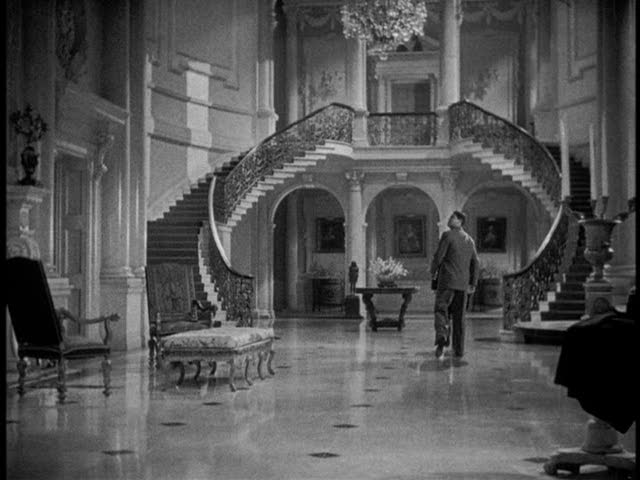
holiday-mansion
Johnny Case (Cary Grant) is amazed by the size of the Seton family’s home.

It turns out that Julia comes from a VERY wealthy/influential family. Johnny is surprised and bemused, BUT then finds himself taken w/ Linda (Katharine Hepburn), Julia’s free-thinking/dramatic older sister and her little brother, Ned (Lew Ayres), a musically-gifted alcoholic. (Linda Seton was loosely based on Gertrude Sanford Legendre, a former débutante who left high society to become a big-game hunter and later spied for the OSS during WWII.) 

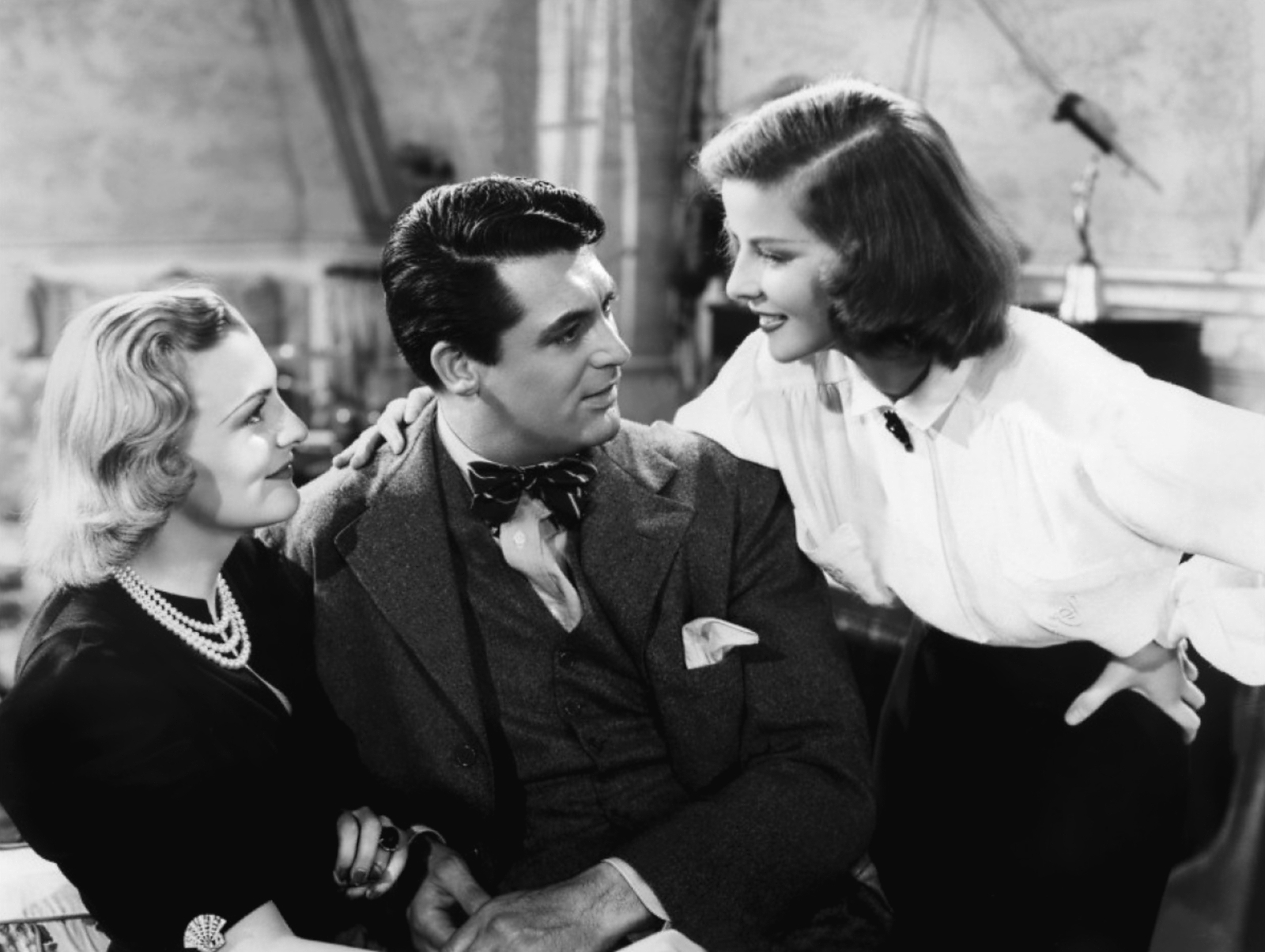
Holiday-trio
Sisters Julia (Doris Nolan) and Linda Seton (Katharine Hepburn) surround Johnny (Cary Grant).

There are a lot of humorous little episodes. I tried to get Father to let me take a nursing course at a hospital. Oh yes, and I almost got arrested trying to help some strikers over in Jersey. Well, how was I to know that Father was on the board of directors at the company? You see, Case, the trouble with me is I never could decide whether I wanted to be Joan of Arc, Florence Nightingale, or John L. Lewis. -Linda talks about her past

It turns out that Julia is NOT that different from her father; at some point you wonder WHAT Johnny saw in her in the first place! Her siblings are discontented with being under their father’s thumb. Mr. Seton is NOT a bad guy, BUT has strong feelings about how things should be done to keep the family on the up and up. 

You’ve got no faith in Johnny, have you, Julia? His little dream may fall flat, you think. Well, so it may, what if it should? There’ll be another. Oh, I’ve got all the faith in the world in Johnny. Whatever he does is all right with me. If he wants to dream for a while, he can dream for a while, and if he wants to come back and sell peanuts, oh, how I’ll believe in those peanuts! -Linda explains, revealing her true feelings for Johnny 

Holiday-party
Johnny (Cary Grant) with his friends, Professor Nick Potter (Edward Everett Horton) and his wife, Susan (Jean Dixon).

[Quoting an imaginary society column] ‘Miss Linda Seton – on New Year’s Eve – entertained a small group of Very Unimportant People.’ -Nick jokes 

In the original play, Nick and Susan Potter are wealthy socialites. Due to the Depression, the plot was altered so that Johnny (“the common man”) would have more ordinary, down-to-earth friends. Johnny’s friends, the Potters, were intellectuals and funny- great combo. They added a LOT of fun to this film! 

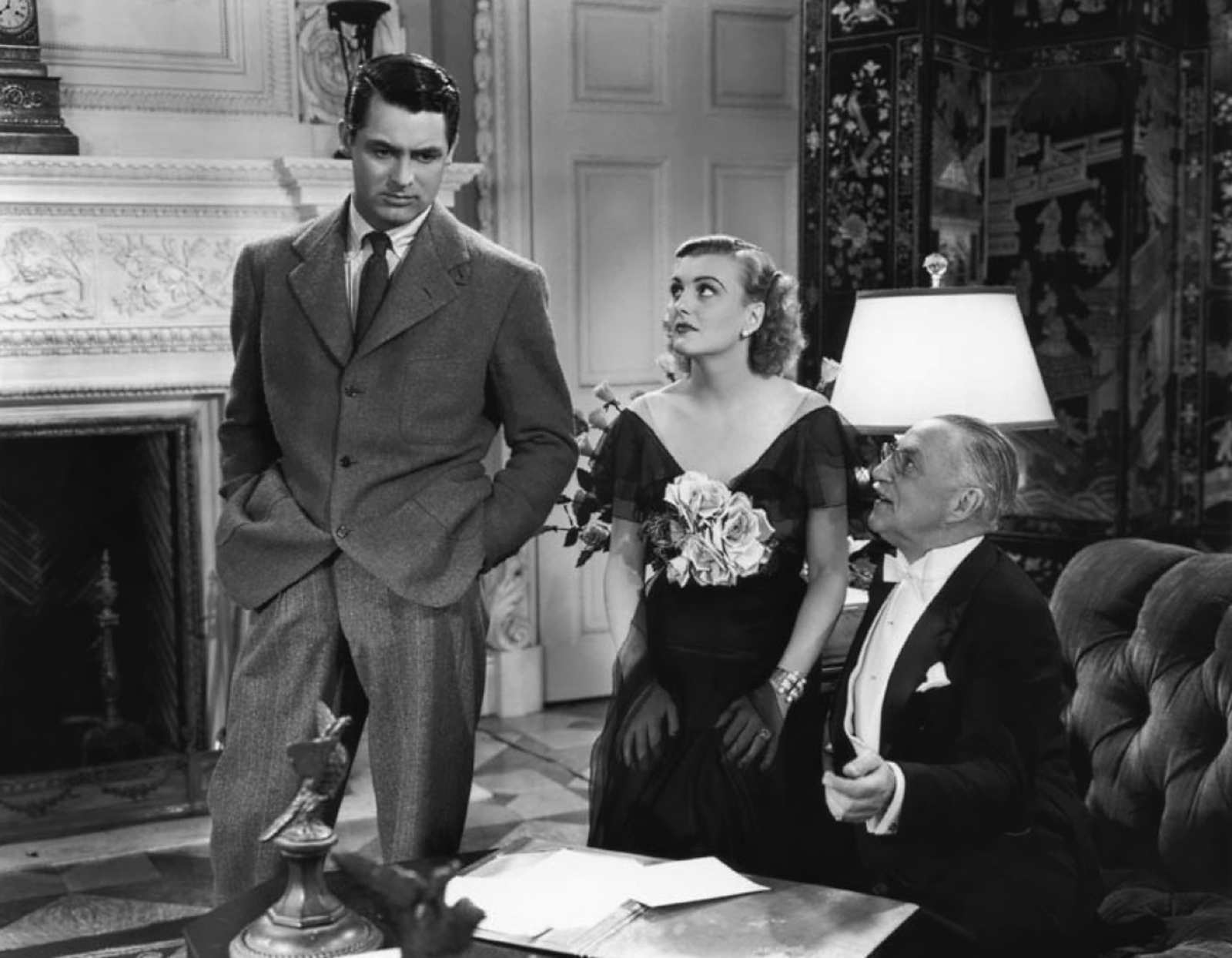
Holiday-4
Johnny (Cary Grant) thinks about his future while his fiancee Julia (Doris Nolan) and her father (Henry Kolker) look on.

[1] Hepburn, clearly the star of this production, acts each scene with an emotion and charm that is almost unheard of in the mainstream cinema of the present. …I found myself becoming so endeared to her character that I probably would have been completely devastated if she didn’t get some sort of happiness in the end, probably one of the highest compliments that I can give to an actor’s performance… He [Grant] is such a fresh and passionate character… 

[2] Cukor takes a lighthearted approach to this story, which keeps it upbeat and entertaining, and he laces it with warmth and humor that’ll give you some laughs and put a smile on your face. But beyond all that, Cukor shows some real insight into human nature and the ways of the world. And it makes this film timeless. 

-Excerpts from IMDB reviews