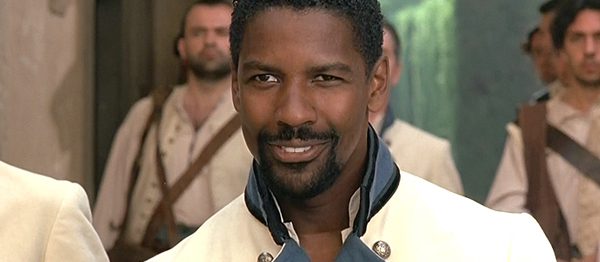
Not as a Stranger (1955) starring Robert Mitchum & Olivia de Havilland

At the opening, Lucas Marsh (Robert Mitchum, one of my favorite actors) is an idealistic intern at a private hospital.  Luke has dreamed of being a doctor since childhood, though he comes from very humble roots (his mother is dead and his father is a drunkard).  His best friend is Alfred Boone (Frank Sinatra in a fine supporting role), the jovial son of a comfortable family who loves chasing women.  Al comments to a classmate that though they all want to be doctors, Luke “wants it more- he has to.”  Luke works as a lab researcher, usually late into the night.
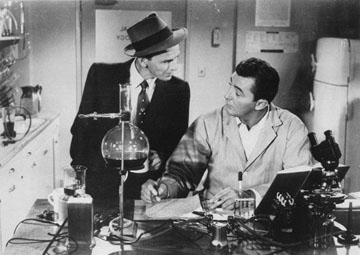
While working, Luke strikes up a friendship with a 1st gen. Swedish-American nurse from Minnesota, Kristen (Olivia de Havilland).  She even arranges it so that he and Al can watch an important surgery.  When Luke’s father spends the money his mother saved for his education, he’s desperate (though he conceals it well).  He gets some help from Al and his teacher, Dr. Aarons (Broderick Crawford), but it’s not enough.  Dr. Aarons, who is Jewish, went through a lot of trouble to become a doctor, and sees great potential in Luke.   
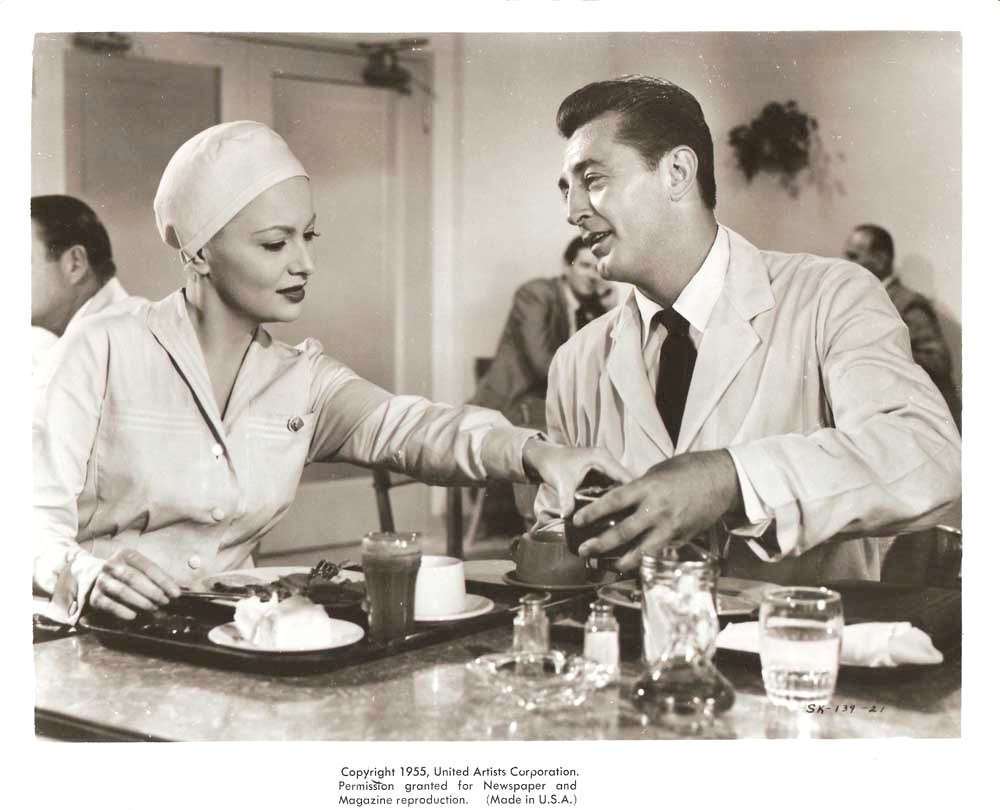
When Kris invites Luke and Al to dine with her friends Bruni and Oley (Harry Morgan from M.A.S.H.), Luke learns that Kris has saved quite a bit of money.   It’s obvious that Kris likes Luke more than a friend, so he asks her out.  (After all, she’s a fine nurse with a “pretty face” and “nice figure.”)  After a few dates, he decides to propose, though Al reminds him that he doesn’t love her.  They nearly come to blows (Luke has a hot temper).  “It’s not like that.  Things are not always black and white,” Luke replies.

They marry and move into her little apartment.  They continue with their respective work; Kris helps Luke prepare for his exams and with his people skills.  (Since he has such high standards, it’s difficult for him to tolerate weakness in others.) 

Marsh, you’re one of the most brilliant students we’ve ever had here.  You’ll be a great physician.  Stop living your life like a Greek tragedy, or you’ll muff it!  -Dr. Aarons
After graduation, the couple move to a small town, where Luke shares a practice with Dr. Runkleman (Charles Bickford), the most experienced doctor in the area.  Dr. Marsh is pleasantly surprised to learn that the older man keeps up with the latest research.  The life of a country doctor is tougher and more tiring than anticipated.  

There is also temptation- a wealthy young widow, Mrs. Lange (Gloria Grahame), summons Dr. Marsh to her home late one night (to check him out).  He’s taken aback by her looks and boldness.  At home, Kris wants to start a family. 

The secret of Robert Mitchum’s success(ful) appeal as an actor was his ability to easily combine tough masculinity and tender vulnerability in one persona, unlike any of his peers (John Wayne, William Holden, Gregory Peck, Charlton Heston).  One felt that Mitchum concentrated more on fully and honestly showing all sides of whatever character that he was playing, even the weak and not-so-tough moments… 

A commentor on YouTube

This film is a must-see for any fan of cinema!  It has well-developed characters, great dialogue, and takes the viewer on a journey.  The editing and pacing are also well done; this is important since the film clocks in at 2 hours and 15 minutes.  (The director is a groundbreaker in the field, Stanley Kramer; he also directed Inherit the Wind, The Defiant Ones, Guess Who’s Coming to Dinner, and many others.)  The ending is fitting and very fulfilling- I got a bit teary-eyed.

Quick opinions of recent views

Black Swan (2010)

We all know the story.  Virginal girl, pure and sweet, trapped in the body of a swan.  She desires freedom but only true love can break the spell.  Her wish is nearly granted in the form of a prince, but before he can declare his love her lustful twin, the black swan, tricks and seduces him.  Devastated the white swan leaps of a cliff killing herself and, in death, finds freedom.

This film was highly hyped when it came out, but I think it’s overrated.  It’s edited well and shot beautifully.  There is an atmosphere of claustrophobia in the film, reflecting the very circumscribed life of the main character, NYC-based ballerina Nina Sayers (Natalie Portman).  It was nice to see veteran actress Barbara Hershey as Nina’s overly-concerned mother.  Too bad not much was done with Winona Ryder’s role.  The meaning of the ending is up to the viewer to decide! 

House of Games (1987)

What I’m talking about comes down to a more basic philosophial principle: Don’t trust nobody.

In David Mamet’s film noir (done in his usual style), respected Chicago psychiatrist/author Margaret Ford (Lindsay Crouse) tries to help a troubled young patient with an IOU.  She’s is drawn into the world of  con man Mike (Joe Mantegna), a smooth/charismatic character who teaches her about “hustling” (through real-world experiences).  Margaret can’t resist the dark side, nor Mike, though she may be be the biggest “patsy” in the game.  

You say I acted atrociously.  Yes.  I did.  I do it for a living.

I recommend this film for Mantegna’s fine performance, as well as for the plot twists.  However, I preferred The Winslow Boy and The Spanish Prisoner (two great Mamet films).     

Please Believe Me (1950)

This film has some nice moments/dialogue, but is pretty uneven.  It takes too long to set up the premise, but that’s not unusual for older films.  Sensible single gal, Alison Kirbe (Deborah Kerr) of London, receives a telegram from Texas, that she has inherited a livestock ranch from an old friend. It is plastered throughout newspapers that Alison has become a rich heiress, and is sailing to the United Slates alone to claim her inheritance.  Smooth-taking gambler Terence (Robert Walker from Strangers on a Train), laid-back playboy Jeremy (Peter Lawford), and Jeremy’s no-nonsense lawyer, Matthew (Mark Stevens) take an interest in Alison aboard the ship.

Rage in Heaven (1941)

I wanted to see this film since a young Ingrid Bergman is in the lead role.  I recommend this film, as does my dad.  Stella (Ingrid Bergman), a refugee/ personal secretary to wealthy English widow Mrs. Monrell, accepts the marriage proposal of her son, Philip (Robert Montgomery).  This is a bit of a surprise since Philip seemed to encourage a relationship between his college  friend, Ward Andrews (George Sanders from All About Eve) and Stella.  After Stella and Philip get married, he assumes the lead management role in the family’s steel business.  Philip’s behavior becomes increasingly erratic, both at home and in the office.  How will Stella, Ward, and those involved in the steelworks cope?

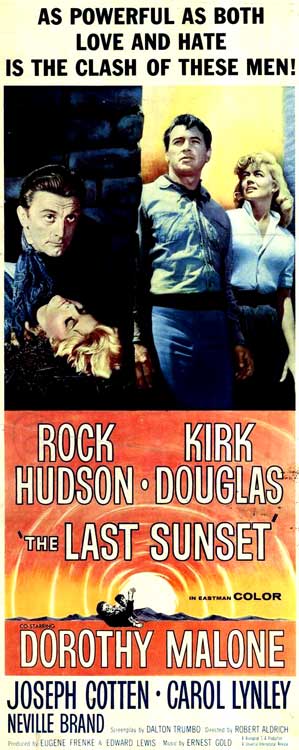
The Last Sunset (1961)

I was flipping through channels a few days ago and happened upon this dramatic Western.  It just caught my attention from the first scene.  A striking man dressed all in black, Brendan O’Malley (Kirk Douglas), rides up to a simple ranch house in the Mexican desert and humbly asks for food and shelter.  From the way they look at each other, we know that there is something going on between him and the lady of the house, Belle Breckenridge (Dorothy Malone), a strong/beautiful woman.  She has a bright/lovely teen daughter, Missy (Carol Lynley), who’s very intrigued by the stranger.

When Mr. Breckenridge (Joseph Cotton, playing against type) comes home, he’s drunk.  The rancher offers O’Malley a job; he needs men (aside from his two Mexican ranch hands) to take his cattle to Texas.  O’Malley says that he can be “the gun” (protect the herd/ladies), but he knows someone who can be a great “trail man.”  He fails to mention that this man is also a marshall, Dana Stribling (Rock Hudson), who has been tracking him for SOME time.

After the drive, O’Malley says he’ll take 1/3 of the herd.  “Oh, and I also plan to take your wife,” he adds nonchalantly.

This film contains unlikely twists and turns.  The characters develop and change over time.  The more traditional handsome man, Hudson, is in the secondary role (the white hat).  I think he does a FINE job w/ his role of the straight-shooter.  Pay attention to the touching scene with Hudson, Lynley, and a baby calf.  But the star is Douglas, who captivates and smolders onscreen (and not just because of his muscles).  He portrays a troubled man full anger, regret, and finally… selflessness.

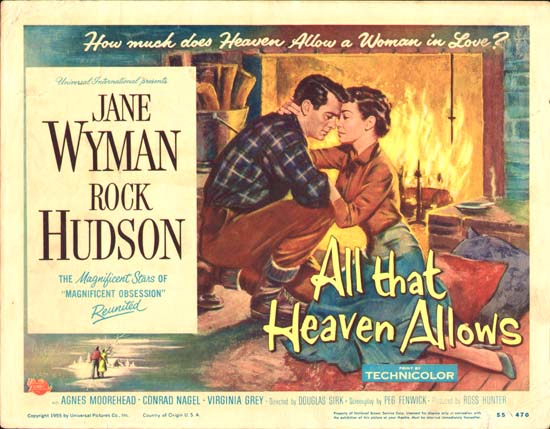
All That Heaven Allows (1955)

Did you see Far From Heaven, the 2002 film starring Julianne Moore, Dennis Haysbert, and Dennis Quaid?  Not only is that film intelligent and sensitive, it harkens back to an era of beautifully-made melodramas.  The director, Todd Haynes, was influenced by the work of Douglas Sirk, the director of All the Heaven Allows, starring Jane Wyman and Rock Hudson, now available on Netflix Instant Play.

Wyman stars as Cary Scott, a widowed mother (somewhere in her 40s) with two grown children living in suburban New York.  Her deep-thinking daughter Kay goes to Princeton and does social work in NYC; she also has a serious boyfriend.  Her jovial son Ned is finishing up college and looking toward launching his career.  The family home is spacious and finely decorated, so we know that the deceased Mr. Scott was a very successful man.

Since her kids pretty much have their own lives, Cary is feeling a bit lonely and wondering what she can do with the rest of her life.  Her best friend and neighbor Sara (Agnes Moorehead; she later co-starred on the TV comedy Bewitched) suggests she get out more to the country club.  Cary does date a bit; she spends time with Harvey, a mild-mannered older man (one of the few single men around).  But she’s still a vibrant woman, so he’s not quite right for her.

Feeling restless, she wonders if she should take up gardening as a hobby.  One lovely Fall day, she invites her handsome younger gardener, Ron Kirby (Hudson), to sit and share some lunch with her.  Ron’s deceased father had cared for the gardens of this community for years, but he has more plans for himself.  They tentatively become friends.  Within one year, Cary and Ron’s lives (and her views) will be profoundly changed by their evolving relationship.

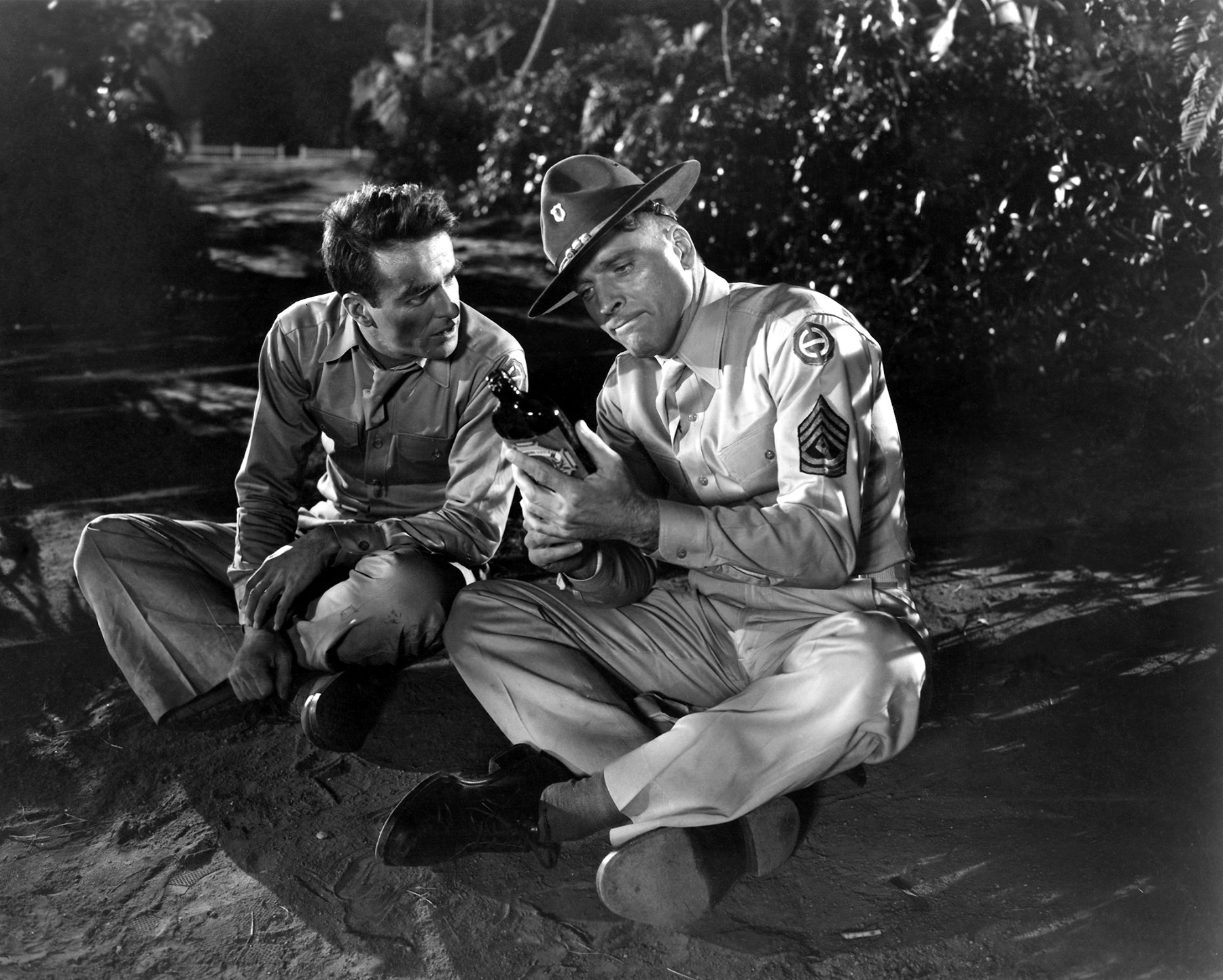
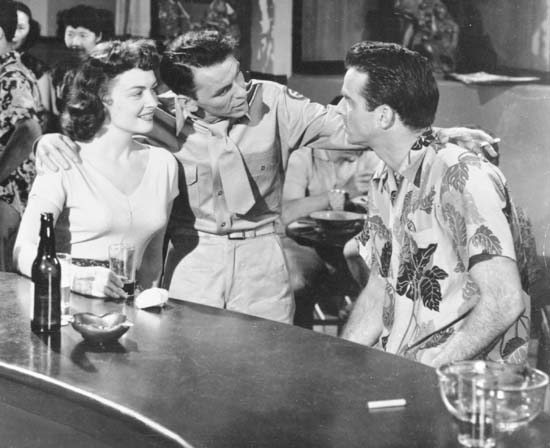
From Here to Eternity (1953)

I saw this film for probably the third time this past week.  (It’s my mom’s favorite.)  It boosted the careers of its stars: Burt Lancaster, Deborah Kerr, Montgomery Clift, Donna Reed, and Frank Sinatra (who provides most of the much-needed humor and optimism).  Wow, what a cast!   The film won 8 Academy Awards; it was nominated for 13.

Young Army Private Robert E. Lee Prewitt (Clift) comes to a new base for his assignment.  From his first day, many of the other men bother him about not fighting (boxing) in the company league; we learn that he was quite successful at it, aside from one (tragic) event.  Sergeant Milton Warden (Lancaster) tells the others to leave the guy alone.  Warden, who’s admired as a great soldier, likes Prewitt, though he calls him “hard-headed.”  Prewitt, no matter what insults or how much punishment he’s given, says he’ll never box again.

She’s not that into you…  but give her time!  Yes, that’s petite Donna Reed (post-It’s a Wonderful Life).  She plays “Lorene” (real name: Alma), a somewhat jaded dance hall girl who Prewitt wants to get close to.  Though he wants a relationship, Alma is hesitant because she wants to keep working to secure her future.  Reed, who’s character is tough and independent-minded, won Best Supporting Actress.

Warden has his life complicated by his intense attraction to Karen (Kerr), the wife of his boss, Captain Holmes.  Like Alma, Karen is more than what she appears to be- sublimating her great loneliness and sorrow by behaving scandalously.  (Above: Kerr and Lancaster share one the most famous kisses in Hollywood film history.  Sigh…)

To her surprise, Karen falls deeply in love with Warden, a simple man who’s content to be a humble soldier.

There is more to romance in this story; there are serious issues that arise.  The jovial Private Angelo Maggio (Sinatra) is bullied by the racist Sgt. Judson (Ernest Borgnine).  Maggio and Prewitt were great friends though opposite in temperment; they have fun and get into trouble together.  But there is a sense of foreboding throughout much of the film, as is fitting-  the story takes place on the island of Oahu just a few weeks before the attack on Pearl Harbor.