NOTE: This is a SPOILER-FREE review. DC area folks can see this film tomorrow (SAT, 9/19/15) at 9:15PM at AFI Silver.
Marshland shows us a world where everyone is out for themselves. -Gareth Wood (Maverick Film)
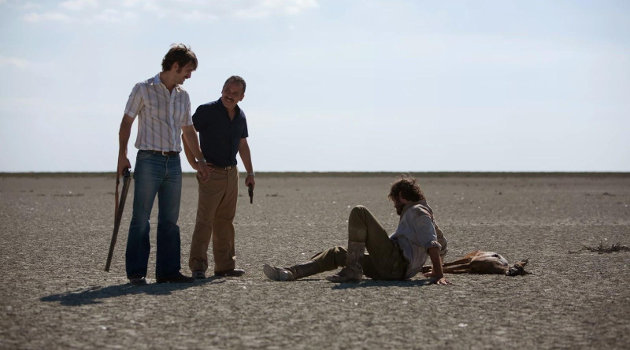
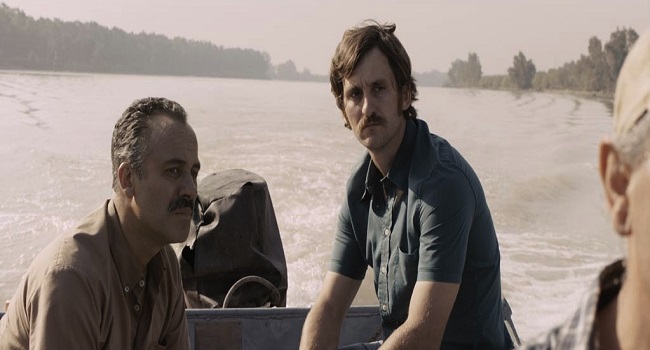
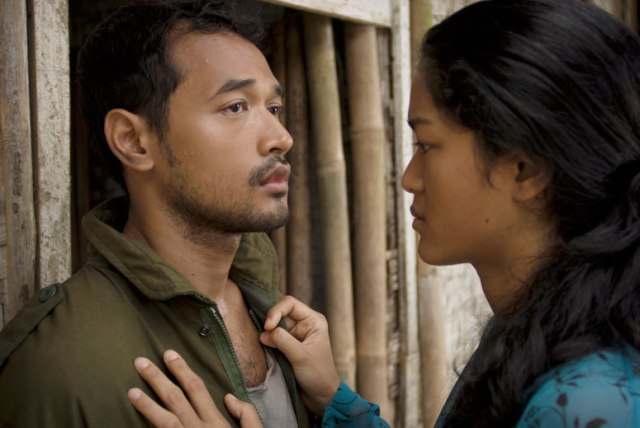
We’re quite familiar w/ the set-up already: missing girls, small town w/ secrets/corruption, and two VERY different homicide detectives (from the big city) brought in to help solve the case. However, this film is set in Spain in 1980, soon after General Franco was overthrown and the country (struggling economically) became a democracy. The missing teens are two sisters, Carmen and Estrella, who were known to “have a reputation.” The cops from Madrid are idealistic father-to-be, Pedro (Raul Arevalo), and jaded, hard drinking Juan (Javier Gutierrez).
Some frames of the film are based on photographs of Atín Aya, whose work impressed the filmmakers when they knew his work in a retrospective exhibition. -IMDB
I recommend this film for fans of Southern Gothic stories, character dramas, and those who like suspense (NOT only action). Don’t worry, there are a FEW well done action scenes. On the way, the cops are assisted by Jesus (a local guide), who provides some of the humor in his dark tale. Jesus gets caught hunting a deer (“Bambi,” he jokes) w/o a license.
The cops work together, BUT also on their own following different leads. The cinematography in this film is VERY good, as my friend commented. The location is almost like a character in the story- we see desert, marshes, rivers, and (in the climax) a rainstorm. If you liked HBO’s True Detective (S1), this is for YOU.
This is a coming-of-age story (one in a shory story collection- Apples from the Desert by Sayvon Leibrecht) about Rachel, a 19 y.o. ultra-Orthodox Jewish girl, who lives in Jerusalem w/ her parents. Unlike most families in their community, she’s the only child of her parents. Rachel yearns for a different life than the one of her housewife mother. Rachel’s unmarried aunt lives down the street, w/ her cat, and seems content to be single/celibate. We learn from her father that people in the community still whisper about the time Rachel drank bleach (in an attempt to kill herself).
At a community center, Rachel watches young secular men and women doing folk dances. This is forbidden in her sect, of course. She eventually gets the courage to joins the class, taking some time off from her job. A red-headed college boy in this class tells her about his life on a kibbutz, and they develop a friendship. Her father, worried about Rachel’s changing attitude and future, plans a different future. Her mother sees that she’s unhappy, but fears losing her only child to the world.
The Dove Flyer (AKA Farewell to Baghdad)
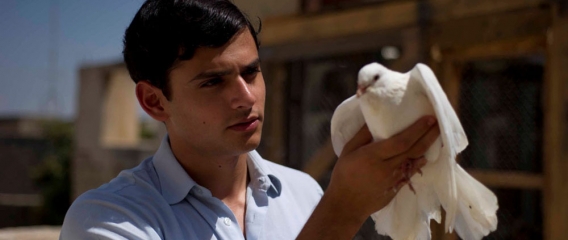
This film (based on the novel by Eli Amir) tells the story of the last years of the Jewish community in Baghdad, Iraq, before their expulsion in 1950 and settlement in Israel. The teen narrator, Kabi, watches as the members of his extended family each develop different dreams/fears: his father wants to emigrate to the promised land, his uncle Hizkel (a Zionist) is suddenly arrested; his Muslim teacher, Salim, believes in the equality of Arabs and Jews; and his other uncle just wants to raise his doves. World War II draws closer, houses are ceased, Jews are beaten in the streets and hung in public. Kabi is watchful of Hizkel’s spirited young wife, who turns heads w/ her blonde hair, blue eyes, and revealing dresses.
The acting is great- all were convincing as Moroccans with good accents and French language. The highlight was Nadine Labaki’s performance, though a secondary role, she stole the scenes with her funny “bitchy” attitude and added many comic relief along with her Grandma. Nadine is famous Lebanese director known for “Caramel” but she is also an acclaimed actress. The multi-talented Hiaam Abbas who appears in many foreign movies, she manages to reincarnate the role of a Moroccan mother with strict high values and morals. -IMDB reviewer
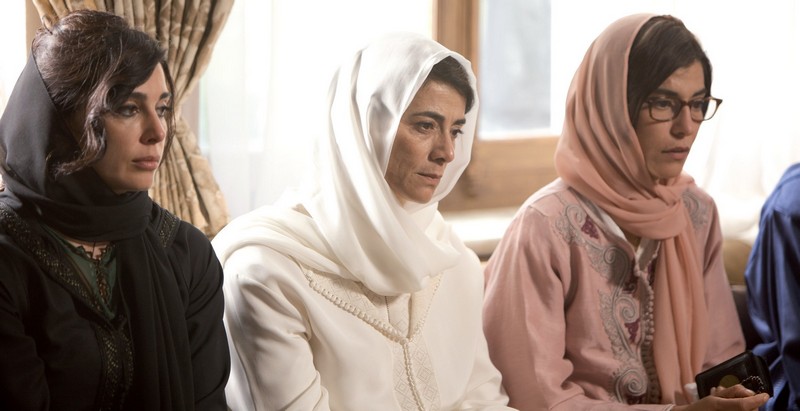
Miriam (Nadine Labaki) and Kenza (Lubna Azabal) sit at each side their mother Aicha (Hiam Abbas) during their father’s wake.
This stereotype-defying film (a mix of comedy and drama) was part of the Arabian Sights Film Festival in DC. It was written/directed by Laila Marrakchi, a young Moroccan woman. I saw it this Fall (with 2 members of a movie Meetup) at the French Embassy; the main language in the film is French (with a good mix of Arabic and English).
The ladies of the Hassan family find their thoughts drifting to the past.
When patriarch Moulay Hassan (Omar Sharif) dies, his extended family, employees, and community gather at his palatial estate (in Marrakech by the coast) for his funeral. We meet his strong widow, Aicha (internationally-renown Israeli Arab actress, Hiam Abbas, from The Visitor). Moulay’s daughters are all quite unique women; there is NYC-based actress/black sheep Sofia (Morjana Alaoui) with her young son, glamorous/dramatic housewife Miriam (Nadine Labaki)- on the verge of an affair, and straight-laced/religious professor Kenza (Lubna Azabal) whose teen son wants to act on Broadway. Sharif appears in a few scenes, adding a magical element of this fine film.
Three sisters with very different lives come together.
We are put in the shoes of the outsider, Sofia, who has recently separated from her director husband (an Irish-American). She hasn’t been home in many years; it was too painful to face the past (we learn why) and she has made a moderate success of herself in the U.S. (usually playing a terrorist). Sofia’s adorable 6 year-old son, Noah, is excited about experiencing a new culture and playing with a large crew of cousins. He’s hesitant to eat the new foods.
Noah bonds with his grandfather, Moulay (Omar Sharif), in a few scenes.
When her reddish-haired grandmother comments that Sofia shouldn’t have married a “foreigner,” Sofia good-naturedly reminds the older lady that she was once a foreigner (being a French woman). “But I married a Muslim and an Arab,” the grandmother says with a sly smile. As the days go by, secrets are revealed about another sister, their beloved housekeeper Yacout (who raised all the girls, as well as her own son), and Moulay. Sofia, who yearns for openness and honesty, is frustrated by (more conventional) sisters. However, she doesn’t have to live in the strictly stratified, dualistic society (people pray in the morning, but don’t necessarily shy away from alcohol and dancing later in the day).
About 400 films are made in the U.S. each year. Even more (600) are made in India. But, did you know that about 100 films are made in Indonesia each year? The Indonesian ambassador to the U.S.,Dr. Dino Patti Jalal, and his wife were joined by the Singaporean ambassador’s wife, actorNicholas Saputra(star of Joni’s Promise), and members of his staff during the first film showing. Recently, Dr. Jalal met with Hollywood director Michael Mann, who will be shooting his film, The Philosopher, in Jakarta. The film’s lead actor will be Aussie actor, Chris Hemsworth.
Lovely Man (2011)
A daughter gets to know her absentee father for one night
This is a 75 minute film, but it packs some big punches. (It won many awards in Asia.) It focuses on the relationship between a transvestite streetwalker in Jakarta and a small-town/devout Muslim teen, who just happen to be father and daughter. Without telling her mother, Cahaya (Raihaanun), travels by train to see the father who left home many years back. Cahaya is dressed conservatively and wears a white hijab (headscarf). When she gets off the train, she stops at a mosque to wash and pray. She’s amazed by the sights and sounds of the big city, as she goes in search of her father’s address. (This film uses shadow and lights very well.) At the side of a bridge, she talks to some women (who are obviously streetwalkers). She meets Ipuy (Donny Damara)- dressed in long wig, sparkly red dress, and high heels (reminiscent of some of the characters in the films of Pedro Almodovar). Needless to say, they are both shocked.
Actor Donny Damara accepting an award
Ipuy wants nothing to do with Cahaya- his life is tough enough as it is. Most people look at him with disgust and treat him unfairly. What would a hijabi like her know about someone like him? (Eventually, Cahaya takes off her hijab, to make her father more comfortable.) She’s carrying a secret, which is giving her much worry. Cahaya exclaims that she needs a father to talk to about important matters. What she doesn’t know is that some gangsters are after Ipuy for stealing a lot of cash.
Joni’s Promise (2005)
Joni goes through a LOT in one day
This funny, light-hearted film is considered to be “one of the first comedies made in Indonesia.” (It reminded me of a French comedy.) A 22 year-old man, Joni (Nicholas Saputra) delivers film reels- a job he likes and considers to be quite important. One afternoon, she sees a very pretty girl standing in line at the theater, but he’s too nervous to talk to her. We learn that she’s with her boyfriend (an entitled rich kid). She gets fed up with her guy, so she goes out. She notices Joni’s good nature and they have a chat. She doesn’t get her name or get give his out. The girl says that they can talk more of he gets done with his deliveries on time. Joni is happy with that- he’s never had a girlfriend yet. Joni’s motorbike gets stolen, he witnesses childbirth, gets a walk-on role in a film, plays the drums, and meets a mysterious artist. Can he make it back to the theater to have his first date?
IMDB photo of actor Nicholas Saputra
The Dancer (2011)
Srintil and Rasus share some fruit
This is a full-length historical drama based on a trilogy of novels. The story focuses on the love between two young people in the village of Dukuh Paruk in Java. As a small child, the parents of Srintil are killed by some fellow villagers, who believed that they were poisoning food. The ronngeng (village dancer) also died- she ate the food.
The teenaged Srintil (Prisia Nasution) and Rasus (Oka Antara) love each other deeply, though they are poor, illiterate, and don’t have many prospects. Rasus works in the rice paddy fields, like the other young men. However, Srintil thinks that she may have the spirit and the talent to become ronggeng. Her grandfather champions her cause, even though they are first met with doubt and derision.The local dance master won’t come to see Srintil perform.
Srintil goes through various rituals to become ronggeng
Rasus has a little dagger-like object which belonged to the former ronggeng. After he presents it to Srintil, everyone proclaims her to be the next ronngeng. She will not only dance , but belong to the village. Her virginity will be sold to the highest bidder- a fact that greatly upsets Rasus. (The elderly blind drummer is the only older person who senses what is going on with the couple.) Rasus runs away to the nearest town, then meets with a military commander (who thinks he could one day become a “loyal” soldier).
Srintil realizes that Rasus has joined the military
Srintil has to go through various rituals, aided by the dance master’s wife. Men bring goats, cows, and money to present to her grandfather and teacher. Before the “deflowering” ceremony, Rasus returns and they sneak off together. Later that night, Srintil pushes him away, explaining that she can’t run away with him forever. (We know that she has status and money in her community now.)
Srintil shines as a dancer (but not in her personal life)
While Srintil adapts to the lifestyle of a dancer, Rasus adapts to that of a soldier. His superiors look on him well and he finally learns to read. He crosses paths with Srintil on very few occasions. They only spend one more night together, but their lives must always be separate. When Srintil urges him to come back to the village and offers money to start his own business, Rasus refuses (too proud).
A (Communist) man from the city comes to talk to the villagers, but they only want more food, and don’t grasp what allegiance to his ideas truly mean. (In fact, 1965-1966 was a very bloody year was Indonesia’s history. Many people, who were thought to be Communist or sympathizers, were killed by the military.) This man also wants Srintil and village musicians to perform at his rallies.
Rasus and Srintil meet after the 1965 war
This film is very powerful! It won the 2011 Best Picture award in Indonesia and was submitted for a Foreign Film Academy Award. It just draws you in with it’s setting, characters, and values (which are quite different from those of urbanized, modern Indonesia). The love story starts out very gently and innocently, then we see the darker aspects (depression, frustration, etc.)- this pair must stay apart because of Srintil’s chosen path. Being a village dancer was being above others- connected to the gods (ancestors.)
Did you enjoy “Paris, I Love You?” Then you may enjoy this film as well. It’s a compilation of 7 different short films (directed by some famous directors from all over the world). The setting is modern-day (communist) Cuba, where people are struggling in their personal and professional lives (just like anywhere else).
In the first film, a young American film student (who knows only a little Spanish) goes out to a club with his cabbie looking for a beautiful girl. He finds a rather unusual individual who defies stereotype, as does the American in his reaction.
In another tale, a jaded/drunken Serbian director comes to Cuba to get an award. But the highlight of his trip is meeting a cabbie with a great talent for music.
A beautiful/ambitious singer is torn between two men- her loving/long-time boyfriend (a struggling basesball player) and a smooth-talking stranger who offers her a contract to work in Spain. (To heighten the contrast- one man is a dark-skinned Afro-Cuban and the other is fair/redheaded.)
Calvet
This is a documentary of Jean Marc Calvet, a French artist living in Nicaragua, who is still struggling with demons (though he’s settled with a family and earns good money). In his own words, he recounts his boyhood, addictions, various jobs (legal/illegal), and especially- his intense regret in not being there for this 18 y.o. son. (He speaks in both French and Spanish.) Will he be able to find his son? If so, how will his son react to his long-absent father?
Clandestine Childhood
Juan is an observant/sensitive 11 y.o. boy who comes from Cuba to Argentina (in 1979) with his family and a group of their comrades. He attends school (under the name Ernesto), makes some friends, and gets a big crush on a pretty classmate.
But he’s not quite like the others- his parents and uncle are guerrillas, and the family is hiding out in an uncle’s house. Juan also has a baby sister, Vicky.
His grandmother comes for a brief visit, and says she can care for the kids. But Juan’s mother angrily insists that her children belong with her.


















 Knightleyemma