Saruman (Christopher Lee) and Grima (Brad Dourif) atop Isengard looking over the army
The two towers refer to Saruman’s (Isengard) and Sauron’s (Barad-Dur) strongholds. The fellowship has gone its separate ways, so there is much more to see in this film. Saruman’s army is getting bigger each day. We see how Uruk-hai are being bred (gross); Treebeard (voiced by John Rhys-Davies, who also plays Gimli) thinks they are orcs crossed w/ men.
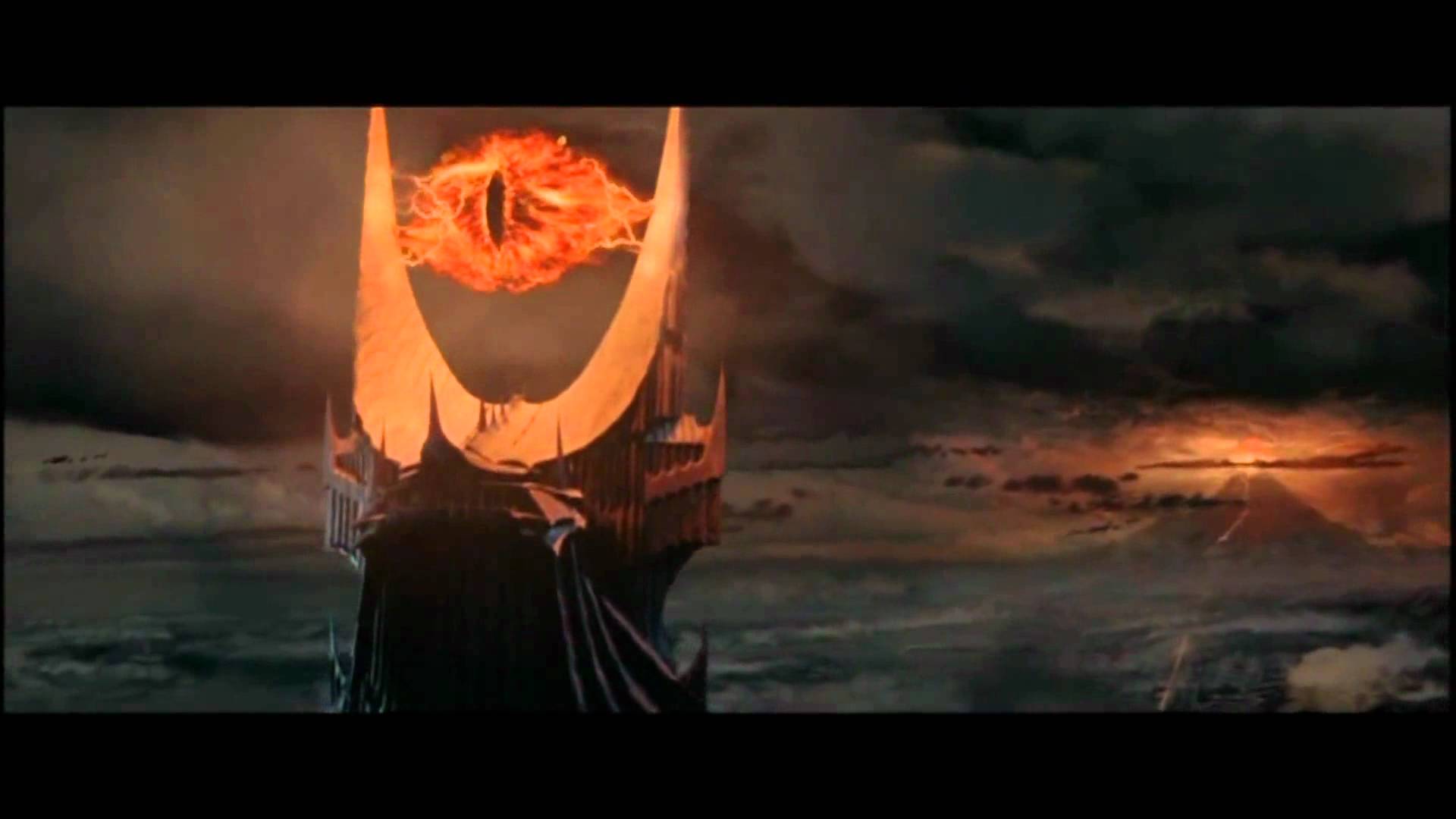
Saruman’s eye atop Barad-Dur
Frodo (Elijah Wood) and Sam (Sean Astin) travel with Gollum (Andy Serkis), a creature that they can’t fully trust. Gollum says that he can’t be far from the ring, and calls Frodo “master.” He had the ring for 500 years, so is in its power (as Galadriel explained in FOTR).
Sam (Sean Astin), Frodo (Elijah Wood), and Gollum (Andy Serkis)
One of the best things about the EE- Sean Bean! We get to learn more about Boromir, his younger brother Faramir (David Wenham), and their father Denethor (John Noble). Faramir offered to go to the council of Elrond at Rivendell, but his father refused him.
Faramir (David Wenham) and Boromir (Sean Bean) drink a toast
Aragorn, Gimli, and Legolas meet Eomer (Karl Urban) and the horsemen loyal to him. He’s in despair, after losing his cousin (Theodred) in battle and being banished from Edoras by Grima. Théoden (Bernard Hill) is under Saruman’s spell, so he can’t function as king. I love the Rohan musical theme!
Eomer (Karl Urban) has been banished from Rohan
The White Wizard that everyone seems to fear turns out to be a good guy- Gandalf!
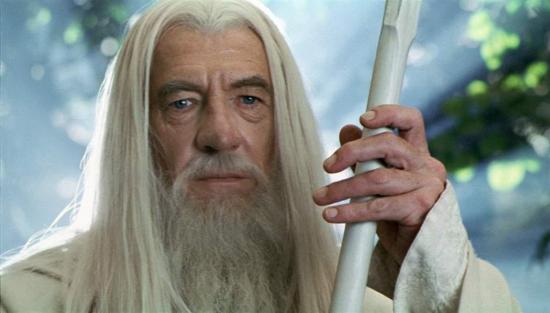
Gandalf the White (Ian McKellan)
Merry and Pip first see him (in Fangorn Forest). We see the ingenuity of these two hobbits. After escaping from Saruman’s forces, Pip leaves a trail which Aragorn follows. Merry realizes that the Ents (tree herders) can help in the battle for Middle Earth.
Aragorn, Gimli, and Legolas riding toward Edoras
The CGI effects on Théoden were very cool! He comes back to his old self in a few moments. But his only son is dead, and he laments this in a nice scene with Gandalf. The young are not supposed to die while “the old linger on.”
Grima and Theoden (Bernard Hill)
My favorite character in this film is Eowyn (Mirando Otto). She is caring, can handle a sword (will see just how well later), and develops a friendship w/ Aragorn. Does she love him? Or does she want to fight beside him as an equal? Maybe both! In the EE, we learn that Eowyn can’t cook very well. Aragorn grows to admire Eowyn.
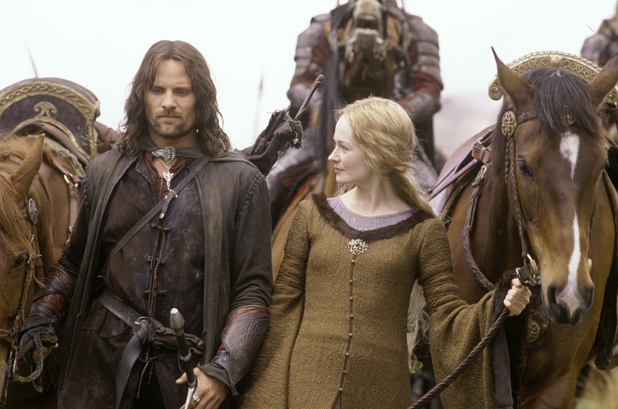
Eowyn (Miranda Otto) asks Aragorn (Viggo Mortensen) about the jewel (Evenstar)
Gimli is quite funny in this film, though he continues to fight very well (as in FOTR). He and Legolas are more friendly here, but have an ongoing rivalry. We learn that dwarf women also have beards.
Gimli (John Rhys-Davies) provides some much-needed humor
Frodo and Sam learn that Boromir is dead from Faramir, captain of Gondor. Faramir is another of my faves in the LOTR films- he’s the reluctant warrior who’s a deep thinker. He sets the hobbits free after realizing the destructive power of the one ring, and the importance of the quest.
Faramir is almost tempted by the ring
Elrond (Hugo Weaving) convinces Arwen (Liv Tyler) to leave Rivendell and travel to The Undying Lands. In a somewhat eerie sequence, he speaks of her future life should she marry Aragorn (a mortal man). I think this is a bit longer in the EE.
Flash forward scene with Arwen (Liv Tyler)
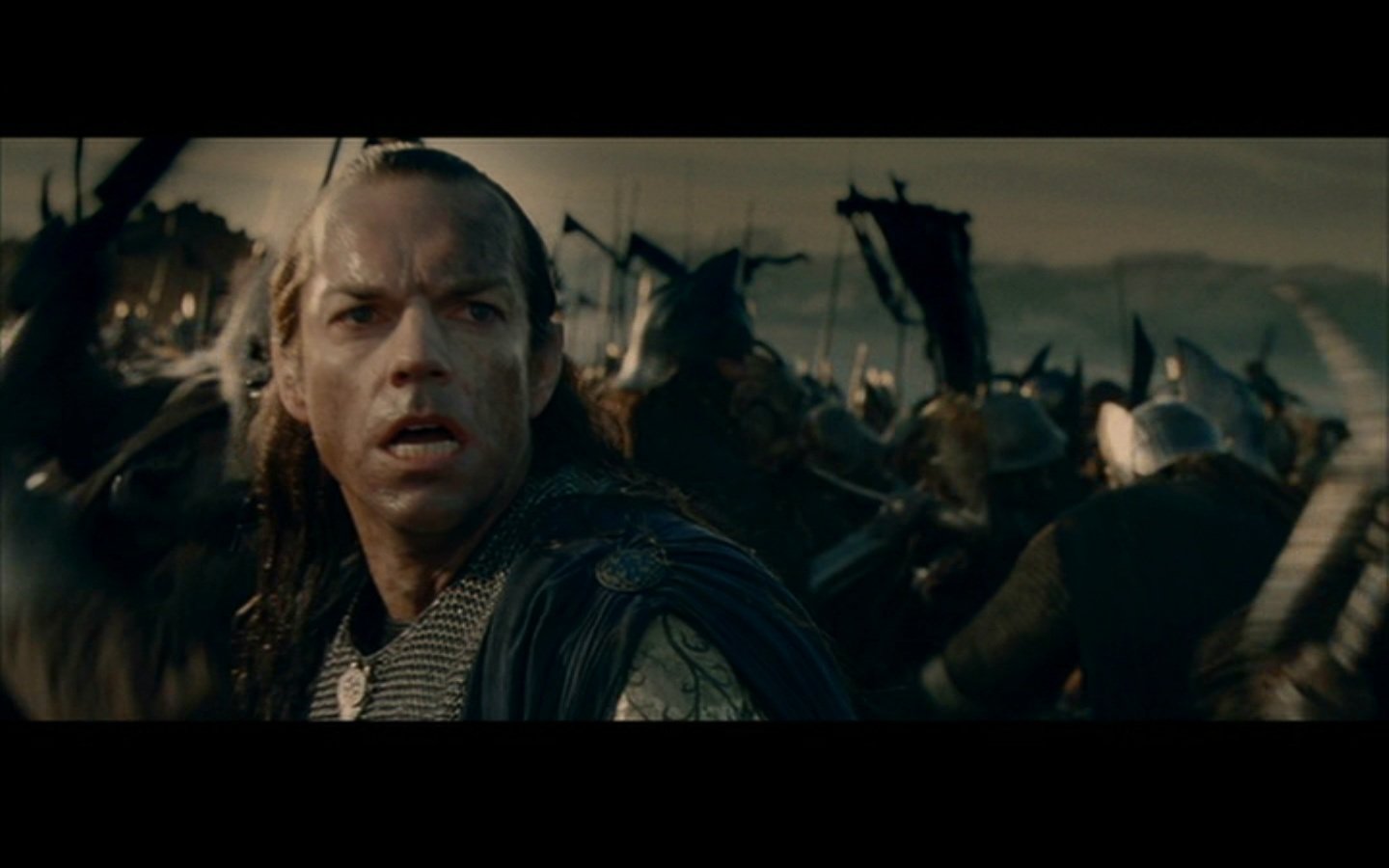
The toughest stuff to shoot was the battle at Helm’s Deep, the cast and crew explain on disc 4 of the EE. The elves, lead by Haldir (Craig Parker), come to fight beside the men/boys of Rohan. Then a new day comes, and Gandalf, Eomer, and his men ride in to defeat the Uruk-hai army.
I loved all the prologue stuff in the EE, esp. the battle/conflict involving Elrond and Isildur. It explained some things to those who didn’t read the LOTR books (like myself). Rings were given to the elves (including a intricate floral one Galadriel wears), dwarves, and men. Saruman’s fate is tied to the One Ring (also called Isildur’s Bane), so as long as it’s out there, evil threatens Middle Earth. Isildur is Aragorn’s ancestor; his sword is called Narsil. Later on, in Rivendell, we see the shards of Narsil.
Bilbo (Ian Holm) examines the ring
There is more Bilbo-reated stuff in the EE, including a scene (in Lothlorien) where we see the destructive power the ring would have on him. Bilbo gives Frodo a shirt of mithril (given to him by Thorin, we later learn from Gandalf), then freaks out upon seeing the ring on a chain worn around Frodo’s neck. Frodo quickly covers it with his shirt.
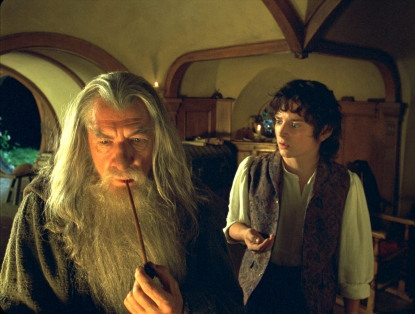
Gandalf (Ian McKellan) & Frodo (Elijah Wood)
After Bilbo’s b-day party (including his disappearing trick), he leaves for Rivendell. Frodo finds Gandalf sitting before the fire; we know that the wizard feels the power of the ring. He dare not even come too close to it. (On the other hand, Saruman joins forces w/ Sauron.)
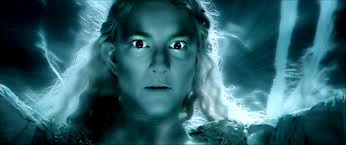
Galdriel feels the evil of the ring.
Later, we see the terrible power it could have upon Galadriel (Cate Blanchett). This was a cool, unexpected bit of acting/CGI! Blanchett and Weaving were very believable as ancient, powerful, wise elves. Arwen (Liv Tyler) did well, but I wished she had more to do in this film. Like Wood, she has that very young/innocent/gentle quality about her. They both have flawless skin (I saw Wood once on the subway in NYC). I loved the exciting horse riding/escape scene (done mainly by a stuntwoman).
Getting ready to fight the cave troll inside Balin’s Tomb
The first time I saw the action sequences inside Balin’s Tomb, I was quite impressed. Everything flowed well from the first instance of the arrow whizzing by Boromir’s (Sean Bean) face.
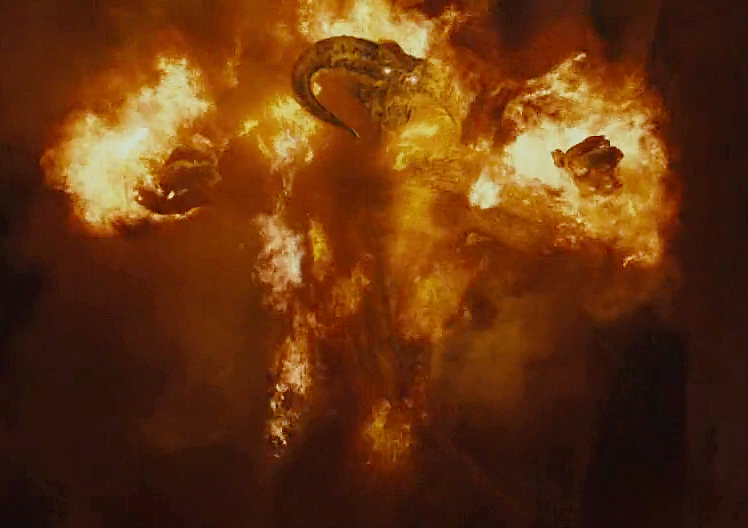
The balrog inside Moria
After a few views of the EE, I was also very impressed with the balrog (a very advanced bit of CGI work).
Aragorn (Viggo Mortensen) realizes that Frodo must go alone to Mordor
Boromir is tempted by the ring (like men before); we’ll learn later the pressures he faced. Perhaps Aragorn won’t be tempted, but Frodo can’t take that chance. He heads off to Moria with Sam (who won’t be left behind). My fave part of the EE set are the interviews with the cast (see disc 4: From Vision to Reality)- a must for any fan of LOTR!
I saw this film during its second week, b/c I wanted to wait until my lil bro was visiting. He said that “the first movie was slow,” an opinion shared by several friends/acquaintances of mine. My mom mainly went to see Richard Armitage (she’s a fan, too). I loved the LOTR films, so I continue to follow these films.
SPOILERS: Don’t read further if you have not yet seen, or don’t want to know, details from this film.
Bilbo (Martin Freeman) fights a giant spider in Mirkwood Forest
Bilbo becomes “a more rounded character” (Freeman’s words) in this film. He uses the ring (several times) to get out of jams, kills an orc (his first kill, I believe), and then faces off against a giant spider. We see how his little sword, later bequeathed to Frodo, got its name- Sting.
The throne of the elven king, Thranduil
Gandalf goes off (again) to see the gathering evil in Dol Guldur. We hear the voice of The Necromancer (later known as Sauron), voiced by Benedict Cumberbatch. Yes, he is everywhere these days, and I’m not complaining!
The dwarves go into Mirkwood Forest, which is not a friendly, cheery place like Rivendell. The king, Thranduil (Lee Pace), is a very interesting character; I wanted to see a bit more of him. He can do and say whatever he pleases in this realm. Thranduil disapproves of his son Legolas’ (Orlando Bloom) “partiality” (perhaps love?) of Tauriel (Evangeline Lilly), the captain of the royal guard.
Thranduil (Lee Pace) talks to Thorin
There is no love lost between Thranduil and Thorin (Armitage), since the elves didn’t come to the dwarves’ aid many years back (when the dragon attacked). I loved the cut-down/insult scene between Thranduil and Thorin; Richard said was his favorite bit of acting in DOS.
Thorin glares at Thranduil
As I said before, great acting is the eyes. We can see the hate/distrust between the two leaders, and their races, displayed here.
Legolas (Orlando Bloom) listens to Tauriel & Kili
On Twitter (and beyond), some book readers commented “Why is Legolas here? He doesn’t add anything. He takes away from Bilbo’s story.” Since I haven’t read any of these books, I can’t comment on that aspect. Legolas gets some cool action moments (as in the LOTR films), but doesn’t make a big mark otherwise. Tauriel, not in the book, is a nicely-developed character. She’s quick to act, a tough fighter, but also caring. Tauriel wants to help the dwarves along on their quest, especially when they are overrun by orcs.
Kili (Aidan Turner)
Some people didn’t like the (potential?) romance between Tauriel and Kili, but I thought their scenes were very well-done. After a while, I got tired of all the action sequences! Aidan Turner (aside from being handsome/likeable) is a good actor, I realized.
The barrel scene (the dwarves escape the dungeon)
The barrel scene was very cool, I have to admit. (I’d seen bits of it before on BTS clips.) Richard said that at one point, he was “dragged under by the current” and had to be pulled out of the “freezing cold water.”
The new characters: Bard (Luke Evans) & Tauriel (Evangeline Lilly)
The human, Bard the Bowman, was a highlight in this film (even more that Tauriel). Luke Evans has a very strong voice and lovely (Welsh) accent. I loved his scene with Thorin at the foot of the mayor’s house. Both men have fallen from what they were born to, we learn.
Bard’s kids are very cute/sweet, don’t you think? The two girls are not professional actors; they are daughters of James Nesbitt (who plays Bofur). When orcs attack, they are very stunned, but Tauriel and Legolas come to the rescue. Tauriel applies an herb, found by Bofur, to Kili’s leg wound and says an elvish prayer.
At the door to Erebor (The Lonely Mountain)
Bilbo figures out another riddle, allowing the company to see the door to Erebor. Hmmm… why did Thorin give up before Bilbo? Some viewers wondered this. Armitage shines in the (quiet) scene that follows- he’s feeling like more of a king.
Sidenote: Some viewers enjoyed the fact that Thorin’s voice was not as gruff/deep as in AUJ; it was more natural. Since Richard has such a wonderful voice, why change it?
Bilbo meets Smaug (Benedict Cumberbatch)
Yes, Smaug is very big/impressive, as I heard! Cumberbatch worked two weeks on the voice (which is fabulous) and the motion capture (as Andy Serkis did with Gollum). In effect, the dragon’s expressions resemble his (to some extent). Bilbo is scared, so he stays calm and flatters the dragon, while the dwarves go about their plans. However, the molten gold doesn’t kill Smaug, and he flies off to attack Laketown. Awww man, we have to wait another year!
Ella No Quiere Dormir Sola (She Doesn’t Want to Sleep Alone)
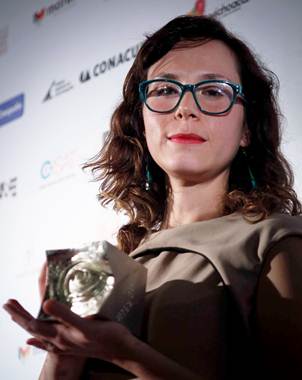
Director Natalia Beristain
This is a film about the connection between two true-to-life women. Director Natalia Beristain based this film partly on the final years of her grandmother, who was a well-known actress in her native Mexico, just like the older protagonists- Dolores (Adriana Roel). The younger protagonist, Amanda (Mariana Gaja), is an out-of-work 33 year-old with a love for photography. Since her father (played by Arturo Beristain, the director’s father) is out of town shooting his latest film, Amanda has to look out for her grandmother, who suffers from both alcoholism and dementia. Dolores is stubborn, prideful, but still has some spark in her, while her mind goes from her glory days onscreen (she was a vivacious beauty) to the banality of modern life (living in an old folks’ home). Dolores loves swimming, so spends hours in the pool. Amanda joins her and then takes some photos. Spending time with her grandmother helps Amanda , who tends to be defensive and distant (even with her caring boyfriend), view herself in a new light.
De Tu Ventana a La Mia (From Your Window to Mine)
Director Paula Ortiz
First time director, Paula Ortiz, also wrote this fine film (which is epic, yet intimate, in scope). Three women of different ages and personalities, living in different times, go through personal turmoil (which any woman can relate to). “The stories of these types of women were not told- they were silent. They didn’t choose their lives,” the director commented.
In 1923, the teenaged Violeta (Leticia Dolero), a petite, delicate beauty is sheltered by her gentle grandmother and teacher (a respected medical doctor). Her mother had some sort of mental illness, so the doctor gives her a potion to drink each day. Violeta falls deeply in love with a college boy who stays at her house over a few weeks. In 1941, Ines (Maribel Verdu from Pan’s Labyrinth and Y Tu Mama Tambien), has long been in love with Paco, an anti-Franco activist. They get married before he’s captured and jailed (in a partly underground prison). Ines, a strong country woman, becomes pregnant and continues to earn a living (in a harsh, desert-like climate). Ines was based partly on Ortiz’s grandmother. In 1975, Luisa (Luisa Gavaza, a character actress in her native Spain), is diagnosed with breast cancer. She doesn’t realize that a man she sees every day is in love with her, and dreams of heroes from classic movies. Her partner in life is her older sister, also unmarried, who cooks and cares for her without much complaint. Luisa was based on the director’s aunt, who lived though the last days of dictatorship.
I will not fall into despair! I will keep myself hardy until freedom is opportune! -Solomon Northrup
This film is being called a Pan-African film, since the director (Steve McQueen) is a black Briton, the star (Chiwetel Ejiofor) is Nigerian-British, and the female lead (Lupita Nyong’o) is Kenyan. As we have seen, outsiders are often the best storytellers of the American experience, of which slavery is a (large) part.
Solomon (Chiwetel Ejiofor) and fellow slaves in sugarcane field
I went to see this film during its second week of release; the theater was packed. Yes, it was difficult (at times) to handle. One of my friends, a lawyer with a background in civil rights, commented that “it should be taught in schools.” Based on a true story (memoir), 12 Years a Slave basically blows every other film I’ve seen about slavery out of the water; nothing even comes close!
Alex Haley’s Roots (starring a young LeVar Burton) is a fine TV miniseries, but will look outdated to younger viewers. Even one of my favorite films, Glory, is told mainly through the eyes of its white hero, Col. Robert Gould Shaw (Matthew Broderick), not the enlisted men of the 54th Massachusetts Colored Regiment (including Andre Braugher, Morgan Freeman, and Oscar-winning Supporting Actor Denzel Washington). Queen (starring a young Halle Berry) is another of Haley’s stories turned mini-series; many will find the (inherently unequal) romance between a white boy and one of his family’s slave girls problematic. Amistad is a powerful film, but it’s focus is mainly on a group of white abolitionist men; Ejiofor has a small role as an interpreter in that film.
SPOILERS: Don’t read further if you have not yet seen, or don’t want to know, details from this film.
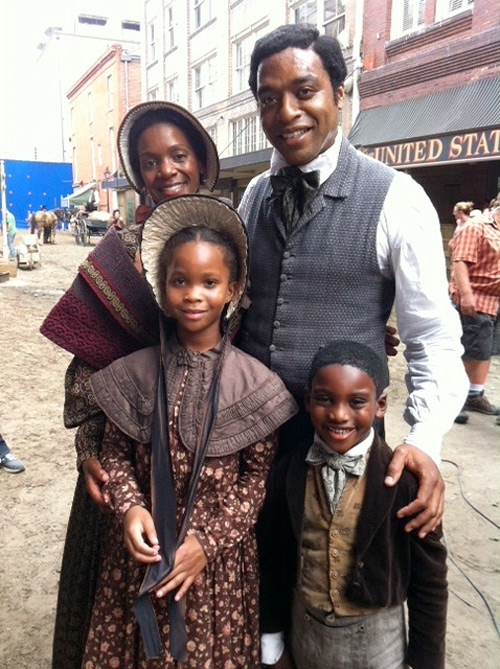
Solomon with his family
This film is told in flashbacks through the eyes of a free man and talented violinist, Solomon Northrup (Ejiofor, finally in a star-making role). He lives a comfortable life with his loving wife (a well-respected cook) and two adoring children in upstate NY at the start of the tale. He has a fondness for nice clothes. One day, two white men from Washington, DC, approach Solomon about making some (fast) money with their traveling circus show. Solomon goes to DC with them and works for 2 weeks, before they drug him (during a lavish dinner) and sell him into slavery. Solomon wakes up in a dark cell, chained up like an animal, but there’s nothing he can do (being in Virginia). He keeps crying out that he’s a “free man,” but no one will listen.
Solomon gets to know the others being held with him, including a well-spoken woman, Eliza (Adepero Oduye), who was once the favored slave of her owner, and has a daughter by him. She also has a adolescent son, who Solomon comforted when he was separated from his family. After this master died, his daughter had them all sold. Solomon, Eliza, and a dozen others are taken further South (via large riverboat).
One young man, Clemens (Chris Chalk from The Newsroom), explains that he shouldn’t be sold further South, since he was taken from his master. He talks tough about escaping by attacking the sailors, though they are greatly outnumbered. Another man (Michael K. Williams from The Wire) is stabbed to death before he can make a move. (I read that fans of The Wire were especially shocked to see such a strong man killed so easily/quickly.) A beautiful young woman grabs onto Solomon’s hand, not in passion, but with loneliness. We wonder how long ago was she loved by anyone?
Solomon and Clemens (Chris Chalk) witness brutality on the boat
Paul Giamatti plays a callous/brutal slave trader, ironically named Mr. Freeman, and does an excellent job. Clemens is “rescued” by his rightful master, to whom he clings like a thankful little boy. Why? Because it’s the master he knows, and has treated him decently. Freeman separates Eliza from her son without flinching, since he can get a great price for a healthy, adolescent boy.
Solomon and fellow enslaved meet slave trader Mr. Freeman (Paul Giamatti)
When a kindly slaveowner, Mr. Ford (Benedict Cumberbatch), tries to buy Eliza and her daughter together, Freeman ups the price of the little girl. He can get a fine price for her in Louisiana, since she’s half-white and “will grow to beauty.” (This is what Eliza feared all along- shudder!)
Eliza (Adepero Oduye) gives into despair
He [Mr. Ford] has a debt problem and can’t manage his business- he sells human beings in order to make himself solvent. -Benedict Cumberbatch
Mr. Ford, who runs a small mill, buys Solomon and Eliza. When they get to his home, Ford comments to his wife that the separation “couldn’t be helped.” Mrs. Ford lightly tells Eliza: “Your children will soon be forgotten.” (This made the audience gasp with shock.) Solomon tries to calm Eliza, but she stays despondent. Mrs. Ford grows “weary” of Eliza’s crying and has her sold away.
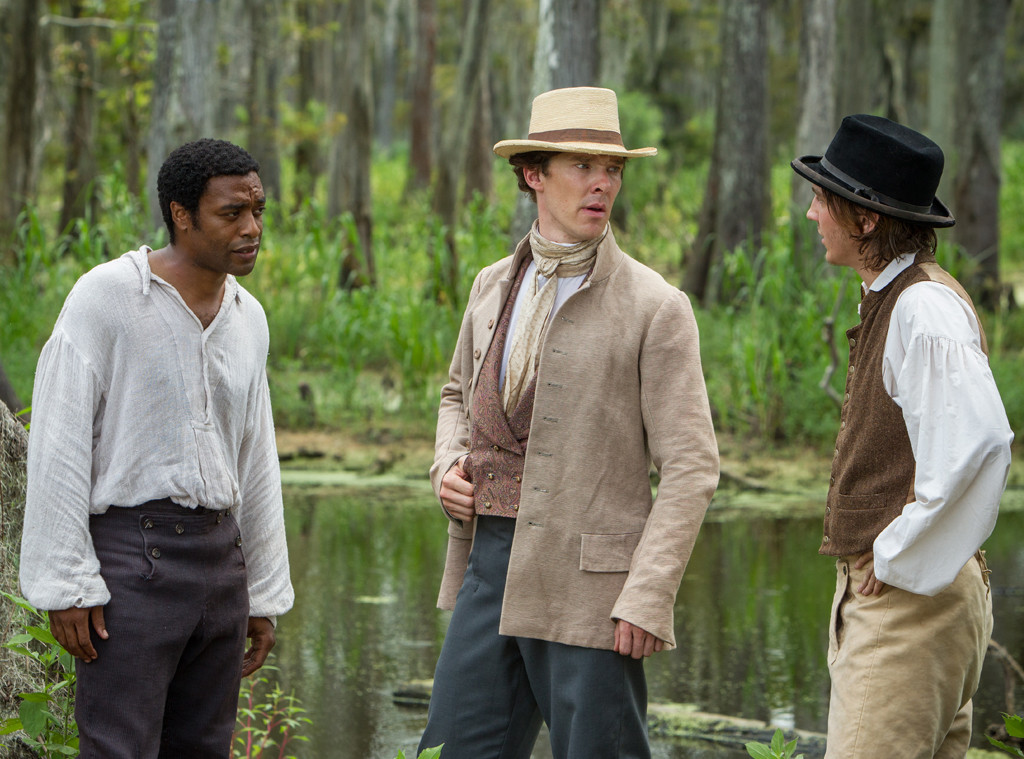
It doesn’t take long for Solomon’s intelligence to show, impressing Master Ford, but garnering the wrath of his insecure overseer, Tibeats (Paul Dano), who has a keen dislike of the African race. (That song he sings is horrid!) When Solomon’s plan works, Mr. Ford presents him with a violin.
Solomon impresses his owner Mr. Ford (Benedict Cumberbatch), not overseer Tibeats (Paul Dano)
Who can forget the long, yet highly effective, hanging scene? Wow! McQueen keeps the camera focused (for a long time) on Solomon, struggling to stay alive, while the other slaves go about their daily routine. Thus, the audience can’t look away! Master Ford takes Solomon into the house one night to protect him. After barely escaping death, Solomon lies in the foyer, shaking and speechless. Ford fetches his rifle, knowing that Tibeats and his brothers seek to kill Solomon. He tells Solomon that he’ll “transfer the debt” to Mr. Epps. I was a bit surprised to see Cumberbatch (the quintessential posh Brit) in this film, but he did a fine job, as usual.
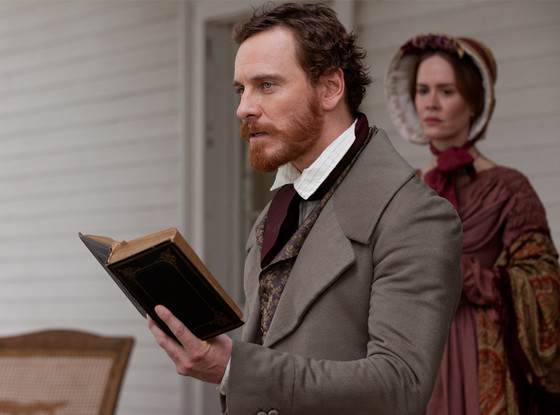
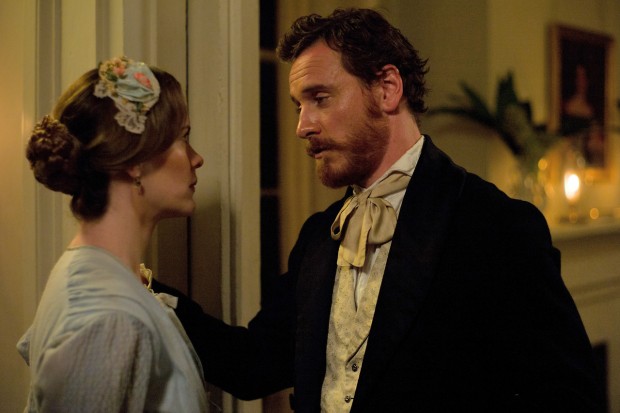
Edwin Epps (Michael Fassbender) reads The Bible while his wife (Sarah Paulson) looks on
How brutal is Mr. Epps? Well, during a recent Daily Show interview, Irish actor Michael Fassbender explained that the saying “don’t be such an Epps” still exists in a part of Louisiana. Master Epps owns a cotton plantation, twists The Bible to his liking, and is liberal with the whip. From the start, Epps takes a dislike to Solomon (who is smarter than his owner, but not so good at picking cotton). A petite, soft-spoken slave woman, Patsey (Nyong’o), is the best picker in the field. “God give her to me,” Epps comments, after he praises her work. (Fassbender is quite creepy in this scene!)
Mistress Epps scratches the face of Patsey (Lupita Nyong’o)
It turns out that alcohol is not Epps’ only weakness- he wants Patsey to yield to his “love” (though he doesn’t know the meaning of the word). When Epps comes to Patsey late at night, she stays as still as she can and won’t look him in the eyes. Mistress Epps (Sarah Paulson from Studio 60 on the Sunset Strip) focuses all her rage at Patsey (throwing a heavy vase; scratching her cheek) in front of the other slaves. (I’ve never seen Paulson in such a meaty film; she’s very scary!)
Epps puts his wife in her place
We get to see Patsey singing and making straw dolls in the fields. And we see the desperation in Epps’ eyes when he’s near Patsey. Why is his wife so one-note? What’s her deal? An African-American journalist shares her analysis:
A white woman’s rage: privileged with no position, positioned with no power, powerful with no promise of independence, fidelity or safety. The white woman could not properly direct her rage at her husband, she could not rail against white male supremacy. She too was in hell, and Black enslaved women were the only ones in the chambers below her. -Michaela Angela Davis
Patsey seeks respite with friendly Mistress Shaw (Alfre Woodard)
[Slave narratives are…] vital for us to have our feet on balanced ground in the future. I think it’s a chunk of our history that we are in denial about and that we don’t accept. And it is the root, I would say, of our contemporary domestic problems. -Alfre Woodard
On her off day, Patsey spends time with Mistress Shaw (Alfre Woodard, one of my favorite actresses), the wife of a neighboring farmer, who used to be a slave herself. Master Shaw fell in love with her, she encouraged his affections, and now lives in ease and comfort. “In time, the good Lord will handle ’em all,” she tells Solomon, when she sees his downtrodden face. Patsey and Solomon have some tea with her, a brief respite from their lives.
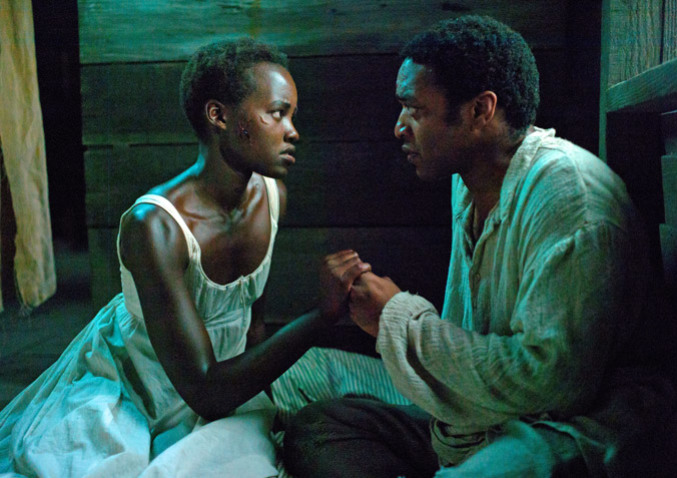
Patsey begs Solomon to end her misery
One of the saddest scenes in the film is when Patsey wakes Solomon up late at night, and begs him to drown her in the nearby river. She doesn’t have the courage to kill herself, and knows it’s not the Christian way. Solomon is horrified by her request- he can’t do that!
Solomon convinces Epps to trust him over Armsby
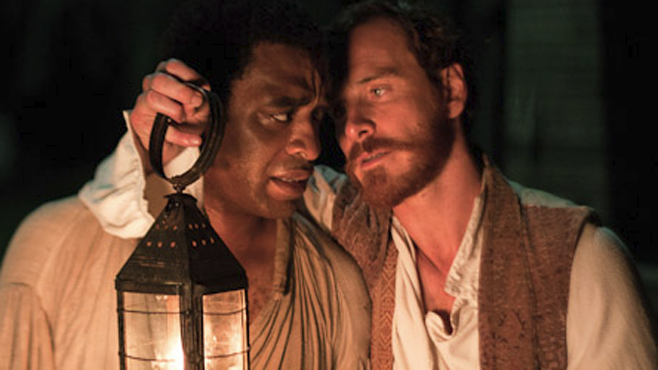
A white indentured man, Armsby (Garrett Dillahunt from Raising Hope), comes to work on the farm. When he brings in a small load of cotton, Epps gives him a few encouraging words, but whips a few of the slaves (who were also bad pickers that day). After Solomon is whipped, Armsby tends to his wounds and tells his life story. Solomon asks him to mail a letter, but he’s not to be trusted! When Epps confronts Solomon, he has to think fast and convince his master that Armsby (the newcomer) is the liar. Notice how Epps often leans on his slaves, as if they’re furniture? But in this scene (pictured above), I thought the director was also trying to show the terrible embrace of slavery in which these two men were bound.
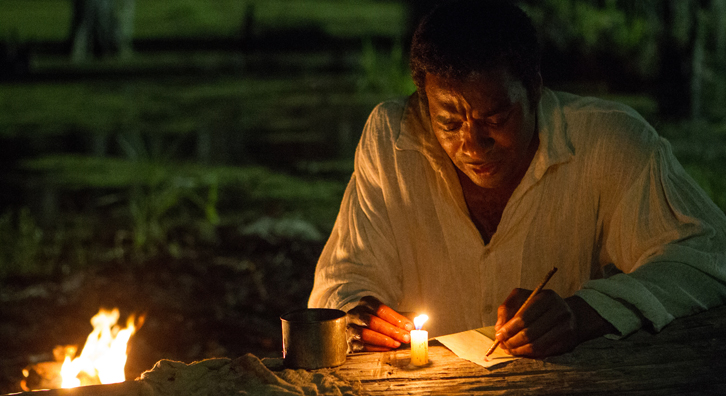
Solomon uses blackberry juice to secretly write a letter
After a long internal struggle, Solomon reconciles himself to his position as a slave (like all the others in the fields). He joins fellow slaves in song in one pivotal scene.
Bass (Brad Pitt) is against slavery
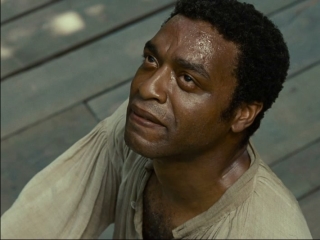
When a traveling builder from Canada, Mr. Bass (Brad Pitt, also a producer), comes to work on a project, Solomon finds a sensible/sympathetic ear. This self-made man is not scared to tell Epps that he feels slavery is inherently wrong. Finally, Solomon reveals his story and gives him a letter. Notice how Bass is sitting on a beam above Solomon? (Some critics found Pitt’s presence distracting, but I saw no problem.)
Solomon looks up at Bass
There is no Hollywood ending here; an elderly white store owner travels down South to vouch for Solomon. Epps rages at him, but Solomon quietly follows his old acquaintance to a carriage. Patsey watches as Solomon rides away; we know she’ll probably never escape her horrible life. When Solomon returned to his family, I felt the tears coming. There was a big “whoa” from the audience. His daughter is married with a baby son. Solomon’s son is taller than him now. Solomon is overcome with emotion, realizing how much he missed (it was stolen from him). He bows his head, cries, and says “forgive me for my lateness.” His wife quietly replies, “There is nothing to forgive.” He survived- that was his heroic act.
Director Steve McQueen and his cast
Ejiofor (if you don’t know his work already) will steal your heart in this movie. His large, expressive eyes say it all, even when Solomon has to swallow his pride (being a free man) and stay silent. When he tries to run away, but runs smack into a lynching in progress, it’s just so heartbreaking! There is nothing showy or overdone- he simply inhabits the character. At one (silent) point, he looks directly into the camera, as if to say “Yes, this really happened.” Fassbender, who has worked with McQueen on several other films, creates a crazed, obsessed, alcoholic- a very compelling villain.
The cinematography is also very effective- we see the brutality of slave life in the (often) gorgeous environment. The director takes some risks, but they pay off. Nudity is used, not to titillate, but to point out the powerlessness of enslaved black bodies. Long takes show us the seriousness of the topic- no romanticizing here. The bloody whipping scene involving Epps, Patsey, and Solomon will stay in your mind for a long time.