All That Heaven Allows (1955)

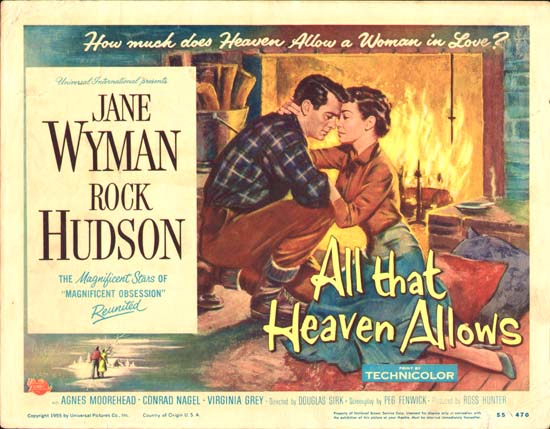
Did you see Far From Heaven, the 2002 film starring Julianne Moore, Dennis Haysbert, and Dennis Quaid?  Not only is that film intelligent and sensitive, it harkens back to an era of beautifully-made melodramas.  The director, Todd Haynes, was influenced by the work of Douglas Sirk, the director of All the Heaven Allows, starring Jane Wyman and Rock Hudson, now available on Netflix Instant Play.

Wyman stars as Cary Scott, a widowed mother (somewhere in her 40s) with two grown children living in suburban New York.  Her deep-thinking daughter Kay goes to Princeton and does social work in NYC; she also has a serious boyfriend.  Her jovial son Ned is finishing up college and looking toward launching his career.  The family home is spacious and finely decorated, so we know that the deceased Mr. Scott was a very successful man.

Since her kids pretty much have their own lives, Cary is feeling a bit lonely and wondering what she can do with the rest of her life.  Her best friend and neighbor Sara (Agnes Moorehead; she later co-starred on the TV comedy Bewitched) suggests she get out more to the country club.  Cary does date a bit; she spends time with Harvey, a mild-mannered older man (one of the few single men around).  But she’s still a vibrant woman, so he’s not quite right for her.

Feeling restless, she wonders if she should take up gardening as a hobby.  One lovely Fall day, she invites her handsome younger gardener, Ron Kirby (Hudson), to sit and share some lunch with her.  Ron’s deceased father had cared for the gardens of this community for years, but he has more plans for himself.  They tentatively become friends.  Within one year, Cary and Ron’s lives (and her views) will be profoundly changed by their evolving relationship.

From Here to Eternity (1953)

I saw this film for probably the third time this past week.  (It’s my mom’s favorite.)  It boosted the careers of its stars: Burt Lancaster, Deborah Kerr, Montgomery Clift, Donna Reed, and Frank Sinatra (who provides most of the much-needed humor and optimism).  Wow, what a cast!   The film won 8 Academy Awards; it was nominated for 13.

Young Army Private Robert E. Lee Prewitt (Clift) comes to a new base for his assignment.  From his first day, many of the other men bother him about not fighting (boxing) in the company league; we learn that he was quite successful at it, aside from one (tragic) event.  Sergeant Milton Warden (Lancaster) tells the others to leave the guy alone.  Warden, who’s admired as a great soldier, likes Prewitt, though he calls him “hard-headed.”  Prewitt, no matter what insults or how much punishment he’s given, says he’ll never box again.

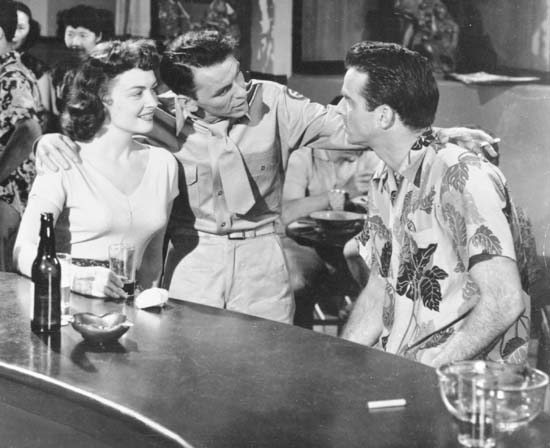
She’s not that into you…  but give her time!  Yes, that’s petite Donna Reed (post-It’s a Wonderful Life).  She plays “Lorene” (real name: Alma), a somewhat jaded dance hall girl who Prewitt wants to get close to.  Though he wants a relationship, Alma is hesitant because she wants to keep working to secure her future.  Reed, who’s character is tough and independent-minded, won Best Supporting Actress.

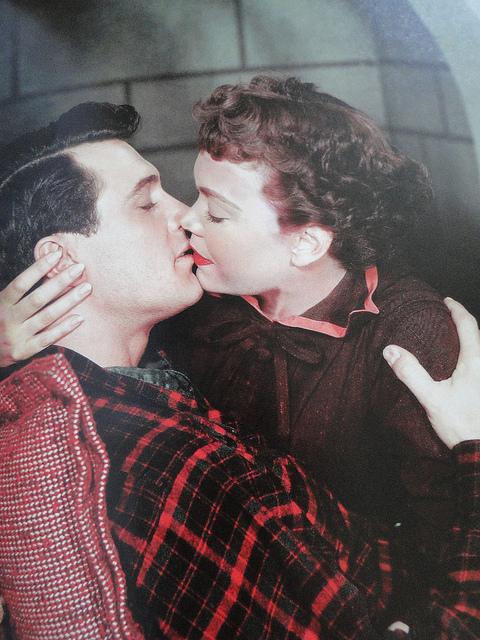
Warden has his life complicated by his intense attraction to Karen (Kerr), the wife of his boss, Captain Holmes.  Like Alma, Karen is more than what she appears to be- sublimating her great loneliness and sorrow by behaving scandalously.  (Above: Kerr and Lancaster share one the most famous kisses in Hollywood film history.  Sigh…)

To her surprise, Karen falls deeply in love with Warden, a simple man who’s content to be a humble soldier.

There is more to romance in this story; there are serious issues that arise.  The jovial Private Angelo Maggio (Sinatra) is bullied by the racist Sgt. Judson (Ernest Borgnine).  Maggio and Prewitt were great friends though opposite in temperment; they have fun and get into trouble together.  But there is a sense of foreboding throughout much of the film, as is fitting-  the story takes place on the island of Oahu just a few weeks before the attack on Pearl Harbor.

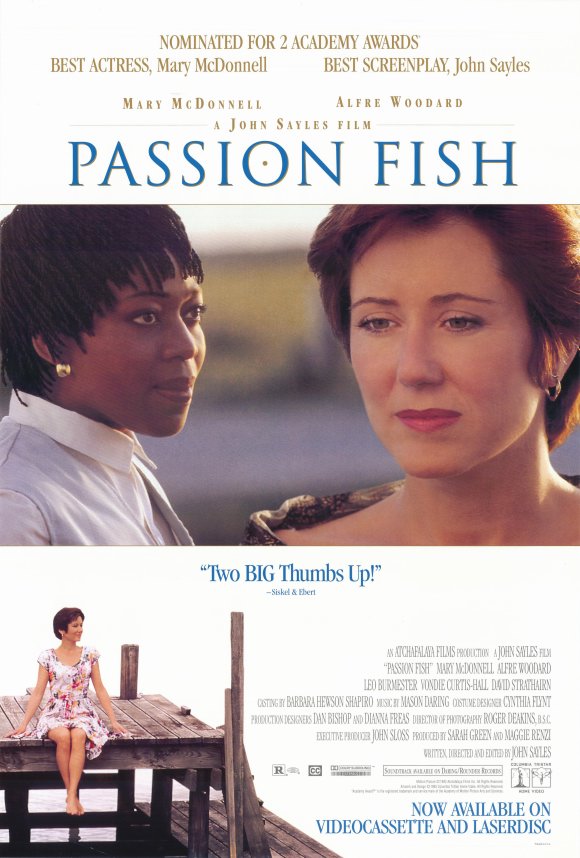
Passion Fish (1992)

John Sayles’ movies are just a treat for an intelligent viewer- thoughtful, multi-dimensional, and well-developed (you go through a journey with the characters).  The respected (yet not widely-known) writer/director doesn’t do any tricks with the camera, choosing instead to let the focus be on his characters.  In Passion Fish, Sayles (a masculine feminist, in my opinion) unfolds the story of two very complicated, stubborn women.  You need to be patient when you watch this type of picture, as things unfold in at a slower pace than in typical modern Hollywood movies.

Mary-Alice Culhane (Mary McDonnell) is a soap opera actress living in NYC when a freak accident results in her paralysis from the waist down.  She decides to move back to her old childhood home in the Louisiana bayou, drink heavily (wine is her favorite), watch TV, and torment several female caregivers who come to work for her.  They quickly leave the job, of course.   Mostly, Mary-Alice wallows in self-pity, feeling that her life is over.

Finally, a determined young African-American nurse from Chicago, Chantelle (Alfre Woodard), comes to work for the diva.  We learn eventually that she desperately needs this job, as well as a place to live.

Don’t worry, this film has a few men, too.  When Mary-Alice’s old car breaks down, Chantelle meets (and gets hit on) by a charming, fun-loving cowboy nicknamed Sugar (Vondie Curtis- Hall).  At the gas station, she meets another local, quiet and handy Rennie (David Strathairn).  It turns out that he and Mary-Alice knew each other since childhood.  Rennie offers to come work on the old Culhane house, so she can get around with the wheelchair.

Watch for a few other characters (and surprises they bring).  Angela Bassett has a few nice scenes as Mary-Alice’s best friend and former co-star.

Double Indemnity & Unfaithfully Yours

Double Indemnity (1944)

It’s just like the first time I came here, isn’t it? We were talking about automobile insurance, only you were thinking about murder. And I was thinking about that anklet.

In this captivating film noir (directed by Billy Wilder) successful insurance salesman Walter Neff (Fred MacMurray) is a goner from the moment he sees Phyllis Dietrichson (Barbara Stanwyck) standing above her stairs wearing only a towel while on a house call.  They are very attracted to each other and carry on a strong flirtation.  But the clever and sultry housewife is thinking of taking out an insurance policy on her husband (without his knowledge) and murdering him.  Though Walter knows this is wrong, he quickly agrees to help Phyllis so that she’ll be free to marry him. 

While Phyllis betrays her husband, Walter betrays his boss and close friend, Barton Keyes (Edward G. Robinson in a rare good guy character role).  Stanwyck told Wilder that she was afraid to take on the role of an out-and-out killer, but was later very glad about her decision.  MacMurray, who thought he couldn’t handle the role, got the chance to show his acting chops.   He’s mostly known for lightweight, Disney roles.  As one IMDB commentator wrote: He is consumed by his passion and he will do anything because of what he perceives will be the reward for doing the crime. Walter Neff was perhaps Mr. MacMurray’s best creation. He is completely believable and vulnerable.

I highly recommend this film because it has an interesting premise, terrific dialogue, and the the two leads have great chemistry together.  The only thing I didn’t like about it- the platinum blonde wig worn by Stanwyck.   

Body Heat (1981) starring William Hurt and Kathleen Turner is a reworking of Double Indemnity set in the tropical heat of Florida.  Hurt plays Ned Racine, a small-time, slacker lawyer who quickly falls head over heels in lust with mysterious Matty Walker (Turner), a beautiful young woman married to an older man (played by Richard Crenna).  Ned agrees to help Matty kill her husband, thinking that she reciprocates his love.  But Matty’s only goal is to be rich.


Unfaithfully Yours (1948)

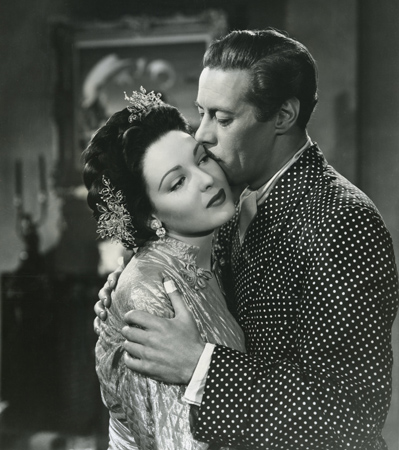
As with Stanwyck, you really can’t go wrong with Rex Harrison!  He was smart, funny, charming, and had a big screen presence.  This screwball black comedy film had me laughing out loud (during many scenes).  But it also has some dark elements and great classical music, too.  Harrison plays a famous British orchestra conductor/nobleman, Sir Alfred de Carter.  Linda Darnell plays his much-younger wife, Daphne.  They seem to have a very lovey-dovey relationship at the opening of the film. 

While he was away, Alfred asked his brother-in-law August to “look after” his wife (in case she was bored/lonely).  But the dimwitted August misunderstood and had a private detective follow Daphne.  Alfred flies off the handle when he hears this: I give you my solemn word, August: if I don’t regain control of myself in a few minutes, concert or no concert, I’ll take this candelabrum and beat that walnut you use for a head into a nutburger, I believe they’re called!

The Strange Love of Martha Ivers (1946)

When the dir. of this film noir, Lewis Blackstone, complained to Lauren Bacall re: the “lack of interesting men in Hollywood,” she immediately recommended Kirk Douglas (her good friend from NYC theater days).  That is how Douglas got his 1st film role- starring opposite Barbara Stanwyck no less!  Stanwyck, known as a generous co-star, helped Douglas manuever through his 1st film.  He does a TERRIFIC job, as do his fellow 3 leads.

In 1928, strong-willed teen Martha Ivers is desperate to run away from her small factory town (Iverstown, PA)  and the domineering/wealthy aunt who’s in custody of her after her parents’ deaths.  A street-smart boy from the other side of the tracks (and close friend), Sam Masterson, is also planning to run away to join the circus.  Their plan is thwarted first by  local cops (under the thumb of the aunt) and then by Martha’s tutor, Mr. O’Neil (trying to ingratiate himself w/ the aunt).  Walter, O’Neil’s straight-arrow son, wants to win Martha’s friendship.  That stormy night, things occur that will change the course of  these characters’ lives forever.

Then we go forward to 1946, when a grown-up Sam (Van Heflin) drives into Iverstown to find “his people” (relatives).  While daydreaming, his car got dinged up, so he has to stop at a garage.   He meets a beautiful young woman Antonia “Toni” Marachek (Lizabeth Scott) sitting on the steps of his former house, now a boarding house.  She’s not sure if she should take the late bus to her parents’ house in the next town.  They commiserate re: the mistakes they’ve made in life, etc.

Sam, a drifter/gambler, is chagrined to discover that “scared little boy” Walter (Douglas) is now a DA w/ political ambition.  Walter is also married to Martha, who has expanded her aunt’s factory, created many jobs, and become a powerful woman in her OWN right.  Toni gets in trouble w/ the law, so Sam goes to Walter’s office seeking help.  Martha comes in while the men are talking; she is VERY happy/excited to see her old friend (and first crush) all grown-up.  She wants to speand some time w/ Sam.  Walter is wary of Sam, fearing that he knows the truth of what happened all those years ago.

This is a well-paced film that contains clever dialogue, intriguing characters, and plot twists.  The quick-witted/confidant Sam is a catalyst for change in the lives of the other characters, but he’s not always 100% sure of the right thing to do.  Martha and Walter’s relationship is complicated and (IMO) HIGHLY dysfunctional.  It’s fun to watch though!