“Ain’t Them Bodies Saints” (2013) starring Casey Affleck, Rooney Mara, & Ben Foster

The tale of an outlaw who escapes from prison and sets out across the Texas hills to reunite with his wife and the daughter he has never met. –Synopsis

This is the (ambitious) debut of a young American director/writer, David Lowery; it was shot in less than one month on location (Texas; Louisiana). Yes, he cast Ruth Guthrie (Rooney Mara) just before she shot to fame! I think the true “star” of the film is Bradford Young; he’s a Black American (which is a rarity in the field of cinematography). Much of this movie was shot during “Golden Hour” (the hour before sunset). I was reminded of Days of Heaven (1978) from another indie director, Terrence Malick. Lowery knows how to set a tone and create a mood; however, this movie is NOT just about “vibes” (as the Youngbloods say). There is simple (or sometimes no) dialogue; we hear voiceover from the emotional letters sent by Bob Muldoon (Casey Affleck) while he is in jail. Music is an important element here; the songs seem like they are lifted directly from the late 1960s/early 1970s in the South.

I had a gut instinct of who would be perfect for these roles. It was those actors. Luckily for me, they said yes. -David Lowery (director) on casting

I watched this free on streaming (Tubi TV) recently; you should check it out IF looking for something original. I was interested b/c Ben Foster has a supporting role; Patrick Wheeler (Foster- sporting a mustache) is a deputy who draws Ruth out of her shell. They grew up in the same little town and attend church together. It’s obvious that the soft-spoken cop has a crush on Ruth, BUT Patrick approaches her in a gentle/respectful manner. In one touching scene, Patrick plays guitar and sings to Ruth’s young daughter (Sylvie). Foster (now 43 y.o.) may be more known for his unhinged/villain roles in recent yrs, such as 3:10 to Yuma and Hell or High Water. He has done a LOT of theater and indies over the yrs. I’ve been a fan of his since Liberty Heights (1999), a coming-of-age drama centered on a working-class/Jewish family in 1960s Baltimore (dir. by Barry Levinson). Foster (who has Jewish heritage on his father’s side) has an older brother in that movie, Adrien Brody (before he became famous).

David Lowery has constructed a beautiful, atmospheric, little indie film with this 1970s Texas crime melodrama. At every point where Lowery could have added Hollywood flourishes and gimmicks to make the film more commercial, he refuses to do so. […]

…Bradford Young deserves all the praise he has earned for his cinematography.

-Excerpt from IMDb review

Two Movies from Noir City DC (OCT 13th-26th, 2023)

Introduction

Hey y’all, how is your Fall season going? Thanks for reading! As local noir-istas may know, Noir City DC film fest is going on (OCT 13th–26th) at AFI Theatre here in my area (downtown Silver Spring, MD). Eddie Muller (TCM host; founder of the Film Noir Foundation) helped to curate the movies for this event. Muller introduced screenings on the opening weekend (OCT 13th–15th); I saw 2 movies (for the 1st time).

The Big Clock (1948) starring Ray Milland, Maureen O’Sullivan, Charles Laughton, George Macready, Pauline York, & Elsa Lanchester

The Strangest and most Savage Manhunt in History! -A tagline for the film

When a publishing tycoon, Earl Janoth (Charles Laughton), commits murder in a heat of passion, he begins to cover his tracks. Janoth frames an innocent man he doesn’t know, BUT who knew the victim, Rita Johnson (Pauline York). That man, George Stroud (Ray Milland), works for one of Janoth’s magazines and is enlisted to trap the “killer.” George must “help” his boss, elude the police, and find proof of his innocence and Janoth’s guilt!

Rita Johnson: You know, Earl has a passion for obscurity. He won’t even have his biography in ‘Who’s Who.”
George Stroud: Sure. He doesn’t want to let his left hand know whose pocket the right one is picking.

Kenneth Fearing’s 1946 novel and this film adaptation bear many similarities to Samuel Fuller’s novel Dark Page (1944) and its screen adaptation Scandal Sheet (1952). Janoth’s right-hand man/lawyer, Steve Hagen (George MacCready), does his dirty work; they’re close (though- b/c of censorship- we don’t see how much). Neo-noir fans will find similarities btwn this movie and (the 2nd adaptation of The Big Clock) No Way Out (1987) dir. by Roger Donaldson. In that movie, Sen. Brice (Hackman) has a V clever/loyal aide, Scott (Will Patton), who cleans up his messes (and is obviously in love w/ the politician).

Don Klausmeyer: Our organization, the Janoth Publications, is trying to find someone, possibly a collector of your pictures.
Louise Patterson: So have I- for fifteen years.

Milland got the roles that Cary Grant turned down, Muller noted; he’s best known for The Lost Weekend (1945) and Hitchcock’s Dial M for Murder (1954). Like Michael Douglas, he has the air of a man who could be a “regular” guy, yet w/ a “shady” side. According to Muller, Louise Patterson (Elsa Lanchester) is based on (IRL American artist) Alice Neel. Laughton and Lanchester were married at this time, though we later learned that he was gay. Director John Farrow and Maureen O’Sullivan (who plays Georgette Stroud) were also married. Unlike what you’d expect from a “typical” noir, there are some of funny moments; Lanchester made my audience LOL during a few scenes.

Act of Violence (1948) starring Van Heflin, Robert Ryan, Janet Leigh, Mary Astor, & Phyllis Thaxter

The Manhunt No Woman Could Stop! -A tagline for the film

Robert Ryan is like one of my top 2 or 3 actors in noir. -Eddie Muller, in intro to the film

WWII veteran Frank Enley (Van Heflin- age 40) is a family man/builder in SoCal. He has a modest house, a beautiful/young wife, Edith (Janet Leigh- just 21 y.o.) and toddler son; he’s respected as a “war hero” in his small town community. One day, he learns that Joe Parkson (Robert Ryan- age 39) is searching for him; he is out for revenge, b/c of something which occurred while they were POWs. Joe drags his right leg as he walks; he carries a handgun. Ann (Phyllis Thaxter- age 29) is the woman following Joe, in the hopes of stopping him from doing something drastic. When Frank has to leave for a builders convention in LA, Joe is close behind! When Frank happens upon a bar, he meets Pat (Mary Astor- in a daring/unglamorous role at age 40).

Joe [to Edith]: Sure, I was in the hospital, but I didn’t go crazy. I kept myself sane. You know how? I kept saying to myself: Joe, you’re the only one alive that knows what he did. You’re the one that’s got to find him, Joe. I kept remembering. I kept thinking back to that prison camp. One of them lasted to the morning. By then, you couldn’t tell his voice belonged to a man. He sounded like a dog that got hit by a truck and left in the street.

No one wore makeup on this movie. Zinnemann wanted somewhat of a documentary look. -Cheyney Ryan (son of Robert Ryan) on the podcast Robert Bellissimo At The Movies (10/12/22)

Some viewers were surprised to see issues tackled so soon after the end of WWII. At the forefront is the question: How does an individual adjust to “normal” life after surviving war? I was excited to watch this movie; it’s currently NOT on any streaming platform. This is a tense noir that’s unpredictable both in its character development and plotting. It’s V well-paced (at only 82 mins), has great dialogue, and important themes. Director Fred Zinnemann (an Austrian Jew who fled Europe before WWII) went on to work on some big movies: High Noon (1952) and From Here to Eternity (1953). As Muller said, Zinnemann learned that both parents were killed in a Nazi concentration camp. The writers of the screenplay are Robert L. Richards and Collier Young (husband of actress/director Ida Lupino).

Edith: Suppose there is a grain of truth to it. Suppose you did have some kind of trouble with him. I can understand how something like that could happen in a prison camp.
Frank: No. You don’t know what happened.
Edith: What was it Frank? Whatever you did you must have had reasons.
Frank: You can always find reasons. Even the Nazis had reasons.

Ryan (who Scorsese called “one of the greatest actors in American film”) and Lupino later starred together in 2 unique noirs- On Dangerous Ground (1951) and Beware, My Lovely (1952). Ryan and Leigh were co-stars in the Western The Naked Spur (1953). Ryan (nearly 6’4″) towers over almost all the others; his simmering rage adds to the intimidating effect. When he talks w/ Edith, his voice is NOT loud/frightening, BUT holds pain/regret. I wanted to see more of Joe’s relationship w/ Ann; they discussed re: what happened in wartime (unlike Frank and Edith). The two leads are opposites in looks: Ryan is brown-haired w/ small/dark eyes, while Heflin is blonde/wide-eyed. Heflin (almost 6″ tall) gets to stretch himself, showing more depth (and emotion) than is usually required of his “Everyman” roles. Leigh does a fine job w/ her role (opposite these experienced men) at such a young age (early in her career). I really liked the cinematography; light, dark, and shadow are used quite effectively.

[1] One of the most daring elements of the film is its suggestion that Heflin is deserving of forgiveness, because the codes of conduct that govern men in the theater of war are different from those that govern us in our day-to-day lives. That maybe doesn’t seem like a daring thing to say now, but at the time it would have been.

Heflin and Ryan are both terrific; Ryan is one of my favorite film noir actors. But the women in the film make quite an impression If the mens’ world- both at war and at home- is one of violence and revenge, it’s the women who act as the voice of reason and sanity, trying to impose a sense of stability amid the chaos.

[2] This grim look at a couple of de-mobbed soldiers continuing their private war at home rarely get mentioned in lists of essential noirs; maybe, upon release in 1949, it was just a little too close for comfort- hinting a truths the victorious American public were unwilling to acknowledge. If so, the film has yet to be rediscovered- or reappraised. […]

Though the script opts for a strange and bitter “redemptive” ending, the acrid taste of Act of Violence lingers long.

-Excerpts from IMDb reviews

Re-watching “The Searchers” (1956) starring John Wayne, Jeffrey Hunter, Vera Miles, Ward Bond, & Natalie Wood

Introduction

The Searchers was voted both the 13th “Greatest Film” of all time and the “Greatest Western” of all time by Entertainment Weekly. It was among the 1st 25 movies to be selected by the LOC for preservation in The National Film Registry in 1989. In 2007, AFI ranked this as the #12 Greatest Movie of All Time. Steven Spielberg, Martin Scorsese, George Lucas, Jean-Luc Godard, John Milius, and Paul Schrader regard this as one of the films that have most influenced them. David Lean (British filmmaker) noted that the way that the landscape was shot (by director John Ford) influenced scenes in Laurence of Arabia (1962).

While on the desert locale, Ford was stung by a scorpion. Worried about his investment, financial backer C.V. Whitney asked Wayne, “What if we lose him? What are we going to do?” Wayne offered to check in on the “stricken” director. A few minutes later he came out of Ford’s trailer and said to Whitney, “It’s OK. John’s fine, it’s the scorpion that died.” LOL!

Synopsis

In 1868, a hardened/middle-aged Confederate veteran of the Civil War, Ethan Edwards (John Wayne), turns up on the small Texan ranch of his brother (Aaron). Instead of settling down to a life of peace, Ethan chooses to embark on a journey of revenge, after Comanches- lead by Chief Scar (Henry Brandon)- who murdered his family, burned their home, and abducted his 2 nieces: Lucy (a teen) and Debbie (9 y.o.) Ethan is joined by a young man (1/8 Cherokee)- Martin Pawley (Jeffrey Hunter)- an orphan/unofficial member of the Edwards family. The 15 y.o. Debbie is played by Natalie Wood (who was still in HS); she has about 10 mins. of screen time in the final act. Young Debbie is played by Lana, Wood’s sister.

The screenplay was adapted by Frank S. Nugent from Alan Le May’s 1954 novel. It was based on the real Comanche kidnapping of Cynthia Ann Parker, a young white girl in Texas in 1836. Parker, who was given the name “Narua” (“one who was found”) would become mother of a Comanche chief, Quanah Parker. She was recaptured after 25 yrs. and never adjusted to life among whites, starving herself to death after the illness/death of her remaining child. Yikes!

Blood Family vs. Found Family

It is V clear that Ethan does NOT consider Marty (who is part Navajo) to be part of his family; he keeps telling the younger man to stop calling him “uncle.” This MAY seem cold/mean to some viewers; after all, Ethan is the one who found Marty out in the desert (after his parents died). He has been raised for many yrs. in the same household as Aaron’s kids. Marty considers the Edwards kids to be his siblings; he refers to Debbie as “my sister.”

Some astute viewers wondered: Is Ethan Debbie’s birth father? Several times, Ford hinted that Ethan had had an affair w/ Aaron’s wife, and was possibly the father of Debbie. Ethan’s thirst for vengeance then could stem NOT from the murder of his brother, BUT of Martha (the woman he’d loved). On a recent re-watch, I saw the subtle clues! In the 1st act, Ethan and Martha share a few meaningful looks. In an early family dinner, Aaron, Lucy and Ben (both blonde-haired) are on one side of the table; on the opposite side are Martha, and Debbie (who all have dark brown hair). Martha strokes Ethan coat when she brings it to him. When the local preacher/sheriff, Rev. Capt. Clayton (Ward Bond), asks why he hung around Texas so long, there is a moment where it looks like Martha wants to speak (before Ethan answers).

Hate, Racism, & Revenge

The actors playing Comanche Indians are ALL Navajo, w/ the exception of Brandon (a German-born Jew). The language, clothing, and dances seen are Navajo, NOT Comanche. Much of the film’s plot is revealed on a prop that most viewers rarely notice. Just before the deadly raid on the homestead, the tombstone (of Ethan’s mother) that Debbie hides next to reveals the source of his hatred for Comanches. The marker reads: “Here lies Mary Jane Edwards killed by Comanches May 12, 1852. A good wife and mother in her 41st year.” We learn that Marty’s parents were also killed by Comanches, BUT he doesn’t have hate for Native Americans. Marty is NOT nice to the Native woman (“Look”) who follows them, thinking that he has bought her (instead of a blanket). Ethan jokes about Marty’s “wife,” who meets a tragic end (at the hand of a different tribe).

Comedy & Romance

There are some light-hearted scenes, a few which hold up, while others are cringe-y. Marty and Laurie (Vera Miles- before Psycho fame) grew up in this same community and are in love, BUT (like some IRL couples) can’t seem to communicate. When the local men first leave to search for the girls, Marty shakes Laurie’s hand good-bye- LOL! Two yrs, later, when Ethan and Marty (w/ facial hair) come to the Jorgensen home, Laurie throws herself into Marty’s arms and kisses him first. Laurie is more sensible/mature than Marty; he acts petulant/boyish when angry. Since Hunter (captain in the Star Trek failed pilot; Jesus in King of Kings) was in his late 20s while filming, it doesn’t seem fitting. In their 5 yrs, of separation, Marty writes Laurie one letter; he hasn’t had a LOT of education (we assume). Laurie fears becoming an “old maid;” there were NOT many options for husbands in the Old West.

Laurie’s father, Mr. Jorgensen (John Qualen- veteran character actor) talks w/ a thick Norwegian-like accent. Laurie’s replacement beau, Charlie McCorry (Ken Curtis), speaks in drawling/slow manner which is annoying! Curtis objected to the accent, BUT Ford argued it’d get him noticed in a thankless role. In the dance scene before the (failed) wedding, the males are some of the most famous stunt men of the era: Chuck Hayward, Terry Wilson, John Hudkins, Fred Kennedy, Frank McGrath, and Chuck Roberson. After this scene, the crew nicknamed them “Ford’s chorus girls” – LOL! The role of the eager/young cavalry officer, Lt. Greenhill, is played by Patrick (Wayne’s son).

Ethan Edwards: Hero or Anti-Hero?

There is TOO much anger, bitterness, and hate in Ethan for him to be close to others. Even after yrs. on the road together, he and Marty don’t become (emotionally) close. He makes Marty his heir when he thinks that he’ll die, BUT Marty refuses. Until his sudden turn in the 3rd act, Ethan considers Debbie to be ruined/savage; she won’t be able to live w/ whites. We are relieved when he decides NOT to kill Debbie! Godard commented that no matter how much he despised the actor’s right-wing political beliefs, every time he saw Wayne taking up Debbie in his arms at the end, he forgave him for everything. What did you think of the ending shot? Is the door closing on Ethan b/c his time (and way of thinking) is coming to an end?

This was one of Wayne’s 3 personal faves, along w/ She Wore a Yellow Ribbon (1949) and The Quiet Man (1952). These films were all directed by Ford. Unlike his usual manner, Wayne decided to stayed in character between takes. When a Navajo child became ill w/ pneumonia, Wayne had his pilot take the little girl to a hospital in his private plane. For this good deed, the Navajos named him “The Man With The Big Eagle.”

[1] An integral part of the combined elements that makes THE SEARCHERS great is Max Steiner’s outstanding score. It is the picture’s driving force – its backbone. Steiner’s music propels the film forward, unifies the narrative and gives greater density to its key scenes. In fact without his music much of the picture’s impact would be considerably diminished.

[2] Ethan Edwards is probably the most racist man Wayne ever portrayed on the screen, yet we feel sympathy for him at the same time. It’s been a hard and bitter life on the frontier for him. Just as it’s been for the Indians as well. Chief Scar, played by Henry Brandon, is Wayne’s opposite number and he makes clear what he thinks of whites. Two of his sons were killed and he’s going to take many white scalps in reprisal.

[3] With all of Ford’s unique ‘touches’ clearly in evidence (the doorways ‘framing’ the film’s opening and conclusion, with a cave opening serving the same function at the film’s climax; the extensive use of Monument Valley; and the nearly lurid palette of color highlighting key moments) and his reliance on his ‘stock’ company of players (Wayne, Ward Bond, John Qualen, Olive Carey, Harry Carey, Jr, Hank Worden, and Ken Curtis), the film marks the emergence of the ‘mature’ Ford, no longer deifying the innocence of the era, but dealing with it in human terms, where ‘white men’ were as capable of savagery as Indians, frequently with less justification.

-Excerpts from IMDb reviews
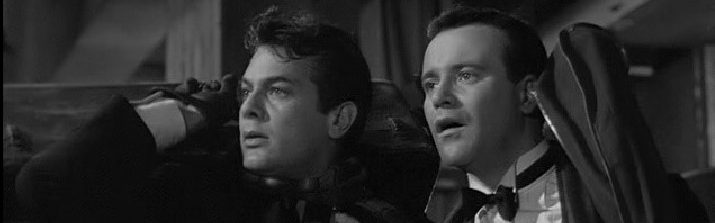
“The Tin Star” (1957) starring Henry Fonda & Anthony Perkins

In the able hands of Henry Fonda and Tony Perkins THE TIN STAR shines like gold! -Cecil B. DeMille

Morg: A decent man doesn’t want to kill, but if you’re gonna shoot, you shoot to kill.
Ben: How about hittin’ them in the arm?
Morg: That hokey-pokey’ll get you killed fast. There’re a lot of guys bragging about shooting a gun out of somebody’s hand. They’re lying. They shot to kill. A wounded man can still kill you.

A world-weary bounty-hunter, Morg Hickman (Henry Fonda- at 52), rides into a small town w/ the body of a criminal he captured. The (formerly safe/orderly) town is facing danger; their sheriff was recently killed. A young/inexperienced local, Ben Owens (Anthony Perkins- just 25), is named the temporary replacement. Ben desperately wants to be sheriff, BUT needs to convince the town’s leaders. His fiancee, Millie Parker (Mary Webster), refuses to marry Ben unless he gives up this goal. While Morg awaits his payment, he stays w/ a widow just outside town, Nona Mayfield (Betsy Palmer), and her young/half Native American son, Kip (Michel Ray). When Ben hears that Morg was a sheriff for many yrs, he asks the older man to teach him what he needs to know.

Morg: [to Ben] Learn what to stay out of. If you step into a fight, make sure you’re the better man. Paste this in your hat: a gun’s only a tool. You can master a gun if you got the knack. Harder to learn men.

I heard about this movie on the Hellbent for Letterbox podcast; it’s “a thinking person’s Western” (as one viewer commented). It was directed by Anthony Mann; he made several movies in this genre w/ Jimmy Stewart. I learned that Stewart was supposed to star here, BUT then (his BFF) Fonda took on the role. Fonda always gives a strong performance; he and Perkins (before Psycho) make a fine- though unexpected- duo. They’re both V tall (6’ 2”) w/ wiry builds, yet give off different types of energy onscreen. Perkins (who studied at The Actors Studio in NYC) isn’t afraid to show Ben’s youthful insecurity and vulnerability.

I thought that the dialogue was great; the 3 writers (Dudley Nichols, Barney Slater, and Joel Kane) were nominated for the 1958 Oscar for Best Writing, Story and Screenplay – Written Directly for the Screen. The supporting characters get their moments. The kindly/elderly Dr. Joe McCord (John McIntyre) is a trusted friend to Ben and the unofficial historian of the community. There are two villains (played by Neville Brand and Lee Van Cleef); these actors also appeared in many noir films. We see how those w/ Native American heritage are treated; they’re relegated to the outskirts of society. The production design is well done; i.e. the large window of the sheriff’s office looks out onto the town square (so Ben can see what’s going on).

[1] You can never take your eyes off Henry Fonda – tall, dark and brooding if there ever was one. Anthony Perkins is (of course) very different to Norman Bates in Psycho and for those of us who saw him in that long before this earlier work, will not be disappointed.

The near-silent ending is as tense as you’ll find anywhere within any Western – and you will be both too – silent AND tense…

[2] We have all the necessary ingredients for a fine screenplay. We have greed, hate, violence, racism, ignorance, and just plain human decency all exposed on screen with an even pace to measure the morals meted out by Fonda’s character as the plot unfolds.

[3] The Tin Star is undoubtedly a very important Western featuring some of the most memorable and heart-warming moments of the genre’s history and a wonderful performance from Henry Fonda.

-Excerpts from IMDb reviews


Countdown to #Halloween: “American Psycho” (2000) starring Christian Bale, Willem Dafoe, Jared Leto, Samantha Mathis, Chloe Sevigny, & Reese Witherspoon

Killer looks. -A tagline for the film

The character is so vain and obsessed with his looks. While the psychology of the character was something that I could perform, you can’t fake the physicality. Being English, I tend to enjoy going down to the pub far more than going to the gym, so it was very unnatural for me. I just had to convince myself that I loved it, which was the most difficult thing about playing this part. Working out is incredibly boring. I swear it’s true that the bigger your muscles get, the fewer brain cells you have. I found I had to stop thinking when I was in the gym because if I thought about it, I’d realize how ridiculous it was that I was pumping iron when I could’ve been out having a drink and a cigarette and enjoying some lunch. I did three hours a day for six weeks with a personal trainer and some time before that. I ate an awful lot during training and then almost nothing during filming. -Christian Bale (actor)

It’s the late ’80s, a 27 y.o. old Wall Street bro, Patrick Bateman (Christian Bale- NOT yet famous), travels among a small network of the young/rich/beautiful. They all come off as vain narcissists who attended elite colleges, dine at the most exclusive restaurants, and constantly compete w/ each other (even when it comes to romance). Patrick has a strict morning routine(“self-care”- we’d say today) to maintain his youthful skin and super-fit body. Patrick’s friends incl. several conventionally handsome/up-and-comers from US/Canada: Paul Allen (Jared Leto), Tim Bryce (Justin Theroux), Craig McDermott (Josh Lucas), and Marcus Halberstram (Anthony Lemke). Willem Dafoe (playing a private investigator) has unique looks; he is thus considered to be odd/suspicious to the audience. Patrick’s fiancee, Evelyn, is played by (soon to be “America’s Sweetheart”) Reese Witherspoon; they hardly spend any time together. An indie movie darling (Chloe Sevigny) is Patrick’s secretary, Jean. We soon learn that Patrick’s “mask” hides someone mentally unstable and dangerous!

Leonardo DiCaprio (already well-known in Hollywood) was 1st offered the (controversial) lead role; he declined the role after a meeting w/ Gloria Steinem (where she said it’d be bad for his career). Ewan McGregor (who’d reach international fame in Star Wars prequels) was also offered the role; Bale convinced him NOT to take it. Before preparing for American Psycho, Bale (w/ a naturally tall/slim build) hadn’t gone to a gym (wow)! The young actor even insisted on paying for his own dental work, as he felt Patrick would have perfect teeth. Looking for a way to create the character of Patrick, Bale came upon an interview w/ Tom Cruise on the Late Show with David Letterman. According to the co-writer of the screenplay/director, Mary Harron, Bale saw in Cruise “this very intense friendliness w/ nothing behind the eyes,” and based his character of on the actor (LOL)! Most of the dialogue is taken word-for-word from the source novel by Bret Easton Ellis.

I re-watched this after many yrs (on Max); this is the type of horror which is NOT for sensitive (esp. squeamish re: blood) viewers. This also contains dark comedy, as it takes on the superficiality of “yuppie” culture. Everyone in Bateman’s circle appears to be the same; it’s no wonder that identity is mistaken and swapped (as many viewers commented). In several cases, Patrick is mistaken for Marcus; they both prefer the same designer suits, glasses, and hairstyle. The film (though low budget for its day) has many designer labels: Nino Cerruti (men’s suits), Rolex (watches), Perry Ellis (underwear), Jean Paul Gaultier (luggage), L’Occitane (skincare), etc. If you’ve lived for some time in NYC, this movie will resonate a BIT more w/ you!

[1] The film looks to examine our own distorted points of view or detachments from reality. Like Patrick Bateman, we may be trapped craving the approval of others and denying ourselves the ability to distinguish fantasies from our reality. People are obsessed with how the others perceive them

To escape the conformity that he, on some level, despises Bateman leads a second life as a killer, where he’s unfettered from the bounds of society. Although he actually wants to be seen as a murderer, as someone different from the rest of society, Bateman is denied even the satisfaction by every self-absorbed yuppie he meets. When he’s seen stuffing a body into the trunk of a car, the witness is only interested in the bag.

[2] The performance of Christian Bale is calculatingly brilliant, and that is due to how wonderfully despicable he is from the start, and it only gets worse. The way he talks is absolutely annoying, and that makes the film hysterical from the start. His facial expressions through the eyes and the way he talks makes me instantly discus him, but there are a lot of fools around in the business world who thinks latching on to a person like that would be an aid to their career.

[3] One of the weirdest movies I’ve seen. Saw on video tape when it came out, then recently watched it again 18 years later. Forgot how fun it is to watch. The absurdity of Bale’s character Patrick Bateman’s shallowness and preoccupation with superficial things, like how upset he gets over a colleague having a better business card than him, makes this movie comedic while he’s slicing up victims. Still not sure about whether or not all of the things happening were all in his head. I guess that’s up for anyone’s interpretation of the story. Very well done and one of Bale’s best performances, as if he’s ever performed badly.

-Excerpts from IMDb reviews