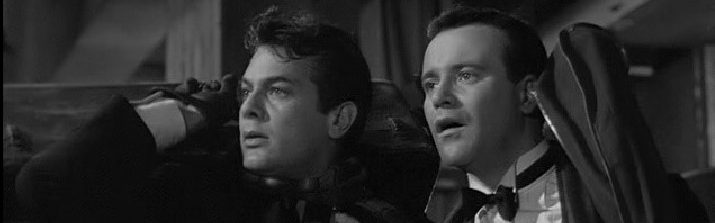
“The Tin Star” (1957) starring Henry Fonda & Anthony Perkins

In the able hands of Henry Fonda and Tony Perkins THE TIN STAR shines like gold! -Cecil B. DeMille

Morg: A decent man doesn’t want to kill, but if you’re gonna shoot, you shoot to kill.
Ben: How about hittin’ them in the arm?
Morg: That hokey-pokey’ll get you killed fast. There’re a lot of guys bragging about shooting a gun out of somebody’s hand. They’re lying. They shot to kill. A wounded man can still kill you.

A world-weary bounty-hunter, Morg Hickman (Henry Fonda- at 52), rides into a small town w/ the body of a criminal he captured. The (formerly safe/orderly) town is facing danger; their sheriff was recently killed. A young/inexperienced local, Ben Owens (Anthony Perkins- just 25), is named the temporary replacement. Ben desperately wants to be sheriff, BUT needs to convince the town’s leaders. His fiancee, Millie Parker (Mary Webster), refuses to marry Ben unless he gives up this goal. While Morg awaits his payment, he stays w/ a widow just outside town, Nona Mayfield (Betsy Palmer), and her young/half Native American son, Kip (Michel Ray). When Ben hears that Morg was a sheriff for many yrs, he asks the older man to teach him what he needs to know.

Morg: [to Ben] Learn what to stay out of. If you step into a fight, make sure you’re the better man. Paste this in your hat: a gun’s only a tool. You can master a gun if you got the knack. Harder to learn men.

I heard about this movie on the Hellbent for Letterbox podcast; it’s “a thinking person’s Western” (as one viewer commented). It was directed by Anthony Mann; he made several movies in this genre w/ Jimmy Stewart. I learned that Stewart was supposed to star here, BUT then (his BFF) Fonda took on the role. Fonda always gives a strong performance; he and Perkins (before Psycho) make a fine- though unexpected- duo. They’re both V tall (6’ 2”) w/ wiry builds, yet give off different types of energy onscreen. Perkins (who studied at The Actors Studio in NYC) isn’t afraid to show Ben’s youthful insecurity and vulnerability.

I thought that the dialogue was great; the 3 writers (Dudley Nichols, Barney Slater, and Joel Kane) were nominated for the 1958 Oscar for Best Writing, Story and Screenplay – Written Directly for the Screen. The supporting characters get their moments. The kindly/elderly Dr. Joe McCord (John McIntyre) is a trusted friend to Ben and the unofficial historian of the community. There are two villains (played by Neville Brand and Lee Van Cleef); these actors also appeared in many noir films. We see how those w/ Native American heritage are treated; they’re relegated to the outskirts of society. The production design is well done; i.e. the large window of the sheriff’s office looks out onto the town square (so Ben can see what’s going on).

[1] You can never take your eyes off Henry Fonda – tall, dark and brooding if there ever was one. Anthony Perkins is (of course) very different to Norman Bates in Psycho and for those of us who saw him in that long before this earlier work, will not be disappointed.

The near-silent ending is as tense as you’ll find anywhere within any Western – and you will be both too – silent AND tense…

[2] We have all the necessary ingredients for a fine screenplay. We have greed, hate, violence, racism, ignorance, and just plain human decency all exposed on screen with an even pace to measure the morals meted out by Fonda’s character as the plot unfolds.

[3] The Tin Star is undoubtedly a very important Western featuring some of the most memorable and heart-warming moments of the genre’s history and a wonderful performance from Henry Fonda.

-Excerpts from IMDb reviews


“The Naked Spur” (1953) starring James Stewart, Janet Leigh, Robert Ryan, & Ralph Meeker

Packed with Technicolor Thrills! -A tagline for the movie

A former rancher/Civil War vet, Howard Kemp (James Stewart), has been searching for a murderer, Ben Vandergroat (Robert Ryan), for a long time. Circumstances compel Kemp to take on 2 partners- an old prospector, Jesse Tate (Millard Mitchell), and a dishonorably discharged Union soldier, Roy Anderson (Ralph Meeker). When they learn that Ben has a $5,000 bounty on his head, greed starts to get the better of Jesse and Roy. Howie and Ben have a (troubled) history, and Ben takes every chance he can to sow doubt btwn the other 2 men. To add to the drama, there is a beautiful/young woman riding w/ Ben- Lina Patch (Janet Leigh in one of her early leading lady roles).

You can take any of the great dramas- it doesn’t matter if it’s Shakespeare or if it’s any of the Greek plays- you can always lay them in the Western and somehow, they come alive. There is this kind of passion and drama. You can have patricide, any kind of -cide- but if you’re in a Western, you can get away w/ it… b/c it’s where… all action took place. -Anthony Mann, director

The Naked Spur (directed by Anthony Mann- who started in B-movies of the noir genre) is the MOST successful Western movie of 1953. It’s a “psychological Western” filmed on location (mainly in the Colorado Rockies) and doesn’t shy away from (gritty) violence. There are several scenes of exciting action, plenty of character development, and terrific dialogue. This is the 1st screenplay by Sam Rolfe and Harold Jack Bloom, who shared an Oscar nom; they went on to have long/successful careers as writers/producers. Mann and Stewart would collaborate on a total of 11 films, incl. 5 Westerns!

Ben [to Howie]: Choosin’ a way to die? What’s the difference? Choosin’ a way to live – that’s the hard part.

As the bitter/troubled Howie, Stewart (44 y.o.) reveals darkness, intensity, and vulnerability; the actor was working to let go of his bumbling/youthful/Everyman image (after returning from WWII). A strong protagonist needs a strong antagonist; Ryan (43 y.o.) wears his black hat (villain role) perfectly. As Ben, Ryan (unshaven/floppy-haired) effortlessly switches btwn grinning nonchalance and deep-thinking (in what is considered one of his best roles). Meeker (a leading man on Broadway) looks at ease as the volatile/sleazy womanizer; the Method-trained actor (32 y.o.) sports a bushy blonde mustache. Paul Newman was Meeker’s understudy in a Broadway play. Leigh (at just 25 y.o.) does a fine job alongside her (older/more experienced) co-stars; she gets a few moments to shine (rare for women in Westerns). Even if this is NOT your fave genre, you may enjoy it a LOT! You can rent the movie on Amazon Prime.

[1] Spectacular location photography in the Rocky Mountains lends a ring of authenticity to the story.

[2] …Ryan’s charming, snake-like villain who dominates this rugged western despite strong performances from the entire cast. He obviously relishes his role and is a joy to watch.

[3] …an outstanding western and has lost none of its glow over the years and like all classic westerns- it just gets better and better with the passing of time.

[4] …Mann directs very assuredly, James Stewart is wonderfully ferocious and Robert Ryan is very charismatic in a more convoluted role. The film looks great, with wonderful sets, scenery, costumes and photography. The music adds to the mood of each scene without feeling too intrusive. The dialogue is excellent and the story- even with the well-worn themes and such- is very compelling.

-Excerpts from IMDb reviews

Proto-Feminist Western/Melodrama: “Johnny Guitar” (1954) starring Joan Crawford, Sterling Hayden, & Mercedes McCambridge

Sam: [to the two men in the kitchen] Never seen a woman who was more of a man. She thinks like one, acts like one, and sometimes makes me feel like I’m not.

Vienna (Joan Crawford- 50 y.o.) has spent nearly 5 years to built a saloon outside of Southwestern town. She hopes to build her own town once the railroad comes through, but most of the locals want her gone. When four men hold up a stagecoach and kill a man, the sheriff and community leaders, led by Emma Small (Mercedes McCambridge- 38 y.o.) come to the saloon to grab four of Vienna’s friends, incl. their leader- Dancin’ Kid (Scott Brady- just 30 y.o.) This was the time when when Ernest Borgnine (aged 37) was playing tough/villainous guys; he’s the hot-headed Bart Lonergan. Royal Dano is Corey, the ailing man true to the Dancin’ Kid, who will get a lot of empathy w/ his performance. Veteran character actor John Carradine (aged 48) plays the loyal caretaker of the saloon- Old Tom. Vienna stands strong against the posse of haters; she is aided by a newcomer- Johnny Guitar (Sterling Hayden- 38 y.o.)- who is NOT what he seems.

Vienna: Down there I sell whiskey and cards. All you can buy up these stairs is a bullet in the head. Now which do you want?

A proto-feminist hero is a female who usually fights against society’s expectations of her; this is a term from the 20th c. As some viewers have noted, Vienna stands for progress and new ideas; the wealthy ranchers- Emma and Mr. McIvers (Ward Bond)- are trying to stop that progress which threatens their way of life. While Vienna and her friends are dressed in bright colors (a rarity for Western movies), the posse is dressed in black. The posse is led by the (repressed/petite) Emma; her voice is full of with fire and brimstone. We learn that Johnny met Vienna when she was working in an Oklahoma City saloon years ago; also from other lines, there is no doubt to her being a former prostitute. Jealousy and rejection compel Emma to destroy both her rival Vienna and her unrequited love- the Dancin’ Kid. Hayden does a fine job here; he and and Crawford have good chemistry in their scenes together. Crawford seems to be in control at all times; she tells Johnny when to play and the Dancin’ Kid when to dance. Even when there is a noose around her neck, she stays strong and the men refuse to hang her (until Emma steps in). As one astute viewer commented: “Emma is also a woman in control, but of external forces; on the inside, emotions, fears, and frustrations dominate.”

Vienna: [to Johnny Guitar bitterly] A man can lie, steal… and even kill. But as long as he hangs on to his pride, he’s still a man. All a woman has to do is slip – once. And she’s a “tramp!” Must be a great comfort to you to be a man.

According to director Nicholas Ray, he began shooting the younger actress’ scenes in the early morning before Crawford got on set, as Crawford was very jealous of McCambridge. Ray was quite unhappy during the filming and later admitted: “Quite a few times, I would have to stop the car and vomit before I got to work in the morning.” Crawford, who had bought the rights to the novel and sold it Republic Pictures, initially wanted Claire Trevor or Barbara Stanwyck (her friend) to play Emma. The actresses fought both on and off camera; one night (in a drunken rage) Crawford threw the costumes worn by McCambridge along an Arizona highway! McCambridge (who also played a strong woman in Giant) later claimed that Crawford attempted to blacklist her. Hayden said: “There is not enough money in Hollywood to lure me into making another picture with Joan Crawford. And I like money.” Crawford referred to Hayden as “the biggest pill in Hollywood.” Francois Truffaut said it reminded him of The Beauty and the Beast w/ Hayden being the beauty- LOL! Check out this film if you want to see a unique Western and don’t mind a big dose of melodrama.

[1] …I think Nick Ray and Phil Yordan decided the story was so ridiculous that they would just concentrate on the emotional elements, also bringing out the pure fantasy (going behind the waterfall to find a hidden fortress, the heroine running from the fire in her white satin dress, etc.) that is the best element of all great film.

[2] Weird and hysterical Western with Freudian touches, dreamlike emotionalism and magnificent dialogue in which is blended domination, humiliation and a deadly confrontation- resulting to be a fascinating and melodramatic film.

Love and hate are woven into two protagonists, the fallen angel Joan Crawford and the spinster landowner Mercedes McCambridge; both of them share a mythical confrontation.

[3] The film starts as a western, but it simply doesn’t conform to that genre, instead it is a weirdly matriarchal piece where the traditional roles are almost roundly reversed and the whole film has an otherworldly feel to it. […] The western clichés become secondary to these relationships and the director seems to prefer these to any lynching or shoot out.

The full colour of the film gives it a gaudy, otherworldly appeal that is very enjoyable. Fires range in terrible, hellish reds, while shadows divide scenes of emotional complexity.

[4] A western without savages, cavalry, rodeos, and the usual John Ford stuff. A different western, ahead of its time, and very misunderstood by the public then, but, fortunately, reborn from the limbo and forgiveness, rediscovered by new generations, and still alive, fresh as in its first day, and always inmortal.

-Excerpts from IMDB reviews

Red River (1948) starring John Wayne & Montgomery Clift

[1] The film is considered a Western take on The Mutiny on the Bounty. The relationship between Tom Dunson and Matt Garth is deeply complex. Although they’re prepared to kill each other, deep down they still respect for one another. This relationship is based on control, idealism, respect, and trust.

[2] Wayne and Clift play beautifully off against each other. Father and surrogate son, first working together and then having a big difference of opinion on the cattle drive. Clift started a film career in Red River playing sensitive people who you can only trod on just so long before they take action. 

[3] If anyone doubts John Wayne as an actor of note then they need look no further than his performance here as Dunson. Tough and durable in essence the character is, but Wayne manages to fuse those traits with a believable earthy determination that layers the character perfectly. With Wayne all the way, matching him stride for stride, is Montgomery Clift as Matthew Garth, sensitive without being overly so, it’s the perfect foil to Wayne’s machismo showing. Walter Brennan and John Ireland also shine bright in support, while a special mention has to go to a wonderful turn from Joanne Dru as Tess Millay…

-Excerpts from IMDB reviews

Fourteen years after starting his cattle ranch in Texas, Thomas Dunson (John Wayne) is ready to drive his 10,000 head of cattle to market (1,000 mi. away in Missouri). Back then Dunson, his sidekick Nadine Groot (veteran character actor Walter Brennan) and a teenage boy, Matthew Garth (an orphan/survivor of an Indian attack on a wagon train) started off with only two head of cattle. Dunson is a harsh task master, demanding a great deal from the men signed up for the drive. Matt is a grown man now (who fought in the Civil War); he has his own mind and soon runs up against Dunson who won’t listen to advice from anyone. One of the drovers, Cherry Valance (John Ireland), proposes that they head toward Abilene. When the cattle stampede, Dunson goes to “gun-whip” one of the hands, but Matt intervenes. The men start taking sides and Matt ends up in charge w/ Dunson vowing to kill him. In the scene where Clift tells him he’s taking over the drive, Wayne turned his back on him and said in a low voice, “I’m gonna kill you, Matt.” This went against director Howard Hawks’ idea to have Wayne cringe, but the actor refused to appear cowardly and played it his way. The improvised moment left Clift astonished, but Hawks liked it (and it was used in the final cut).

Bet I ate ten pounds in the last sixteen days. Before this shenanigan is over, I’ll probably eat enough land to incorporate me in the Union. The state of Groot. -Groot complains (re: traveling through dirt roads)

You’re fast with that gun, Matt. Awful fast. But your heart’s soft. Too soft. Might get you hurt some day. -Cherry comments / Could be. I wouldn’t count on it. -Matt replies

There are only two things more beautiful than a good gun: a Swiss watch or a woman from anywhere. Ever had a good… Swiss watch? Cherry jokes w/ Matt

This is the kind of Western for the classic movie fan who avoids (or doesn’t usually enjoy) the Western genre! After seeing Wayne’s performance, rival director John Ford commented to Hawks: “I never knew the big son of a bitch could act.” This led to Ford casting Wayne in more complex/multi-layered roles, incl. The Searchers (1956), and The Man Who Shot Liberty Valance (1962). Hawks originally offered the role of Dunson to Gary Cooper, but he declined it (b/c he didn’t believe the ruthless nature of the character would’ve suited his screen image). This was the debut of Clift (26 y.o. during filming and looking gorgeous), who was known as a talented theater actor. He learned to ride horses while at military prep school, but that was a different kind of riding than this role. Hawks always had high praise for how hard Clift worked (on his cowboy skills) for this picture. After seeing the final version of Red River, Clift found his performance mediocre, but recognized it as a star-making role. He later said: “I watched myself in Red River and knew I was going to be famous, so I decided I would get drunk anonymously one last time.” Burt Lancaster (a former acrobat) was first offered the role of Matt, but he had already signed on to star in the iconic film noir, The Killers (1946), which was his debut. 

There was concern that the leads (Wayne and Clift) would’t get along, since they were opposed on all political issues and both were outspoken on their views. The actors agreed not to discuss politics during shooting. Clift sometimes joined Wayne and Hawks in the nightly poker games they organized. Clift later said: “They tried to draw me into their circle, but I couldn’t go along with them. The machismo thing repelled me b/c it seemed so forced and unnecessary.” In Life Magazine, Wayne described Clift as “an arrogant little bastard.” 

Reviews of Recently Viewed Films

Terminal Station (1953) starring Jennifer Jones & Montgomery Clift

Last week, I saw this rare little gem of a movie one afternoon (on TCM); the David O. Selznick cut is titled Indiscretion of an American Wife. Then, I decided to check out the slightly longer version from the Italian director, Vittorio De Sica(Amazon Prime); it contains a a few more (ambiguous) lines/scenes. De Sica’s films are known for romantic neo-realism. My parents (fans of Sophia Loren) really enjoyed Yesterday, Today and Tomorrow (1963) and Marriage Italian Style (1964) which both won Oscars. 

If my art seems pessimistic, it is a consequence of my continuing optimism and its disillusion. At least I have enthusiasm. It is necessary to all professions to have enthusiasm in order to have success. -Vittorio De Sica

Why did you come with me? -Giovanni asks Mary

You didn’t look very wicked. I’m not an imaginative woman. It was you. It was Rome! And I’m a housewife from Philadelphia. -Mary replies

A married American woman, Mary Forbes (Jennifer Jones) has been involved for a month w/ a slightly younger Italian-American teacher, Giovanni Doria (Montgomery Clift), in Rome while visiting relatives. One rainy morning, Mary suddenly decides to return home to her husband and young daughter, but w/o telling anyone (aside from her nephew, played by a young Richard Beymer). She goes to the (newly built) train terminal, realizes that she is not at all sure about leaving, and agonizes over her decision. Giovanni joins her at the station, very confused and hurt, as she had just told him “I love you” the previous night.  

[1] This is such a contained, focused film, and demands so much of its two actors, every little nuance matters in a kind of exciting dramatic way. The closest thing this compares to, as two lovers or would be lovers talk in a train station, is Brief Encounter (1945), and that’s a masterpiece of acting and cinema both. Here, with Montgomery Clift and Jennifer Jones, it comes close.

[2] Jennifer Jones, beyond radiant in her prime-of-life womanhood, exudes a sensuality that both contrasts strikingly with her 1950s-prim exterior and celebrates the troubled woman within…

-Excerpts from IMDB reviews

There is plenty of drama behind this film! Producer Selznick (then married to Jones), wanted to have a slick romance depicted; De Sica wanted to show a ruined romance (which was fully supported by Clift). De Sica favored realism, so wasn’t interested in Hollywood-style close-ups; Selznick eventually hired cinematographer Oswald Morris to film some of these. Each day on the set, Selznick had critical letters for De Sica (who didn’t know English). The script was altered several times, as the two men had such different visions. Two scenes were written by Truman Capote, who gets screenplay credit. 

The Violent Men (1954) starring Glenn Ford, Barbara Stanwyck, & Edward G. Robinson

Never meet the enemy on his terms. -John says to his ranch hands

I’ll fight for the privilege of being left alone. -John explains to Lee 

A former Union Army officer, John Parrish (Glenn Ford), fully recovered from his war wounds, plans to sell his ranch to the wealthy owner of Anchor Ranch, Lew Wilkison (Edward G. Robinson) and move east w/ his fiancee, Caroline (May Wynn). However, the low price offered by Wilkison, and his hired mens’ bullying tactics, make Parrish think again. When one of his young ranch hands is murdered, he decides to stay and fight, using his battle know-how. At Anchor Ranch, Lew’s shrewd wife, Martha (Barbara Stanwyck), has been having an affair w/ his handsome younger brother, Cole (Brian Keith), who has a Mexican girlfriend, Elena (Lita Milan), that he supports in town. Lew and Martha’s 20-something daughter, Judith (Dianne Foster), has become distant and angry; she has suspected deception in her home.

I know what you’re thinking- whoa, there are a lot of ladies in this Western! I was watching this at my dad’s; even he noticed this fact. Well, not all of these women are well-developed. Caroline seems like she’d marry any guy to get out of her hometown. Elena loves Cole desperately, but we don’t know much about her; her sudden/violent action at the end is quite unexpected (bordering on soap opera). Judith, who’s very much a “daddy’s girl,” is intrigued by Parrish, yet also abhors the violence that ensues during the stampede. Some viewers commented that in order to get a big star like Stanwyck, the role of Martha must’ve been bulked up by the writers. Who doesn’t like Stanwyck!? But I was expecting this film to be more about Parrish. 

[1] The Fifties was the age of the adult western, themes were entering into horse operas that hadn’t been explored before. There’s enough traditional western stuff …and plenty for those who are addicted to soap operas as well.

[2] …the actors in question deserved a better story from which to work from, it is, when all is said and done, a plot that has been milked for all it’s worth, and then some. …still a very rewarding film regardless of the missed opportunities evident with the production.

I learned that this film was shot partly in Old Tucson; my dad noticed this before I did! The cinematography is well done, which is a must for a Western. The best action scene is the one between the unapologetic/violent cowboy, Matlock (one of Lew’s men), and Parrish in the saloon. Ford plays it so cool; he can handle himself w/ a gun man-to-man. This isn’t quite a hit, but worth a look.

The Candidate (1972) starring Robert Redford

…one of the many great movies about the world of politics. It holds up as well today as it did in 1972 (maybe even better). 

A sad commentary on the way things work. Very relevant. I recommend it for fans of Robert Redford or anybody interested in politics 

It’s fair to say that many Americans are fed up w/ politics these days- LOL! It’s refreshing to take a day (or even a few hours) avoiding the news, even if you’re a news junkie (like me). This film was recently shown on TCM; I’d heard much about it, but never watched it. Also, who doesn’t love Redford!? Peter Boyle plays the political expert who convinces Redford to run for Senate (Democratic side, of course). Look out for cameos from journo Mike Barnicle (currently seen on MSNBC’s Morning Joe) and Redford’s real-life pal, Natalie Wood (playing herself).