Les Miserables (2012)

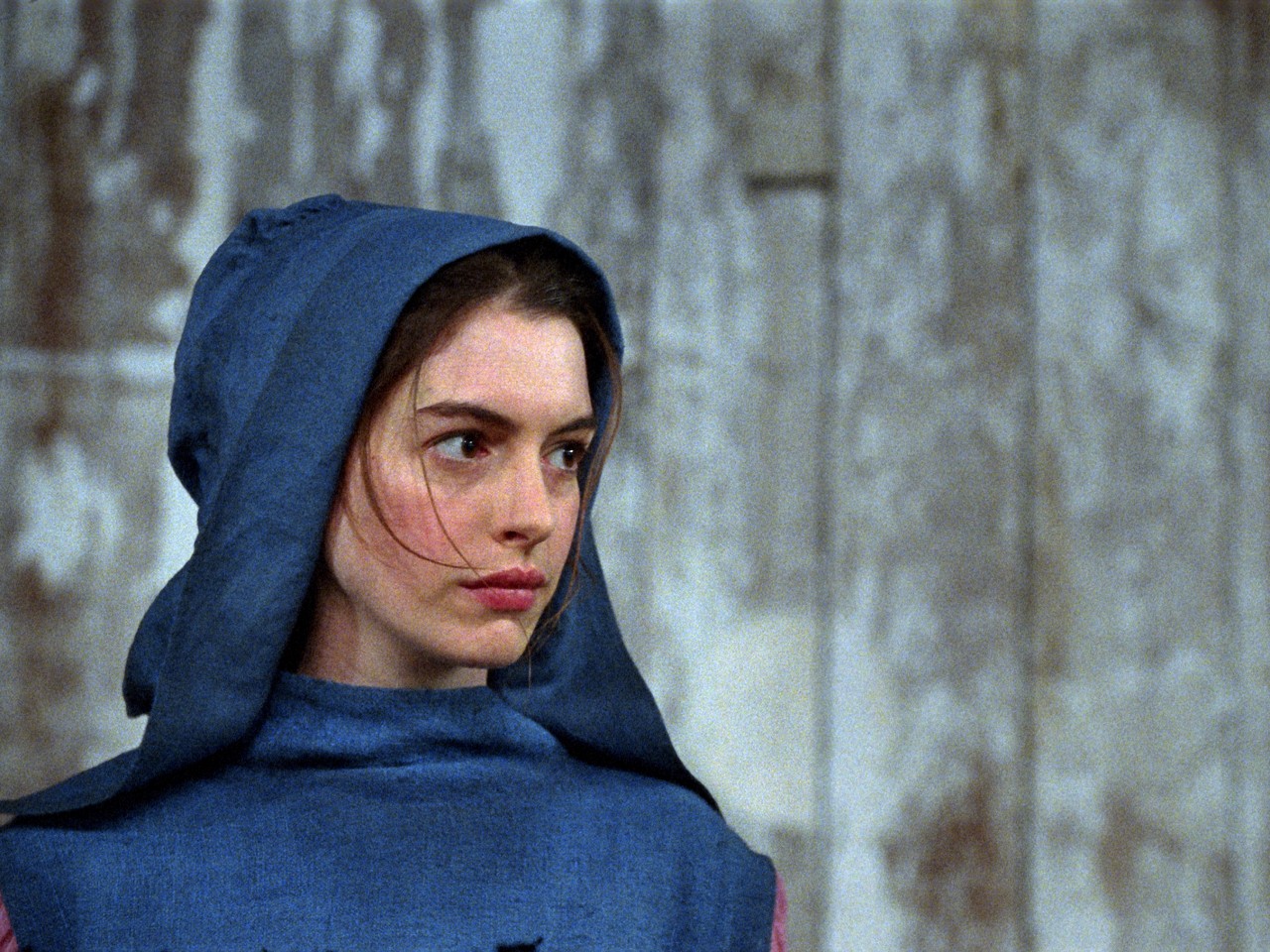
Anne Hathaway as Fantine

Tom Hooper (just 40 years old) is the British director who brought us these compelling/gorgeous miniseries: John Adams (2008), Elizabeth I (2005), and Daniel Deronda (2002).  Though I haven’t seen it yet, he made a big mark with The King’s Speech (2010), which won 4 Oscars.  He brings a very well-known, large-scale tale down to a (small) human level.  No doubt, the star of Les Mis is American Anne Hathaway, who shed not only 15 lbs., but almost all of her long hair, for the role of Fantine.  Oh, and Hathaway can sing, too!  Wow…  Viewers will want to see more, but she appears in the first third of the film only.
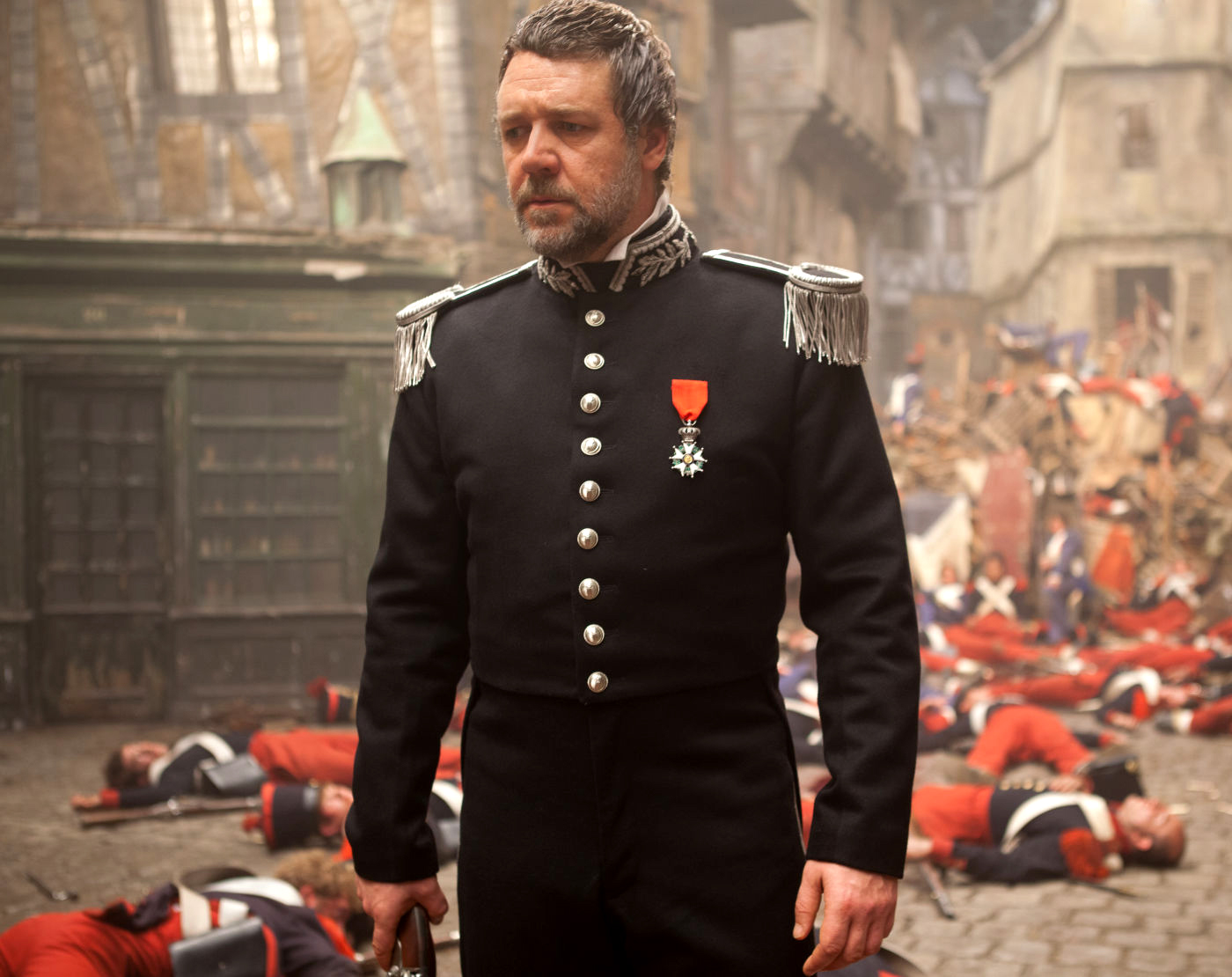
Russell Crowe as Javert

One person who defininitly should not sing is Australian Russell Crowe, I’m sorry to say.  His songs are tolerable (unlike that of Gerard Butler in The Phantom of the Opera), but he doesn’t have a strong voice, and is clearly not very comfortable with this element of the film.  (I love Crowe-a fabulous actor-but the producers/studio should’ve looked for a more suitable voice.  Everyone can’t do any job.)  The film seemed to slow down when Javert came onscreen, aside from the swordfighting scene.
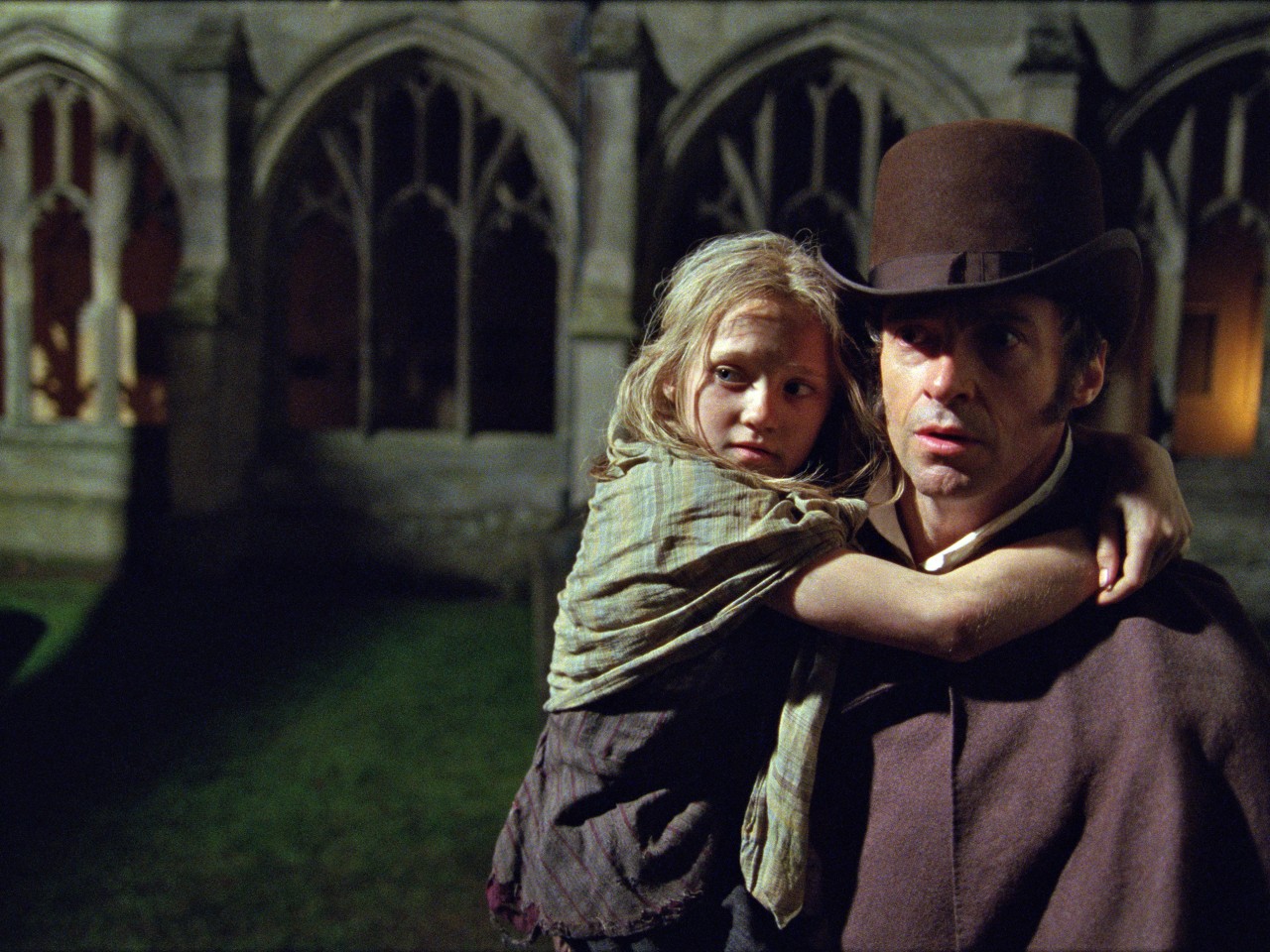
Hugh Jackman as Jean Valjean carrying young Cosette

Hugh Jackman (another Australian; got his start in theater) stars as Jean Valjean, a man who transforms his life by taking Fantine’s young daughter, Cosette, into his care.  Jackman can sing (but you probably knew that already).  In the many close-ups, you can see his emotional range.  I was pleasantly surprised, and feel that he needs to challenge himself even more with his next film roles (no offence to X-Men fans).

The Thenadiers with young Cosette

Students protesting on the streets

The film gets a jolt of energy when we meet the money-grubbing Thenardiers (played by Brits Sascha Baron-Cohen and Helena Bonham-Carter) and young, idealistic men who call for revolution (led by Enjolras, American Aaron Tveit).

Amanda Seyfried as Cosette and Eddie Redmayne as Marius

Then the love-at-first-sight thing happens between the teenage Cosette (American Amanda Seyfried) and idealistic Marius (Brit Eddie Redmayne).  A few in the audience wanted to see more of Eponine (British newcomer Samantha Barks).  Her voice was lovely!  (She also worked in theater.)

Samantha Barks as Eponine

I felt that Cosette and Marius had good chemistry together; their singing was pretty good, too.  However, the film is too long; editing a bit wouldn’t have hurt.  Why draw things out that most of the audience already knows about?

Colm Wilkinson as The Bishop

Long-time fans of Les Mis are in for a treat- Colm Wilkinson plays The Bishop, the man who gives Valjean the “gift of silver” to “become an honest man.”  Wilkinson, an Irishman, played Valjean onstage for many years; his voice is amazing!

Wow, this is a MUST-READ for fans of RA!!!

feignedmischief's avatarFeigned Mischief

Sometimes you meet people for a fleeting moment, and yet they touch you in ways that leave you changed and thankful for that single encounter. Such was the case when I met Richard Armitage last night. However, I am getting ahead of myself…

Confession: I am not the biggest Armitage fan on the planet. I respect the man but I am not a keen collector of his work. I found out about RA through my sister whose fine taste in men should have raised alarm bells. I have since regretted her repeated pleas to watch North & South and slowly but surely, I have started devouring every piece of work that he did to atone for my sins. Better late than never, huh?

Now, enough of my questionable Armitage geekdom… It is already 6 am here in London and I am wide awake and my brain is loaded with wonderful…

View original post 1,000 more words

The Taming of the Shrew (Folger Theater)

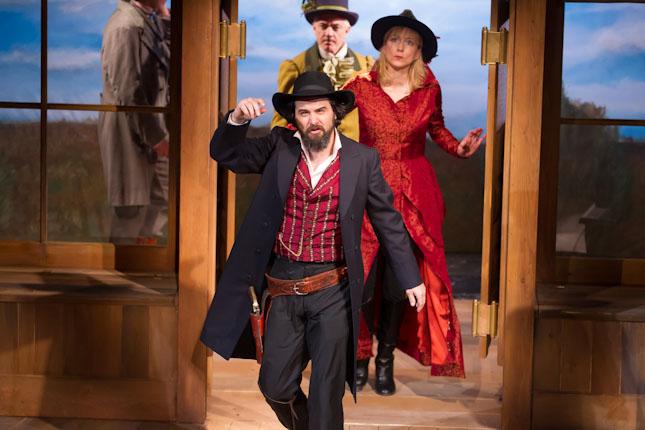
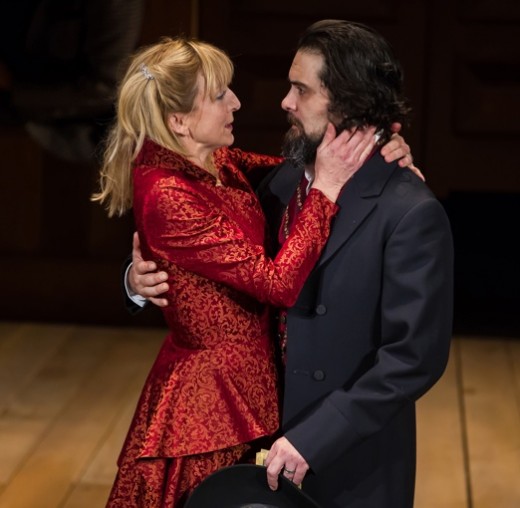
Real life husband and wife Cody Nickell and Kate Eastwood Norris starred in the Folger’s recent adaptation of Shakespeare’s The Taming of the Shrew.  As you can guess from pic above, the comedy was set in the Old West (director Aaron Posner was inspired by HBO’s Deadwood).  There was original music played onstage by the composer.  Also, two of the traditionlly male characters (Baptista and  Tranio) were turned into women.

At the start of the play, Kate is angry, bitter, and fights w/ her little sister, Bianca, and the suitors who constantly mill about her.  Of course, she is only masking her disappointment and loneliness. 

When he first arrives in town to see his old buddy Hortensio, Petruchio is a bold, brassy golddigger; he’ll marry ANY woman if she’s rich.  Bianca’s suitors (Gremio, Lucentio,  Hortensio) can’t believe their luck, b/c once Kate’s married off, they can court Bianca. 

There are a LOT of laughs in this production, BUT at the heart, it’s love story of two VERY strong-willed individuals.  If you know the text, you probably noticed that some lines were switched from Kate to Petruchio.  The final scene showed that the couple were on equal footing; the audience REALLY enjoyed the twist!

Othello (Folger Theater)

Ahh, Othello, one of my favorite characters created by the Bard!  He’s right up there with Hamlet.  He’s the ultimate outsider-insider: an African (Moor; former Muslim who converted to Christianity) in world of whites (Venice, Italy) who commands respect for his military victories.  Then he marries a white girl (the noblewoman Desdemona) and all hell breaks loose.  Well, it’s not quite that simple…

He is a contradictory man- a great speaker who is also capable of great violence.  Othello is a military man who sees things in black and white (this has a double meaning), unlike Iago, who deals in shades of gray.  Being such, he sees killing Desdemona as an act of justice.  My favorite professor said that though he was a skilled warrior, Othello probably had very little experience with love.  He relies too much on Iago’s judgment, because he knows more about the ways of white women.

The current production at the Folger is pretty good, with creative and gorgeous sets, costumes, and music.   The action, including swordplay, was exciting.   For the isle of Cyprus, Middle Eastern clothes and belly dancing is probably not accurate though.  I went to a preview show last Sunday.  The matinee audience was mainly elderly and college-aged, aside for a few who were around my age.

There were a couple of scenes where I got lost in the drama- good to have!  Back in high school and college, I saw Othello (played by Owiso Odera) as more heroic/larger than life; this play cut him a bit down to size.  He wasn’t such a big presence; Iago (Ian Merrill Peakes, who was in Henry VIII last year) was the star and better actor.  Merril Peakes spoke the language with ease and conviction.  Othello, who’s slight accent seemed to drift in and out, spoke the lines, but was not quite there when it came to feeling the words. Othello’s first crucial scene (in front of the Duke of Venice and other important nobles) was not as strong as I’d have liked.  But he did have good chemistry with Iago in their one-on-one scenes.

Emilia (Karen Peakes; also wife of Ian Merrill Peakes) did a great job; her character has some great lines.  Emilia is cynical, experienced, and wise- a contrast to the naive Desdemona.  The actress who played Desdemona got better throughout the play, but was too much of a lightweight.  She was too bubbly in her depiction, which created a tone that I didn’t think was fitting for a very young woman who had recently been disowned by her father.  Rodrigo (Luis Butelli; also in Henry VIII) was the spurned suitor who followed Desdemona to Cyprus.  He provided the comic relief without being over the top.  Cassio was the naive, young lieutenant who fell from Othello’s favor because he couldn’t handle alcohol.

As pointed out above, this production emphasized religion and violence (Othello has these bursts, escalating as we go on).  Othello wore a noticeable gold cross around his neck.  In early scenes, the soldiers, including Cassio,  wore outfits like the Knights Templar- chain mail and white tunics with large red crosses.  (I don’t know if that is accurate, but think it’s possible.)  Also, characters often crossed themselves when they were fearful, worried, etc.