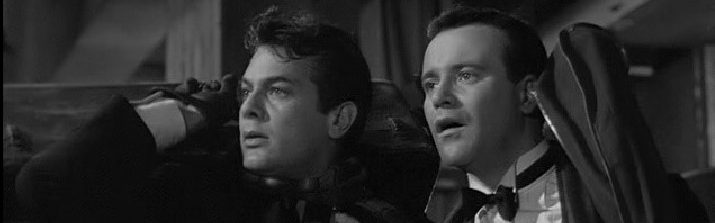
This melodrama is based on a novel and directed by Douglas Sirk (known for his distinct style and focus on “women’s problems”). In our time, his influence can be seen in Todd Haynes’ Far from Heaven and the AMC’s Mad Men.
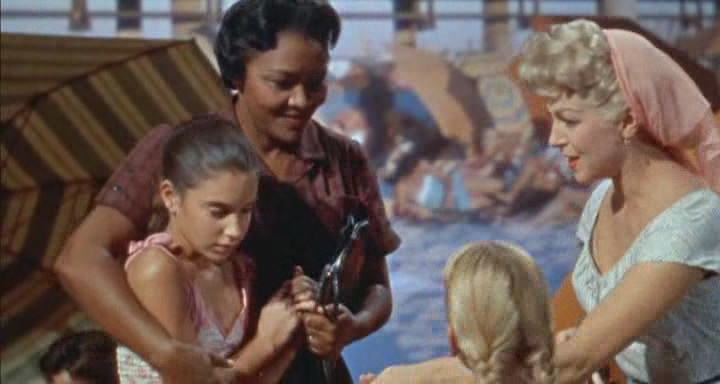
Widowed/single mother, Lora Meredith (Lana Turner), temporarily loses her 6-year old daughter, Susie, at the beach on Coney Island. She scrambles to find the girl amid the crowd, and runs into a handsome photographer, Steve Archer (John Gavin), who offers his help. When she finds Susie, she is with a kind black woman, Annie Johnson (Juanita Moore) and her 8-year old daughter, Sarah Jane (who has dark brown hair and looks white). “Her father was almost white,” Annie explains to the surprised Lora, who thought Annie was the girl’s nanny. It turns out that Annie is also a widow, and she and her child have no place to stay. Lora asks them over to her humble Manhattan apartment.

In no time, the four are functioning as family. Lora goes out into the theater world to seek work as an actress; Annie takes care of the home, kids, and picks up little jobs now and then. The girls go to school and grow up like sisters, though conflicts arise when Sarah Jane insists on hiding her true racial identity. For many months, Steve and Lora date. Though he loves his art, he gets a stable job in marketing. He’s good with Susie, too. But he’s not as perfect as he seems…

In time, Lora achieves the success she dreamed of professionally. She becomes a star of theater, then movies, working with notable directors. The family moves to a spacious house on Long Island. Annie is always there- the “wind beneath her wings”- serving as a homemaker, confidant, and partner. In one poingnant scene, Lora admits that Annie was more of a mother to Susie than she was (because of her high ambitions).
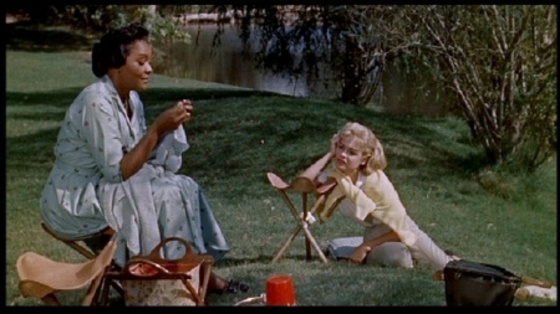
The girls grow into beautiful, charming, independant-minded teenagers. Susie (petite, blonde Sandra Dee) has a positive outlook on life, though Sarah Jane (Susan Kohner, an actress of Czech and Mexican heritage) is troubled and restless.

There is much to admire in this film, but also troubling aspects (reflecting the limitations of Hollywood and US.) Why is Annie always humble, obliging, and wise? Why doesn’t she have weak moments, like Lora? Why weren’t African American actresses chosen to play Sarah Jane (as in the 1934 version)? I’ll have to watch that version, too. Some of the themes in this film are very modern: navigating a man’s world without a husband, raising a child as a single parent, and mother-daughter conflicts.
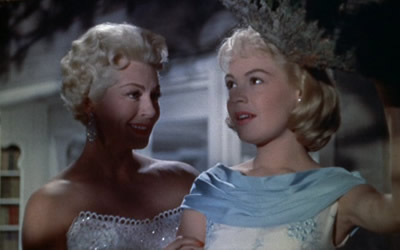
Lora and Annie are like two sides of a coin- one has the strength to face the outside world (with her beauty and confidence), while the other has a quiet, inner strength (stemming from her spirituality). Moore won a Best Supporting Actress Oscar for her performance.

I was impressed by Kohner’s performance; I thought she did a fine job of a rebellious, conflicted individual seeking a place in the world.

























































 Knightleyemma