David Lee Murphy


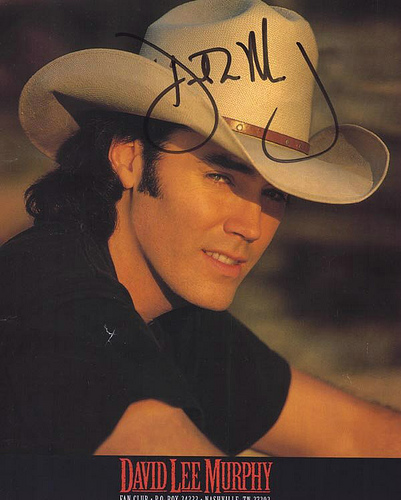
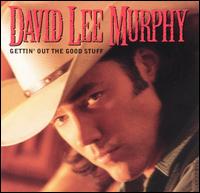
David Lee Murphy (b. 1959) is a successful Nashville singer/songwriter (originally from Illinois).  He wrote the very fun and high energy song On A Mission for the trio Trick Pony.  Before being getting a record deal w/ Mercury in 1994, David co-wrote songs w/ Reba and Doug Stone.  David has also written songs for Aaron Tippin, Kenny Chesney, and Jason Aldean (Big Green Tractor: one of the young singer’s hits).   In 2003, he toured w/ Lee Roy Parnell and John Berry (one of my fave singers).  Another cool fact: we share the same birthday- JAN 7. 

His voice is pure, honest, and no-frills (he doesn’t need any).  Even people who don’t usually like country music can appreciate his sound;  there is NO sharp twang (accent) to this voice.  Instead, there is just something light (youthful; easygoing), smooth, and natural.   I would esp. recommend his songs if you like singers like Mark Chesnutt and Gary Allan.   One of David’s influences was Waylon Jennings; they wrote together shortly before Jennings died. 


Just Once (a fun/fast-paced song featured in the film 8 Seconds; David’s 1st hit song)

http://www.youtube.com/watch?v=QHCoI31UmEE&feature=related

Dust On The Bottle  (a cool song w/ great electric guitar)

http://www.youtube.com/watch?v=uNkF_ZpQ4eg&NR=1

Party Crowd

http://www.youtube.com/watch?v=fIdx1HSFWG8&NR=1

The Road You Leave Behind

http://www.youtube.com/watch?v=x6DLsf8VG5Y

She’s Really Something To See

http://www.youtube.com/watch?v=U0UvT8Wrhg8&NR=1

We Can’t All Be Angels

http://www.youtube.com/watch?v=o56pznB8FDY&feature=related

Unfortunately, David has not recorded his own music since 2004.  But he keeps on writing for other singers. 

http://www.davidlee.com/home.php

David is also on FB and Twitter.  Currently, he is one of the many country singers raising money for flood relief in TN. 

http://www.facebook.com/pages/David-Lee-Murphy/131741595263

http://twitter.com/davidleemurphy

“Elmer Gantry” (1960)

The screen has never known a man like ELMER GANTRY!  (movie tagline)

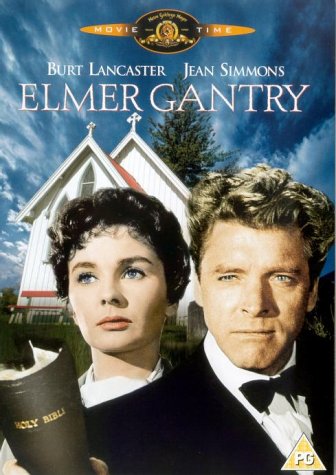
At the opening, we meet Elmer Gantry (Burt Lancaster), a travelling salesman in a dusty little town in Prohibition era Midwest.  He drinks and tells stories at a rowdy bar on Christmas Eve.  All the while, he keeps an eye on the red-suited blonde in the corner.   (Women are one of his weaknesses.)  Some men comment that he “talks like a preacher” after Elmer convinces them to give money to women representing the Salvation Army.   At the end of the night, he takes home the blonde.  Well, it’s not really his home- it’s a tacky hotel room.


Something seems to shift in Elmer’s mind (and maybe his heart) when he goes to a tent revival and sees a beautiful, Evangelical preacher called Sister Sharon Falconer (Jean Simmons).  Earlier, he’d seen her posters; she’s kind of celebrity in small Midwestern towns.  When he briefly speaks to her, he realizes that she’s a no-nonsense gal.  Elmer is even more intrigued, so he cozies up to the group’s choir leader, Sister Rachel (Patti Page), to learn more about Sharon.  Rachel gets a huge crush on Elmer and invites him to join their entourage.  Never one to shy away from dramatics, Elmer hops onto the train at the last minute. 

Aboard the train, Elmer gets a seat by Sharon.  She finds him interesting; he’s a far cry from the “sanctimonious prigs” she usually meets.  Elmer also meets Jim Lefferts (Arthur Kennedy), a jaded Pulitzer Prize-winning journalist who’s been travelling w/ these Evangelicals and reporting on their movement.  Jim believes in evolution, not God.  Both Sharon and Jim quickly realize that Elmer is not a “true believer” in any cause (except maybe himself).

In no time, Elmer takes center stage at revivals, “warming-up” crowds for Sharon.  Her sober-minded manager doesn’t like the new direction.  But Sharon points out that Elmer’s “theatrics” are bringing in more lost souls yearning to be saved.  (Of course, some just want to be entertained.)  As Elmer (who was kicked out of his seminary) gains popularity, it appears that he’s finally found his calling- selling salvation.  Sharon starts to get close to him, too.  But wait, this isn’t the end of the story!       

Elmer Gantry explores some big issues: ambition, corruption (moral/political), faith, freedom of speech, forgiveness, hypocrisy, etc.   Even before this Oscar-winning film (based on a novel) was released, it was controversial.   Initially, no studio wanted to finance it.   Director (Richard Brooks) didn’t want Shirley Jones (pic above) in the role of Lulu, the young woman who unlocks Elmer’s past, but Burt Lancaster insisted. 

Though some viewers called his portrayal over-the-top, that is precisely what the character demanded!  Elmer is a bundle of energy, confidence (false or real), and words.  Not only does Lancaster make Elmer likeable, he makes him very fun to watch.  (There are MANY laughs in this film!)  But my fave scene is the one out in the woods where Elmer confronts Sharon about what men and women REALLY want from each other.  Elmer is not w/o redeeming qualities.  But does he deserve to be saved?  Watch this multi-layered film and decide for yourself!    

http://www.imdb.com/title/tt0053793/

What I watched recently…

Casa de los Babys (2003)

Motherhood can be one of life’s joys, but it is also fraught with trials and tribulations.  But what about the path to motherhood itself?  It’s not always smooth and easy.  This film (written, directed, & edited by indie filmmaker John Sayles) concerns a modern/controversial issue- foreign adoption.  As with Sayles’ other films, Casa de los Babys is for thinking people.  No character is one-sided.  Each actor gets a scene (or two) to shine.

Somewhere in Latin (or South) America, 6 women wait in the same hotel (nicknamed by locals as la casa de los babys) for their chance to be a mother.  (This film was shot in Acapulco, Mexico.)  The women don’t have much in common, hailing from different states and backgrounds.  But the women hang out at the beach, shop in the bazaar, see the sights, and share meals together.  They discuss future plans for their babies.  Who has the best ideas on how to raise a child?  Who has the most potential to be a positive/nurturing mother?

Skipper (Daryl Hannah) is a statuesque/serene woman from Colorado who works out often and speaks little.  Gayle (Mary Steenburgen) is a soft-spoken/born-again Christian/Southerner who seeks to mediate conflicts between the group members.  Jennifer (Maggie Gyllenhaal) is a wealthy 24 y.o. from DC who’s nervous and missing her husband terribly.  Eileen (Susan Lynch) is a sweet/thoughtful Irish immigrant to Boston who’s pinching pennies b/c her hubby is out of work.  Nan (Marcia Gay Harden) is a Kansan who holds strong (and often offensive) opinions.  She’s ticked off b/c she’s beein waiting longer than the rest (2 mos.) for her baby.  Leslie (Lily Taylor) is a single, 30 y.o. editor from NYC  who speaks Spanish and is brimming w/ sarcarstic humor.  Though still young, she’s “done the relathionship thing,” and wants to “get on with the kid thing.”

Besides the Americans, there are several other interesting characters.  Senora Munoz (Rita Moreno) is the tough/determined owner of the hotel who worries re: her ex-con son.  Senora Munoz’s brother Ernesto (Pedro Armendariz) is the forthright lawyer who helps the Americans w/ their adoption paperwork.  Asuncion (Vanessa Martinez; the teen Pilar in Sayles’ Lone Star) is the hardworking young maid at the hotel who supports her younger siblings; they are orphans who live in the mountaineous region above the beach.  Diomedes is a gentle/educated man who wants to go to the US b/c there is no work locally.  He gives Skipper and Jennifer a little tour, as he has nothing else to do.  A little homeless boy (around 7 or 8 y.o.) wanders the streets of the town washing windshields and looking to make money.  (To me, he is a sad reminder that older kids are rarely adopted.)

http://www.imdb.com/title/tt0303830/

http://en.wikipedia.org/wiki/Casa_de_los_Babys


Law & Order: UK (Season 1)

Dick Wolf has transported his successful NYC-based Law & Order TV series “across the pond” to London.  All of the Season 1 episodes (13 on 3 discs) were based on shown-on-TV L&O episodes.  (Long-time fans will recognize this right away!)  The producer took various scripts and modified them to fit UK law.  This show looks wonderful (high production value- like a big-screen movie), is fast-paced, and has top-notch (subtle) acting.  The veteran actors have terrific chemistry w/ their younger partners.  Some eps are more exciting than others, as w/ other L&O shows.

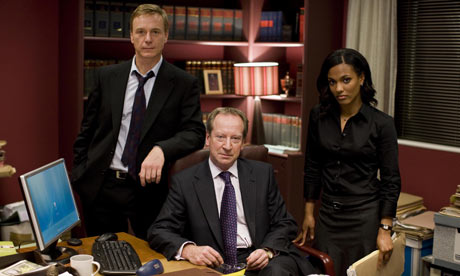
The Brit detectives are DS (Detective Sergeant) Ronnie Brooks (Bradley Walsh), “a gentle man and gentle cop” who’s a recovering alcoholic/street food lover.  Ronnie has a sympathetic ear, talks often re: his 2 exes, and is VERY likeable.  His partner is DS Matt Devlin (Jamie Bamber from Battlestar Gallactica), a young man of Irish parentage who worked his way up from humble roots.  He’s charming and eager to please.  While the experienced Ronnie sees a case from many perspectives, Matt is more quick to judge.

The lawyers (called Crown Prosecutors) are James Steel (Ben Daniels), a highly principled/sharp-dressed barrister from the upper crust (w/ posh accent).  His intensity, height, and sharp blue eyes may bring to mind actor Michael Moriarty, who played ADA Ben Stone.  James wears a wig in court, as is the custom.  Judges are referred to as “my lord” or “my lady.”  His is supported by Alesha Phillips (Freema Agyeman from Dr. Who), a young woman who has worked her way up from a council house (like the inner-city projects in US).  She performs research and goes through a mountains of paperwork (everything needs to be on hard copy).  Alesha is very passionate about the law, like her boss.

London is itself a character in this series.  Issues of class, race, and poverty are dealt w/ directly (perhaps more so than in the US).  One’s class is usually denoted by one’s accent.  (Not all English accents are the same!)

You will see a few British Asian (South Asian/desi) guest actors on L&O: UK.  In fact, the CPS barrister who consults on this show is British Asian- Nazir Afzal, director of CPS London South, is well-known for cracking down on “honor” crimes.  He has been awarded the OBE (Order of the British Empire).

http://en.wikipedia.org/wiki/Law_and_Order_UK

http://www.cps.gov.uk/london/


“The Pacific” (Parts 1-3)

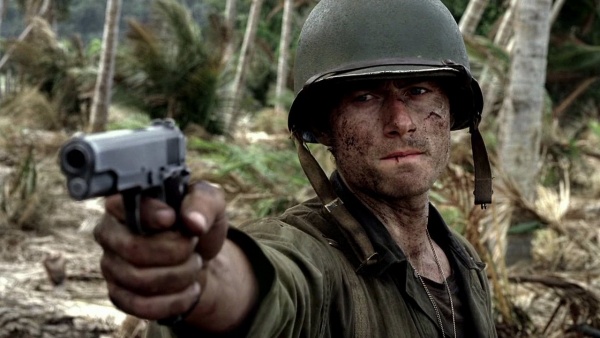
This is a 10-part miniseries on HBO produced by Tom Hanks.  Unlike Band of Brothers, this series delves more into the personal lives of the Marines.  This past SUN, 4/25, I watched the first 3 eps. 

Part 1

Christmas 1941: The Marines say goodbye to their families and head out to Guadalcanal- a litle known place in the South Pacific.  They include Sgt. John Basilone (Jon Seda), a natural leader who fought in the Phillipines.  He comes from a large/warm Italian-American family.  Basilone invites his good friends J.P. Morgan and Manny Rodriguez home to share Christmas dinner.   

PFC Robert Leckie (John Badge Dale) prays at his local Catholic church and shares a few words w/ his pretty neighbor, Vera, who he wishes to write to while away.  He’s a new Marine and aspiring writer who wanted to bring along his typewriter.  Leckie and his father have a strained relationship, and share a cold goodbye at the docks. 

18 y.o. PFC Sidney Phillips (Ashton Holmes) hails from a wealthy Southern family, and leaves behind his disappointed friend Eugene (Joseph Mazzello), who can’t fight due to his lifelong heart murmur. 

PFC Lew “Chuckler” Juergens (John Helman) is a jokester with a lot of bravado.  He regales the company with humor. 

Upon reaching Guadalcanal, the men of Able Company (led by Sgt. Briggs) find it a tropical paradise.  They dig trenches and set up their machine guns after the ship leaves.  They are told to destroy any letters or anything containing addresses by their CO. 

At Alligator Creek, they face a barrage of  shots from the Japanese soldiers.  One man cowers in fear, unable to speak.  The Marines are surprised at first, but they quickly take action.  In the morning, many Japanese lie dead on the beach or floating in the water.  Juergens is promoted for his skill w/ the machine gun. 

One Japanese soldier is found alive.  When two Marines take hold of him, he blows them all up with a grenade.  A bunch of guys start messing with another Japanese guy, wounding him in several places.  Finally, Leckie kills him to put him out of his misery.  Later, Leckie goes through the knapsack of the dead Japanese soldier, seeing the photo of his family and a little cloth doll.  In a letter to Vera, he writes that he’s fighting an enemy that he doesn’t understand.  
On the way to Tokyo, Basilone’s company marches past this group, and realizes that these men have been through some tough fighting.  “They look like they’ve been through the ringer.” 

Part 2 

By September of 1942, the Marines have been left alone to fight the Japanese.  Most of the food and supplies are gone.  They must hide from the Japanese bombers and survive the jungle.  “The malaria was vicious” and they went through periods of “starvation.”  One vet said: “You would just pray and hold on.”

One of Basilone’s men is killed while they march through the jungle.  “We’ve been swallowed by the jungle” Leckie comments as the men of Able Company eat rations from 1919 in the rain.  Basilone’s guys are tired, sick, and lacking in (real) food.  Tensions are high as they await the navy.  But the army has landed, their battalion leader announces.

Marines take supplies from the Army’s crates, before running off into the jungle.  The Army gets newer rifles, Phillips notices with bitterly.  Leckie steals some moccasins and a box of cigars (for this guys).  He becomes sick after eating some canned peaches.  PFC Wilbur “Runner” Conley is sick with diarrhea. 

At camp, Basilone’s men face fire at night from bombers.  He must encourage the disheartened men, including young newbies.  Several Marines lie dead in the morning; it was a direct hit.  Col. Chesky says he needs Rodriguez  to be a runner, and he and Basilone part ways.

Sgt. Briggs gives his men Lucky Strikes, the cigarettes that only officers get.  He calls the camp and warns Col. Chesky that the enemy is headed right toward them.  Amid fighting, both of Morgan’s machine guns goes out, and Basilone goes to assist him.  On the way, he comes face-to-face with some Japanese soldiers.  Basilone and few others have to fight close-up. 

Basilone reaches Morgan’s side and quickly takes out many enemies with his machine gun.  Then he jumps up and goes after remaining Japanese to “clear the field” for his friend, who looks on with shock. 

In the morning, both Basilone and Morgan realize that they need new helmets.  A medic notices that Basilone has 3rd degree burns.  He wonders where Rodriguez is, as Morgan doesn’t know.  “I puttin’ you in for a medal, John,” the Col. tells Basilone.  Later, as Basilone walks through the quiet jungle, he finds the dead body of his close pal, Manny Rodriguez.

Back in Mobile, Alabama: though he still has the murmur, Eugene Sledge tells his father that he’s enlisting.  His dad has heard about the cruelty of this war, and doesn’t want his son to “one day have to spark, no life, no heart.”

Leckie shares a poem he’s written about their victory at Guadalcanal.  “We’re finally outta this s***hole,” another Marine says. 

Basilone is noticeably upset about Manny’s death.  “You know me, John, I try not to think,” Morgan tells Basilone when he ponders about possibly making a false move and ending up dead.

“Everyone knows about the Marines 1st Company.  You’re on the front page of every newspaper.  You’re heroes back home,” a young man serving coffee at a supply station tells a worn-out Leckie and his fellows.

Part 3

Melbourne, Australia: The Marines sail in to crowds, banners, and calls of adulation for “our Yanks.”  They are bemused at first, seeing that their camp is on a cricket field.  They head out to the streets, ready for some R&R, though they are technically AWOL (w/o liberty passes). 

Basilone and Morgan order a variety of booze and toast to Rodriquez.  When a home guard insults the Yanks, Basilone punches him.  A drunken Leckie chases a beautiful/exotic brunette onto a streetcar, to the surprise of his buddies.  She asks him to call on her “at home” (properly).  Phillips meets a gorgeous blonde girl (and her protective grandfather).  He asks permission to date her, like a polite Southern gentleman.  “Hands off the merchandise,” the grandfather warns.  Basilone is given “the highest honor given to a Marine.”

Leckie goes to the house of his date, Estella, who is from a warm/welcoming Greek immigrant family.  Her parents are proud to have a Yank for dinner, so they don’t go out.  Estella’s mama came with her family to Australia after her homeland (Smyrna) was sacked by the Turks.  She got married late and only has Estella for a child.  “I fled the Leckie family.  I was last- last is least.” Bob tells them, commenting about his large family.  They invite him to stay w/ them in their home when they hear that the Marines sleep in the stadium. 

At night, Estella sneaks into the guest room.  “One of my brothers was too old (for the service) and another who died as a child,” Leckie tells her when she asks about his family.  His father hasn’t been “right in the head” since then.  Estella also had a brother who died as a baby, but “we don’t talk about it.”  Leckie helps clear the vines from their roof in the morning to repay their hospitality.

Basilone looks disappointed when Col. Chesky tells him he’s going home to sell war bonds.  Leckie gives silk stockings (to Estella) and a leg of lamb for the family.  They learn that a family friend/neighbor, a young man named Alexie, has been killed in the war.  “He and Estella were friends ever since they were children.”  Bob goes to Alexie’s wake which is attended by the Greek immigrant community in the area.

Late at night, Bob sits w/ Estella’s mom, who is upset to hear about so many dead Greek boys.  She says “we need prayer” at a time like this; Bob says he prays as well.  Mama says that “we like having you in the house” and “Baba always wanted a son like you.”  She kisses him, and says “I pray you come back to us.”  Estella watches from the kitchen, her eyes full of concern for Bob’s uncertain future.

After a long and arduous march, Bob comes back to Estella.  “I’m fairly crazy about you, Robert.  But I don’t want to have a baby w/ you,” she tells him w/ tears in her eyes.  “You’re dumping me b/c you think I’m going to get killed!?”  She says that Mama has grown too close to him, and it would be too painful if they lost him.  “She’s lost so much already,” Estella concludes.  Leckie leaves in anger, saying the Mama “can save her breath” on prayers for him.

Leckie takes the place of another Marine to stand guard outside the barracks.  But a superior officer gets very angry when he yells at him and then pulls a handgun.  Leckie is put in the brig (jail) for his insubordination. 

In the morning, Leckie learns that he’s been reassigned to the battalion intelligence section.  Before shipping out, young Phillips and his Australian girlfriend finally share a night together.  Morgan and Basilone say goodbye as John heads back home.
http://www.hbo.com/the-pacific/index.html
My 1st Broadway play!!!

That’s my first love- the theater.  Denzel Washington 

INTRODUCTION

This past Saturday, I went to NYC to see my first Broadway play, the Pulitzer Prize winning Fences by August WilsonFences is part of Wilson’s Pittsburgh Cycle, a collection of ten plays.  Each drama explores a different decade in the 20th century, and each examines the lives and struggles of African Americans.  The 13-week limited engagement of Fences is at the Cort Theater (138 W. 48th St. btwn 6th Ave & Bdwy).

Playwright August Wilson

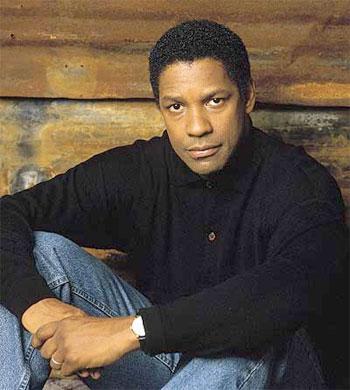
Fences is a powerful family drama set in the late ’50s starring Denzel Washington (twice an Oscar winner) and Viola Davis (recent Oscar nominee).  This is a character-driven story with one simple set (action takes place on the front porch of a humble little house).  I was lucky enough to get a ticket for the 9th row (close to stage). Once I got over the “Wow, I’m seeing Denzel in person!” feeling, I really got involved in the play.  The (diverse) audience enjoyed it very much, too.  We laughed, we got teary-eyed, and… WE SAW DENZEL!!!

Denzel Washington (Troy)

At one point, Denzel’s character enumerated all that he had to give before exiting the stage.  One elderly woman called out: “I’ll take it!”  LOL!  And yes, he is JUST as handsome up close as onscreen. 

As expected, Denzel stopped traffic in front of the theater for some minutes while people hovered about seeking pictures or just a glimpse before the limos set off.   Unfortunately, he didn’t stay for autographs, but I noticed the young actor who played his son (Chris Chalk) signing playbills.

PREMISE

At the start of the play, Troy Maxon (Denzel Washington) is a 53 yr. old former Negro League baseball player who hauls trash in the Hill District of Pittsburgh w/ his best pal Jim Bono (actor/theater educator Stephen McKinley Henderson).  Troy lives in an old house w/ his 2nd wife Rose (Viola Davis) and their 17 y.o. son Cory (Chris Chalk).   Though Troy is illiterate, he is a hard-worker hoping to get a promotion.  Troy and Rose seem to have a solid (yet passionate) relationship after 18 yrs. together.  Cory works at the A&P (grocery store), but hopes to attend college on a football scholarship.

Viola Davis (Rose)

When Lyons (Russell Hornsby), Troy’s 34 y.o. son from a previous marriage, drops by on a FRI (payday) to ask for $10, Troy is NOT too amused.  He tells Lyons that he’s a married man now, and needs to take care of himself and his wife.  (Lyons’ wife works as a laundress, though she has trained as a nurse.)  Troy advises him to “learn a trade,” but Lyons insists that he’ll stick to music.  “I’m not like the rest of you- I’m a musician,” Lyons says with bravado.  Rose and Bono persuade Troy, and he grudgingly allows Rose to loan out the $10.  (Rose, a practical AND caring woman, is the keeper of the family purse.)  As Lyons picks up his horn to leave, the disappointment is evident on Troy’s face.  “He’ll be back,” Troy concludes.

While Lyons was visiting, Troy’s younger brother Gabe (Mykelti Williamson) dropped by.  Gabe, a WWII vet, has a “metal plate in his head” and is now mentally handicapped.  We learn that the Maxon house was bought w/ money from Gabe’s veteran’s benefits.  But Gabe recently moved out of the house to live in a boarding house.  “I got two rooms!” he enthusiastically tells Rose.  Gabe sells fruit in the neighborhood to earn a bit of money for his room/board.  

Though Rose is patient/kind with Gabe, his presence is an irritation to Troy.  “I done everything I can for the boy,” Troy exclaims w/ exasperation when Rose worries about Gabe’s health/habits.  Being in the hospital wasn’t right for Gabe, Troy rationalizes, b/c “what did he go over there and get his head blown off for” (if he can’t have freedom).

Troy has been waiting for Cory to help him finish the fence around the yard.  But Cory has been practicing football after school.  Cory announces to his parents a recruiter is coming to see him soon, and needs his Troy’s signature to sign him up (to play for a college in North Carolina).  Rose is very proud of her son, but Troy is skeptical.

Chris Chalk (Cory)

We learn that Troy has gotten a position as a driver, so he won’t be working in the back of the garbage truck w/ Bono anymore.  (Driving positions usually went to white men.)  When Bono points out that Troy can’t drive yet, Troy shoots back: “Everyone doesn’t gotta know my business!”  He’ll learn how to drive before it’s time for him to take up the new position.  Lyons comes by w/ good news- he has a steady gig at a good club.  Troy’s surprised when Lyons offers to give him back the $10 he borrowed.   When he invites his father to come hear him, Troy refuses by saying “I’m too old to be going to clubs.”           

Cory is desperate for his father to understand; he names different athletes (including blacks and Jews) who have excelled in baseball.  Troy bitterly tells Cory that he’s more stupid than he thought, and that there’s no future in sports for a black man.  Troy is enraged when Cory tells him that he’s quit his job at the A&P to concentrate on football.  Father and son square-off, and it looks like they will come to blows!

To learn what happens, go read (or see) the play! 


THEMES

Baseball is one of the themes of the play.  On stage right, a ball of rags is tied to a branch.  Both Troy and Cory practice swinging at the ball at the start of the play.  Later on, when the father and son argue, the bat will be turned on Troy – though Troy will ultimately win in that confrontation.  At the end of Act One, he warns his son: “You swung and you missed. That’s strike one. Don’t you strike out!”

Troy was a great baseball player, at least according to his friend Bono.  Although he played for the Negro Leagues, he was not allowed to on the white teams.   The success of Jackie  Robinson and other black players is a touchy subject for Troy.  He never earned the recognition or the money which he felt he deserved – and discussion of professional sports will often send him into a tirade.  Though Rose insists that “you were too old,” Troy feels it was solely racism that kept him shut-out.

During Act Two of Fences,  he uses a baseball metaphor to explain why he had an affair:

I fooled them, Rose.  I bunted.  When I found you and Cory and a halfway decent job . . . I was safe.  Couldn’t nothing touch me. I wasn’t gonna strike out no more.  I wasn’t going back to the penitentiary.  I wasn’t gonna lay in the streets with a bottle of wine.  I was safe.  I had me a family.  A job.  I wasn’t gonna get that last strike.  I was on first looking for one of them boys to knock me in.  To get me home.  …then when I saw that gal . . . she firmed up my backbone.  And I got to thinking that if I tried . . . I just might be able to steal second.  Do you understand after eighteen years I wanted to steal second?

Father-son relationships are very crucial in Fences.  On the stage, the emotionally strained relationship between Troy (who’s based on August Wilson’s stepdad) and Cory is highlighted.  At one point, Corey asks “Why don’t you like me?”  Troy is amused by this question, and retorts w/ “I don’t have to like you!”  Troy goes on to say that he gives his son food, a roof over his head, and provides for his life.  But Cory wants more from his father, but Troy is incapable of expressing that.     

But the unseen relationship of the play is the one between Troy and his father, who was a sharecropper in early 20th century Alabama.  Troy reveals secrets from his youth to Bono and Lyons in one (quietly powerful) scene.  After noting some of his father’s brutish behavior, Troy (who fled from home at 14) flatly calls him “The Devil.”  (Denzel really shines in this scene!) 

Freedom is another theme in Fences.  Several times Troy exclaims that he “needs to be free.”  But from what?  To the audience, he seems to have a lot going for him (at the opening of the play).  He has a supportive wife, talented sons, and a loyal best friend.  He’s struggling to make ends meet, but he’s NOT alone.  Everyone in the community is (of course) dealing w/ ingrained racism.  

As Troy’s character is revealed, we realize that he can NEVER be free of the one man he hates- his father.  Though Troy says he doesn’t behave like his old man, Troy is very hard on Cory.  When Cory gets angry and obstinate, Rose says w/ frustration: “You’re just like him!”  Perhaps we can never be free of our past, parents, and mistakes- they make up our character.     

THE ACTING

With such a stellar cast, the acting could NOT be anything but top-notch!  Denzel hit JUST the right notes w/ his role; he made Troy a believable (yet flawed) character.  With this type of character, some actors could go over-the-top, but Denzel keeps it grounded.  Troy is a complicated man, though HE would never admit to that.  He is charming, funny, sarcastic, hard-headed, etc. just like all of us.  But he DOES NOT analyze his actions; that’s just NOT his way.

Viola Davis’ role grows as the play goes on.  She does a terrific job in portraying Rose, a woman of great character and integrity.  We sense that Rose could’ve done much better for herself, given her sensibility and sensitivity, but she stuck with Troy out of love/passion/loyalty.  She invested a lot in their relationship, and is DEEPLY hurt when it breaks.  But, above all, Rose is a survivor, and Viola Davis suits this role to a tee.  There is no sense of acting.      

Related Links

Official site (w/ a GREAT NYT video interview)

http://www.fencesonbroadway.com./index.html

Denzel finds his “voice” in Fences

http://www.npr.org/templates/story/story.php?storyId=126195963

About playwright August Wilson:

http://en.wikipedia.org/wiki/August_Wilson

2 short interviews w/ Denzel:

http://www.youtube.com/watch?v=RKsDRcuePnk

http://www.youtube.com/watch?v=edtA7NapVKY