“Star Trek”: Season 2, Episode 6 (“The Doomsday Machine”)

This ep was nominated for a Hugo Award for Best Dramatic Presentation at the 1968 World Science Fiction Convention. Norman Spinrad recycled a short story of his called “The Planet Eater” which was heavily influenced by Herman Melville’s Moby Dick. He convinced Gene Roddenberry that the material would be suitable for his TV show. The U.S.S. Constellation and its crew were destroyed by a “miles long” robot which consumes planets for fuel, leaving only a guilt-ridden/nearly hysterical Commodore Matt Decker (William Windom) aboard the “wasted hulk.” Capt. Kirk, Scotty, and a few crewmen beam over to begin repairs while Decker beams aboard the Enterprise. Kirk loses radio contact w/ his ship. The Planet Killer suddenly attacks the Enterprise, so ship is thrown off-course from the Constellation‘s position. Next, Decker seizes command from Spock- the story takes off! Decker recklessly takes the Enterprise into battle against the seemingly indestructible weapon. Kirk attempts to get the Constellation moving again to come to the aid of the Enterprise.

All our main heroes get something to do here! We see the new Engineering set created for Scotty; he gets a prominent role. Kirk works to repair the other ship, even getting his elbows dirty. McCoy (concerned/frustrated) tries to stop Spock from handing control over to Decker. Spock explains that Starfleet regulations allow it, but notice his side-eye and micro-expressions. Also, McCoy didn’t give Decker a medical exam yet (so can’t qualify him as “unfit for duty”). Sulu is sweating up a storm while trying to figure out whose orders to follow.

According to Windom, he had Decker compulsively twiddle w/ data tapes in his hand as an homage to Humphrey Bogart, who did the same thing w/ ball-bearings as Captain Queeg in The Caine Mutiny (1954). Those data tapes are gold and green, reminiscent of the colors of his and Kirk’s uniforms and hint at the tension between the two starship captains. Windom did not enjoy working on the ep; Shatner and Nimoy weren’t getting along at the time (giving the set a tense atmosphere). He purposely overacted; many years later, Windom realized that his character was a reference to Capt. Ahab from Moby Dick.

This is the most effects-heavy episode of S2; if you’re watching on Netflix (like me), you’re seeing the remastered version. When the series was digitally remastered (for 2007 DVD release), the upgrade required nearly 200 new effects shots. This was one of very few episodes to have its own score composed specifically for it; Sol Kaplan’s music was later used in The Immunity Syndrome, Obsession, and The Ultimate Computer. Many fans have noted similarities between the “planet killer” theme and the “shark” theme in John Williams’ score for Jaws (1975).

[1] The Doomsday Machine is a war story at many levels. It is the story of war spun out of control exemplified by a self-sustaining ancient device which seeks, destroys and digests whole solar systems. It is a story about military conduct aboard Federation ships. And it is, of course, a parable connected to the development and proliferation of nuclear arms.

[2] We’re back to some overwhelmingly grim tidings with this episode, a jarring reminder that there are some very dangerous threats out there in space. In a way, this can be looked upon as a precursor to the entire Borg threat introduced on the TNG series; on that show, something like the Borg was needed to shake the Enterprise and the Federation out of their complacency – or, shake them to the core, as is done to Commodore Decker here.

[3] The cosmic threat of this huge alien weapon, while exciting in itself, takes on a much more darker tone thanks to the presence of Decker on the bridge of the Enterprise. The whole plot seems to take a back seat, for awhile at least, to the strange, awful relationship between our psycho-damaged commodore and this unfeeling machine. Everyone else becomes an incidental side player to the conflict between these two, but, of course, it’s Decker, in his insanity, who creates a relationship; he no longer sees it as just a machine, a programmed robot, but as his personal devil.

-Excerpts from IMDB reviews

“Star Trek”: Season 2, Episode 4 (“Mirror, Mirror”)

During an ion storm over an alien planet, there is transporter malfunction on the Enterprise. The landing party of Kirk, McCoy, Scotty, and Uhura find themselves in a mirror (parallel) universe aboard a ship run by a ruthless crew. Their evil counterparts take their places on the real ship. Our heroes must find a way back before they’re discovered by a crew (where using treachery, violence, and seduction are common)! Kirk also must avoid destroying the peace-loving Halkans, who refuse to deal w/ the Empire (b/c of the power for destruction that their dilithium crystals would give them).

The Mirror Universe salute may remind modern viewers of the Nazis; however, it comes from Ancient Rome. One the first things you’ll notice is the clothing, accessories, and hair (esp. the mustache and goatee on Spock). TOS was usually not allowed to show women’s navels, but Uhura’s toned abs are visible. They filmed while a PA took the Standards representative to lunch- LOL! Sulu wears a red shirt as he has a different role in Security; he has a long scar on one cheek. Phasers are worn upside-down on the left hip; I only noticed this on my third viewing.

Kirk (to fit in w/ his environment) warns the Halkan commissioner: “We will level your planet and take what we want- that is destruction: you will die as a race.” Kirk is faced w/ more complication when he discovers a gorgeous woman waiting in his quarters- Lt. Marlena Moreau (Barbara Luna- an actress w/ Latina and Filipina heritage). She is clever, opportunistic and feisty; she desires to be “the woman of a Caesar” (another call-back to Ancient Rome). Marlena gets suspicious b/c this Kirk is a lot less brutal and insensitive. After filming had begun, Luna was diagnosed w/ strep throat. Since the script called for Capt. Kirk to kiss her, they had to postpone that scene for three weeks until she was well.

This is one the most popular TOS eps; also, The Mirror Universe was later depicted on Star Trek: Deep Space Nine and Star Trek: Enterprise. Ronald D. Moore (a writer/producer on later Trek series) cited this episode as one of his favorites; he is also the creator of the rebooted Battlestar Gallactica. The writers examine the negative side of the main characters, which is fun and unexpected. While Spock remains mostly true to the Spock we know/love, Sulu is a cunning schemer and young Chekov turns out to be a risk-taker. I also discovered that there is a second Vulcan serving on the ship (as Mirror Spock’s security guard).

[1] Instead of the usual prime directive and the overriding desire to do good, this anti-Enterprise world is just plain awful and a great counter-point to the sometimes saccharine-like world of Star Trek where everyone gets along a bit too often!

[2] …there’s something about tapping into the dark side of all our beloved characters here which makes this an irresistible mix of tension and adventure – an ultimate Trek, if you will.

[4] The acting takes it over the top. William Shatner’s Kirk displays the quick wits and cleverness that make the character so interesting. And notice how our good guy Kirk is not entirely uncomfortable in his new, dangerous environment. Leonard Nimoy’s evil version of Spock is genuinely menacing in a cool, calculating way. Nichelle Nichols’ Uhura shows us a cunning, wily side… But the acting prize goes to George Takei. …his evil Sulu is slimy, sleazy, scary, and wonderfully despicable.

-Excerpts from IMDB reviews

“Star Trek”: Season 1, Episode 22 (“The Return of the Archons”)

The Enterprise travels to Beta III to learn what happened to the U.S.S. Archon, which went missing a century earlier. A crewman in the landing party disappears, while another (Sulu) returns in a strange state. The word “Archon” was the title of certain Greek heads of state, incl. those in the Athenian Republic. It comes from Greek root “arch”, meaning “leader, highest, chief” (found in monarch, hierarchy, and anarchy).

Kirk beams down w/ another landing party just before the chaos of “Festival” (or “Red Hour”) begins at 6PM. They say they’re visitors from “The Valley,” escape the streets for a hotel, where the owner (Reger) and town elders ask if they are “Archons.” To learn more, Kirk has to convince some citizens to disobey Landru (who has ruled this society for 6,000 years). There are Lawgivers (wearing brown robes w/ long staffs in hand) everywhere; they are watching and waiting for those who disobey.

Spock: This is a soulless society, Captain. It has no spirit, no spark. All is indeed peace and tranquility – the peace of the factory, the tranquility of the machine, all parts working in unison.

Kirk: Mr. Spock, the plug must be pulled.

Spock: Sir?

Kirk: Landru must die.

Spock: Captain, our prime directive of non-interference…

Kirk: That refers to a living, growing culture. You think this one is?

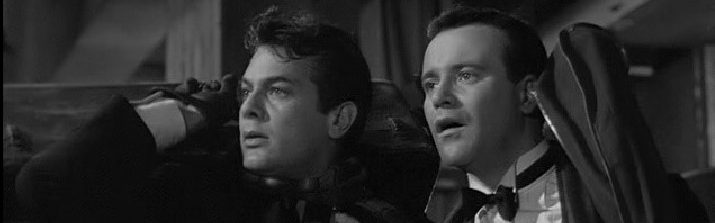
This ep contains the first mention of the Prime Directive. This is also the first ep where Kirk, Spock, McCoy, and their landing party are disguised in the clothes of the native society. Nimoy looks a but more elegant than usual w/ a black cape (to cover up Spock’s Vulcan ears). Spock is seen sleeping with his eyes opens- another element of the alien side of his character. In the dungeon, Spock punches a guard in the face w/ his fist (first time we see) instead of using the Vulcan neck pinch.

This story is the inspiration for The Purge (2013) and its sequels; I haven’t seen those movies yet. Ben Stiller named his production company Red Hour; he is a huge fan of ST: TOS. The location scenes were filmed at the 40 Acres backlot in Culver City, CA. This is the same place where Miri and The City on the Edge of Forever were shot. The sets were featured prominently on The Andy Griffith Show and originally constructed to portray 19th century Atlanta for Gone with the Wind (1939). Westerns were very big in the ’60s, so it was cost-effective to use the sets, as well as the costumes.

[1] Some rather deep and sophisticated concepts were presented in this episode, quite sophisticated even for this show; the drawback was an unexciting narrative, even a drab pace. 

[2] This episode always makes me wonder if this was the inspiration for the Borg. The planet has 1 ruler/leader, who’s name is Landru. But he is really just a computer. This was a common theme in the original Star Trek… computers gone awry.

[3] There’s also Roddenberry’s intriguing symbolism of ‘the three’, those elder statesmen, who were immune to ‘absorption’. They were among the last remaining citizens who understood that ‘freedom is never a gift’.

-Excerpts from IMDB reviews

“Star Trek”: Season 1, Episode 20 (“Tomorrow is Yesterday”)

Time travel is one of the most common (and popular) topics in sci-fi. No doubt many of you have watched the Back to the Future movies (starring a young Michael J. Fox) and/or the TV series Quantum Leap (starring Scott Bakula- the captain in Star Trek: Enterprise). In this ep, Capt. Kirk says the first moon shot was in the late ’60s (which turned out to be accurate)! A fan noted that the day after this ep originally aired astronauts Gus Grissom, Ed White, and Roger Chaffee perished in a flash fire in their Apollo Command module during a launch rehearsal.

When the Enterprise is flung back in time while trying to escape the gravitational pull of a black star (black hole), they find themselves in orbit around Earth- late 1960s. When they are seen by a U.S. Air Force pilot, Capt. John Christopher (guest star Roger Perry), they beam him aboard. They face the dilemma of what to do with him, as he learns more and more about the future. Lucille Ball (who started Desilu Productions) chose Perry for this role; he was a Broadway actor and had guest roles on many TV series.

Spock: We cannot return him to Earth, Captain. He already knows too much about us and is learning more. I do not specifically refer to Captain Christopher; but suppose an unscrupulous man were to gain certain knowledge of man’s future. Such a man could manipulate key industries, stocks, and even nations, and in so doing, change what must be. And if it is changed, Captain, you and I, and all that we know, might not even exist.

Kirk: Your logic can be most… annoying.

There is also some humor (as we expect) in this ep. The ship’s computer (voiced by Majel Barrett) has a glitch; it’s addressing Capt. Kirk as “dear” in an “affectionate” tone. Roddenberry was fascinated by the potential of a matriarchal society, and explored this theme in later eps and series.

Capt. Christopher: I take it that a lady computer is not routine.

Spock: We’d put into Cygnet XIV for general repair and maintenance. Cygnet XIV is a planet dominated by women. They seemed to feel the ship’s computer system lacked personality. They gave it one. Female, of course.

Capt. Christopher: [laughing] Well, you, you people certainly have interesting problems. I’d, uh… I’d love to stay around to see how your girlfriend works out, but…

Of course, Capt. Christopher is surprised to see the advanced tech, women working onboard, and (esp.) an alien- Spock. Capt. Kirk is fascinated by the pilot; he is probably much like what he would be (if he’d grown up in the 20th century). Later in the story, when Capt. Kirk is in danger, Spock and Capt. Christopher have to work together to rescue him. Spock’s response (and delivery) were very effective in this little scene.

Capt. Christopher: You don’t trust me, do you Spock?

Spock: In fact, I do. [Pause] But only to a certain point.

“Star Trek”: Season 1, Episode 18 (“The Squire of Gothos”)

In the book, Q-Squared, author Peter David wrote that Trelane was an adolescent Q entity. This is questionable to some fans, as Trelane requires support equipment to perform his type of magic and makes mistakes (which implies he is not omnipotent). I’m a big fan of ST: TNG; John de Lancie is introduced as Q in that series. Roddenberry was channeling Trelane when he created Q, the actor thought; he said “I only filled out the character.”

When Kirk (William Shatner) and Sulu (George Takei) vanish into thin air from the bridge of the Enterprise, Spock (Leonard Nimoy) sends a landing party to the planet below to locate them. They find an 18th c. castle and a foppish/aristocratic man, Trelane (William Campbell), who seems to know a great deal about Earth (though in the wrong time period). Trelane acts like a spoiled child, w/ Kirk and his crew as (unwilling) playmates. Trelane comments about the beauty of Lt. Uhura and another female in the crew, Yeoman Teresa Ross (Venita Wolf), who looks like a real-life Barbie doll. Later, he puts Yeoman Ross in a pink princess-type of gown and dances w/ her (while Uhura- magically- plays the piano). Spock finds Trelane to be an incredible pest; Nimoy’s weary/annoyed looks are just the right touch. Our heroes soon realize that to free themselves, they must locate and destroy Trelane’s source of power!

The Squire of Gothos is one of the “sillier” episodes of Star Trek, and therefore one of the most entertaining ones.

Spock intrigues Trelane. He has studied Earth, but has only gotten as far as the 18th century. A Vulcan like Spock is something he can’t account for.

The antique-cluttered set is the perfect setting for Campbell’s performance: we see the artifacts from a dozen cultures (including an apparently stuffed specimen of the “salt vampire” seen in The Man Trap), which Trelane casually disintegrates.

So what is this episode really about? Are we just the playthings of the gods? Are we on a plane so far below other beings that even their children can discard the human race on a whim? A scary thought!

-Excerpts from IMDB reviews

In his fight with Shatner in the forest, Campbell fell and dislocated his shoulder. As he flung his arm up in his instinctive reaction to the pain, the shoulder popped back into its socket! Due to Campbell’s injury, the ep finished shooting a day over schedule. The actor said: “It was just a great role. It was sensational. I’ll never forget it. It would be very easy for any actor who had any training to play the Squire of Gothos. The character was so well written and, of course, it was the show.” Look for Campbell as a Klingon in the fan fave ep- The Trouble w/ Tribbles in S2.