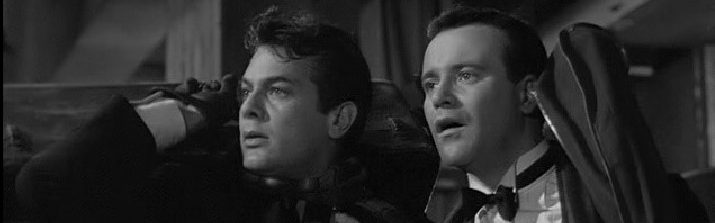
A Classic Rom Com: “The Lady Eve” (1941) starring Barbara Stanwyck & Henry Fonda

[1] Practically everyone in the film has (at least) two names: Jean/Eve, Charlie/Hopsie, Muggsy/Murgatroyd/Ambrose, Harry/Colonel Harrington, Pearlie/Sir Alfred and so on. This suggests, quite rightly, that people are complicated complex beings, and that appearances often have nothing to do with reality.

Fonda …it must really take quite a lot of true acting ability to execute the pratfalls that he does without making Charlie such a wimp that you can’t imagine Jean still wanting him at the very end.

[2] …it’s all about sexual gamesmanship, and its tone is both matter-of-fact and dizzyingly playful at the same time.

…a boudoir farce, a slapstick clinic, a cynical dialogue comedy AND a love story of great, soulful heart.

[3] This may have been Henry Fonda’s best comedy part. …Fonda does so well in the part because he plays it absolutely straight. No tongue in cheek, no winks at the audience, Fonda plays it straight and sincere.

-Excerpts from IMDB reviews

Col. Harrington: Don’t be vulgar, Jean. Let us be crooked, but never common.

This screwball comedy was written/directed by Preston Sturges, who wrote for theater/movies, then got into directing after age 40. He wrote the screenplay for Remember the Night (1940) starring Stanwyck and Fred MacMurray. Returning from a year in Amazon forest studying snakes (his passion), the heir to an ale fortune, Charles Pike (Henry Fonda), meets Jean Harrington (Barbara Stanwyck) aboard a ship. Charles (shy/nerdy) is putty in the hands of Jean (who exudes confidence/charm). His street-tough bodyguard, Muggsy (William Demarest), is suspicious of the young woman. Charles and Jean fall in love, but he breaks up w/ her after learning that Jean and her father, Col. Harrington (veteran character actor Charles Coburn), are con-artists!

Jean: You see, Hopsie, you don’t know very much about girls. The best ones aren’t as good as you probably think they are and the bad ones aren’t as bad. Not nearly as bad.

Some time later, the Harringtons run into a friend who goes by the name Sir Alfred McGlennon Keith (Eric Blore). His latest con involves cheating millionaires at cards in a uber-rich town in Connecticut, where the Pikes happen to live. Eve gets an idea: taking on the persona of an Englishwoman (Lady Eve Sidwich) who could be Sir Alfred’s niece, and seeking revenge on Charles.

Jean: He isn’t backwards. He’s a scientist.

Sir Alfred: Oh, is that what it is? I knew he was… peculiar.

There are many laughs (thanks to the snappy dialogue and physical comedy); the romance is done very well, too! The opening credits feature a grinning cartoon snake, reminding us of Satan in the Garden or Eden. Even before Charles climbs aboard the ship, Jean drops an apple (representing knowledge) which hits his head. The single ladies checking him out make Charles very uncomfortable, but Jean trips him to get his attention. Everything about Jean- her perfume, high heels, looks, and sparking wit- have a strong effect on Charles. The chemistry between Fonda (who plays his role totally seriously) and Stanwyck (who is good in every role) is electric!

“Clash by Night” (1952) starring Barbara Stanwyck, Paul Douglas, Robert Ryan, & Marilyn Monroe

The title derives from Matthew Arnold’s poem Dover Beach (1867):

Ah, love, let us be true

To one another! for the world, which seems

To lie before us like a land of dreams,

So various, so beautiful, so new,

Hath really neither joy, nor love, nor light,

Nor certitude, nor peace, nor help for pain;

And we are here as on a darkling plain

Swept with confused alarms of struggle and flight,

Where ignorant armies clash by night.

Mae: What do you want, Joe, my life’s history? Here it is in four words: big ideas, small results.

Directed by Lee Strasberg, Clifford Odets’ play, Clash by Night, had a short Broadway run from late 1941 to early 1942. The cast included Robert Ryan as Joe Doyle (the character who is Marilyn Monroe’s boyfriend in the film), Joseph Schildkraut as Earl Pfeiffer, Lee J. Cobb as Jerry Wilenski, and Tallulah Bankhead as Mae Doyle. Wow, how cool would it have been to see Cobb (one of Hollywood’s best character actors) perform live!? The production revolved around a Polish family on Staten Island, NY, before the US gets into WWII. In the original play, Jerry (the cuckolded husband) kills Earl (his wife’s lover) in their climactic fight; Hollywood (of course) had a different idea.

Earl: Jerry’s the salt of the earth, but he’s not the right seasoning for you.

Mae: What kind of seasoning do I need?

Earl: You’re like me. A dash of Tabasco or the meat tastes flat.

This was one of Monroe’s early roles, she was under an acting coach (who worked for 20th Century Fox where Monroe, then only 25, was on contract) and wanted her on the set. The coach would stand behind director Fritz Lang and tell her when a scene was good enough. When Lang (known for his difficult personality) realized this, he demanded the coach leave the set. After Monroe complained and wouldn’t act w/o her, Lang allowed the coach to return, on the condition that she not direct Monroe. The actress was loaned out to RKO Pictures for this film; she shows a lot of potential here (brightening up the mood of the story).

Jerry: I like you – you know that.

Mae: You don’t know anything about me. What kind of an animal am I? Do I have fangs? Do I purr? What jungle am I from? You don’t know a thing about me.

The film noir drama is set Monterey, CA, a town where almost everyone is connected to the commercial fishing industry. After 10 yrs, Mae Doyle (Barbara Stanwyck) returns home, feeling tired, bitter, and depressed. Her macho/judgmental younger brother, Joe (Keith Andes), wonders what she’s been doing w/ her life. Mae fell for a married politician who died; she has nowhere left to go. Joe’s spunky/beautiful 20 y.o. girlfriend, Peggy (Monroe in an early supporting role), takes a liking to Mae. After a short time dating, Mae decides to marry a fisherman, Jerry D’Amato (Paul Douglas), a naive/optimistic bear-like man who feels “safe.” Of course, she isn’t in love w/ Jerry (and he knows that). After a year of domestic life and having a baby girl, Mae feels stifled. She has an affair w/ Jerry’s friend, Earl Pfeiffer (Robert Ryan), a film projectionist who is recently divorced. Jerry finds out about their betrayal- he could explode w/ jealousy and anger!

Earl: Mae – what do you really think of me?

Mae: [coolly] You impress me as a man who needs a new suit of clothes or a new love affair – but he doesn’t know which.

Earl: [stung] You can’t make me any smaller. I happen to be pre-shrunk.

There is some great scenery- the ocean waves breaking on the beach, seagulls flocking, seals playing on rocks. We see the rough-and-tumble lives of blue-collar people; Peggy works in a fish cannery while Joe works on Jerry’s boat. People in this community fight loudly and drink heavily (drowning the disappointments of their unfulfilled lives). Jerry’s Sicilian immigrant father drinks b/c he can’t get any work at his advanced age. His bachelor uncle, Vince, also drinks and avoids responsibility.

[1] The power of “Clash by Night” lies… in the no-nonsense acting of Stanwyck and Ryan, tough as nails, but raw at the core. They have an animal eroticism together between them that sparkles like fireworks, but they are also, alas, quite self-pitying.

[2] Stanwyck has never better than she is here, and she dominates the film, vanquishing such heavyweight co-stars… …she is magnificent in this movie, which seems almost to flow from her. As her simple, trusting husband Paul Douglas is almost as good; and Robert Ryan nearly steals the show as a sadistic loser who is somehow magnetic, pathetic and yet highly observant, all at the same time. 

-Excerpts from IMDB reviews

I heard about this movie from a film noir group on Facebook; you can rent it for $2.99 on Amazon. It has some fine/memorable dialogue, which is why many people watch classics. Stanwyck (who was going through a divorce from actor Robert Taylor) inhabits her conflicted character; she is rarely at ease (note her body language, esp. in the early scenes). This is the type of role usually given to an anti-hero man in Hollywood. Instead, Mae is a conflicted woman who must choose between Jerry- the nice guy (security/respectability)- and Earl- the bad boy (danger/uncertainty). Though these are middle-aged people, they are not quite settled in their minds. Mae and Earl expected much more from life; they are drawn to each other like magnets. Jerry is content to be the breadwinner, husband, and father. The younger couple project a different energy in their scenes, but soon we realize that Joe would be a controlling husband (and perhaps) diminish Peggy’s spirited personality.

Odets was born/raised in Philly and came from Jewish heritage (Russian and Romanian). He dropped out of HS to work as an actor. He was understudy on Broadway in 1929 to the young Spencer Tracy in Conflict by Warren F. Lawrence. Odets became one of the founding members of The Group Theatre, which became one of the most influential companies in the history of the American stage. They based their acting technique (new to the US) created by Russian actor/director Constantin Stanislavski. It was further developed by Group Theatre director Lee Strasberg and became known as The Method (or Method Acting). From working in the theater, Odets developed a great love of language, and was inspired to write his own plays. His socially relevant dramas, popular during the time of the Great Depression, inspired several generations of playwrights: Arthur Miller, Paddy Chayefsky, Neil Simon, and David Mamet.

Rewatch: “The Strange Love of Martha Ivers” (1946) starring Barbara Stanwyck, Van Heflin, Lizbeth Scott, & Kirk Douglas

The prologue suggests a Gothic movie, with the spooky figure of Mrs. Ivers dominating the eerie household that Martha wants to flee; then, the film changes to a noir with a fine plot. In fact, Lewis Milestone, the director, has mixed styles in the picture, but the end result makes a satisfying film to watch.

Barbara Stanwyck is at her peak–sure, confident, and unfailing. Van Heflin’s natural talent makes everything he does seem effortless. Kirk Douglas offers a most impressive film debut in what, in retrospect, is an uncharacteristic role. Lizabeth Scott (who seems to me a fascinating cross between Lauren Bacall and Rosemary Clooney) is constantly engaging.

The black & white cinematography is magnificent, and the fatal character of Barbara Stanwyck is one of the most dangerous and manipulative villains I have ever seen in a film-noir.

-Excerpts from reviews on IMDB

I discovered this classic film a bit late (my earlier review was from 2011). I’ve seen it maybe three times over the years; somehow, it feels fresh each time! The film (which is a blend of melodrama and noir) was written by Richard Rossen, who went on to work on “The Hustler.” The director is Lewis Milestone, an immigrant from Moldova (then part of Russia), who worked on many fine films, incl. The Front Page, Of Mice and Men, and Mutiny on the Bounty (w/ Brando). According to film historians, a few days of this film (which started shooting during a strike in Hollywood) were directed by Byron Haskin.

Barbara Stanwyck was 39 y.o. in this movie; her two co-leads were 36 y.o. Van Heflin (who had just served in WWII), and 30 y.o. Kirk Douglas (in his film debut). According to film historians, Stanwyck did not like to be upstaged; when she saw the coin trick Heflin had learned (Milestone’s suggestion), she informed him he should make sure he did not do it during any of her important lines. Heflin only used the trick once in a scene with her. And what a debut for Douglas! Even though the actor (recommended to producer Hal Wallis by his close friend Lauren Bacall) is playing a weak-willed alcoholic spurned by his wife, his role is meaty and the star potential in clear onscreen. You see the maturity and commitment to character (honed in the theater) and the ironic expressions which he came to be known for in his prime years.

Martha Smith (Stanwyck), Sam Masterson (Heflin), and Walter O’Neil (Douglas) grew up together in the small city (Iverstown) w/ a burgeoning steel industry. As teens in 1928, Martha and Sam (a rebellious boy from “the wrong side of the tracks”) are the best of friends who plan to run away to join the circus. Walter, an obedient/fearful boy and son to Martha’s tutor, knew about the plan. Martha was an orphan determined to escape her controlling aunt (played by famed villain Judith Anderson). Martha, the child of a wealthy mother and a humble mill worker father, hated her aunt, who disapproved of her heritage and behavior (strong-willed). After Martha is caught and brought back to the family mansion, her aunt reveals that she has changed the girl’s last name to “Ivers” (reflecting her maternal heritage). Of course, young Sam escapes and goes on adventures of his own. After her aunt is dead, Walter’s father (an ambitious/calculating schoolteacher), takes over caring for her and securing the future of his son.

As adults in their 30s in 1946, the trio is reunited. Sam notices the sign of his old town, gets distracted, and runs into a pole (minor fender bender). FYI: The young sailor who is in the passenger seat is director Blake Edwards. This requires Sam to stop at the local garage for repairs and look for a hotel to stay. He runs across an old cop on his beat who used to chase him as a kid. When he goes back to his childhood home, Sam meets Toni (Lizbeth Scott), a pretty young blonde w/ a husky voice (reminding us of Bacall). She misses her bus to her hometown, but isn’t too upset about it. Sam has lived the life of a gambler (after leaving the circus), getting in trouble w/ the law, and spending a lot of time in hotel rooms.

After Toni gets in trouble, Sam goes to see Walter (who is running for DA) at his office. While they talk, Martha comes in; at first, she doesn’t realize who this man is. After a few moments, she runs into Sam’s arms. Sam hugs her twice, surprised at how beautiful she has become. Walter is (obviously) jealous, imagining that they may still have feelings for each other. Later, in these scene w/ Sam and Martha at her office, we learn that she has the real power in Iverstown (not her husband). She has grown the steel mill in size and workforce. The Ivers mansion has been redecorated to suit her style.

The melodrama element of this film is heightened by the music and costumes (designed by the famed Edith Head). Martha doesn’t dress like a typical businesswoman. She wears a lot of outfits, incl. a fur stole, cape, and several gowns that would suit a Manhattan cocktail party (not a steel town). In the final scene of the movie, Stanwyck wears a gorgeous flowing gown with a beaded waistline which is high in the front and lower in back. Film historians said Head designed this to draw attention from the actress’ long waist and somewhat low hips.

The film noir genre is known for it’s theme of the past (incl. old flames, friends, enemies) coming back to haunt you, and this film is no exception. Though Heflin is the hero who the audience can relate to, it’s the (explosive) scenes between Stanwyck and Douglas that reveal just how dysfunctional marriage can become! I really enjoyed how the romance between Sam and Toni, who both have somewhat shady pasts and alcoholic fathers, enfolded in a natural way. Their fresh and hopeful relationship is in direct contrast to that of the O’Neils. In the very last scene, we see Sam and Toni driving happily westward. He advises: “Don’t look back, baby. Don’t ever look back.”

Reviews of Recently Viewed Films

Terminal Station (1953) starring Jennifer Jones & Montgomery Clift

Last week, I saw this rare little gem of a movie one afternoon (on TCM); the David O. Selznick cut is titled Indiscretion of an American Wife. Then, I decided to check out the slightly longer version from the Italian director, Vittorio De Sica(Amazon Prime); it contains a a few more (ambiguous) lines/scenes. De Sica’s films are known for romantic neo-realism. My parents (fans of Sophia Loren) really enjoyed Yesterday, Today and Tomorrow (1963) and Marriage Italian Style (1964) which both won Oscars. 

If my art seems pessimistic, it is a consequence of my continuing optimism and its disillusion. At least I have enthusiasm. It is necessary to all professions to have enthusiasm in order to have success. -Vittorio De Sica

Why did you come with me? -Giovanni asks Mary

You didn’t look very wicked. I’m not an imaginative woman. It was you. It was Rome! And I’m a housewife from Philadelphia. -Mary replies

A married American woman, Mary Forbes (Jennifer Jones) has been involved for a month w/ a slightly younger Italian-American teacher, Giovanni Doria (Montgomery Clift), in Rome while visiting relatives. One rainy morning, Mary suddenly decides to return home to her husband and young daughter, but w/o telling anyone (aside from her nephew, played by a young Richard Beymer). She goes to the (newly built) train terminal, realizes that she is not at all sure about leaving, and agonizes over her decision. Giovanni joins her at the station, very confused and hurt, as she had just told him “I love you” the previous night.  

[1] This is such a contained, focused film, and demands so much of its two actors, every little nuance matters in a kind of exciting dramatic way. The closest thing this compares to, as two lovers or would be lovers talk in a train station, is Brief Encounter (1945), and that’s a masterpiece of acting and cinema both. Here, with Montgomery Clift and Jennifer Jones, it comes close.

[2] Jennifer Jones, beyond radiant in her prime-of-life womanhood, exudes a sensuality that both contrasts strikingly with her 1950s-prim exterior and celebrates the troubled woman within…

-Excerpts from IMDB reviews

There is plenty of drama behind this film! Producer Selznick (then married to Jones), wanted to have a slick romance depicted; De Sica wanted to show a ruined romance (which was fully supported by Clift). De Sica favored realism, so wasn’t interested in Hollywood-style close-ups; Selznick eventually hired cinematographer Oswald Morris to film some of these. Each day on the set, Selznick had critical letters for De Sica (who didn’t know English). The script was altered several times, as the two men had such different visions. Two scenes were written by Truman Capote, who gets screenplay credit. 

The Violent Men (1954) starring Glenn Ford, Barbara Stanwyck, & Edward G. Robinson

Never meet the enemy on his terms. -John says to his ranch hands

I’ll fight for the privilege of being left alone. -John explains to Lee 

A former Union Army officer, John Parrish (Glenn Ford), fully recovered from his war wounds, plans to sell his ranch to the wealthy owner of Anchor Ranch, Lew Wilkison (Edward G. Robinson) and move east w/ his fiancee, Caroline (May Wynn). However, the low price offered by Wilkison, and his hired mens’ bullying tactics, make Parrish think again. When one of his young ranch hands is murdered, he decides to stay and fight, using his battle know-how. At Anchor Ranch, Lew’s shrewd wife, Martha (Barbara Stanwyck), has been having an affair w/ his handsome younger brother, Cole (Brian Keith), who has a Mexican girlfriend, Elena (Lita Milan), that he supports in town. Lew and Martha’s 20-something daughter, Judith (Dianne Foster), has become distant and angry; she has suspected deception in her home.

I know what you’re thinking- whoa, there are a lot of ladies in this Western! I was watching this at my dad’s; even he noticed this fact. Well, not all of these women are well-developed. Caroline seems like she’d marry any guy to get out of her hometown. Elena loves Cole desperately, but we don’t know much about her; her sudden/violent action at the end is quite unexpected (bordering on soap opera). Judith, who’s very much a “daddy’s girl,” is intrigued by Parrish, yet also abhors the violence that ensues during the stampede. Some viewers commented that in order to get a big star like Stanwyck, the role of Martha must’ve been bulked up by the writers. Who doesn’t like Stanwyck!? But I was expecting this film to be more about Parrish. 

[1] The Fifties was the age of the adult western, themes were entering into horse operas that hadn’t been explored before. There’s enough traditional western stuff …and plenty for those who are addicted to soap operas as well.

[2] …the actors in question deserved a better story from which to work from, it is, when all is said and done, a plot that has been milked for all it’s worth, and then some. …still a very rewarding film regardless of the missed opportunities evident with the production.

I learned that this film was shot partly in Old Tucson; my dad noticed this before I did! The cinematography is well done, which is a must for a Western. The best action scene is the one between the unapologetic/violent cowboy, Matlock (one of Lew’s men), and Parrish in the saloon. Ford plays it so cool; he can handle himself w/ a gun man-to-man. This isn’t quite a hit, but worth a look.

The Candidate (1972) starring Robert Redford

…one of the many great movies about the world of politics. It holds up as well today as it did in 1972 (maybe even better). 

A sad commentary on the way things work. Very relevant. I recommend it for fans of Robert Redford or anybody interested in politics 

It’s fair to say that many Americans are fed up w/ politics these days- LOL! It’s refreshing to take a day (or even a few hours) avoiding the news, even if you’re a news junkie (like me). This film was recently shown on TCM; I’d heard much about it, but never watched it. Also, who doesn’t love Redford!? Peter Boyle plays the political expert who convinces Redford to run for Senate (Democratic side, of course). Look out for cameos from journo Mike Barnicle (currently seen on MSNBC’s Morning Joe) and Redford’s real-life pal, Natalie Wood (playing herself).