Wiseguy (Season 1, Part 1)

It’s cool to see so many ’80s shows coming out on DVD, Hulu, Netflix, etc.  Some deserve a second look, though the cars, clothes, hairstyles may be dated.  One of the shows that recently caught my attention is Wiseguy (a crime drama which originally aired from 1987-1990 produced by Stephen J. Cannell).  Unlike other shows before it, and not many since, the series had several story arcs and focused on the consequences of life undercover.  (Look for a young Annette Bening in this arc.)

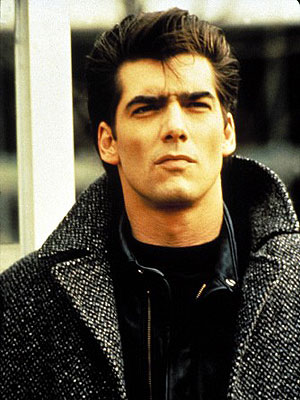
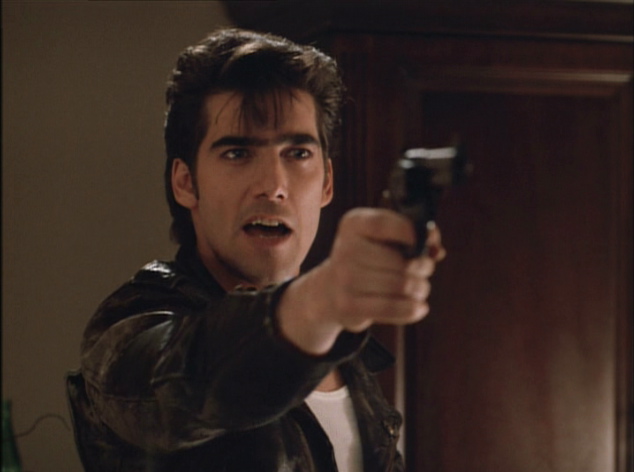
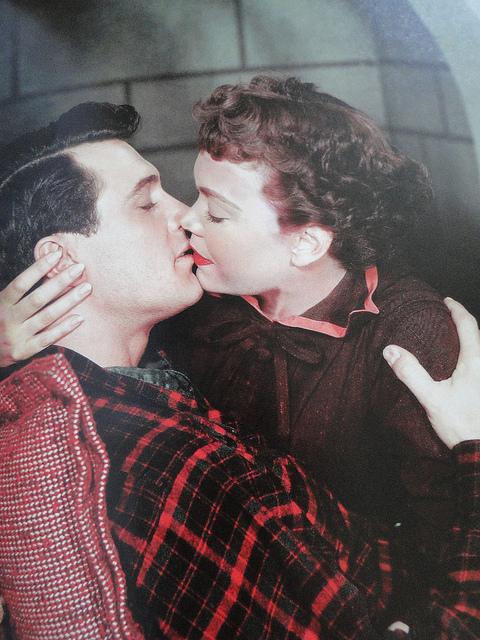
Vincent Terranova (Ken Wahl, who acted with Paul Newman and received praise for his natural acting ability) is an agent in the (fictional) organized crime division (OCB) of the FBI.  He’s young (just 30 y.o. at the start of the show), a first generation Italian-American (who can actually speak Italian), and from working-class Flatbush, Brooklyn.  He’s very proud of his heritage and community.  Being very close to his family, they are an integral part of the show; older brother Pete (Gerald Anthony) is a local priest; his mother (Elsa Raven) is a widow in somehwhat fragile health.  We learn later that Vinnie’s father was an honest man all his life; he drove a bread truck, never succumbing to the tempation of easy money, crime, and so on.

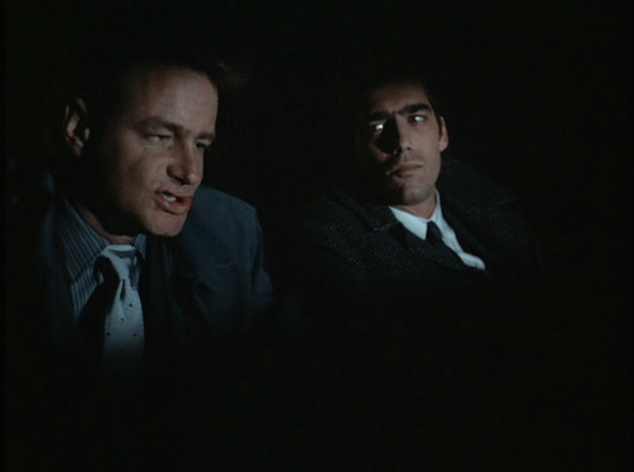
In the 2 hr. pilot, Vinnie is released from Newark State Pen after 18 mos.  He’s earned the rep of “wiseguy,” but this disturbs him deeply because his mother refuses to see him.  When he angrily asks his superior officer Frank McPike (Jonathan Banks) why he had to do the full sentence, McPike points out that it had “to look real.”  He’s now supposed to go to his first undercover assignment, but Vinnie insists on time off.  Suddenly, Vinnie’s traning officer is murdered by the older brother of Atlantic City Mafia leader Sonny Steelgrave (Ray Sharkey).  This propels the agent into action.

Vinnie uses his wit, natural bravado,  and boxing skills (he’s a former Golden Gloves fighter like Sonny) to win the respect of the mafioso and enter a new world (“terra nova” translates directy to “new land”).  Sonny decides to take him on as a driver and gives him a huge penthouse suite in one of his hotels.

Vinnie (ideally) calls Lifeguard (Jim Byrnes) every morning with the latest updates on the case, and is provided with quick news from the OCB side. Lifeguard also, under the name of Mike Terranova, provides Vinnie with an emergency contact number without revealing Vinnie’s true identity. (The cover location is “Sailor Hardware”; the codephrase “Uncle Mike” indicates an emergency request for assistance).

As Vinnie rises within the organization, he (naturally) grows very close to Sonny, a man who has a lot of charm and some admirable qualities, despite being a criminal.  He’s not a cartoonish villain.  Eventually, Vinnie becomes Sonny’s right-hand, then a “made” man.  The internal conflicts of the protagonist and the murky gray area in which he operates make Wiseguy very compelling.


Related Links

http://www.imdb.com/title/tt0092484/

http://www.amazon.com/s/ref=nb_sb_noss?url=search-alias%3Dmovies-tv&field-keywords=Wiseguy

Double Indemnity & Unfaithfully Yours

Double Indemnity (1944)

It’s just like the first time I came here, isn’t it? We were talking about automobile insurance, only you were thinking about murder. And I was thinking about that anklet.

In this captivating film noir (directed by Billy Wilder) successful insurance salesman Walter Neff (Fred MacMurray) is a goner from the moment he sees Phyllis Dietrichson (Barbara Stanwyck) standing above her stairs wearing only a towel while on a house call.  They are very attracted to each other and carry on a strong flirtation.  But the clever and sultry housewife is thinking of taking out an insurance policy on her husband (without his knowledge) and murdering him.  Though Walter knows this is wrong, he quickly agrees to help Phyllis so that she’ll be free to marry him. 

While Phyllis betrays her husband, Walter betrays his boss and close friend, Barton Keyes (Edward G. Robinson in a rare good guy character role).  Stanwyck told Wilder that she was afraid to take on the role of an out-and-out killer, but was later very glad about her decision.  MacMurray, who thought he couldn’t handle the role, got the chance to show his acting chops.   He’s mostly known for lightweight, Disney roles.  As one IMDB commentator wrote: He is consumed by his passion and he will do anything because of what he perceives will be the reward for doing the crime. Walter Neff was perhaps Mr. MacMurray’s best creation. He is completely believable and vulnerable.

I highly recommend this film because it has an interesting premise, terrific dialogue, and the the two leads have great chemistry together.  The only thing I didn’t like about it- the platinum blonde wig worn by Stanwyck.   

Body Heat (1981) starring William Hurt and Kathleen Turner is a reworking of Double Indemnity set in the tropical heat of Florida.  Hurt plays Ned Racine, a small-time, slacker lawyer who quickly falls head over heels in lust with mysterious Matty Walker (Turner), a beautiful young woman married to an older man (played by Richard Crenna).  Ned agrees to help Matty kill her husband, thinking that she reciprocates his love.  But Matty’s only goal is to be rich.


Unfaithfully Yours (1948)

As with Stanwyck, you really can’t go wrong with Rex Harrison!  He was smart, funny, charming, and had a big screen presence.  This screwball black comedy film had me laughing out loud (during many scenes).  But it also has some dark elements and great classical music, too.  Harrison plays a famous British orchestra conductor/nobleman, Sir Alfred de Carter.  Linda Darnell plays his much-younger wife, Daphne.  They seem to have a very lovey-dovey relationship at the opening of the film. 

While he was away, Alfred asked his brother-in-law August to “look after” his wife (in case she was bored/lonely).  But the dimwitted August misunderstood and had a private detective follow Daphne.  Alfred flies off the handle when he hears this: I give you my solemn word, August: if I don’t regain control of myself in a few minutes, concert or no concert, I’ll take this candelabrum and beat that walnut you use for a head into a nutburger, I believe they’re called!

Othello (Folger Theater)

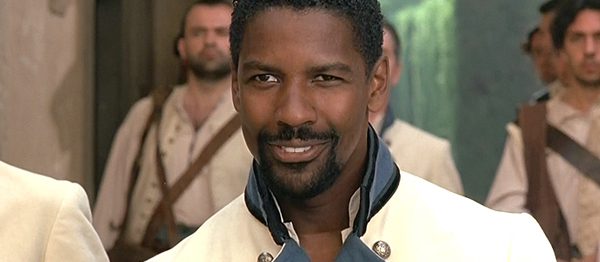
Ahh, Othello, one of my favorite characters created by the Bard!  He’s right up there with Hamlet.  He’s the ultimate outsider-insider: an African (Moor; former Muslim who converted to Christianity) in world of whites (Venice, Italy) who commands respect for his military victories.  Then he marries a white girl (the noblewoman Desdemona) and all hell breaks loose.  Well, it’s not quite that simple…

He is a contradictory man- a great speaker who is also capable of great violence.  Othello is a military man who sees things in black and white (this has a double meaning), unlike Iago, who deals in shades of gray.  Being such, he sees killing Desdemona as an act of justice.  My favorite professor said that though he was a skilled warrior, Othello probably had very little experience with love.  He relies too much on Iago’s judgment, because he knows more about the ways of white women.

The current production at the Folger is pretty good, with creative and gorgeous sets, costumes, and music.   The action, including swordplay, was exciting.   For the isle of Cyprus, Middle Eastern clothes and belly dancing is probably not accurate though.  I went to a preview show last Sunday.  The matinee audience was mainly elderly and college-aged, aside for a few who were around my age.

There were a couple of scenes where I got lost in the drama- good to have!  Back in high school and college, I saw Othello (played by Owiso Odera) as more heroic/larger than life; this play cut him a bit down to size.  He wasn’t such a big presence; Iago (Ian Merrill Peakes, who was in Henry VIII last year) was the star and better actor.  Merril Peakes spoke the language with ease and conviction.  Othello, who’s slight accent seemed to drift in and out, spoke the lines, but was not quite there when it came to feeling the words. Othello’s first crucial scene (in front of the Duke of Venice and other important nobles) was not as strong as I’d have liked.  But he did have good chemistry with Iago in their one-on-one scenes.

Emilia (Karen Peakes; also wife of Ian Merrill Peakes) did a great job; her character has some great lines.  Emilia is cynical, experienced, and wise- a contrast to the naive Desdemona.  The actress who played Desdemona got better throughout the play, but was too much of a lightweight.  She was too bubbly in her depiction, which created a tone that I didn’t think was fitting for a very young woman who had recently been disowned by her father.  Rodrigo (Luis Butelli; also in Henry VIII) was the spurned suitor who followed Desdemona to Cyprus.  He provided the comic relief without being over the top.  Cassio was the naive, young lieutenant who fell from Othello’s favor because he couldn’t handle alcohol.

As pointed out above, this production emphasized religion and violence (Othello has these bursts, escalating as we go on).  Othello wore a noticeable gold cross around his neck.  In early scenes, the soldiers, including Cassio,  wore outfits like the Knights Templar- chain mail and white tunics with large red crosses.  (I don’t know if that is accurate, but think it’s possible.)  Also, characters often crossed themselves when they were fearful, worried, etc.

The Strange Love of Martha Ivers (1946)

When the dir. of this film noir, Lewis Blackstone, complained to Lauren Bacall re: the “lack of interesting men in Hollywood,” she immediately recommended Kirk Douglas (her good friend from NYC theater days).  That is how Douglas got his 1st film role- starring opposite Barbara Stanwyck no less!  Stanwyck, known as a generous co-star, helped Douglas manuever through his 1st film.  He does a TERRIFIC job, as do his fellow 3 leads.

In 1928, strong-willed teen Martha Ivers is desperate to run away from her small factory town (Iverstown, PA)  and the domineering/wealthy aunt who’s in custody of her after her parents’ deaths.  A street-smart boy from the other side of the tracks (and close friend), Sam Masterson, is also planning to run away to join the circus.  Their plan is thwarted first by  local cops (under the thumb of the aunt) and then by Martha’s tutor, Mr. O’Neil (trying to ingratiate himself w/ the aunt).  Walter, O’Neil’s straight-arrow son, wants to win Martha’s friendship.  That stormy night, things occur that will change the course of  these characters’ lives forever.

Then we go forward to 1946, when a grown-up Sam (Van Heflin) drives into Iverstown to find “his people” (relatives).  While daydreaming, his car got dinged up, so he has to stop at a garage.   He meets a beautiful young woman Antonia “Toni” Marachek (Lizabeth Scott) sitting on the steps of his former house, now a boarding house.  She’s not sure if she should take the late bus to her parents’ house in the next town.  They commiserate re: the mistakes they’ve made in life, etc.

Sam, a drifter/gambler, is chagrined to discover that “scared little boy” Walter (Douglas) is now a DA w/ political ambition.  Walter is also married to Martha, who has expanded her aunt’s factory, created many jobs, and become a powerful woman in her OWN right.  Toni gets in trouble w/ the law, so Sam goes to Walter’s office seeking help.  Martha comes in while the men are talking; she is VERY happy/excited to see her old friend (and first crush) all grown-up.  She wants to speand some time w/ Sam.  Walter is wary of Sam, fearing that he knows the truth of what happened all those years ago.

This is a well-paced film that contains clever dialogue, intriguing characters, and plot twists.  The quick-witted/confidant Sam is a catalyst for change in the lives of the other characters, but he’s not always 100% sure of the right thing to do.  Martha and Walter’s relationship is complicated and (IMO) HIGHLY dysfunctional.  It’s fun to watch though!

Cairo Time (2009)

This little gem of an indie film (written/directed by a 2nd gen Arab-Canadian woman, Ruba Nadda) reminded me of old Hollywood romances though it’s set in busy, modern-day Egypt.  If you like thoughtful, slow-paced, character-driven stories, you’ll enjoy it.  The cinematography and lighting alone will WOW you!       

Juliette Grant (Patricia Clarkson), an American magazine editor from NYC, travels to Cairo for the first time, expecting to spend some time w/ her hubby, who runs a UNHCR camp in Gaza.  At the airport, she’s greeted by the former head of her hubby’s protection detail, Tareq Khalifa (Alexander Siddig).  Now retired from his job, Tareq runs a tea shop/spends time w/ pals.  After a few days of jet lag and hanging around the hotel, Juliette decides to venture out and experience the city.  Tareq will be her guide on this journey. 

Juliette, w/ her serene and observant ways, seeks to adapt herself to the ways of Cairo.  (She’s not content to sit about complianing w/ the typical diplomat wives.)  With the gentlemanly Tareq, Juliette sees and begins to understand the real city, full of beauty, history, and contradictions.  They learn about each other, too.

Yes, that is Dr. Bashir from Star Trek: Deep Space 9.  (Sid impressed the producers SO much that had he been a bit older, he would’ve been cast as the captain!)  It is SO refreshing to see a Muslim-background character portrayed as a sweet, thoughtful, and all-around normal guy.  Check out Syriana if you haven’t seen it yet, b/c he has a meaty role there.      

Related Links:

http://www.imdb.com/title/tt0896529/

http://www.cairotime.ca/