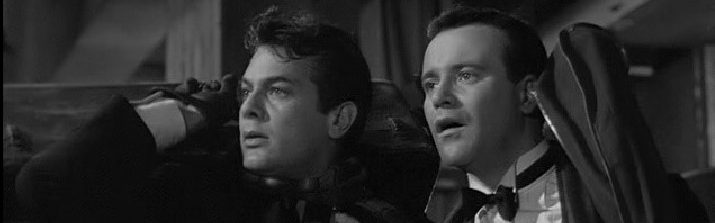
“Warlock” (1959) starring Richard Widmark, Henry Fonda, Anthony Quinn, Dorothy Malone, & Dolores Michaels

In the frontier mining community of Warlock, rancher Abe McQuown’s (Tom Drake) San Pablo gang terrorizes the inhabitants, humiliating the town’s Deputy Sheriff and running him out of town. One of the cowboys in the gang is Curley Burne (DeForest Kelley); the actor would find fame as Dr. McCoy on the original Star Trek TV series. In desperate need of protection, the town’s leaders hire an (unofficial) Marshall, Clay Blaisedell (Henry Fonda), to bring law and order. Clay arrives w/ his close friend, Tom Morgan (Anthony Quinn), who is a businessman. These two men stand up to the gang and the town gets quieter (for a time). Johnny Gannon (Richard Widmark), a former member of the gang, reforms and decides to become the (official) Deputy Sheriff. Frank Gorshin (uncredited) plays Billy, Johnny’s brother; he later appeared in the famous TOS ep- Let that Be Your Last Battlefield. IMDb notes that this was the 1st movie for Gary Lockwood (the main guest star on the TOS ep- Where No Man Has Gone Before). I didn’t notice him as one of the gang; look for the tall man w/ a black hat, blue bandana, and dark mustache. Lockwood started his Hollywood career as a stuntman; he’d go on to star in 20001: A Space Odyssey.

Jessie: The men you posted are coming into town.

Clay: I thank you for warning me, but I’ve already heard.

Jessie: Why does it have to happen? Why do these things always have to end in bloodshed?

Clay: Ah, that’s how things are, Miss Jessie. That’s why I was hired… why you hired me.

Jessie: And so they’ll come into town, and you’ll shoot them all down dog-dead in the street, is that it?

Clay: Or them me.

Jessie: Or them you…

Someone once said, there are ONLY 2 types of movies: the hero goes looking for adventure or a stranger comes to town. In this case, we find 2 strangers (w/ money, shiny guns, and fancy clothes) primarily concerned w/ making more money, then moving on to another town. This is a complex/mature Western, as it subverts some of the tropes of the genre. Some viewers thought Clay and Tom are a BIT too close (more than pals), though director Edward Dmytryk (known for his work in film noir) said the homoerotic undercurrents were unintentional. There are 2 supporting roles for women; BOTH are blonde, pretty (of course), yet also independent-minded. Lily Dollar (Dorothy Malone- tall/curvy/glam) tracks Clay and Tom down, looking to get revenge. Lily invites Johnny over for a home-cooked meal at her house. Jessie Marlow (Dolores Michaels) is one of Warlock’s leaders; her father left her a successful mine. Jessie does NOT approve of violence, though she feels drawn to Clay.

The acting is strong here, as we’d expect from the main cast. Widmark can play the angst and action well; he still looks youthful. Fonda (in a rare “shady” role) conveys depth to a gunslinger. Quinn (using a slight limp) is playing against type; he was often cast as a “macho” man. The running time is a BIT long (and feels like it); there is much going on w/ backstories of several characters. The action takes place mostly in the town (20th C. Studios in Culver City, CA); I wanted to see more of the (Moab, Utah) locations. There is the use of matte paintings for some backdrops (commonplace long into the 1990s).

[1] Complex psychological western. I like another reviewer’s point about the conflict between law and order in the film. Only Widmark’s Gannon appears concerned with enforcing law in addition to order, while the rest of the town is more concerned with simply order. Fonda’s Clay Blaisdell stands as the pivotal character, a morally ambiguous gunslinger with a dubious past. The mutual attachment between him and sidekick Morgan (Quinn) is highly unusual for a macho western. As hired gunslingers, they’re a formidable team.

[2] Here all central characters are multi-layered, there is a plenty going on that begs the utmost attention, where tragedy hangs heavy with its looming presence, and Dmytryk threads all the story strands together with thoughtfully potent results.

Adapted by Robert Alan Aurthur from Oakley Hall’s novel, Warlock boasts three excellent male lead performances and a firing on all cylinders supporting cast.

-Excerpts from IMDb reviews

“Too Late for Tears” (1949) starring Lizabeth Scott, Don DeFore, Dan Duryea, & Arthur Kennedy

She Got What She Wanted… With Lies… With Kisses… With Murder! -A tagline for the movie

One night on an empty LA highway, a man in a speeding car tosses a bag into Jane (Lizabeth Scott) and Alan Palmer’s (Arthur Kennedy) convertible, as they’re heading down a mountain road to a party. When they open the satchel, they find $60,000 inside! Alan wants to turn it over to the police; Jane (w/ a life of luxury now w/in reach) persuades him to hang onto it “for a while.” Soon, the Palmers are tracked down by Danny Fuller (Dan Duryea), a shady character who claims the money belongs to him. To hang on to the cash, Jane relies on her feminine wiles, even if it leads her to danger!

Alan: What is it, Jane? I just don’t understand you! I’ve tried to give you everything you wanted, everything I could.

Jane: Yes, you’ve given me a dozen down payments and installments for the rest of our lives.

This is a B-movie (w/ a small budget), BUT packs a big punch when it comes to entertainment. It was independently produced and released via United Artists, so it wasn’t a studio picture. The director is Byron Haskin and the screenwriter is Roy Huggins (perhaps more known for his TV work, incl. Maverick). I always liked the work of older James Garner, so have been watching some eps of this Western series in the pandemic. In this story, the femme fatale is a housewife (rare for noir) married to a decent man!

Scott and Duryea play up the melodrama (which suits this story), as opposed to the more naturalistic Kennedy (who took this role in order to play Biff on Broadway in Death of a Salesman). Kennedy also had many character roles in Westerns. Kathy Palmer (Kristine Miller) does a good job as Alan’s caring/working gal younger sis. Miller had a supporting role in I Walk Alone w/ Scott. The character played by Don DeFore brings mystery when he enters the story; this actor worked in the theater, small movies, and eventually found success in TV.

Danny [to Jane]: You know, tiger, I didn’t know they made ’em as beautiful as you are, and as smart. Or as hard.

This movie shows us (yet again) that you don’t need famous actors, elaborate sets, or glam locations to make something effective (and enjoyable). The “bad girl” here is SO bad that she even scares a career criminal- whoa! FYI: Adjusted for inflation, $60,000 would be equal to about $663,000 (2021). The Film Noir Foundation provided the funds to restore this movie; the process took 5 yrs (after the print was discovered in France). TCM aired the fully restored version in 2015; you can also see it free on YouTube.

“The Naked Spur” (1953) starring James Stewart, Janet Leigh, Robert Ryan, & Ralph Meeker

Packed with Technicolor Thrills! -A tagline for the movie

A former rancher/Civil War vet, Howard Kemp (James Stewart), has been searching for a murderer, Ben Vandergroat (Robert Ryan), for a long time. Circumstances compel Kemp to take on 2 partners- an old prospector, Jesse Tate (Millard Mitchell), and a dishonorably discharged Union soldier, Roy Anderson (Ralph Meeker). When they learn that Ben has a $5,000 bounty on his head, greed starts to get the better of Jesse and Roy. Howie and Ben have a (troubled) history, and Ben takes every chance he can to sow doubt btwn the other 2 men. To add to the drama, there is a beautiful/young woman riding w/ Ben- Lina Patch (Janet Leigh in one of her early leading lady roles).

You can take any of the great dramas- it doesn’t matter if it’s Shakespeare or if it’s any of the Greek plays- you can always lay them in the Western and somehow, they come alive. There is this kind of passion and drama. You can have patricide, any kind of -cide- but if you’re in a Western, you can get away w/ it… b/c it’s where… all action took place. -Anthony Mann, director

The Naked Spur (directed by Anthony Mann- who started in B-movies of the noir genre) is the MOST successful Western movie of 1953. It’s a “psychological Western” filmed on location (mainly in the Colorado Rockies) and doesn’t shy away from (gritty) violence. There are several scenes of exciting action, plenty of character development, and terrific dialogue. This is the 1st screenplay by Sam Rolfe and Harold Jack Bloom, who shared an Oscar nom; they went on to have long/successful careers as writers/producers. Mann and Stewart would collaborate on a total of 11 films, incl. 5 Westerns!

Ben [to Howie]: Choosin’ a way to die? What’s the difference? Choosin’ a way to live – that’s the hard part.

As the bitter/troubled Howie, Stewart (44 y.o.) reveals darkness, intensity, and vulnerability; the actor was working to let go of his bumbling/youthful/Everyman image (after returning from WWII). A strong protagonist needs a strong antagonist; Ryan (43 y.o.) wears his black hat (villain role) perfectly. As Ben, Ryan (unshaven/floppy-haired) effortlessly switches btwn grinning nonchalance and deep-thinking (in what is considered one of his best roles). Meeker (a leading man on Broadway) looks at ease as the volatile/sleazy womanizer; the Method-trained actor (32 y.o.) sports a bushy blonde mustache. Paul Newman was Meeker’s understudy in a Broadway play. Leigh (at just 25 y.o.) does a fine job alongside her (older/more experienced) co-stars; she gets a few moments to shine (rare for women in Westerns). Even if this is NOT your fave genre, you may enjoy it a LOT! You can rent the movie on Amazon Prime.

[1] Spectacular location photography in the Rocky Mountains lends a ring of authenticity to the story.

[2] …Ryan’s charming, snake-like villain who dominates this rugged western despite strong performances from the entire cast. He obviously relishes his role and is a joy to watch.

[3] …an outstanding western and has lost none of its glow over the years and like all classic westerns- it just gets better and better with the passing of time.

[4] …Mann directs very assuredly, James Stewart is wonderfully ferocious and Robert Ryan is very charismatic in a more convoluted role. The film looks great, with wonderful sets, scenery, costumes and photography. The music adds to the mood of each scene without feeling too intrusive. The dialogue is excellent and the story- even with the well-worn themes and such- is very compelling.

-Excerpts from IMDb reviews

“The Bedford Incident” (1965) starring Richard Widmark, Sidney Poitier, James MacArthur, & Martin Balsam

The cold war just got hotter. -A tagline for the movie

Capt. Finlander: It’s been my experience with the press that they ignore truth for sensationalism.

Capt. Eric Finlander (Richard Widmark) plays a hardened cold-warrior on the American Naval destroyer USS Bedford. Ben Munceford (Sidney Poitier) is a famous photojournalist given permission to interview the captain during a routine patrol. Lt. Cmdr. Chester Potter (Martin Balsam) comes with Munceford; he is the new doctor assigned to the ship. As they are adjusting to the ship, the Bedford discovers a Soviet sub nearby. Capt. Finlander begins a relentless pursuit, pushing his crew… perhaps to the breaking point!

Ben Munceford: I’ve heard a lot about you, Commodore, but I never expected I’d meet you.

Commodore Schrepke: Is that so?

Ben Munceford: Not aboard an American destroyer.

Commodore Schrepke: [Is] that so surprising in these times?

Ben Munceford: I guess not, if one can make the switch mentally. But I, uh… I still connect you with… Hitler’s navy.

Commodore Schrepke: Your pardon: Admiral Dönitz’s navy, sir.

This movie unites (real-life pals) Widmark and Poitier; they also worked on No Way Out (1950) and The Long Ships (1964). Poitier had been making films for 15 yrs at this time, BUT this was the 1st film in which his race was neither mentioned nor relevant. The role of the medical officer was written for Poitier, BUT he asked to play the journo instead. The former U-Boat commander onboard, Commodore Wolfgang Shrepke (Eric Portman- a Brit known for playing Germans), is a NATO advisor. The eager/cute Ensign Ralston (James MacArthur) MAY be familiar to some viewers; he played the older bro (Fritz) in the 1960 Disney classic- The Swiss Family Robinson. Look out for a 20-ish Donald Sutherland; he’s one of the nerdy scientists in the ship’s lab in an early scene.

Commodore Schrepke: That permission specifically said “if the sub is still in territorial waters,” is that not so?

Capt. Finlander: A matter of interpretation, Commodore.

Commodore Schrepke: But the Russian is in international waters. The ocean is free, my captain.

Capt. Finlander: Yeah, so it is.

Commodore Schrepke: So you have lost your opportunity. It was magnificent –

Capt. Finlander: Look, if I catch a man robbing my house and he makes a break for the street, do I let him go just because he made it to the sidewalk?

The director (James B. Harris) and screenwriter (James Poe) were able to visit a Navy destroyer in Norfolk, VA for pre-production research in late 1963. When Munceford and Lt. Cmdr. Potter are flying out to the destroyer, they are aboard an H-19 helicopter, which was called the Whirlwind by the British. Interior scenes were filmed aboard a British Type 15 frigate (the H.M.S. Troubridge); much British military equipment can seen around the ship. The cameras Munceford uses are the Nikon Model F and Pentax; the tape recorder he uses is a 1964 Philips EL3300 (the world’s 1st commercial compact cassette recorder).

I’m a long-time fan of Poitier and saw several of his more famous films growing up; he was a hero to MANY people (of all backgrounds) for his acting and activism. In the pandemic, I’ve been focusing on the noir genre; Widmark got his start there, though he later made many Westerns. I plan to watch and review more of this movies in the near future. I’m also a fan of the submarine drama Crimson Tide (1995) starring Denzel Washington and Gene Hackman. There are a LOT of sub-related movies out there; I recently listened to reviews of a few on the podcast Submersion.

#Noirvember: “House of Strangers” (1949) starring Edward G. Robinson, Susan Hayward, and Richard Conte

After serving 7 yrs in prison, NYC-raised lawyer Max Monetti (Richard Conte), goes to the bank run by his brothers Joe, Tony and Pietro. He promises to revenge them. Next, he visits his lover, Irene Bennett (Susan Hayward), who asks him to forget the past and start a new life in San Fran. In flashback, we see Max’s life in the early ’30s. He was the favorite son of his father, Gino Monetti (Edward G. Robinson), who had a small bank in Little Italy on the Lower East Side (LES). Gino is an egotistical/self-made Italian immigrant who ruled over his family like a tyrant. Max was a competent lawyer engaged to a young woman, Maria Domenico (Debra Paget). Max meets Irene when she comes to him for legal help; they have a LOT of spark, but their love affair is troubled. The new Banking Act takes effect in 1933, and Gino is investigated by the feds for misapplication of funds. Max forms plan to help his father…

Max [to Irene]: Always looking for a new way to get hurt from a new man. Get smart, there hasn’t been a new man since Adam.

This is a film noir that is also a dysfunctional family drama (how appropriate for the holidays- LOL)! If you are an immigrant or a 1st gen American, you MAY esp. relate to this movie. It’s a BIT of a mixed bag, though it has some (timeless) themes and (mostly) good acting. The character of Gino Monetti is loosely based on Amadeo P. Giannini (1870-1949), founder of the Bank of Italy, which became the Bank of America. According to articles from the entertainment press in March of 1948, Victor Mature was to be cast as Max. This film reunites Conte, Paget, and Hope Emerson who appeared in Cry of the City (1948)- a V fine movie. Of course, MANY of you will know Robinson and Paget from The Ten Commandments (1956).

I like watching Conte (discovered by John Garfield and Elia Kazan); he has a challenging role here. No offense to the fans of Mature, BUT Conte is a stronger actor. Max (who sometimes operates in the “gray areas”) has to decided btwn the “good girl” (virgin) from his neighborhood and the mature/WASP “temptress” (experienced w/ men). Conte and Hayward play off each other well; they have a sort of combative energy. Now, are there some stereotypes in this story? Yes, though we classic movie fans are aware this can be the case sometimes. People of Italian heritage were considered “exotic” in the 1940s; Hollywood (for many decades) did NOT create subtle characters who were ethnic (or racial) minorities. Some (modern) viewers couldn’t get over the accent used by Robinson, his pencil-thin mustache, and mannerisms.

Max: Pa, have you read the new banking act?

Gino: I don’t even read the old one. Why?

There was also drama behind-the-scenes (BTS) of this movie. According to the biography of director Joseph L. Mankiewicz (People Will Talk), the producer (Sol Siegel) hired Philip Yordan to adapt Joseph Weidman’s novel (I’ll Never Go Home Again) for the screen. After Yordan submitted 3/4 of the script, Siegel decided that it was unacceptable, fired him, and asked Mankiewicz to redo the script. Mankiewicz rewrote ALL of Yordan’s dialogue, reshaping the script. The Screen Writers Guild ruled that Yordan receive sole story credit and he and Mankiewicz share credit for the screenplay. Mankiewicz refused to share credit for a screenplay he had basically written, so received NO credit. The studio remade House of Strangers in 1954 as a western- Broken Lance (starring Spencer Tracy as the patriarch). Yordan was given credit for the story and won the Oscar for Best Writing, Motion Picture Story. Yordan was also front for many screenwriters blacklisted in the ’50s.

[1] The acting is this film is nothing short of fantastic. Robinson is perfect as the dictatorial, ruthless Gino. Conte is totally believable as the favorite son – efficient and slightly to the right of slimy. Luther Adler gives a brilliant performance as the henpecked Tony. The rest of the cast is uniformly excellent. Susan Hayward plays Max’s love interest, a woman who gives as good as she gets. She looks sensational and does a terrific job in her role. Stardom is right around the corner for her, and it’s no surprise.

[2] …a great story of hatred and forgiveness. Edward G. Robinson has one of his best performances (if not the best) and wins the Best Actor award in the 1949 Cannes Film Festival. Richard Conte has one of his best roles (if not the best) in his well-succeeded career. Susan Hayward is very beautiful and elegant and performs a strong female character.

[3] I said it was an adult movie… The characters are ambiguous, as people in real life would be. In some ways, for instance, Pa is a lovable old patriarch, but he’s also monstrously insensitive to the feelings of others. And the murderous resentment of the older kids is made understandable too. And Richard Conte’s character is aggressive and domineering at the beginning, just as a spoiled youngster might be, but he develops into a Mensch by the end of the tale. Hayward develops too…

-Excerpts from IMDb reviews