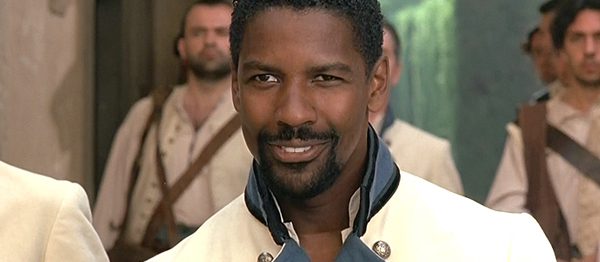
“Star Trek: DS9” – Season 1, Episode 7 (“Dax”)

The teleplay for this ep was co-written by the fabulous Dorothy (D.C.) Fontana; she wrote several eps of TOS and improved many others as script editor. Fontana (only in her mid-to-late 20s) was pivotal in developing the character of Spock and Vulcan culture in TOS; she later wrote some TNG eps. If you like courtroom drama and strong character development, then you’ll enjoy this story. I think it’s the strongest ep (so far) in S1.

After having Klingon coffee (raktajino) and getting hit on (yup, again) by Dr. Bashir (Alexander Siddig), Lt. Jadzia Dax (Terry Farrell) walks toward her quarters. On the way, she is attacked by three hooded aliens in a corridor. Bashir tries to intercede, but gets knocked out in a fight. These aliens know how to get around the station’s security controls, so they quickly reach their ship and set off. Luckily, Major Kira (Nana Visitor) pulls it back w/ a tractor beam (yay). Cmdr. Sisko (Avery Brooks) demands answers for the assault and attempted kidnapping of his science officer. Ilon Tandro (Gregory Itzin) insists he has the right to take Dax back to Klaestron IV, as Dax is accused of murder and treason! According to Ilon, his father Gen. Tandro (a martyred hero to his people) was murdered and betrayed by Curzon 30 yrs ago.

Cmdr. Sisko: I want you to find all the medical evidence you can to support the theory that Jadzia Dax and Curzon Dax are two entirely separate people. Major…

Dr. Bashir: Excuse me, sir, I-I don’t know that there is any medical evidence on that.

Cmdr. Sisko: Assume there is, then find it.

[Sisko has asked Kira to search for precedents involving Trills]

Major Kira: Is a Trill responsible for the conduct – for the acts – of its antecedent selves?

Cmdr. Sisko: Right, that kind of thing.

Major Kira: What if I find the answer is yes?

Cmdr. Sisko: Then that answer is wrong. From this minute on, our answer is “no.”

After the above scene (in Sisko’s office), we see that the world of DS9 is going to be different from that of TNG. Could you imagine Picard saying these lines? No way, life is black or white on the Enterprise! A no-nonsense/sassy Bajoran arbitrator, Renora (veteran character actress Anne Haney), holds a hearing to determine if Jadzia (only 28 y.o.) can be held responsible for a crime supposedly committed by Curzon (the previous host of the Dax symbiont). Constable Odo (Rene Auberjonois) travels to Klaestron IV to look for some evidence that could help Jadzia; he meets w/ Gen. Tandro’s widow, Enina (veteran Irish actress Fionnula Flanagan). This actress (who also has a strong theater background, like Auberjonois) did a terrific job w/ her role!

Renora: This will be an informal hearing, so I’m going to start with some informal advice: I am one hundred years old. I do not have time to squander listening to superfluous language. In short, I intend to be in here until supper, not senility.

As the hearing goes on, Sisko is frustrated by the fact that Dax says nothing in her own defense. I really liked the scene in her quarters; we learn more re: both characters and see their developing (friend) chemistry. Like many fans and critics, I wish Dax had more lines in this ep; Farrell does a good job. The actress admitted to being intimidated (at first) w/ portraying a character over 300 yrs old who had lived many lives.

…finally get an episode centered on Dax. She has been seriously neglected as a character up to this point, including the aspects of her complicated relationship to Sisko, and this episode does a bit to explore that relationship.

It nicely explores the morality of holding holding one host responsible for the sins of the previous host and whether it is the host or the symbiont which is responsible.

-Excerpts from IMDB reviews

Hitchcock on Catholic Guilt: “I Confess” (1953) starring Montgomery Clift, Anne Baxter, & Karl Malden

German refugees, Otto Keller (O.E. Hasse) and his wife Alma (Dolly Haas), work as caretaker and housekeeper at a Catholic rectory in Québec City, Canada. While robbing the house of a lawyer (who he sometimes works for), Otto ends up killing the man. Racked w/ guilt, he heads to the church where Father Michael Logan (Montgomery Clift) is up late. Otto confesses to murder; he says he wore a cassock that night as a disguise. After two schoolgirls come forward as witnesses, the police question all the local priests. Inspector Larrue (Karl Malden) suspects Fr. Logan from the start, sensing that he’s hiding something. It turns out that the deceased was blackmailing Ruth (Anne Baxter), who grew up w/ Logan and loved him before he went off to fight in WWII. She loves him still, though is married to a politician.

Fr. Logan: I never thought of the priesthood as offering a hiding place.

Sir Alfred Hitchcock (who was raised Catholic) told a New York Times reporter in August 1952, that he chose Québec for filming because “in no American city do you find a priest walking down the street in a cassock.” This movie was based on the 1902 play “Nos deux consciences” by Paul Anthelme, a journalist. In the play, the priest and his lover had a baby, and the priest was hanged at the end. These elements had to be removed from the movie b/c of the Hays Code. I Confess was banned in Ireland b/c it showed a priest having a relationship w/ a woman (even though it took place before the character took orders). The screenwriter (George Tabori) wanted the script to be a subtle dig at the McCarthy hearings, as it centered on a man unable to tell the truth when questioned by authorities. Tabori found that Hitchcock only wanted to make a thriller. Peter Bogdanovich noted that this is a favorite of French New Wave directors.

Hitchcock created detailed storyboards for each scene, as was his custom. He couldn’t understand Clift’s Method acting technique; he became frustrated after the actor blew take after take, failing to follow instructions. Tension occurred over Clift’s insistence on having his acting coach (Maria Rostova) by his side. Hitchcock found that Clift didn’t listen to him at all. Karl Malden, who was friendly w/ Clift, found the process difficult. Clift would immediately turn to Rostova for feedback after each scene. Clift was drinking heavily also; he’d come on-set hungover (which wasn’t unusual for leading men in Hollywood’s Golden Age). As a closeted gay man, I’m sure he had a lot of pressure on his shoulders.

This isn’t your typical Hitchcock- it lacks the sly humor, memorable music, and (of course) the suspense he was known for. However, it’s atmospheric, moody, w/ a thread of foreboding running throughout. French is spoken a bit by supporting characters. There are towering old churches, crosses and crucifixes of all styles, marble statues, and houses of Parliament. There is a flashback section that’s quite engaging, where you see a lighter side of Clift and Baxter. I liked Clift and Malden together; they project very different energies. Malden famously played a priest in On the Waterfront; fans of The West Wing know him as President Bartlet’s priest. Baxter has her hair dyed blonde (which I thought was distracting) and wears some stylish outfits, thanks to Orry Kelly.

[1] Forced into complicity with the murderer, Father Logan behaves as though he is guilty despite his innocence…

[2] The movie is a somber psychological drama, and the story of a forbidden love, and perhaps a Christ allegory (the priest has to suffer for another man’s sins- he has to bear his own cross).

[3] When the camera sweeps up to a full screen view of Clift’s face and you see those glowing, brooding eyes, you fall under their collective spell.

-Excerpts from IMDB reviews

“Star Trek: TNG” – Season 6, Episodes 16 & 17 (“Birthright, Parts I & II”)

Part I

[Dr. Bashir has commented on Data’s more “human” attributes.]
Data: Most people are interested in my extraordinary abilities – how fast I can compute, my memory capacity, how long I will live. No one has ever asked me if my hair will grow, or noticed that I can breathe.
Bashir: Well, your creator went to a lot of trouble to make you seem human. I find that fascinating.

This TNG ep (written by Brannon Braga and edited by Rene Echevarria) originally aired between “Q-less” and “Dax” in S1 of DS9. While the Enterprise helps repair damages to DS9, a mysterious alien (James Cromwell) approaches Lt. Worf (Michael Dorn), claiming his father wasn’t killed in the battle of Khitomer 25 yrs ago, but is still alive and held in a Romulan prison camp. At first, Worf rebuffs this, for the dishonor it would bring his family. He changes his mind after talking to Counselor Troi (Marina Sirtis) and Lt. Cmdr. Data (Brent Spiner). Lt. La Forge (LeVar Burton) helps Dr. Bashir (Alexander Siddig) conduct an experiment w/ alien technology (found in the Gamma Quadrant). The equipment surges w/ power and a plasma shock knocks out Data. He experiences a vision of his “father” (creator), Dr. Noonien Soong.

Dr. Soong: I wasn’t sure you’d ever develop the cognitive abilities to make it this far, but if you’re here, if you can see me… you’ve crossed over the threshold from being a collection of circuits and subprocessors and have started a wonderful journey.

I enjoyed the youthful enthusiasm Bashir brought to this ep; he and Data (who is one of my favorites on TNG) get some nice moments. The doctor wants to know more re: the android’s “humanity.” We find out Data can grow hair, has a pulse, and can breathe if he wants to. Data and Worf have a fine scene in 10 Forward. I really liked the scene where Picard explains to Data that “he is a culture or one, and no less valid” than any other culture. Data’s paintings connected to his “dream” are pretty good. Spiner gets to stretch himself by also playing Dr. Soong.

Part II

Tokath: We’ve put aside the old hatreds. Here, Romulans and Klingons live in peace. I won’t allow you to destroy what we have.

Lt. Worf: Do not deceive yourself. These people are not happy here. I see the sadness in their eyes.

Tokath: That’s not what I see when I look in my wife’s eyes. I married a Klingon. So you see, when I warn you not to disrupt our lives here, I’m not speaking just as a jailor; but as a man protecting his family.

This ep was written by Echevarria and edited by Braga. These two writers, as well as Ron Moore, were esp. interested in the Klingons. In TOS, the Klingons are one-note bad guys; they are developed more in TNG and also play crucial role in DS9. Many fans complained that here was no further exploration of Data’s visions. We never uncover the mystery of the device Bashir had (and he doesn’t appear even in the ep).

Toq: Today I learned the ritual hunt, but that is not all I learned. I discovered that warriors’ blood runs through my veins. I do not know how, or why, but we have forgotten ourselves. Our stories are not told, our songs are not sung!

After discovering survivors from the Romulan attack on Khitomer (which established peace between the Klingons and the Federation), Worf resists becoming one of them. The elders explain that it’s not a prison, as they’ve chosen to remain, since returning would dishonor their families. Worf begins to teach the younger Klingons about their ancestry and tradition. A young woman becomes interested in Worf. Dorn gets to carry this ep, which he is very capable of doing. Though I’ve heard some women fans say that Worf is “a symbol of toxic masculinity,” he slowly evolves into well-rounded character over his time on TNG, the movies, and (later) on DS9.

[1] Overall a very mixed episode; some good moments but also some uncomfortable themes.

[2] This is the first time we get to hear actual Klingon music...

And in true Worf fashion, he never backs down. …Worf’s obsession with Klingon Duty, Honour and Principles could be at times, tiresome.

-Excerpts from IMDB reviews

“Star Trek: DS9” – Season 1, Episode 5 (“Captive Pursuit”)

Tosk: [on holosuite programs] I have no use for fantasy adventure. I live the greatest adventure one could ever desire.

Michael Westmore and his makeup department won an Emmy for their work on this ep. The story was inspired by the 1924 Richard Connell short story The Most Dangerous Game (which is taught in many junior high schools). An unknown ship is coming from the Gamma Quadrant on the other side of the wormhole- could be exciting! The ship has engine trouble and the pilot (a new race of alien to DS9) seems nervous and reluctant to accept help. O’Brien convinces him to come on board and the alien introduces himself as “Tosk” (Scott MacDonald). The make-up was based on an alligator featured in Smithsonian Magazine. Tosk says the wormhole caused his ship’s problems. O’Brien senses that he has a secret. Some viewers noted that Tosk may be of a closely related species to the Jem’Hadar, who are created by the Dominion. Don’t miss this one- it’s considered a highlight of S1!

I loved how O’Brien was very tricky and behaved most unlike a Federation officer. The same, to a lesser extent, can be said for Sisko.

Despite Tosk’s reptilian appearance and mannerisms, Meaney and MacDonald give their characters a certain odd and subtle chemistry which helps to carry the intelligently plotted story and well-written script. Avery Brooks also makes a very nice impression…

This story hits all the notes of a classic Trek- moral issues, human moments, conflict between Federation and alien value systems, tension and suspense, sci-fi technology, exploring the unknown, and Prime Directive invocations.

-Excerpts from IMDB reviews

“Star Trek: DS9” – Season 1, Episode 4 (“Babel”)

Those of you fed up w/ quarantine life, coronavirus updates, and related topics may want to skip this one- LOL! This is the first time that Ira Stephen Behr wrote a teleplay for the series. Naren Shankar (who has a science background and started out as an intern on TNG) contributed to the story. The title is based on the biblical story of the The Tower of Babel in Genesis. Man wanted to be closer to God, so built this high tower. God was angered, destroyed the tower, and punished the men by making them speak many different languages (babbling), thus beginning the various nations and cultures.

The ep starts off comedic, then gets serious, building tension from scene to scene. Chief O’Brien is very busy as systems (built by the Cardassians) all over DS9 are failing. He has to free people stuck in an airlock and Dax wants him to repair a malfunction in the science lab. O’Brien must also repair the navigational computer for Kira, but Sisko can’t get good coffee, so wants the Ops replicator fixed ASAP. All of a sudden, he becomes aphasic- the words coming out of his mouth don’t make sense. Bashir has no clue what happened, as nothing is physically wrong w/ O’Brien. The crew works to find a cure before the entire station is effected. Eventually, Dax also turns aphasic during a meeting in Ops. People all over the station start displaying the symptoms- it’s an epidemic!

[1] Pretty unnerving though how relevant this still is in 2020.

[2] The O’Brien scenes at the start are great. I love his sarcastic comments, and Colm Meaney is such a great actor (with an awesome accent)…

[3] Some unusual partnerships are forged. Never question the strength of the Ferengi immune system.

-Excerpts from IMDB reviews

The frenemy relationship between Odo and Quark is explored further; we get moments of humor. When Odo discovers Quark accessing crew quarters illegally to make use of a replicator, Quark says: “Never ask when you can take.” This is the first example of a collection of Ferengi sayings which will later be called The Rules of Acquisition. Quark takes on responsibility when the command officers have been affected by the virus. To add to the excitement, a ship tries to break quarantine which threatens to cause an explosion (since it’s clamped to the station when the engines power up).

Odo: I need to get to Docking Port V now. That ship’s gonna explode in five minutes!

Quark: I’ll beam you over.

Odo: You?

Quark: Relax. I served on a Ferengi freighter for eight years.

Odo: All right.

[He rushes onto the transporter pad.]

Quark: I must have witnessed the procedure hundreds of times!

Odo: Witnessed? You mean to say you never handled the controls yourself?

Quark: Energizing!

[Waves Odo goodbye as he beams him away.]