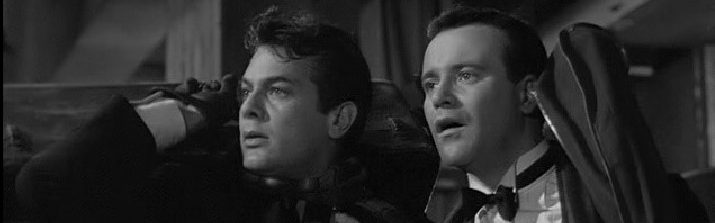
“Star Trek”: Season 2, Episode 18 (“The Immunity Syndrome”)

The Enterprise is sent to investigate the disruption of the Gamma VII-A solar system and the destruction of the U.S.S. Intrepid, staffed by Vulcans. When they arrive, they find a large dark mass floating in space. This ep has a great introduction w/ Spock realizing that his own people died and sensing their “astonishment” (fine acting from Nimoy). Spock doesn’t know how the ship is being drained of energy and pulled towards this “hole in space.” Life support systems are diminishing quickly. Stimulus is injected in the Bridge crew (esp. Kirk) to keep them going despite exhaustion from a previous mission.

Drawn into the mass, they find a huge amoeba-like creature. Kirk and McCoy wonder that mankind’s sole destiny may be in repelling such invaders of our galaxy; our species may act like antibodies of the galaxy-body, fending off invading cosmic viruses. Were this creature to reproduce, as the crew discovers it is about to, it would eventually fill the entire galaxy. The crew is working as a team under pressure against an unknown threat. There is the drama of Spock and McCoy competing to see who gets to take the shuttlecraft to get a closer look and research further. Kirk must decide which of his two friends to send on the dangerous mission. Scotty is worried about the engines, which are losing power fast. There is a lot of atmosphere, foreboding, character development, and dialogue (incl. science and medical talk).

Mr. Spock: I’ve noticed that about your people, Doctor. You find it easier to understand the death of one than the death of a million. You speak about the objective hardness of the Vulcan heart, yet how little room there seems to be in yours.

Dr. McCoy: Suffer the death of thy neighbor, eh, Spock? Now, you wouldn’t wish that on us, would you?

Mr. Spock: It might have rendered your history a bit less bloody.

“Star Trek”: Season 2, Episode 20 (“Return to Tomorrow”)

From a planet devoid of life for half a million years, the Enterprise hears the voice of a powerful being (Sargon- voiced by James Doohan), who can control ship. He transports the landing party (Kirk, Spock, McCoy and astro-biologist Ann Mulhall) to room miles underneath the planet. However, the security guards they planned to take along were prevented from coming along. Sargon is one of only three survivors of an intelligent race made of pure energy/pure thought. They started life on Earth and spread out to many other places, so refer to our heroes as “my children.”

Suddenly, Sargon possesses Kirk’s body! He requires Spock’s and Dr. Mulhall’s bodies, too, but promises they will be returned after they build advanced robots to house themselves. Sargon gives them time to freely make up their minds and beams them back to the ship. McCoy warns against hosting the lifeforms, but Kirk, Spock, and Dr. Mulhall (Diana Muldaur- Dr. Pulaski on ST:TNG) are intrigued. We soon see that the aliens can only survive in human bodies for short periods of time w/o killing their surrogates!

It must’ve been fun for Shatner and Nimoy to take on two roles as aliens inhabiting the bodies of Kirk and Spock. Shatner as Sargon goes from over-the-top dramatics to being dignified and caring. His scenes w/ his wife Thalassa (in the body of Dr. Mulhall) are sweet and touching. Nimoy gets to play Henoch, who seeks to remove Sargon from the equation and take over. Nimoy has an excuse to play w/ different emotions; he creates a twisted (yet smooth-talking and smiling) villain. Henoch tries to trick Nurse Christine Chapel, who we know loves Spock.

This ep and its writer, John T. Dugan, earned a WGA Award nom in the category Best Written Dramatic Episode in 1968. Dugan wrote the original script after he had read an article about highly sophisticated robots. In his original draft, Sargon and Thalassa continue their existence as spirits w/o bodies, floating around the universe. However, Roddenberry (as he often did) re-wrot the script to change the ending (w/ the aliens fading out into oblivion). This is the reason Dugan put his pen name (John Kingsbridge) in the credits.

[1] Dr. McCoy’s objections are warranted and well expressed, but a final centerpiece speech by Kirk explains the risks and rewards of flight, space flight, sciences and alien encounter. He states “Risk is our business” in a well written and delivered plea.

[2] It’s haunting, tragic, deeply romantic, dream like, and sensual. The idea that god like aliens long to be human, to have all the feelings and emotions we take for granted, is deeply inspiring.

I loved how the “temptation” of Thalassa was so Biblical, with the suave Henoch in the role of the serpent.

-Excerpts from IMDB reviews


“Star Trek”: Season 2, Episode 10 (“Journey to Babel”)

The Enterprise is transporting several diplomatic delegations to a conference on Babel re: the future of the mineral-rich planet, Coridan. This ep introduces the Andorians and the Tellarites; later in the series, we learn that they are two of the four founding members of the United Federation of Planets. Among the passengers are Mr. Spock’s parents, the Vulcan ambassador, Sarek (Marc Lenard), and his human wife, Amanda (Jane Wyatt from Father Knows Best). There is obviously a chill between father and son. It turns out that Sarek is very ill w/ a heart condition; Dr. McCoy wonders if/how he can be saved. To add to the drama, there tension among the delegations; a spy is transmitting messages to a hostile ship which is following closely. When Capt. Kirk is wounded in an attack, Spock takes command just as his father needs a transfusion (that only he can provide)!

In the first ep ever to feature Spock’s parents (who are fan faves); Lenard received more fan mail than Nimoy for two weeks after this aired. We learn that Vulcans have a longer lifespan than humans. Being new to the show, Lenard and Wyatt asked Nimoy for advice on how the two of them could display their love in a subtle way. Nimoy suggested Sarek and Amanda touch and stroke each other’s hand by the index and middle finger. In S1 of TOS, Lenard (who was only 6 yrs older than Nimoy) played the unnamed Romulan commander in another terrific ep- Balance of Terror. Lenard had been a potential candidate for the recasting of Spock (when salary negotiations w/ Nimoy were going on at the end of S1).

Writer D.C. Fontana chose the name “Amanda” for Spock’s mother b/c it means “worthy of love” in Latin- how cool! She had become curious about past references to Spock’s background and fully fleshed them out here. Fontana also thought this would be an interesting way to reflect issues of the Generation Gap. Roddenberry wanted Kirk to be more involved with the story, so he wrote the scene where Amanda explains to Kirk about the rift between her son and husband. However, Fontana felt that it would be inappropriate for Amanda to discuss this w/ someone she had just met.

[1] …though there are some humorous moments, it’s mostly an episode driven by intrigue, suspense and interesting drama on the Vulcan side, where even more backstory is revealed on Spock…

Nimoy gives another subtly excellent performance; his demeanor is slightly different when speaking with his mother about the situation between himself and his father. Despite the Vulcan reserve, you sense his discomfort and sadness.

[2] The presence of Spock’s parents allows writers D.C. Fontana and Gene Roddenberry to further their character development of Spock as a man half-Vulcan and half-human. There are a number of wryly humorous moments between Spock and his father, who we learn not only have the normal Vulcan unemotional relationship, but who have some bad feelings towards each other. Maybe because they’re feelings, they don’t talk about it, and just ignore the situation as best as they can. Amanda… proves to be a surprising fulcrum balancing the two.

-Excerpts from IMDB reviews

“Star Trek”: Season 2, Episode 4 (“Mirror, Mirror”)

During an ion storm over an alien planet, there is transporter malfunction on the Enterprise. The landing party of Kirk, McCoy, Scotty, and Uhura find themselves in a mirror (parallel) universe aboard a ship run by a ruthless crew. Their evil counterparts take their places on the real ship. Our heroes must find a way back before they’re discovered by a crew (where using treachery, violence, and seduction are common)! Kirk also must avoid destroying the peace-loving Halkans, who refuse to deal w/ the Empire (b/c of the power for destruction that their dilithium crystals would give them).

The Mirror Universe salute may remind modern viewers of the Nazis; however, it comes from Ancient Rome. One the first things you’ll notice is the clothing, accessories, and hair (esp. the mustache and goatee on Spock). TOS was usually not allowed to show women’s navels, but Uhura’s toned abs are visible. They filmed while a PA took the Standards representative to lunch- LOL! Sulu wears a red shirt as he has a different role in Security; he has a long scar on one cheek. Phasers are worn upside-down on the left hip; I only noticed this on my third viewing.

Kirk (to fit in w/ his environment) warns the Halkan commissioner: “We will level your planet and take what we want- that is destruction: you will die as a race.” Kirk is faced w/ more complication when he discovers a gorgeous woman waiting in his quarters- Lt. Marlena Moreau (Barbara Luna- an actress w/ Latina and Filipina heritage). She is clever, opportunistic and feisty; she desires to be “the woman of a Caesar” (another call-back to Ancient Rome). Marlena gets suspicious b/c this Kirk is a lot less brutal and insensitive. After filming had begun, Luna was diagnosed w/ strep throat. Since the script called for Capt. Kirk to kiss her, they had to postpone that scene for three weeks until she was well.

This is one the most popular TOS eps; also, The Mirror Universe was later depicted on Star Trek: Deep Space Nine and Star Trek: Enterprise. Ronald D. Moore (a writer/producer on later Trek series) cited this episode as one of his favorites; he is also the creator of the rebooted Battlestar Gallactica. The writers examine the negative side of the main characters, which is fun and unexpected. While Spock remains mostly true to the Spock we know/love, Sulu is a cunning schemer and young Chekov turns out to be a risk-taker. I also discovered that there is a second Vulcan serving on the ship (as Mirror Spock’s security guard).

[1] Instead of the usual prime directive and the overriding desire to do good, this anti-Enterprise world is just plain awful and a great counter-point to the sometimes saccharine-like world of Star Trek where everyone gets along a bit too often!

[2] …there’s something about tapping into the dark side of all our beloved characters here which makes this an irresistible mix of tension and adventure – an ultimate Trek, if you will.

[4] The acting takes it over the top. William Shatner’s Kirk displays the quick wits and cleverness that make the character so interesting. And notice how our good guy Kirk is not entirely uncomfortable in his new, dangerous environment. Leonard Nimoy’s evil version of Spock is genuinely menacing in a cool, calculating way. Nichelle Nichols’ Uhura shows us a cunning, wily side… But the acting prize goes to George Takei. …his evil Sulu is slimy, sleazy, scary, and wonderfully despicable.

-Excerpts from IMDB reviews

“Star Trek”: Season 2, Episode 1 (“Amok Time”)

[1] One of the more iconic episode from TOS, and rightfully so. It’s also full of firsts. It the first episode to feature Walter Koenig as Chekov, the first to bill DeForest Kelley alongside William Shatner and Leonard Nimoy in the opening credits, and perhaps most importantly, the first to feature Gerald Fried’s iconic “battle music”.

[2] The episode… it examines the estrangement of arranged marriages by a traditional society, and the lengths the parties involved will go to to alter the bargain made in which they had no say. 

[3] Nimoy does a fantastic job in this episode showing off a wide range of emotion, something normally not asked of him.

-Excerpts from IMDB reviews

Even though it was not the first ep filmed for S2, it was the first one that was aired on TV. This also marks the first visit to the planet Vulcan, and the first time we get so see other Vulcans (beside Spock). Vulcans were named for Roddenberry’s concept for their planet being a “volcanic”, desert world. We hear the Vulcan phrases: “Peace and long life” and “Live long and prosper” accompanied by the hand salute (which Nimoy modified from a gesture made by Jewish priests).

Mr. Spock is NOT himself, as he is acting illogical and irate (even throwing the plomeek soup that Nurse Chapel brings him against a wall)! FYI: This soup stained the set for several weeks. He insists that the Enterprise be diverted to his home planet- Vulcan- for shore leave (which he never takes). Spock finally reveals to Capt. Kirk that these behavioral aberration happen every 7 yrs when Vulcans must mate (pon farr) or die! Nurse Chapel comes to see Spock in his quarters, worried about his condition (esp. b/c she is in love w/ him). They get a brief scene (where he probably senses that she has feelings for him) and we learn that Vulcans also dream.

In one of the best scenes of this ep, Kirk disobeys Starfleet orders out of friendship; as he explains to McCoy, Spock has saved his life many times. There is another great scene in the turbolift w/ where Spock requests Kirk to accompany him down to the planet, as a close friend; then here is a pause and he asks McCoy the same thing. Kirk and McCoy think they’re about to be be in roles of “best men” at the wedding ceremony, but there is much more involved. As a viewer commented, the final scenes are Shakespearean.