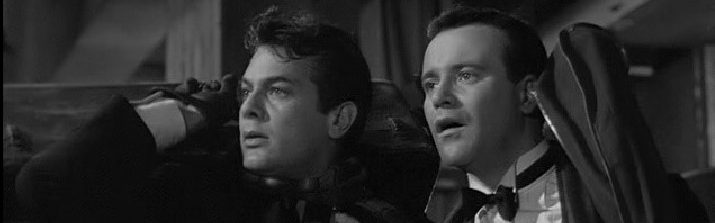
#Noirvember: “House of Strangers” (1949) starring Edward G. Robinson, Susan Hayward, and Richard Conte

After serving 7 yrs in prison, NYC-raised lawyer Max Monetti (Richard Conte), goes to the bank run by his brothers Joe, Tony and Pietro. He promises to revenge them. Next, he visits his lover, Irene Bennett (Susan Hayward), who asks him to forget the past and start a new life in San Fran. In flashback, we see Max’s life in the early ’30s. He was the favorite son of his father, Gino Monetti (Edward G. Robinson), who had a small bank in Little Italy on the Lower East Side (LES). Gino is an egotistical/self-made Italian immigrant who ruled over his family like a tyrant. Max was a competent lawyer engaged to a young woman, Maria Domenico (Debra Paget). Max meets Irene when she comes to him for legal help; they have a LOT of spark, but their love affair is troubled. The new Banking Act takes effect in 1933, and Gino is investigated by the feds for misapplication of funds. Max forms plan to help his father…

Max [to Irene]: Always looking for a new way to get hurt from a new man. Get smart, there hasn’t been a new man since Adam.

This is a film noir that is also a dysfunctional family drama (how appropriate for the holidays- LOL)! If you are an immigrant or a 1st gen American, you MAY esp. relate to this movie. It’s a BIT of a mixed bag, though it has some (timeless) themes and (mostly) good acting. The character of Gino Monetti is loosely based on Amadeo P. Giannini (1870-1949), founder of the Bank of Italy, which became the Bank of America. According to articles from the entertainment press in March of 1948, Victor Mature was to be cast as Max. This film reunites Conte, Paget, and Hope Emerson who appeared in Cry of the City (1948)- a V fine movie. Of course, MANY of you will know Robinson and Paget from The Ten Commandments (1956).

I like watching Conte (discovered by John Garfield and Elia Kazan); he has a challenging role here. No offense to the fans of Mature, BUT Conte is a stronger actor. Max (who sometimes operates in the “gray areas”) has to decided btwn the “good girl” (virgin) from his neighborhood and the mature/WASP “temptress” (experienced w/ men). Conte and Hayward play off each other well; they have a sort of combative energy. Now, are there some stereotypes in this story? Yes, though we classic movie fans are aware this can be the case sometimes. People of Italian heritage were considered “exotic” in the 1940s; Hollywood (for many decades) did NOT create subtle characters who were ethnic (or racial) minorities. Some (modern) viewers couldn’t get over the accent used by Robinson, his pencil-thin mustache, and mannerisms.

Max: Pa, have you read the new banking act?

Gino: I don’t even read the old one. Why?

There was also drama behind-the-scenes (BTS) of this movie. According to the biography of director Joseph L. Mankiewicz (People Will Talk), the producer (Sol Siegel) hired Philip Yordan to adapt Joseph Weidman’s novel (I’ll Never Go Home Again) for the screen. After Yordan submitted 3/4 of the script, Siegel decided that it was unacceptable, fired him, and asked Mankiewicz to redo the script. Mankiewicz rewrote ALL of Yordan’s dialogue, reshaping the script. The Screen Writers Guild ruled that Yordan receive sole story credit and he and Mankiewicz share credit for the screenplay. Mankiewicz refused to share credit for a screenplay he had basically written, so received NO credit. The studio remade House of Strangers in 1954 as a western- Broken Lance (starring Spencer Tracy as the patriarch). Yordan was given credit for the story and won the Oscar for Best Writing, Motion Picture Story. Yordan was also front for many screenwriters blacklisted in the ’50s.

[1] The acting is this film is nothing short of fantastic. Robinson is perfect as the dictatorial, ruthless Gino. Conte is totally believable as the favorite son – efficient and slightly to the right of slimy. Luther Adler gives a brilliant performance as the henpecked Tony. The rest of the cast is uniformly excellent. Susan Hayward plays Max’s love interest, a woman who gives as good as she gets. She looks sensational and does a terrific job in her role. Stardom is right around the corner for her, and it’s no surprise.

[2] …a great story of hatred and forgiveness. Edward G. Robinson has one of his best performances (if not the best) and wins the Best Actor award in the 1949 Cannes Film Festival. Richard Conte has one of his best roles (if not the best) in his well-succeeded career. Susan Hayward is very beautiful and elegant and performs a strong female character.

[3] I said it was an adult movie… The characters are ambiguous, as people in real life would be. In some ways, for instance, Pa is a lovable old patriarch, but he’s also monstrously insensitive to the feelings of others. And the murderous resentment of the older kids is made understandable too. And Richard Conte’s character is aggressive and domineering at the beginning, just as a spoiled youngster might be, but he develops into a Mensch by the end of the tale. Hayward develops too…

-Excerpts from IMDb reviews

#Noirvember: “One False Move” (1992) starring Bill Paxton, Billy Bob Thornton, Cynda Williams, & Michael Beach

There was no crime in Star City, Arkansas. No murder. And no fear. Until now. -A tagline for the movie

After a drug rip-off which involves 6 murders, the LAPD are on the hunt for a dangerous trio: a sadistic genius- Pluto (Michael Beach; best known for ER), his volatile former cellmate- Ray (Billy Bob Thornton; also co-wrote the screenplay)- and Ray’s 20ish gf- Fantasia (Cynda Williams). Evidence indicates that these fugitives are headed to the small town of Star City, Arkansas. Detectives Dud Cole (Jim Metzler) and John McFeely (Earl Billings) contact the local Chief of Police- Dale Dixon (Bill Paxton)- then head to Star City to continue their investigation. Dale, an energetic cop/family man, is excited by the chance to participate in a nationwide manhunt.

Can something from 1992 look fresh and unexpected (to modern/jaded eyes)? Every element is firing on ALL cylinders in this (lesser-known) indie film: acting, directing, editing, sound/music, sets/production design, costumes/hair, etc. I kept hearing about how great it was on movie podcasts, so decided to check it out (Amazon Prime). This is NOT a typical action/crime/drama, as it’s more interested in character development. None of the main ensemble is what he/she seems at 1st glance. I was a BIT surprised to see Paxton in a complicated role; he is perfectly cast and able to show his range. Thornton (sporting a few extra lbs. and rat-like ponytail) is an immature/sloppy/volatile villain; his trigger finger is itchy. Beach (pressed/polished) is a calm/calculated villain; he is more dangerous than his partner. Williams (who was married to Thornton 1990-1992) is NOT the strongest of actors, BUT she does well here, being paired w/ seasoned actors. Like MANY women (incl. women of color), Williams didn’t have much of a career after her 20s. She is also known for her supporting role in Spike Lee’s ‘Mo Better Blues (playing a singer/love interest of Denzel Washington’s character).

The issue of race adds another layer to the story. The director- Carl Franklin (a former actor) is a Black man; I learned of him in 1995 (when I saw another great neo noir- Devil in a Blue Dress– starring Washington). The racism depicted in this movie is casual/subtle. The contrast between life/values of the city vs. the small town (country) are shown also. For those who want danger, I admit that I was on my the edge of my seat during several scenes. The tension builds… and builds… until the (emotionally powerful) climax! This film was considered “too violent” when it premiered at Sundance; it was produced by a company that makes movies that go direct to video. Luckily, One False Move did get a (limited) big screen release, after critics Roger Ebert and Gene Siskel spoke of its merits. Siskel put this movie as his fave of 1992; Ebert placed it in 2nd place- wow! Some of you may recall that 1992 was an esp. strong year for movies; these are some titles: A Few Good Men, Damage, Howard’s End, Malcolm X, The Last of the Mohicans, and Unforgiven.

[1] The film starts off quite violently, but once it gets going, the emphasis is on good old-fashioned character study.

[2] Franklin has a wonderful way with his camera, only revealing enough for us to fill in the blanks, and often his camera is used as a character POV device, with close ups and cuts blending seamlessly with mood of the story.

[3] The script deals with the themes of the contrast between the country and the city, racism, and the mask that many people wear to hide the complexities of their lives and their past. Somehow, all these themes come together in the most seamless and nuanced manner to enhance the poignancy of the film.

[4] I have seen this movie twice. The first time, for the whole movie I was on the edge of my seat. This was an intense film. From the extremely brutal beginning to the climatic end, I couldn’t relax once.

-Excerpts from IMDb reviews

#Noirvember: Films from Noir City DC (OCT 2022)

This year was my 2nd time attending the Noir City DC Film Festival at AFI Silver Theatre (here in my current neighborhood- Silver Spring, MD). I ended up seeing 3 movies- one of which I’d never watched before. During the 1st weekend, TCM’s Noir Alley host, Eddie Muller, introduced the films. I bought Eddie’s book on the behind-the-scenes story of Gun Crazy (1950).

All the King’s Men starring Broderick Crawford, John Ireland, Joanna Dru, John Derek, & Mercedes McCambridge

Jack Burden (John Ireland) is a newspaper reporter who hears of Willie Stark (Broderick Crawford) when his editor sends him to Kanoma County to cover the man. What’s SO special about this “nobody” running for county treasurer? He’s supposedly an honest man! Burden discovers this to be true when he sees Willie delivering a speech and having his son pass out handbills, while local politicians intimidate him. Willie is honest and brave; he’s also a “hick” whose schoolteacher wife educated him at home. He loses the race for treasurer, BUT later makes his way through law school. He becomes an (idealistic) attorney who fights for what is good. Someone in the governor’s office remembers Willie, when they need a patsy to run against the govermor and split the vote of his rival. While these (wiser/experienced) political types underestimate Stark, Burden (who becomes Stark’s biggest supporter) overestimates the man’s idealism.

I’d never seen this movie before; it will esp. interest those of you who follow politics. Here we find some of the same themes as in A Face in the Crowd (1957)- a must-see for fans of classics. After living through the Trump presidency, you’ll (no doubt) find comparisons aplenty! The basis of this movie is a Pulitzer-winning novel, All the King’s Men, by Robert Penn Warren; the book was loosely based on the life of a Louisiana politician- Huey Long. The screenwriter/director, Robert Rossen, also worked on Body and Soul (1947) and The Hustler (1961). Ireland reminded me a BIT of Henry Fonda w/ his looks. This is the 1st movie role for McCambridge; she makes a big impression as a tough/unapologetic political operator. Dru is NOT able to convey deep emotion, so in several moments, she dramatically turn away from the camera. Crawford, known for playing mostly “heavy” (tough guy) roles, seems to inhabit his role here. Both Crawford and McCambridge won Oscars for their work!

A Place in the Sun (1951) starring Elizabeth Taylor, Montgomery Clift, & Shelley Winters

A chance meeting w/ his uncle after his father’s passing leads to George Eastman (Montgomery Clift) being caught in the middle of two worlds and NOT truly belonging in either one. The son of poor Christian missionaries, George meets his wealthy (paternal) uncle, Charles Eastman (Herbert Heyes), while working as a bellhop in his uncle’s hotel in Chicago. Wanting a better life for himself, George takes his uncle up on his offer for a job in one of the Eastman factories in California. Under his cousin Earl’s directive, George is placed on the factory assembly line. George sees this position as a stepping stone to something better, which he’s willing to work hard to achieve. Feeling lonely, George breaks the rule of no fraternization when he starts dating a fellow assembly-line worker, Alice Tripp (Shelley Winters). Several months later, Mr. Eastman suddenly promotes George professionally and personally. Although he’s NOT used to high society, George is soon befriended by beautiful/young socialite, Angela Vickers (Elizabeth Taylor- then just 18 y.o.)

Quite a big audience was present to watch this film; it’s a classic that stands the test of time. I watched it (w/ my family) as a kid. Mike Nichols said this film was his favorite; the filmmaker watched it 50+ times! Nichols noted that it also influenced how he directed his 1st movie- The Graduate (1967). The director of A Place in the Sun, George Stevens, was one of the most respected/prolific of his era. He came up through the Hollywood studio system, working as a stills photographer, then as a cinematographer. Stevens directed MANY critically-acclaimed/well-loved films, incl. Alice Adams (V early in Katharine Hepburn’s career), Woman of the Year (teaming up Spencer Tracy w/ Hepburn), The More the Merrier (a fun/early rom com), Shane (considered one of the best Westerns), and the epic family drama Giant (also w/ Taylor). The source novel for this movie, An American Tragedy, was written by Theodore Dreiser; it’s based on a true story. The book was adapted into a play by Patrick Kearney. The screenplay was written by Michael Wilson; he also worked on The Bridge on the River Kwai and Laurence of Arabia.

In 1991, this movie was selected for preservation in the U.S. National Film Registry by the Library of Congress. One critic wrote that this film represents America, where people are NOT satisfied w/ what they have, BUT always looking for something better. Another critic pointed out the connection shown btwn social class and desirability. The costumes, set design, editing, music/sound, directing, and acting ALL combine to make this an effective (and affecting) story. The director makes some great choices, incl. those memorable close-ups of two of the hottest actors to appear in film. In one pivotal scene, George embraces and speaks reassuringly to Alice, BUT Clift’s body is hidden from the camera. When George and Angela interact, she is often shown in the power position (as a male love interest). Notice their embrace on the balcony, where Clift hunches down and enfolds himself tightly in Taylor’s arms. At the lake, Taylor is sitting up w/ Clift laying his head down in her lap. In the end, did you think that George was a victim of circumstance or a calculating villain?

He would discuss the scene, but not the lines, and would photograph the second or third rehearsal so the scene had an almost improvisatory quality. Stevens would print the first take, then spend the next three hours minutely rehearsing the scene, then film it again. He explained to me that in this way he often got actors’ unplanned reactions that were spontaneous and human and often exactly right. And often when actors overintellectualize or plan their reactions, they aren’t as good. -Winters, describing Stevens’ way of directing

…because Monty was the New York stage actor, and I felt very much the inadequate teenage Hollywood sort of puppet that had just worn pretty clothes and hadn’t really acted except with horses and dogs. -Taylor, on feeling intimidated to act w/ Clift (before they became the best of friends)

Body and Soul (1947) starring John Garfield & Lili Palmer

Charley Davis (John Garfield) wins an amateur boxing match and is hailed as a local wonder. He meets a young woman, Peg (Lili Palmer), the winner of a beauty pageant. Peg lives in the West Village of NYC and is studying to be painter. The young men of Charley’s Lower East Side (LES) neighborhood are mostly jobless; some are looking to make some quick money. Charley’s friend, Shorty (Joseph Pevney- later director of many eps of Star Trek), tries to get the attention of a boxing promoter, Quinn (William Conrad), when he comes to the local pool hall. Suddenly, Charley’s father is killed in a bombing of his small candy store! Charley’s mother, Anna (Anne Revere), is strongly opposed to him fighting; she wants him to continue w/ night school and become a “professional.” Instead of letting his mother sign-up for “relief” (the precursor to welfare), Charley gets Shorty to set up a fight through Quinn. Charley travels to many states and his career grows, as he keeps winning fights. When an unethical promoter, Roberts (Lloyd Gough), shows an interest in Charley, he finds himself faced w/ difficult choices.

This movie (directed by Robert Rossen) is considered to be the best of Garfield’s short/bright career; the screenplay was written by one of his childhood friends- Abraham Polonsky. This role fits Garfield like a (boxing) glove; he also produced the film. Revere (who is related to that Paul Revere) is perhaps NOT the 1st choice for a Jewish mother, BUT she does good in her role (as usual). Palmer (who is British) and Garfield have good romantic chemistry, BUT her (posh) accent is out of place in the gritty world of the LES. Canada Lee plays Ben, a Black boxer who fights Charley, then becomes one of his trainers/close pals. Lee gets a few meaty scenes (rare for this era for people of color in film); he mainly worked in theater. The cinematographer, James Wong Howe (Chinese-American), filmed the pivotal fight holding the camera while being pushed around the ring by an assistant on roller skates! Martin Scorsese saw this movie as a boy; its influences can be seen in Raging Bull (1980), as some viewers noted.

#Noirvember: “State of Grace” (1990) starring Sean Penn, Ed Harris, Gary Oldman, & Robin Wright

A family ripped apart by violence. A love corrupted by betrayal. A friendship stained by blood. -A tagline for the movie

This is the month when ALL of us film noir fans celebrate the genre; I’m starting off w/ a neo noir which MANY won’t know about. A young Boston patrolman, Terry Noonan (Sean Penn), is recruited to go undercover in his old neighborhood (Hell’s Kitchen in NYC) and infiltrate the Irish mob run by the older brother- Frank Flannery (Ed Harris)- of his childhood best friend, Jack Flannery (Gary Oldman). To complicate matters further, Terry’s 1st love that he is still pulled toward- Kathleen (Robin Wright- in her early 20s)- is the younger sister of the Flannery brothers. Penn and Wright became a couple during the filming; they have good chemistry here. Several incidents in this movie are based on testimony given by captured NYC mobsters, incl. the meeting in the restaurant w/ the Italian mafioso and the dead man’s hand sequences.

I never heard of this film (shot partly inside one of Trump’s hotels) until recently; it was released in the same year as the (now mob classic) Goodfellas! Who could live up to that comparison!? The director, Phil Joanou, was in his late 20s (like some of his actors) when this movie was made. Though the (then up-and-coming) actors are hungry (and doing their best), the script is NOT very strong. As MANY experienced actors have commented over the yrs: “If it’s not on the page, it’s not on the stage.” I stopped the movie 3x while watching it last weekend to do chores (which I hate doing – LOL); this proved that it lacked momentum. It is also too long- 2 hr. 14 mins. When this happens in a movie categorized as “action/crime/thriller,” it’s NOT a good sign.

Though Penn would go on to become a big name 1st, I was more impressed by Oldman (who has long-ish hair and a grungy look). His NYC accent is flawless and he seems to totally inhabit his volatile, hard-drinking character. In the few quiet scenes, Oldman gets to show the hidden insecurity/vulnerability of Jackie, such as when he and Harris share a hug. Oldman hails from an area of London which is known to be tough. Fun fact: Oldman fell in love w/ Uma Thurman while working on this film; she was the former gf of the director. I learned that Penn and Oldman performed a (fiery/dangerous) stunt themselves- yikes! Harris has long been a character actor that I admired; Wright is also good (as I expected), though early in her career. Look out also for John Turturro and a V young/skinny John C. Reilly in (smaller) roles. If you like neo-noirs, the ’90s aesthetic, mob movies, and/or the gritty side of NYC, then check it out (free for Amazon Prime subscribers).

“Storm Warning” (1951) starring Ginger Rogers, Ronald Reagan, Doris Day, & Steve Cochran

On the way to a job, a NYC based model, Marsha Mitchell (Ginger Rogers), decides to stop at a small town (Rock Point) to visit her sister, Lucy Rice (Doris Day), who she hasn’t seen in 2 yrs. She will be able to finally meet Lucy’s husband, Hank (Steve Cochran- a character actor who often played villains), who works at the local mill. Upon arriving in town, Marsha witnesses a Ku Klux Klan (KKK) murder! She saw two of the men’s faces (after they removed their hoods), BUT they didn’t see her. We soon learn that the man was Walter Adams, a reporter from out of town who’d been investigating the KKK. Upon later arriving at Lucy’s house, Marsha is shocked to see that Hank was one of the men involved in the murder! Marsha is speechless for a moment, wondering how she’ll break the news to her sister (who looks to be SO happy w/ her life). Meanwhile, the county prosecutor, Burt Rainey (Ronald Reagan), knows that the KKK committed the murder. It seem that everyone in town is aware of this, BUT Rainey knows that none of the locals will come forward to implicate the KKK.

Sheriff Art Jaeger: Well, that’s all there is. I take orders. You give me an order, l’ll do it. You know anybody in Rock Point who will go to the inquest for you and testify against the Klan? Tell me, and l’ll bring ’em in. If you don’t, and you don’t, stop kicking my men around for not doing what you can’t do yourself.

Burt Rainey: I know. But every time someone from New York, Washington, or points north, starts poking his nose in our affairs, we holler foul. Well, if we don’t want the meddling, one of these days we’re gonna have to start cleaning up our own messes. You and me. All of us.

Warner Bros. wanted Lauren Bacall to star, but she’d decided to travel to the Belgian Congo (as it was then called) w/ her husband, Humphrey Bogart, who’d be making The African Queen (1951). This is Day’s first non-singing role. Joan Crawford was asked by studio boss Jack L. Warner to play the lead role; Crawford declined by saying: “Come on, Jack. No one would ever believe that I would have Doris Day for a sister!” LOL- too real! Alfred Hitchcock liked Day’s performance here so much that he asked her to act in The Man Who Knew Too Much (1956). Day was V happy to work w/ Rogers; before Day’s success as a big band singer, she’d aspired to be a dancer (and Rogers was one of her childhood idols). The writers (Daniel Fuchs and Richard Brooks) were known for fine work; Brooks was nominated for 6 Oscars over his long career.

Burt Rainey: Nobody saw anything. Nobody heard anything. It’s a shame Adam’s body keeps getting in the way.

Walt Walters: I don’t know who’s the guiltier, the one who commits the crime or the one who just stands by and refuses to do anything about it.

Burt Rainey: Sometimes, I sit around for hours trying to figure that one out.

This is an (oddly) compelling film noir/melodrama that I saw recently for the 1st time (Amazon Prime). It’s playing during the Noir City DC film festival at AFI (in my neighborhood of Silver Spring, MD). Where is this town located: Midwest, Southwest, or South? None of the locals have a Southern accent. Christmas is coming soon, BUT there is no snow or Winter weather. There is no mention of race; the ONLY Black residents are seen in a crowd scene (blink and you’ll miss them). There are references to “safety” (incl. of women on the streets) and “outsiders” (who are looked upon w/ suspicion). Local lawmen and businessmen are fearful and complacent; they’ve put up w/ the KKK’s influence for yrs. The KKK is considered more of a criminal organization rather than a hate group.

[1] In many ways, this is a taut and excellent drama. BUT, it also pulls some of its punches. It’s VERY strange that there are no black folks as characters in the film–not even as the victim. Now I am NOT saying the KKK didn’t sometimes kill whites, but this was the exception to the rule and completely negates the whole racism angle. It’s sad, but the film seemed to want to play it safe by playing it that way. However, while Hollywood was very hesitant to address race…

[2] The Ku Klux Klan might have been the Elks in white sheets. No pun intended, but they get quite a white washing here. No mention at all of their racism or hatred of Catholics, Jews, and foreign born of all kinds. Still they are a nasty bunch who have a habit of doing in people who disagree with them.

Ronald Reagan here is a District Attorney who is bland in a very poorly written role. The problem with the Klan was that the various county District Attorneys in the South were more than likely Klan members, or who, at best, just looked the other way. After all, these cretins with the hoods were the very voters who put in the District Attorneys. When the Klan was prosecuted, if witnesses were found against it back in those days, it was always done at the federal level by appointed United States Attorneys.

[3] …this film isn’t very good as a history lesson… […] Storm Warning is still pretty entertaining and worth a look for anyone curious about how such subject matter was treated in an era of censorship and post-war political atmosphere.

-Excerpts from IMDb reviews