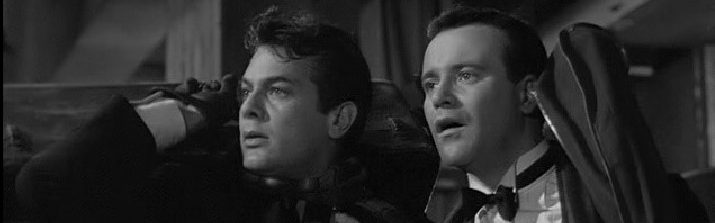
“Citizen Kane” (1941) starring/directed by Orson Welles

Radio’s Most Dynamic Artist . . The Man At Whose Voice A Nation Trembled . . . Now the screen’s most exciting NEW star! ORSON WELLES in the picture Hollywood said he’d never make! – A tag line from the film

Following the death of publishing tycoon Charles Foster Kane (Orson Welles- just 26 y.o.), reporters scramble to uncover the meaning of his final word: “Rosebud.” The film begins with a news reel (which comes directly from RKO Pictures) detailing Kane’s life for the masses. Then, we see flashbacks from Kane’s life- his simple boyhood, life as an idealistic young newspaper publisher, attempt at politics in mid-life, and two (failed) marriages. As the reporters investigate more, we see a man’s rise to fame and fall from the top of his world. Kane (who died alone surrounded by statues and other treasures from all over the world) is based on media tycoon William Randolph Hearst.

Kane [in old age]: You know, Mr. Thatcher, if I hadn’t been very rich, I might have been a really great man.

Young Charles Foster Kane (8 y.o.) comes into a LOT of money; his mother/owner of a boarding house, Mary (Agnes Moorehead), decides he should be sent away from Colorado to the East. He will be raised by his new guardian, a humorless banker named Mr. Walter Parks Thatcher (George Coulouris). Charles’ father (Harry Shannon) is reluctant to give up his son; though he’s an alcoholic w/ potential for violence, the boy seems to love him. When Mary is signing away the boy, there is the (then innovative) use of the “deep focus lens.” While the mother acts cold (calling him “Charles), his father takes a warmer tone (calling him “Charlie”). Upon reaching 25, Kane (handsome/energetic) comes into ALL his inheritance; he impulsively buys a newspaper (The New York Inquirer) against the wishes of Thatcher. His closest pal Jedediah Leland (Joseph Cotten) becomes the theater critic; being from “old money,” Jed can scoff at high society. Kane’s general manager, Mr. Bernstein (Everett Sloane), is loyal/helpful until the end. When Kane writes up his “declaration of principles,” his face is almost obscured in shadow; this is a hint of things to come. Jed looks almost directly at the camera, saying that paper will be worth something one day.

Mr. Bernstein: Old age. It’s the only disease, Mr. Thompson, that you don’t look forward to being cured of.

Kane’s first wife, Emily Monroe Norton (Ruth Warrick), is the sophisticated niece of the president; they meet (offscreen) in Europe and have a whirlwind romance. Emily starts to resent the long hours Kane spends at the newspaper; their politics are also different. In a series of clever/concise scenes at the breakfast table, we see the deterioration of their relationship (from flirty/loving to silent/cold). One night, outside a pharmacy, Kane meets a 22 y.o. aspiring opera singer- Susan Alexander (Dorothy Comingore). It turns out that he can maker her laugh; Susan also doesn’t know who Kane is (being a naive girl new to the city). After Kane enters politics, his affair w/ Susan is uncovered by a private detective working for his rival. When given the choice between Emily (who was loyal to him for 15 yrs) and Susan, Kane chooses Susan (thus loses his political career).

Kane: Mr. Carter, here’s a three-column headline in the Chronicle. Why hasn’t the Inquirer a three-column headline?

Carter: The news wasn’t big enough.

Kane: Mr. Carter, if the headline is big enough, it makes the news big enough.

Mr. Bernstein: That’s right, Mr. Kane.

They get married and he even builds an opera house where Susan can perform; it turns out she’s a terrible singer (no matter how hard she practices). Kane and Jed have a falling out; Jed is drunk and gives his true opinion re: Susan’s “talent.” Their break-up scene where we are looking up at the characters was achieved by Greg Toland (cinematographer) cutting holes in the floor of the studio. Later on, there is break-up w/ Susan, after she gets tired of living a lonely/unfulfilled life in his huge California estate Xanadu (named for the “pleasure palace of Kubla Khan” in the poem by Samuel Taylor Coleridge).

Jed [to Kane]: You don’t care about anything except you. You just want to persuade people that you love ’em so much that they ought to love you back. Only you want love on your own terms. Something to be played your way, according to your rules.

Once you see this film (or rewatch it a few times), you realize how influential it was to later films! It is very well made and ahead of it’s time, as I realized seeing it recently. Watching this film on TV, a young Scorsese began to notice editing techniques and camera moves (incl. the use of the “wide angle lens”). In previous American films, the camera didn’t move, Scorsese noted. As NYT film critic A.O. Scott commented: “Most of the scenes are shot a low angle, so we feel as if we’re sitting in an orchestra seat watching a play. It is also un-mistakenly cinematic… deep focus asymmetrical compositions and bold contrasts in light and shadow to get at themes not explicitly stated in the film’s script. Welles slows time down w/ subjective dream-like sequences and speeds it up w/ witty and inspired montages.”

[Susan is leaving Kane]

Kane: [pleading] Don’t go, Susan. You mustn’t go. You can’t do this to me.

Susan: I see. So it’s YOU who this is being done to. It’s not me at all. Not how I feel. Not what it means to me. [laughs] I can’t do this to you? [odd smile] Oh, yes I can.

Is this the best film ever made? I don’t think so, but it’s worth a watch for cinephiles. Citizen Kane is essentially a character study of a man who is rich, powerful, yet probably feels inadequate inside (as he can’t connect to other people). Love is something that Kane wanted all his life, both Jed and Bernstein tell the reporter. Most the the actors are newcomers from The Mercury Theater, Welles’ theater company. Cotten went on to have a fine career; he said he was proud to have appeared in several box office hits. He is perhaps best known as Uncle Charlie in Hitchcock’s Shadow of a Doubt. Sloane makes a terrific villain in Welles’ film noir The Lady from Shanghai.

“Tombstone” (1993) starring Kurt Russell & Val Kilmer

Doc Holliday: Forgive me if I don’t shake hands. (Isn’t this relatable after quarantine life!? LOL!)

After success cleaning up Dodge City, Wyatt Earp (Kurt Russell) moves to Tombstone, AZ, looking to get rich. He meets his brothers Virgil (Sam Elliott) and Morgan (Bill Paxton), as well as his old friend Doc Holliday (Val Kilmer). A band of outlaws- The Cowboys- are causing problems in the area w/ random acts of violence. In time, The Cowboys (who wear red sashes on their waists) come into confrontation with Holliday and the Earps, leading to a shoot-out at the O.K. Corral. I had forgotten that there were two (legendary) actors here- Charlton Heston (the elderly rancher Henry Hooker) and Robert Mitchum (the narrator)- wow!

Morgan Earp: Look at all the stars. You look up and you think, “God made all this and He remembered to make a little speck like me.” It’s kind of flattering, really.

There are so many good actors in this movie (and I heard ALL the mustaches were real)- some famous and others more known for character roles. The villains are headed up by Curly Bill (Powers Boothe- who formed part of the ensemble in Deadwood), Johnny Ringo (Michael Biehn- went to the Univ. of Arizona for several yrs), Stephen Lang (Ike Clanton), and his lil bro Billy Clanton (Thomas Haden Church- who usually does comedy). Wyatt’s wife Mattie (Dana Wheeler Nicholson) has become addicted to laudanum. Virgil’s (much younger) wife Allie (Paula Malcolmson) is a Irish immigrant; this actress was also in Deadwood (her real accent is Irish). Morgan’s wife Louisa (Lisa Collins) was married to Billy Zane (who plays Mr. Fabian, the actor). Wyatt’s love interest is the independent-minded actress- Josephine Marcus (Dana Delany). The mayor of the town is Mr. Behan (Jon Tenney); this actor has appeared in many cop shows. A chubby Billy Bob Thornton plays a hot-headed (but also cowardly) gambler. 90210 fans will get a kick out of seeing Jason Priestly (a young deputy). Doc Holliday is joined by his lady friend/fellow gambler Kate (Joanna Pacula).

Wyatt Earp: [Vigil has agreed to become Tombstone’s town marshall, upsetting Wyatt] What in the hell are you doin’? I told you we weren’t gettin’ involved!

Virgil Earp: You got us involved when you brought us here.

Wyatt Earp: Now you hold on a minute, Virg!

Virgil Earp: Hold on nothin’! I walk around this town and look these people in the eyes. It’s just like someone’s slappin’ me in the face! These people are afraid to walk down the street, and I’m tryin’ to make money off that like some goddamn vulture! If we’re gonna have a future in this town, it’s gotta have some law and order!

Russell (who has worked in Hollywood since a young boy) said that after original director Kevin Jarre (also the screenwriter) was fired, he directed a majority of the movie. George P. Cosmatos (who was not very comfortable w/ the English language) oversaw the filming, though he has directing credit. The film was nearly cast with Richard Gere as Wyatt Earp and Willem Dafoe as Doc Holliday- LOL! All the actors do a fine job, though Kilmer probably has the best lines. Both Holliday and Ringo are educated men; they even argue in Latin.

Wyatt Earp [to Morgan]: In all that time workin’ those cow towns, I was only ever mixed up in one shootin’, just one! But a man lost his life and I took it! You don’t know how that feels, and believe me boy, you don’t ever want to know. Not ever!

As Wyatt explains to his younger (idealistic) brother Morgan, there is really nothing exciting about killing another person. Wyatt is reluctant to take on a lawman role again; his older brother Virgil is the one who changes his mind. Once his brothers are affected, Wyatt quickly springs into action! This is a fun, action-packed, yet also touching story about brotherly/familial love, friendship, romance, and justice. I esp. liked the various horse riding scenes, which go from playful/romantic to quite tense/dangerous.

[1] Throughout the entire film, his [Kilmer’s] acting and character embellishments are so nuanced and well done that by movies end, we feel his loss in a very personal way. Credit must also go out the the costumers and make-up artists for their contribution to the overall effect of his role. All the way through the film, he looks sickly, pale and world-weary. His mannerisms and intensity of gaze profoundly establish this character as a focal point in this production. …I consider this role as probably the very best for Val Kilmer. It required subtlety and careful restraint and made the viewer believe that we weren’t watching an actor merely regurgitating lines and hitting their foot-marks. I, for one, was entranced by the carefully studied body language and facial expressions…the sweaty desperation of a man who sensed his own mortality but strove to enact his own justice for justices sake. This was just very well done!

[2] …speaking as a woman, this is by no means just a guy’s flick. It’s been one of my favorite films since the day it came out. It’s got everything- drama, romance, action, and an honest to goodness story. There are even interesting themes, like the moral dilemma that Wyatt finds himself in– Is he compelled to help fight the Cowboys even though he’s “retired” and just wants to live out his life in peace? Is there a moral equivalence between killing for justice and killing for retribution? How far can a man go to sacrifice his own integrity and better judgment?

The love story simply served its purpose in helping viewers to better understand the character of Wyatt. Also the friendship between Wyatt and Doc was portrayed tenderly… And okay, as a woman, let me just say that there is no one sexier than Sam Elliot. Man alive, if there ever was a person born to portray a cowboy, that guy is IT. If you’ve never seen a Western, or are not a fan, try this movie. It will make a believer out of you.

-Excerpts from IMDB reviews

“Anna Karenina” (2012) starring Keira Knightley, Jude Law, & Aaron Taylor-Johnson

Vronsky: I love you!

Anna: Why?

Vronsky: You can’t ask why about love!

In 1874, in Imperial Russia, the aristocratic Anna Karenina (Keira Knightley) travels from St. Petersburg to Moscow to save the marriage of her brother Stiva- AKA Prince Oblonsky (Matthew Macfadyen)- who recently affair w/ the governess. My fellow Austen fans know that Knightley and Macfadyen previously starred together in Pride & Prejudice (2005), also directed by Joe Wright. Anna has a loveless marriage w/ her husband, Count Alexei Karenin (Jude Law); they have a young son- Serhoza. Anna meets a cavalry officer, Count Alexei Vronsky (Aaron Taylor-Johnson), at the train station; they have a strong attraction to each other right away. She learns that Vronsky will propose to Princess Kitty (Alicia Vikander- in one of her early roles), the younger sister of her sister-in-law Dolly (Kelly Macdonald). Anna convinces Dolly not to divorce Stiva; Kitty invites her to stay for a ball. The diamond necklace that Anna wears is an exclusive piece created by Chanel. Anna and Vronsky dance at the ball and call attention to themselves. They begin a love affair that will lead to tragedy for Anna.

Karenin: I consider jealously to be insulting to you and degrading to me. I have no right to inquire into your feelings. They concern only your conscience.

Wright adopted an experimental (some said ambitious) approach to this story; the majority of the film was shot on a theater built in Shepperton. The skating rink, train station, and stables were dressed on top of the theater. Doors open onto Russian landscapes; some actors walk from one set to another under the stage. Toy trains and doll houses were used for some shots. Levin (Domhnall Gleeson- in one of his early roles) is allowed to venture out of the theater b/c Wright wanted to stress the fact that Levin is the only authentic character. The soundtrack makes use of a Russian folk song that was also adapted by Tchaikovsky in his Fourth Symphony (written in the same time as Tolstoy’s novel). The song that the (presumably gypsy) Masha (Tannishtha Chatterjee) hums and sings near the end is a Bengali lullaby (a language spoken in Bangladesh and the West Bengal region of India). Wow, I was NOT expecting that!

Countess Nordston: Would you die for love, Konstantin Dmitrich?

Levin: I would. But not for my neighbor’s wife.

[pause]

Levin: An impure love is not love, to me. To admire another man’s wife is a pleasant thing, but sensual desire indulged for its own sake is greed, a kind of gluttony, and a misuse of something sacred which is given to us so that we may choose the one person with whom to fulfill our humanness. Otherwise we might as well be cattle.

Countess Nordston: Ah, an idealist!

[laughter erupts]

I just saw this (1st time) last week and was a BIT disappointed (though I didn’t have high hopes for it). I’d heard/read reviews from several viewers who either hated it or were meh (unimpressed). As one viewer commented: “It looks like a perfume ad.” One podcaster said that Wright goes more for “style and beauty than substance.” I thought he did a great job w/ Atonement and liked the freshness he brought to Pride and Prejudice. Macfadyen is the ONLY actor who looks like he’s having fun w/ the role. Macdonald is naturally good in everything, but I think she is under-used here. There is almost no chemistry between Knightley and Taylor-Johnson (who has some distracting hair). I learned that he is British (I assumed he was American b/c I first saw him on Nocturnal Animals). Several fans of the book were esp. disappointed w/ Taylor-Johnson’s portrayal, b/c Vronsky is supposed to be more of a “deeper” man. Law does a fine job (though he looks unglamorous); some of his fans may be shocked to see his (natural) hairline. The younger couple (Gleeson and Vikander) do a good job also; I liked the sweet scene w/ the letter blocks. Levin’s scenes out working the land were done well. These actors teamed up for Ex Machina, a hit movie that was also critically-acclaimed.

There are other versions of this story to check out, if you’re interested; I have seen two other adaptations. The 1997 movie (starring Sophie Marceau and Sean Bean) has the romantic chemistry lacking here, but some viewers felt Marceau was a bit TOO restrained. I always like seeing Alfred Molina; he plays Levin. The 2000 mini-series (starring Helen McCrory and Kevin McKidd) has intelligence and maturity (which some book readers felt Knightley lacked). Sadly, McCrory recently passed away from cancer. I liked how Karenin (Stephen Dillane) and Levin (Douglass Henshall) were portrayed in that show.

[1] I’m not saying all films have to be constructed in a conventional manner, but when the form overtakes the substance something has gone wrong.

Aaron Taylor-Johnson as Count Vronsky is a piece of serious miscasting. Instead of looking like a great lover and sure temptation for wavering Anna, he looks like some feeble dandy with his foppish shock of dyed curly blonde hair which makes him look quite ridiculous.

Keira Knightley does the best she can, despite looking most of the time like she’s attending a fashion shoot.

[2] Keira Knightley’s version of Anna is not nearly as bad as you would think. She has the sense to restrain herself a little so that the many other elements of the novel shine through. […] This Anna takes Vronsky just because she can, and then ultimately regrets it. We can feel her frustration: she’s young and wants to have fun but she’s tied down to a stuffy older husband. In that sense, it’s quite a modern interpretation, but not hideously so.

Aaron Taylor-Johnson as Count Vronsky was just miscast. If the novel had been about Anna seducing a schoolboy, he would have been great, but Vronsky is meant to be a dashing man. The styling is atrocious- he looks like a seventies Scandinavian Eurovision entry.

Jude Law as Karenin. A bizarre choice… However, he gives a performance that is probably his best.

-Excerpts from IMDB reviews

“The Glass Menagerie” (1987) starring Joanne Woodward, John Malkovich, & Karen Allen

Tom [in the opening]: Yes, I have tricks in my pocket, I have things up my sleeve. But I am the opposite of a stage magician. He gives you an illusion that has the appearance of truth. I give you truth in the pleasant disguise of illusion.

In Tennessee Williams’ memory play, Tom Wingfield (an aspiring writer working at a shoe warehouse) longs to escape from his stifling apt. in St. Louis, where his genteel/Southern-bred mother, Amanda, worries about the future prospects of his older sister, Laura (who walks w/ a limp and is mentally fragile). While Tom escapes to the movies, Laura has created a world of her own w/ her collection of glass figurines. The original Broadway stage play opened at the Playhouse Theatre on March 31, 1945 and ran for 563 performances. The play has autobiographical elements, featuring characters based on Williams (named Thomas), his mother, and his sister (Rose). Growing up, I saw the 1973 TV version starring Katherine Hepburn (Amanda), Sam Waterston (Tom), Joanna Miles (Laura), and Michael Moriarty (Jim- the gentleman caller) on PBS. All 4 actors received Emmy noms; Miles and Moriarty won. Waterston and Moriarty (who started in the theater) are best known for their roles as ADAs on Law and Order.

Amanda: Rise and Shine! Rise and Shine!

Tom: I will rise but I will NOT Shine…

This movie was directed by Paul Newman (who was married to Woodward); they were an iconic pair in front of and behind the camera. The New York Times reviewer wrote (in part): “starts stiffly and gets better as it goes along, with the dinner-party sequence its biggest success; in this highly charged situation, Ms. Woodward’s Amanda indeed seems to flower.” Amanda (Joanne Woodward) is a survivor who has to be practical; she works at a department store and sells magazine subscriptions on the side. Her charming/alcoholic husband (whose portrait hangs in a prominent place in the apt.) abandoned the family long ago (“a telephone man who fell in love with long distance”). Amanda speaks often of the comforts of her youth and the admiration she received as a young woman (“17 gentlemen callers on one afternoon”).

Amanda: You are the only young man that I know of who ignores the fact that the future becomes the present, the present becomes the past, and the past turns into everlasting regret if you don’t plan for it!

Tom (John Malkovich) chafes under the boring routine of his his life, longing for “adventure.” Is he really going to the movies (even Amanda is suspicious), or is this cover for something Williams couldn’t reveal in the 1940s? As one viewer commented: “Malkovich etches a remarkable portrayal of Tom- defiantly unafraid of the character’s possible gay subtext- that grows in poignancy to a heartbreaking final monologue.” Malkovich had better clothes (and a nice hairpiece) than Waterston, who dressed more like a working-class man.

Amanda becomes obsessed w/ finding “a gentleman caller” for Laura (Karen Allen), who dropped out of business college and has no job. Allen conveys a lot of vulnerability in her characterization. I esp. liked the scenes w/ Tom and Laura; they are very close (though of differing personalities). Under pressure from his mother, Tom invites Jim (James Naughton), a shipping clerk/friend from work, to dinner. In one of his monologues, Tom explains that “the gentleman caller” represents “something that one hopes for.” I really liked how Moriarty played Jim, but I think Naughton did a good job also.

It turns out that Jim is the boy who Laura had a crush on in HS; he was a popular athlete, singer, and actor. Now, he is a confident/positive-thinking young man seeking to improve his position. Jim tries to get Laura to overcome her “inferiority complex” and they dance and even share a kiss. Even though I knew the story, I felt disappointed when Jim (considered the most “normal” character) revealed that he was engaged. Tom goes off to the Merchant Marines, but he always regrets that he couldn’t help Laura (just as Williams couldn’t prevent the lobotomy that was performed on Rose).

[1] Paul Newman shows much respect for Williams’ play (some will say “too much”), but when you deal with first class actors, who cares?

His wife Joanne Woodward displays of the nuances of an over-possessive mother, beyond good and evil; deserted by a man whose picture is still hanging on a wall, she tries to help her children avoid her sad life… […Wearing a horrible grey wig, she still thinks she’s attractive and puts on her coquette act before Jim. A great performance by an actress.

[2] Under-rated beautifully realized version of a famous play – everything is just right and Karen Allen’s work as the tragic Laura is deeply moving… 

[3] Joanne Woodward shines in a multi-layered, brilliant turn as one of the most interesting characters in modern literature, Amanda Wingfieid. She gives just the right touch to small moments that give the viewer an enlightening peek at the desperate condition of the fading southern belle…

John Malkovich also turns in a terrific performance…

[4] I think John Malkovich did an amazing job as Tom. His monologues at the beginning of every scene were especially well-done. He gave the movie a really dream-like quality.

-Excerpts from IMDB reviews

“Trial by Jury” (1994) & “The Juror” (1996)

Trial by Jury (1994) starring Joanne Whalley-Kilmer, Armand Assante, Gabriel Byrne, & William Hurt

For one juror, the question of guilt or innocence is a matter of life or death… her own. -Tag line

For those who’ve seen The Juror (see below), this film (which was released first) will seem very familiar! However, this story focuses more on the trial, rather than what happens outside the courtroom. Both individuals are (oddly) happy to appear for jury duty, as many viewers have chuckled at. The son here is younger and there is a supportive grandfather character (who lives upstate on a small farm). The fathers (ex-husbands to the protagonists) are barely mentioned; they’re absent from the daily lives of the sons. Both moms must survive under tremendous pressures and eventually take actions into their own hands (rather than relying on the authorities).

In NYC, Valerie Alston (Whalley-Kilmer) is a single mom/owner of a vintage clothing store called to participate in the jury of the trial of mobster Rusty Pirone (Assante). Just before the trail begins, the key witness for the prosecution is executed, along w/ the four police officers who were protecting him. The lead prosecutor, Daniel Graham (Byrne), is on a mission to get Pirone, and also the media’s attention. An alcoholic ex-cop, Tommy Vesey (Hurt), threatens to hurt Valerie’s son unless she says “not guilty.”

I enjoyed the parts w/ Byrne and his team of eager/ambitious prosecutors. Assante made a smooth/compelling villain (w/ a love of classic films and everything old-fashioned). Playing against type, freelance baddies Hurt (w/ waves in his blonde hair) and Kathleen Quinlan share a dysfunctional dynamic. The third act of the story is (obviously) inspired by the noir genre. I wasn’t a fan of the editing; this movie could’ve been shorter and more tightly put together.

You will feel Gabriel Byrne’s frustration as he tries to catch the mob boss and and work within the law only to have the legal system perverted by the influence of that mob. You will see how his character… could easily have gone in that direction.

-Excerpt from IMDB review

The Juror (1996) starring Demi Moore, Alec Baldwin, Joseph Gordon-Leavitt, James Gandolfini, & Anne Heche

In upstate NY, Annie Laird (Moore) is a sculptor (clerk by day) raising a smart/observant 13 y.o. son, Oliver (Gordon-Leavitt) on her own. Annie is cautious, responsible, and busy (though doesn’t mind going to jury duty). She even comments to Oliver: “I need some excitement in my life!” Her closest friend is a carefree/single doctor, Juliet (Heche), who also shares a great rapport w/ Oliver. I liked the female friendship element in this story, thought the women seemed like opposites. Annie is one of the jurors chosen for the trial of Louie Boffano, who is accused of the murders of a rival mob family (incl. a 10 y.o. boy). A mysterious man dressed in black (Baldwin) bugs Annie’s (eclectic-looking) farmhouse; his friend/colleague Eddie (Gandolfini) keeps a lookout.

The next day at a gallery in NYC, Annie receives a check for $12,000, as she has finally sold some of her work. Outside this gallery, a man introduces himself to Annie as “Mark”- the art dealer who purchased the sculptures. He humbly asks her to go have coffee; they have a chat re: art vs. business (which I liked). When Mark explains that “art is used as a kind of currency” in Japan, Annie becomes indignant, saying: “I don’t want my work treated as currency!” Some critics/viewers said this was naive of Annie; after all, she is trying to transition to becoming an artist full-time. Annie decides to go out on a date with Mark, encouraged by Juliet, who thinks her friend is too reserved. Well, Mark (who had some serious issues- we will learn) reveals his true intent for getting close to Annie- she must declare that Boffano is “not guilty.”

To keep the viewer guessing, Baldwin’s face is kept mostly in shadow during the early scenes. There is a good amount of tension in this film, which keeps the viewer’s attention. There are some implausible moments and the editing could’ve been tighter. I thought Gandolfini did an esp. fine job; he was probably the most “normal” character (though still a baddie) in the movie. There are twists and turns, so you won’t be bored. I liked the (pivotal/intense) action scene between Baldwin and several mobsters. Like many viewers, I didn’t see the point in taking the story to Guatemala. We also never learn much re: Dr. Boone (Matt Craven)- is he Annie’s ex/Oliver’s father or just an old (platonic) pal? The final face-off is exciting, but also rather cliched (as seen in other action movies).

The role she [Demi Moore] plays here is, in a sense, the feminine counterpart of many Harrison Ford roles, the ordinary person elevated to heroic action by compelling circumstances.

Alec Baldwin… He fills the screen with his presence like something you can’t get rid of. He is so compelling you want to push him away or just give up. And he is charming-evil, but charming.

-Excerpt from IMDB review