June Bride (1948) starring Bette Davis

1948junebride3
A poster for the film

Despite the title, this movie isn’t really about a wedding, at least not in the way you might think. Instead, it’s a surprisingly biting look at a grown-up relationship set against the backdrop of a wedding. -Blonde at the Film

…the dialogue is terribly adult, taken directly from the play without much editing, often reminiscent of pre-Codes. June Bride is lots of fun and much snappier and wittier than reviewers give it credit for, though to be fair, it does occasionally buckle under the weight of post-war sensibilities. -She Blogged By Night

Independent, happily single women’s magazine editor, Linda Gilman (Bette Davis), takes an appointment w/ globe-trotting foreign correspondent, Carey Jackson (Robert Montgomery), who also happens to be her ex-boyfriend. Carey (after suddenly leaving the country a year ago) is eager to get into Linda’s good graces (admitting that she’s the ONLY woman who made him think of settling down), though she wants nothing to do w/ him. After all, Linda likes her life as it is, and she doesn’t lack male company. Carey negotiates w/ Linda to get a job at the magazine, saying that he won’t mind having a woman for a boss.

Linda, Carey, and a team (incl. noted character actresses Mary Wickes and Fay Bainter) go to Indiana to cover a small-town girl weds boy-next-door wedding. The Brinkers are a typical Midwestern family w/ strong values, a garish parlor (which needs to be redone), and two teen daughters (Jean and Boo), and a few secrets. 19 y.o. Jeanne (Barbara Bates) and fiance Bud Mitchell (Raymond Roe) seem to be VERY much in love and eager to wed. However, 17 y.o. Boo (who greatly admires Linda) reveals that Jeanne was once engaged to Bud’s older brother, Jim (Ray Montgomery). Carey (who was bored by all the wholesomeness) sees “an angle,” and leaps on it.  

It’s a light comedy, so Davis is NOT the first name that would come to one’s mind. But she wanted to make a comedy for a change. Montgomery’s character is a BIT egotistical, yet also mischievous and energetic; Davis is more business-like and mature about their (conflicted) relationship. If you like this film, check out Christmas in Connecticut (1945) starring another iconic actress, Barbara Stanwyck.

The Manchurian Candidate (1962) starring Frank Sinatra, Laurence Harvey, Janet Leigh & Angela Lansbury

TMC_poster
A poster for the film

…it feels as if it were made yesterday. Not a moment of “The Manchurian Candidate” lacks edge and tension and a cynical spin. And what’s even more surprising is how the film now plays as a political comedy, as well as a thriller.

-Roger Ebert

I love this movie & find it disturbing. It’s a thriller but at times it even seems a satire.

Sinatra is so great here, you hardly notice how good Laurence Harvey is.

#TCMParty (selected tweets)

I keep telling you not to think! You’re very, very good at a great many things, but thinking, hon’, just simply isn’t one of them. -Mrs. Iselin explains to her husband

There is something timeless, yet also eerily timely about this classic film (in Trump’s America). Though it was released in 1962, it is set in 1952 in New York and DC; the use of black and white makes it look older. I think the novelist (Richard Condon) was influenced by Hamlet; note Sgt. Raymond Shaw’s (Laurence Harvey) deep hatred for his stepfather, Senator John Iselin (James Greogory), who married his domineering mother, Eleanor Shaw Iselin (Angela Lansbury). We are NOT told anything re: Raymond’s birth father; I imagine that he was a wealthy/intelligent/influential man. In the youthful romance of Raymond and Jocelyn Jordan (Leslie Parrish), there is an echo of the feud between noble families as in Romeo & Juliet

TMC_train_mtg
Maj. Bennett Marco and Rosie chat on the train in a mysterious manner.

Janet (Psycho) Leigh plays a shady, Robert Walker-like femme fatale whose cryptic language may or may not indicate she’s a member of the Communist Ring… The most celebrated (and widely discussed) meet-cute in film history occurs aboard a train, as Janet Leigh and Sinatra whisper sweet-somethings in the most roundabout, I’ve-never-heard-people-talk-like-this way imaginable. 

-Stanford Arts Review

Women are (in several scenes) depicted as capable, smart, and active agents in their romantic lives. Obviously, Mrs. Iselin is the power behind her loud-mouthed/dim-witted husband. A young Josie comes to Raymond’s rescue after he’s bitten by a snake. Rosie (Janet Leigh) approaches Maj. Bennett Marco (Frank Sinatra) during their train ride, shows him that she’s VERY interested, then tells him her address and phone number.

TMC_raymond_mother
Mrs. Iselin (Angela Lansbury) and Raymond (Laurence Harvey)

It’s a terrible thing to hate your mother. But I didn’t always hate her. When I was a child, I only kind of disliked her. -Raymond explains to Bennett Marco 

This is the type of film that you MUST pay attention to, or you’ll miss something! It showcases Sinatra’s acting range; many critics/classic movie fans consider this performance to be the best of his career. The Manchurian Candidate proves us just how scary Lansbury can be, if the script calls for it; I wished there was more of her performance. The way that she controlled Raymond’s life has contributed to how his life is like at that start of the story: humorless, friendless, and loveless. He attempts to get away by taking a job w/ a newspaper editor he admires, BUT alas, his life is NOT his own. 

TMC_costumeball
Mrs. Iselin (Angela Lansbury) faces off against Senator Tom Jordan (James McGiver).

There are people who think of Johnny as a clown and a buffoon, but I do not. I despise John Iselin and everything that Iselinism has come to stand for. I think, if John Iselin were a paid Soviet agent, he could not do more to harm this country than he’s doing now. -Senator Jordan says to Mrs. Iselin

Little details add to the richness of the story. There is a scene where an African-American soldier is having a nightmare/flashback (VERY similar to that of Marco), BUT we see that the ladies in the tea party are African-American. That’s b/c it’s happening w/in the context of his life, NOT that of a white man. There are two supporting East Asian characters, including Dr. Yen Lo (Khigh Dhiegh) and Korean translator-turned-cook, Chunjin (Henry Silva- of Puerto Rican heritage). In one exciting scene, Marco and Chunjin fight using karate. 

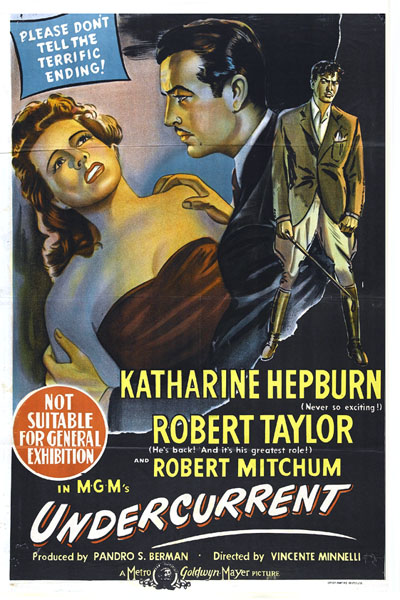
Undercurrent (1947) starring Katharine Hepburn, Robert Taylor, & Robert Mitchum

Undercurrent-1946.jpg
A poster for the film

This is a film I’d NEVER heard of, BUT was curious to see (since it has both Hepburn and Mitchum). It was shown on TCM last week and is directed by the famed Vincente Minnelli (husband of Judy Garland and father to Liza). Minnelli does a VERY good job w/ a domestic drama mixed w/ film noir, which is NOT something you’d expect if you know his more well-known works (Meet Me in St. Louis, Father of the Bride, Gigi). He also directed The Bad and the Beautiful, which shows the dark side of Hollywood. 

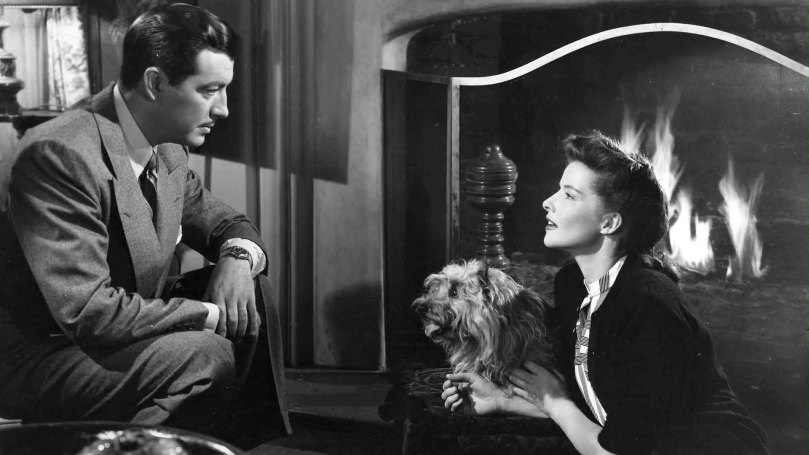
Hepburn is cast against type here, which fans (like me) may enjoy, and even some haters will be pleasantly surprised to see. She plays Ann Hamilton, the quirky/single daughter of small-town professor, Dink (Edmund Gwenn from Miracle on 34th Street). Ann prefers playing w/ her dog and tinkering in her home chemistry lab, eschewing ideas of marriage pushed upon her by cranky housekeeper, Lucy (Marjorie Main) and eager academic, Prof. Bangs (Dan Tobin).

Hepburn_Taylor_fireside_Undercurrent
Alan Garroway (Robert Taylor) chats with Ann Hamilton (Katharine Hepburn) at her home.

[1] Call it Film-Noir. Call it Mystery/Suspense. Call it Psychological Thriller. Call it what you may…I call it: absorbing drama.

It moves very deliberately… and the facts are revealed one by one, in true mystery fashion, until the fantastic, thrilling ending.

[2] Hepburn gives her usual intelligent performance, showing a vulnerable, feminine side that is very appealing. There is a scene in a fitting room where she is absolutely stunning. The scenes between her and her father, played by Edmund Gwenn, are delightful and realistic…

[3] As others have noted, the plot has “Rebecca-esque” qualities, but a character completely its own.

-Various IMDB comments

One night, Ann’s life is changed when she meets Alan Garroway (Robert Taylor), a suave/dapper inventor who was meeting w/ Dink. It turns out that his company helped win WWII w/ a cutting-edge missile guidance system. Ann is struck by him at first sight; it’s obvious that he is interested, too. Soon, they’re married and off to DC! Ann meets his (high society) friends, gets a new/stylish wardrobe, and learns that her new husband is more complicated than she thought. 

Hepburn_Gwenn_Undercurrent
Her father (Edmundf Gwenn) looks on as Ann (Katharine Hepburn) receives roses.

Film Trivia:

BOTH Taylor and Mitchum were younger than Hepburn. 

In Minnelli‘s autobiography, he says that Mitchum was very uncomfortable in the role of the sensitive Michael.

Katharine Hepburn and Robert Mitchum did NOT get along during the filming. One day, Hepburn told Mitchum, “You know you can’t act, and if you hadn’t been good looking you would never have got a picture at all. I’m tired of working with people like you who have nothing to offer.” (OUCH!)


2017 Washington Jewish Film Festival: In Between

in_between_still_1_h_2016.jpg
It is the time now for women to come and speak up. Until now, we were listening to men, and they were the ones to run everything. -Maysaloun Hamoud (writer/director)

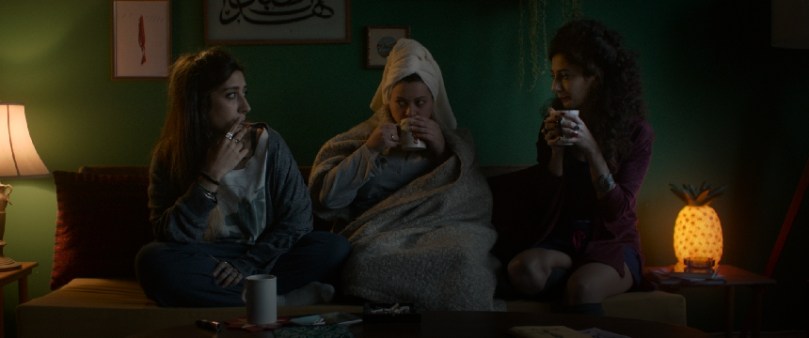
Arab-Israelis make up about 20 percent of Israel’s citizenry. They share the same ethnicity, language, and culture of Palestinians in the West Bank and Gaza Strip; many identify as Palestinians rather than Israeli. This film (written and directed by 35 y.o. Maysaloun Hamoud- pictured below) tells the story of three 20-ish Arab women (two Muslim and one Christian) who have left their hometowns to work/study in Tel Aviv. They find themselves stuck between traditional Arab society (which values modesty, virginity, arranged marriage) and a more open/Westernized Israeli society (w/ dating, alcohol, drugs).

In Between_dir.jpg

Laila (Mouna Hawa) is an attorney sharing an apt. w/ close friend, Salma (Sana Jammeieh). Into their world enters Noor (Shaden Kanboura), a hijabi Computer Science major who is prepping for finals. We can see that the pals are dismayed to be stuck w/ this new roomie. Though Noor is religious, she is NOT judgmental re: Laila and Salma’s smoking, drinking, and parties w/ a diverse group of friends. She focuses on studying and keeping in touch with her fiance, Wissam. She cooks for him when he comes over to her new place. Wissam keeps pressuring her to move up the date of their wedding. He does NOT approve of her new building or roomies (who slowly become her friends). 

Laila (who loves to flirt) starts seriously dating a man, Ziad, who had his eye on her from a wedding they both attended. Ziad is VERY attracted to Laila, particularly b/c she is an uninhibited/beautiful/strong woman. Salma quits her restaurant job, after she and a fellow Palestinian coworker are yelled at by their (Israeli) boss for joking around (in Arabic) in the kitchen. She also has to deal w/ dinners set-up by her wealthy parents to introduce her to single men. 

In_Between_18-860


[1] …the movie is also very much about sisters doing it for themselves. There’s an automatic solidarity whereby women– at least young women of similar ages– are all automatically soulmates; and men, it almost goes without saying, are swine. Despite those stereotypes, the movie holds interest by virtue of believable acting and believable situations. 

[2] The three women characters were believable, warm, expressing solidarity to each other despite their very different personalities and lifestyles. The theme of personal conflicts between tradition and modernity is not new. What makes this film different is that the issues are very real and current and those outside the tradition don’t see it. 

-Excerpts from IMDB reviews

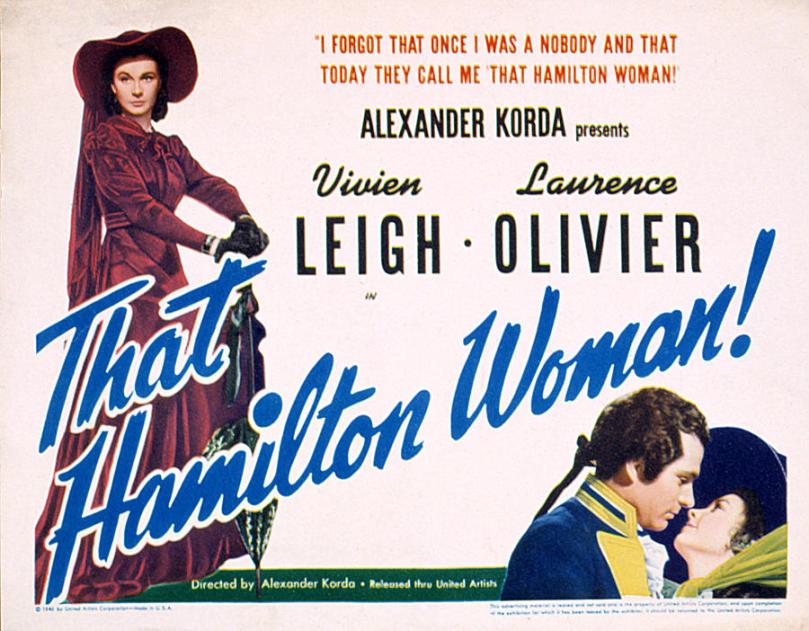
That Hamilton Woman (1941) starring Vivien Leigh & Laurence Olivier

that-hamilton-woman-poster.jpg
A promotional poster for the film

Indeed, it’s difficult to separate the “real Olivier” and the “real Leigh” from their parts here—and the parts that had made them who they now were: he the more conservative and guilt-ridden son of a parson, she the reckless flibbertigibbet who nevertheless had a shrewd eye for power and manipulation. 

-Molly Haskell, The Criterion Collection

That-Hamilton-Woman-1941-closeup
Closeup of Emma (Vivien Leigh) and Nelson (Laurence Olivier)

It was 1940, Britain was in peril. Hoping to enlist the Americans in the fight against Hitler, producer/director Alexander Korda hatched the idea for this film. Cables went back and forth between London and Hollywood (where the soon-to-be Mr. and Mrs. Olivier were living temporarily, awaiting the finalization of their respective divorces). Korda had both actors under contract; he offered them bonuses, as well as the opportunity to recoup some of the money lost after their failed stage production of Romeo and Juliet. The production had to be done quickly- five weeks. Churchill would later say that it was his favorite movie.

So, your nephew sent me to you with his paintings and the bric-à-brac because he’s broke! -Emma exclaims to Sir William Hamilton 

A housemaid turned wannabe fiance to one British gentleman, Emma Hart (Leigh), is suddenly shipped off to Sir William Hamilton (Alan Mowbray). He is a middle-aged widower, even-tempered, and a collector of great works of art. Sir William admires beauty. As he wishes, Emma learns languages, singing, dancing, etc. Her doting mother, Mrs. Cardogan-Lyon (Sara Allgood), is her loyal companion through it all. In time, Sir William marries Emma (making an honest woman out of her); they live in a palatial seaside home in Naples, since he is Ambassador to Italy. Though she could not be presented at court in England, the clever/vivacious Emma becomes a close confidante of the Queen of Naples. 

That Hamilton Woman_1st_mtg.png
Nelson (Olivier) and Emma (Leigh) meet for the first time

One day, a British battleship arrives in Naples, and Cmdr. Horatio Nelson (Olivier) meets with Sir William re: docking and affairs of state. Emma bursts in on them, worried about a party she is planning. Her husband doesn’t mind, BUT Nelson insists on speaking to the ambassador in private. Emma starts to wonder if her life of is frivolous.

That-Hamilton-Woma_court.jpg
Emma (Leigh) and Nelson (Olivier) at the opera

They told us of your victories but not of the price you paid! -Emma exclaims to Nelson (after seeing his wounds)

Five years later, Emma meets Nelson (now a lord, thanks to his MANY victories in the Napoleonic Wars) again. She is glad to see him alive, BUT also shocked by the fact that he has lost the sight in one eye and an arm. Emma wants to help, she tells Nelson, and uses her influence w/ the queen to get more troops for the war. They talk, plan, attend plays, and become close friends. Rumors start to spread…

[1] …when it comes to the cinema, her acting technique on screen is every bit as expert as Laurence Olivier’s. (In fact, Olivier himself admitted this when he saw her as Scarlett O’Hara.)

[2] Vivien Leigh and Laurence Olivier make a terrific pair and of course have great chemistry together, which really complements this true story. The actors give great performances, and I think the film really tries hard not judge the actions of Lady Hamilton and Lord Nelson which caused a tremendous scandal in their own time. Anyone who likes historical drama and wants to escape into another world for a few hours is bound to enjoy.

[3] Although the film was made by Hollywood, it is British to its core and fiercely patriotic. It was intended as an anti-Nazi propaganda piece… The Nazi allegory is most clearly seen in the scene when Sir William explains to his wife that the British Empire is periodically attacked by military adventurers, in Nelson’s line “We are alone but unafraid” and his speech denouncing the idea of negotiating with dictators… I imagine that it was quite a stirring film for the Britons of the day. 


-Various excerpts from IMDB reviews