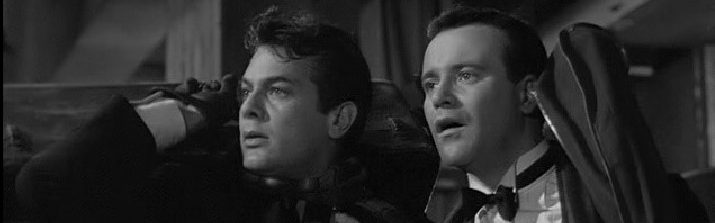
“Nightmare Alley” (1947) starring Tyrone Power, Joan Blondell, Colleen Gray, & Helen Walker

Pete Krumbein: Throughout the ages, man has sought to look behind the veil that hides him from tomorrow. And through the ages, certain men have looked into the polished crystal… and seen. Is it some quality of the crystal itself, or does the gazer merely use it to turn his gaze inward? Who knows? But visions come. Slowly shifting their forms… visions come. Wait. The shifting shapes begin to clear. I see fields of grass… rolling hills… and a boy. A boy is running barefoot through the hills. A dog is with him. A… DOG… is… with… him.

Stanton Carlisle: Yes… go on… his name was Jib. Go on!

Pete: [Choked laughter] Humph. See how easy it is to *hook* ’em!

Twentieth Century-Fox bought the film rights to William Lindsay Gresham’s novel in 1946 for $50,000 at the request of star Tyrone Power, who wanted to change his image and show his range. The studio built a carnival set on the backlot covering 10 acres; it hired 100+ sideshow attractions and carnival workers. Studio head Darryl F. Zanuck hated this movie so much that he eventually took it out of circulation. Zanuck ordered the happy scene to be added (no shock there). The movie was re-released in 1956-1957 and did good business, esp. in drive-ins. It received wide distribution (on TV) after Power’s premature death in 1958. The DVD release (2005) brought Nightmare Alley back into wide circulation. According to Eddie Muller, con men/grifters in the new age movement would ask “Are you a friend of Stan Carlisle?” to confirm that the person they were talking to was in the same line of business.

Stan: You’ve got a heart as big…

Zeena Krumbein: Sure, as big as an artichoke, a leaf for everyone.

The movie opens at a carnival offering a muscle man, young women in skimpy outfits, a mind-reader, and the “geek” (a freakish man who supposedly bites the heads off live chickens). Among the crowd is a new worker, Stanton Carlisle, who is esp. interested in Zeena (Joan Blondell), the mentalist who was successful w/ her mind-reading act (before her hubby/partner, Pete, became an alcoholic). Stan is observant and ambitious, so he sets out to charm Zeena and learn her secrets. Stan’s true nature is revealed when he bluffs the sheriff (who has come to shut down the carnival); he’s good at manipulating others’ emotions (and enjoys it)!

Stan [to Molly]: Listen to me, I’m no good. I never pretended to be. But, I love you. I’m a hustler. I’ve always been one. But, I love you. I may be the thief of the world, but, with you I’ve always been on the level.

There are scams, swindles, deceptions and betrayals; we see the exploitation of people who are gullible or vulnerable. Stan’s rise from the seedy carnival to classy nightclub is captivating to watch! Stan is that rare homme fatale who uses his looks and sex appeal; near the end, he undergoes a de-glamorization that may shock some viewers. This is an obscure film, but much praised by noir fans. As Muller commented, even by film noir standards, this is a dark tale. I learned that both the director (Edmund Goulding) and writer eventually committed suicide!

The film wisely always plays to Power’s performance as charming and affable. It only hints at sinister intent, and so we’re on the ride with him seeing him as almost a heroic figure despite his cynical and insidious approach towards the world. For Stan, money is almost secondary to his desire to prove that he’s smarter than everyone else, which is why the film casts Lilith in his path to show us someone who’s not only potentially more dangerous, but also someone who’s more ingratiated with society. -Matt Goldberg (Collider)

The black and white photography by Lee Garmes is very well-done; it was perhaps too dark for audiences of that day. There are 3 interesting women characters- a rarity even today in Hollywood! Blondell (buxom and still good-looking in middle-age) is clever, jaded, but also good-hearted. Colleen Gray (in an early role) is “girl next door” pretty and sweet; her character falls hard for Stan. Helen Walker is smart, sophisticated, yet chilling as psychologist Lilith Ritter. She’s smarter and more ruthless than Stan; notice how her eyes shine w/ joy when she makes a fool of him!

[1] It was a raw, exposed nerve of a film. Instead of the Hollywood diction we had come to expect, this film expressed itself in 1940’s carny colloquialisms. And nobody in the cast was soft – they were all hard knocks characters, almost down for the count, but still fighting.

[2] Power, Blondell, Gray, Helen Walker, and the marvelous Ian Keith turn in great performances in a gritty film somewhat ahead of its time for its unrelenting toughness, its hard view of alcoholism, a look inside the world of mentalists and carnival life, and its theme of the supernatural.

[3] Nightmare Alley is a remarkable film- it hardly blinks in showing a cynical, scheming “preacher” doing his thing. Given the norms of Hollywood at the time, or almost at any time, it does give you a lot to consider. Tyrone Power is brilliant…

-Excerpts from IMDB reviews

“Obsession” (1943): Italian Adaptation of “The Postman Always Rings Twice”

In Fascist Italy, Gino Costa (Massimo Girotti), a young/handsome tramp, stops at a humble restaurant (trattoria) run by Giovanna (Clara Calamai) and her husband Bragana (Juan de Landa). Giovanna is unhappy w/ her older/controlling husband, who she married for security/money. Gino does some work around the place and he and Giovanna quickly fall in love. She refuses to run away w/ him and lead the life of a poor wanderer. Gino leaves for another town and becomes friends w/ a street artist, Lo spagnolo (“the Spaniard”); they work together for a few weeks. One day, Gino sees Giovanna and Bragana at a street fair; it is obvious that they haven’t gotten over each other. After a day of fun (w/ plenty of drinking on Bragana’s part), Giovanna comes up w/ a plan to finally be rid of her husband! Gino (though reluctant) goes along w/ the plan.

The film’s negative was destroyed by the fascist government of Benito Mussolini during WWII, but (first-time director) Luchino Visconti managed to save a print. In Italy, some priests sprinkled theaters w/ holy water after this film was shown- LOL! Obsession wasn’t seen in the U.S. until 1976, as James M. Cain’s publishers fought the release. Cain is perhaps best known for Double Indemnity, though The Postman Always Rings Twice was quite a popular work also. I heard about it recently (from a Facebook film noir group); it caused quite a controversy and was way ahead of it’s time.

The original actress cast for Giovanna was the glamorous/diva-like Anna Magnani, but she became pregnant before shooting. Unlike some other femme fatale, Giovanna isn’t glamorous or evil; she is more like a spoiled girl-next-door (too good to cook and clean). Bragana isn’t totally a bad man either, but (like many husbands of his day) has to “wear the pants” in the family. He is short, stout, and unattractive (though he can be jovial at times). Gino is down on his luck, not that educated, but also handsome w/ a strong physical presence. Lo spagnolo (Elio Marcuzo) brings a sense of lightness/fun into the film; I really liked his character. The young dancer/part-time prostitute, Anita (Dhia Christiani), is only in the film for few minutes, but she made a big impression. The director and actress were able to do a lot w/ this character- I thought she was heartbreaking!

Most of the people behind the film were still in their 20s and willing to take risks. Let us compare these two scenes where the (would-be) lovers first see each other. In the ’46 American film noir (starring Lana Turner and John Garfield), we first see Cora (the object of desire) from the POV of Frank. Here we first see Gino’s face from the POV of Giovanna (making the man the object of desire)! While the American version gets more into the world of cops and lawyers, Obsession concentrates more on the psychological effects of the crime on the lovers. If you’d like to know more re: the neo-realism movement, check this film out.

[1] Ossessione is a very complex film with complex characters. It’s always fascinating, but it does go on a bit too long. This is partly due to the neorealist stylistics that Visconti was inventing within this film. It was, after all, the first film that won that label. We see a lot of the action prolonged as it would be in real life, without any hurrying to the next plot point.

[2] The movie is brilliantly filmed, and the acting by the three leads are first rate. You really get a genuine insight into 1940s Italian working class life. The character of The Spaniard adds an interesting touch to the story with a possible homosexual relationship between Gino and himself. It’s very subtle but it’s there if you look. […] The movie is surprisingly frank for the time and period (Mussolini’s Italy), much more realistic and earthy than Hollywood movies of the same period.

[3] …such graceful camera movements, such beautiful composition, such wonderful faces, such terrific characters, such a great story development, the first movie adapted from James M. Cain’s “The Postman Always Rings Twice.”

…I can’t believe this was made in ’43, eight years before Brando was supposed to have introduced realistic acting to the world with “A Streetcar Named Desire” (1951). The actors in this may not have used The Method technique… but they’re some of the best, most genuine and realistic performances up to this date in cinema.

-Excerpts from IMDB reviews

“Odds Against Tomorrow” (1959) starring Harry Belafonte, Robert Ryan, Shelley Winters, & Ed Begley

Dave Burke (veteran character actor Ed Begley) is looking to hire two men to assist him in a bank raid: Earle Slater (Robert Ryan), a white/middle-aged ex-con, and Johnny Ingram (Harry Belafonte- also co-producer), a young/Black singer w/ a gambling problem. Ingram (who likes the finer things in life) is recently divorced from his schoolteacher wife, Ruth (Kim Hamilton), w/ whom he shares a young daughter. Burke arranges for Ingram’s creditors to put pressure on him. Slater (who has a quick temper) feels humiliated by his failure to provide for his devoted wife, Lorry (Shelley Winters), who works two jobs. The two men, though reluctant at first, eventually accept to do the crime. Slater loathes and despises Blacks; tensions in the gang quickly mount.

[after Slater insults Ingram]

Burke: Don’t beat out that Civil War jazz here, Slater! We’re all in this together, each man equal. And we’re taking care of each other. It’s one big play, our one and only chance to grab stakes forever. And I don’t want to hear what your grandpappy thought on the old farm down in Oklahoma! You got it?

Belafonte chose Abraham Polonsky (writer/director of Force of Evil) to write the script. As a blacklisted writer, Polonsky used the name of John O. Killens (a Black novelist/friend of Belafonte). In 1997, the WGA restored Polonsky’s credit. The director is Robert Wise (West Side Story; The Sound of Music); he used infra-red film in some scenes (to create a distorted feel).

This is the first film noir with a Black protagonist! The bartender at the jazz club is a young Cicely Tyson (her second film appearance); she passed away in early 2021. Noir icon Gloria Grahame makes a brief (yet important) appearance. The movie was praised highly by James Ellroy and influenced the work of Jean-Pierre Melville (a French director). The volatile chemistry between the three men is at the center of the movie. I liked the character development, on locations shots of NYC (incl. Central Park), and the slightly uneasy atmosphere. Jazz and Calypso music are played at the smoky club where Ingram performs.

[1] Good low budget heist film. Ryan’s character is one of the ugliest portrayals of a white racist in film. Belafonte’s character is one of the most multi-faceted and complex potrayals of an African American up until that time, and the performance doesn’t date at all. Wise keeps the pacing taut and the suspense high.

[2] Personally I found Belafonte’s contribution the most searing. He captures the role of the divorced father to a tee. The scene where he is awakened by his ex-wife after sleeping (ever so slightly) with is daughter is masterful. You can sense the longing in his heart for the nuclear family that once was.

[3] Wise wants to communicate a whole context, he wants to detail his characters to a fault. How many directors would dare that today? Robert Ryan’s part is very complex. First he seems friendly, but further acquaintance shows a lack of self-confidence (he’s getting old, he’s a washout, he wants to go for broke). And he is a racist. Rarely, this obnoxious feeling has been depicted with such wit.

-Excerpts from reviews on IMBD

Socially Conscious Noir: “Crossfire” (1947) starring Robert Young, Robert Mitchum, & Robert Ryan

Homicide Capt. Finlay (Robert Young) finds evidence that one or more of a group of soldiers is involved in the death of a middle-aged/kindly Jewish man, Joseph Samuels (Sam Levene). In flashbacks, we see the night’s events from different viewpoints, as Army Sgt. Keeley (a youngish Robert Mitchum) investigates on his own, trying to clear the sensitive/young Mitchell, to whom circumstantial evidence points. Then the real (and ugly) motive for the killing begins to dawn on both Finlay and Keeley. This was the breakout role for Robert Ryan, who played Montgomery, one of the experienced/jaded soldiers. Ryan didn’t like the negative aspects of his character- that resulted in him being typecast in villain roles. In real life, Ryan was a liberal progressive actively involved in the Civil Rights movement. A very young Gloria Grahame (who was loaned from MGM) plays a dancehall girl who meets Mitchell.

Finlay: Hating is always the same, always senseless. One day it kills Irish Catholics, the next day Jews, the next day Protestants, the next day Quakers. It’s hard to stop. It can end up killing men who wear striped neckties. Or people from Tennessee.

The film is based on Richard Brooks’ first novel, The Brick Foxhole (1945), written while he was a sergeant in the Marine Corps. One of the subplots dealt w/ homophobia, but that was changed to anti-Semitism. The decision was made by producer Adrian Scott (who purchased the rights) knowing that any depiction of homosexuality would not pass the Hayes Code. Brooks would write the screenplays for other notable noirs, incl. The Killers (1946) (uncredited), Brute Force (1947), Key Largo (1948), and Mystery Street (1950). Due to of the film’s tight (24 day) shooting schedule, it was able to beat the similarly-themed Gentleman’s Agreement to theaters by 3-1/2 months and stole some of its thunder. However, Oscar acclaim went to Gentleman’s Agreement, which won 3 out of its 8 noms, incl. Best Picture. Crossfire was overlooked; it had 5 noms. It has been suggested that one reason it didn’t win any Oscars was director Edward Dmytryk and Scott’s testimony before HUAC in late 1947. They refused to state whether they were, or had been, Communists and were subsequently blacklisted.

[1] Ryan, creates a fully shaded and frighteningly convincing portrait of an ignorant, unstable bigot; we see his phony geniality, his bullying, his resentment of anyone with advantages, his “Am I right or am I right?” smugness; how easily he slaps labels on people and what satisfaction he gets from despising them.

CROSSFIRE’s message seems cautious and dated now, though not nearly so much as GENTLEMAN’S AGREEMENT. […] The script seems afraid to mention any real contemporary problems. […] Still, it did take some guts to depict, immediately after World War II, an American who might have been happier in the Nazi army, and the movie’s basic premise is still valid.

[2] Crossfire is a “message” movie but it is also a cracking good drama, and that’s what I enjoyed about it. Plus the cast is dynamite – Roberts Preston, Mitchum and Ryan, and the beautiful Gloria Grahame. Mitchum doesn’t have a big a role as you might expect (the movie was released the same year as Out Of The Past in which he gives a much more substantial performance), but he’s always great to watch, and Robert Ryan steals the movie as a very nasty piece of work.

[3] As late as 1947, it was a big deal for a movie to announce that anti-Semitism existed, and that it was bad. (It was unthinkable, of course, for Hollywood to address the real subject of the book on which the movie was based- its victim was a homosexual.) Nevertheless, thanks to good writing and excellent acting, CROSSFIRE remains a persuasive examination of what we would now call a hate crime.

-Excerpts from IMBD reviews

Bogart & Stanwyck Together: “The Two Mrs. Carrolls” (1947)

Sally Morton (Barbara Stanwyck) and Geoffrey Carroll (Humphrey Bogart)- a struggling artist- get married following the passing of Geoffrey’s first wife. Despite quickly falling in love w/ him while on vacation in Scotland, Sally never thought she’d marry him when she discovered that he was already married (regardless of his vow to get a divorce). Then the first Mrs. Carroll’s (called an invalid) passing changed the situation. The time of the first Mrs. Carroll’s illness resulted in Geoffrey’s greatest works, incl. a portrait of her as “The Angel of Death.” While Sally brings a house in the England countryside and a rough-around-the-edges housekeeper (Christine), Geoffrey brings a pre-teen daughter (Bea) into the marriage. Their happiness begins to change when glamourous/flirtatious Cecily Latham (Alexis Smith- who also co-starred w/ Bogart in Conflict) commissions Geoffrey to paint her portrait. Cecily and her mother were introduced to the Carrolls by a London lawyer, Charles Pennington (Sally’s former fiancé). The affable Penny (his nickname) is still in love w/ Sally, which doesn’t amuse Geoffrey.

Bogart says “I think this is the beginning of a beautiful hatred”, which is a nod to the famous line from Casablanca (1942). The movie was completed in June 1945, but released in March 1947, when Bogart’s box-office appeal was at a high (though most critics thought he was miscast). The role of an artist, a profession that viewers, critics, and even the actor himself felt deviated from his typical tough guy persona, there were limits to what he’d agree to. When the director (Peter Godfrey) asked Bogart to wear an artist’s smock and beret, he refused- LOL! I liked the chemistry between Bogart and Stanwyck; they got along well during the filming. I wasn’t a fan of the pacing, the child actress (calm and precocious), or the music (a bit overdone).

[1] Stanwyck has never been better as a panic-stricken wife, trying to survive her husband’s evil doings. Bogart gives a highly underrated performance as a psychopath, who gets brutal when his murder plot doesn’t go according to plan. His presence on screen is often frightening.

[2] Humphrey Bogart, for all of the heroic roles during this stage of his career, is cast against type, and Barbara Stanwyck, always the femme fatale, is now a damsel in distress as matters spiral beyond her control as grave danger closes in on her. The role-reversals of the stars works well and the byplay between them is good.

[3] One problem is that there is an enormous amount of subtlety employed in its unravelling. In fact I would say there is a little too much subtlety, to the point where the details that are supposed to be underplayed to maximise the mystery and suspense do not seem to be underplayed at all, but rather they appear to have simply been ommitted.

The second little problem is with Bogart’s character. He’s the centre of this story, a mentally disturbed and jealous painter who, it would appear, murdered his first wife… But we’re not really given any insight into his character until very late in the film. At first he appears to be just like your stereotypical artist; insular, unpleasant, cynical. But we know, or at least assume, that he has actual psychotic tendencies underneath that eccentric, but nonetheless ordinary exterior.

-Excerpts from IMDB reviews