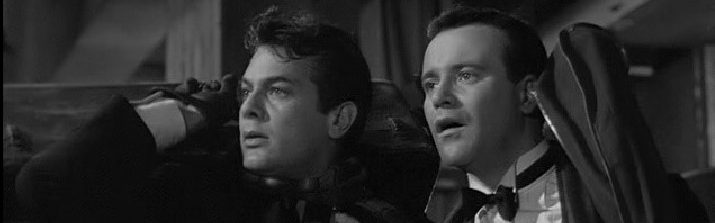
“Nobody Lives Forever” (1946) starring John Garfield & Geraldine Fitzgerald

G.I. Nick Blake (John Garfield), a successful con man in pre-military life, has just received an honorable discharge from the Army. Rather than return to his old life, he plans to settle down in NYC (his hometown) w/ his blonde/glamorous/singer gf, Toni Blackburn (Faye Emerson; also daughter-in-law of FDR), and the money he amassed before WWII: $50,000. When that plan doesn’t pan out, Nick decides to head to LA w/ fellow con man/pal, Al Doyle (George Tobias- the comic relief), and live it up at the beach for a while. He is informed by Pop Gruber (Walter Brennan), his aging former mentor (now running small street cons in L.A.) of a potential big mark. A former associate, Doc Ganson (George Coulouris- one of Orson Welles’ Mercury Players in Citizen Kane), has found a Midwestern widow worth $2M vacationing in town, Gladys Halvorsen (Geraldine Fitzgerald; also Laurence Olivier’s wife in Wuthering Heights). Doc doesn’t have either the bankroll or the charms to carry out this con himself. Nick agrees both to bankroll and carry out the con, negotiating 2/3 of the take for himself, leaving Doc and his 2 associates w/ a minimum of $30,000. Doc doesn’t like the conditions, but he accepts the offer, being desperate for a score. The con becomes complicated as Nick must also deal w/ Gladys’ business manager, Charles Manning (Richard Gaines), gets recognized by people from his past, and grows to genuinely like Gladys (who is young, kind, and pretty).

Unlike in The Postman Always Rings Twice (which was also released in 1946), the romance here is more demure. […] The bad guys have more mirth than menace. -Eddie Muller, host of Noir Alley (TCM)

Garfield (as filmmaker Sydney Pollack commented) was a Method actor and a bridge between the classic Hollywood studio actors and those actors who changed acting forever- Marlon Brando, Montgomery Clift, and James Dean. This is one of Garfield’s lesser-known films (a blend of noir and romance). Nick is a charmer who lies effortlessly; it’s easy for him to ingratiate himself into Gladys’ lonely life. They swim at the beach, eat fine meals, and share some convos. I esp. liked their day trip to the mission (a historical church w/ beautiful grounds); Nick is filled w/ regret and reveals some truth about his past. Despite thinking he won’t change, he does end up in love w/ Gladys and can’t bring himself to steal her money. The actors have nice chemistry, though it’s more sweet than steamy.

The screenplay is by W.R. Burnett, who also wrote a number of film crime classics, incl. Scarface, Little Caesar, High Sierra, and The Asphalt Jungle. Burnett’s dialogue is sharp and tough, and he displays insight (and even sympathy) for the criminal mind. Director Jean Negulesco knows how to create a mood. Cinematographer Arthur Edeson (Casablanca; Frankenstein) make this mood memorable and visually appealing. Though it lags at times, if you like the noir genre, it’s worth watching!

[1] Many films from the mid-40s deal w/ men struggling to readjust to their civilian lives after their wartime service. This film offers a twist: the hero’s pre-war career was as a successful con artist. He doesn’t have any trouble getting his job back, but does he still want it? WWII is a source of anxiety and moral confusion in many postwar noirs, but this film (set during the war) suggests that a stint with Uncle Sam can straighten out a crooked guy.

[2] The stars are lovely together, and the film has a rich atmosphere throughout, each setting clearly defining the moment. The nightclub scenes evoke the ’40s postwar feeling, the California scenes are bright and sunny, and the scenes on the pier are spooky and dense with fog. A very good film.

[3] The movie contains many elements of noir, as well as the fine cast. Despite these positive elements, Negulesco’s slow, deliberate pacing is more consistent with a romantic or psychological approach than with a crime drama.

-Excerpts from IMDb reviews

“Against All Odds” (1984) starring Rachel Ward, Jeff Bridges, & James Woods

Certainly, we’ve tried to retain certain qualities from the original film [Out of the Past], mainly the electric, dangerous interaction of the three main characters. However, the story itself, the background of the characters and the setting are very different. I think we’ve come up with a film that deals with the unique nature of power in Los Angeles and how that power consumes and almost destroys the three main characters. Years from now, I can see theaters playing this version and the original on the same bill and the audience seeing two very different films. -Taylor Hackford, director

Reluctantly, broke/injured football player- Terry Brogan (Jeff Bridges, at age 34)- accepts the job to track down Jessie Wyler (British actress Rachel Ward), the ex-gf of old friend/nightclub owner, Jake Wise (James Woods- always a believable villain). On the beaches of Cozumel, Terry NOT only finds the elusive woman, BUT unexpectedly falls in love w/ her. Soon, Terry finds himself trapped in a web of passion and intrigue, as Jessie starts to feel the burden of choice in this dangerous love triangle. Can they have a future together?

I saw this movie last week after learning it was a remake of one of my fave noir films- Out of the Past (1947) starring Robert Mitchum, Kirk Douglas, and Jane Greer (who plays Jessie’s controlling mom/wealthy land developer, Mrs. Wyler). You can read my review here. It was V cool to see veteran actor Richard Widmark (looking fit at age 70); he plays Ben Caxton (Mrs. Wyler’s top lawyer/old friend). Woods and Bridges both loved working w/ Widmark, and remembered his love of pancakes. He used to have a plate waiting for him while shooting a scene, and Woods and Bridges would often hide it. Widmark refused to go back to shooting before the cakes had been recovered- LOL!

Terry: So what is it you don’t like exactly, football players, tacos, or beer?

Jessie: I like tacos and beer.

Bridges was Hackford’s 1st choice for the lead (played by Richard Gere) in An Officer and a Gentleman (1982), but Bridges had a packed schedule then (appearing in 3 movies). Hackford kept Bridges in mind when creating the character of Terry. Ward got top billing above her male co-stars; she was well-known at that time (after her work on the hit miniseries The Thorn Birds). For Bridges, this was his 1st lead role in a commercial film; he was more of a supporting actor before. The helmets and uniforms used by the football team Terry is playing for were from the (defunct) USFL’s LA Express. As a wide-receiver, his main role was to catch forward passes from the quarterback. He’d have to be fast, as on just about every play, the wide receiver needs to run at full speed.

Well, I consider myself a character actor, and leading man is a character that you play. -Bridges, when asked re: playing a leading man

Terry is cut from the team; he thinks it’s b/c of his recurring shoulder issue (though the team has been doing well). However, his friend/conditioning coach, Hank Sully (Alex Karras- best known as the dad in Webster), says that Terry is too expensive to keep on. Terry goes to see his long-time lawyer, Steve Kirsch (Saul Rubinek), but he refuses to help. Steve’s secretary, Edie (Swoosie Kurtz), has a bit of a crush on Terry. He seeks out Jake, who’s desperate to find his ex and know she’s safe. When Terry was getting started in his pro career, Jake helped him out (watch to see exactly what happened). Though they share a past, there is (underlying) tension between the two men’s interactions. Early in the film, they have a car race which is V tense/potentially dangerous. Jake’s black Ferrari 308 and Terry’s red Porsche were specially modified for high-speed driving w/ special onboard camera mounts. Bridges and Woods commented that many viewers went back to theaters to re-watch this scene.

There are millions of dollars in production values on the screen that one could never create in Hollywood. It’s exciting to think that many moviegoers will be seeing these fantastic locations for the first time. Stylistically, I wanted to contrast these rough, ancient Mexican textures with the cold, modern surfaces of Los Angeles. Often, L.A. has been used in films as a kind of lotus-land… people waking up in the morning, saying, ‘God, I can’t believe those palm trees’. But people from L.A., especially those who wield power, don’t feel or act that way. It’s not that the absurdities are lost on them; they’ve simply made their peace with the city and attend to business. That’s the point of view I’m taking in this film. Jeff Bridges and Rachel Ward are both fugitives from the corruptive power and manipulation of Los Angeles. The romantic, other-worldliness of the Yucatan provides a setting for them to find each other… something that would never have been possible in L.A., because of their respective’ emotional baggage and class differences. -Hackford re: the importance of shooting in Mexico

We got along right away! It could’ve been awkward… […] It went smoothly. -Bridges, when asked re: shooting steamy scenes w/ Ward

Bridges looks gorgeous w/ his thick blonde mane, w/ or w/o full beard, and 6-pack abs (yowza)! He gets to wear some cool outfits, for those of you into fashion. There is much more to like about this movie, incl. the romance between Terry and Jessie. The actors have good chemistry together. Ward was newly married to Aussie actor Bryan Brown; they co-starred on The Thorn Birds (playing a married couple). Bridges was awaiting the birth of his 2nd child; he carried a beeper b/c it was tough to call LA from some of the shooting locations.

[1] Parts of “Against All Odds” are absolutely magnificent. The Mexican location photography is terrific. Rachel Ward looks great, as does Jeff Bridges.

[2] Bridges plays his role quite convincingly as a wounded man, a naive guy who put his foot in a place he never should have been in from the beginning. The man has a heavy burden on his shoulder and he succeeds very well in carrying it. […]

Though the story has its share of lopsided scenes, it is still one worthy enough to enjoy. For Jeff Bridges fans, who have overlooked this one, should see him in his prime. He brings his charm and personality here like he’s done in almost 45 years he has graced the silver screen. It will surely please everyone who enjoys romance, suspense and action.

-Excerpts from IMDb reviews

This is a good movie. The plot can be confusing. You may have to see it twice. -Gene Siskel

I agree, it’s good. Bridges is good in everything I’ve seen him in. -Roger Ebert

“Sudden Fear” (1952) starring Joan Crawford, Jack Palance, & Gloria Grahame

HEARTBREAK… Poised on a Trigger of Terror! -A tag line for the film

Actor Lester Blaine (Jack Palance- his 1st lead role w/ Oscar nom) has almost landed the lead in Myra Hudson’s (Joan Crawford- in her 3rd/last Oscar-winning role) new Broadway play. However, Myra (a writer/patroness of the arts) vetoes the director and producer b/c she doesn’t think Lester looks like a “romantic leading man.” On a train from NYC to San Fran, Lester and Myra meet again by chance; he sets out to prove her wrong- by romancing her for real! Later on, we meet Irene Neves (Gloria Grahame), who has recently been dating Myra’s friend/young lawyer, Junior Kearney (Mike Conners- a former football player). Another long-time pal/lawyer of Myra’s is Junior’s older bro, Steve (Bruce Bennett- also Crawford’s no-good ex-hubby in Mildred Pierce).

Lester [after being rejected for the lead role]: Miss Hudson, in your own native city of San Francisco, there’s an art gallery in the Legion of Honor in which there’s an oil painting of Casanova. It’s quite obvious that you have never seen this painting. For your information, Miss Hudson, this is what Casanova looked like: he had big ears, a scar over one eye, a broken nose, and a wart on his chin, right here. I suggest, Miss Hudson, that when you return to San Francisco, you visit this gallery and see this painting!

Crawford was a “boss lady” BOTH in front of and behind the camera, as many of y’all classic fans know! As the executive producer (EP), she was heavily involved in ALL aspects of the production. Crawford hired Lenore J. Coffee (screenwriter), David Miller (director), and suggested using Elmer Bernstein (composer). The music score comes partly from Igor Stravinsky’s ballet Rite of Spring. She insisted on Charles Lang (cinematographer) and personally cast Palance and Grahame as co-stars. Crawford’s 1st choice for Lester was Clark Gable; Brando was offered the role also.

Lester: [quoting Myra’s play] When I wake in the morning, when I go to sleep at night, I think of you. You’re like the air which surrounds me, the sky which spreads above me, the earth beneath my feet. When I hear music, when I see beauty, when I breathe in the sunlight, I think of you. You are the sister I never had, the mother I have almost forgotten, the wife I have always dreamed of. There isn’t a relationship you can name which exists between a man and a woman of which I wouldn’t say let it be you. Let it be you.

On the train, Lester tells Myra he was born in Pittsburgh and spent some of his early years as a coal miner. In real life, Palance was born in Lattimer (in the eastern part of PA), and he did follow his father (an immigrant from Ukraine) into the anthracite coal mines for a time. Lester also mentions being in the Army during WWII; Palance was in the Air Force during the war. Palance (just in his early 30s) is a great match for Crawford both w/ his acting talent and physicality (height, severe cheekbones, square jawline, and intense gaze). Grahame’s character is more clever, nasty, and take-charge here (than in other roles); she looks a BIT fragile in scenes w/ Palance (w/ an imposing physique).

[1] This is a real edge-of-your-seat nail-biter. David Miller did a terrific job of directing this one, and the cinematography is spectacular by Charles Lang. Some of the shots are as inspired as anything ever seen in Hollywood…

[2] The three leads, Joan Crawford , a wealthy lady getting old and thinking she ‘s found true love, Jack Palance, not the romantic lead of her play but a disturbing character, and Gloria Grahame at her bitchiest are terrific.

[3] Truly thrilling in places and just plain classic Crawford. Watch for the moment when Joan embraces her love interest Palance and asks, “I was just wondering what I’d done to deserve you.”

-Excerpts from IMDb reviews

“The Prowler” (1951) starring Van Heflin & Evelyn Keyes

 A masterpiece of sexual creepiness, institutional corruption and suffocating, ugly passion. -James Ellroy, novelist (L.A. Confidential; The Black Dahlia) commenting on this film noir (his favorite movie)

I learned re: The Prowler while listening to The Big Picture podcast ep w/ guest Patton Oswalt; he’s also a big fan of the noir genre. John Huston (uncredited producer) conceived this project as a star vehicle for former wife, Evelyn Keyes, as a parting gift. She’d complained about her lack of challenging roles while under contract at Columbia Pictures. Keyes is best known as Sue Ellen, Scarlett O’Hara’s lil sis on Gone With the Wind (1939), though she appeared in many other films. I saw her in The Killer Who Stalked New York (1950); this is relatable in today’s pandemic life.

In an affluent suburb in SoCal, blonde/glam housewife, Susan Gilvray (Keyes), sees a prowler outside her house late at night and calls the police. Officer Webb Garwood (Van Heflin) and his partner, Officer Bud Crocker (John Maxwell), answer the call, but don’t find anyone. Later that night, Webb returns to Susan’s house with the pretext of checking if everything is OK. Susan (a former actress) invites him in to have coffee; it turns out they’re from the same small town in Indiana. Susan is married to the broadcaster of a late-night radio show; they don’t have any kids. Webb comes by another night and kisses Susan; she tries to put him off, but they soon become involved romantically.

Webb: [picking the lock of her husband’s storage box to get some cigarettes] Does he keep everything locked up?

Susan: Mostly.

Webb: You, too?

Susan: That’s a leading question.

Webb: Ha, probably does. A mean, jealous guy like that wants his wife all to himself. I can’t say I blame him, though. I’d do the same myself…

Webb: [opening the storage box] There. See how silly it is to keep things locked up?

Susan: Maybe. But it did delay you for a little while.

Webb: Is that all he wants, just to delay things?

Susan: Sometimes a little delay does the trick.

This film was considered shocking in its day; after all, it focuses on a cop that’s a bad guy. Heflin shifts about, scratches himself, and moves like a panther. Webb is an expert in gaslighting; he uses psychological manipulation to put self-doubt and confusion in Susan’s mind. Eddie Muller (host of TCM’s Noir Alley) became good friends w/ Keyes later in her life; this was her fave role. Muller noted that this film can be looked at through the lens of a woman desperate to have a baby. To bring attention to this issue, the song “Baby” is repeated a few times throughout the film.

[1] Very much a two character piece, The Prowler flips the favoured femme fatale formula around to great effect. Here it’s the male protagonist that is the seducer, a cop no less, the abuse of power hanging heavy over proceedings like, yes, some “prowler” lurking in your back garden. It’s made clear to us very early on that Garwood is troubled, he’s up to no good, with a snarl here and a shifty smirk there, we just know that poor Susan is under threat from a man meant to protect her. […]

A criminally undervalued actor in his generation, Heflin serves notice here that he could play a bad guy convincingly, almost terrifyingly so too. His shift from meek, almost puppy dog love yearner, to conniving bastard is handled adroitly and gives film noir one of its best homme fatales.

[2] This is the kind of film noir that has its foot rooted in the ‘B’ tradition. What I mean is Losey and his writers (including blacklisted Dalton Trumbo) are keeping their aims low, and scoring high within their limitations.

[3] It is very beautifully and atmospherically shot and tightly edited, although the sets are on the sparse side. While it is not exactly lavish or expensive-looking, ‘The Prowler’ also doesn’t look cheap. The music looms ominously without being intrusive. Joseph Losey directs with a sure and stylish hand, that indicates somebody who knew what he was doing. The script on the most part is taut and intelligent, and it was amazing too at how daring and subversive it was for back then.

-Excerpts from IMDb reviews

“The Hitch-Hiker” (1953) directed by Ida Lupino

When was the last time you invited death into your car? -A tag line for the film

Two friends, Roy Collins (Edmond O’Brien- who has appeared in several noir films) and Gilbert Bowen (Frank Lovejoy- the more conventionally handsome of the pair), on their way to Mexico for a fishing trip, pick-up a stranded motorist, Emmett Myers (William Talman- the prosecutor on Perry Mason) who turns turns out to be psychopath/escaped convict. Myers has a facial deformity which prevents one of his eyes from ever closing- creepy! He has murdered other good Samaritans; he taunts/threatens the two pals, getting joy from holding them hostage w/ his gun. Myers’s destination is a ferryboat in Baja, CA. Collins and Bowen hope to stay alive long enough to escape or maybe get rescued by Mexican cops.

Emmett Myers: You guys are soft. You know what makes you that way? You’re up to your neck in IOU’s. You’re suckers! You’re scared to get out on your own. You’ve always had it good, so you’re soft. Well, not me! Nobody ever gave me anything, so I don’t owe nobody!

The Hitch-Hiker is the ONLY film noir of the classic era directed by a woman- Ida Lupino! She was born/raised in England, then came over to the US as a teenager in the ’30s. At Warner Bros. (where she was contracted), Lupino often played characters much older than her years (b/c she had the maturity and talent). As a V slim/petite ingenue, she had her hair colored platinum. In the late ’40s, Lupino (inspired by Italian neo-realist directors, incl. Vittorio De Sica and Roberto Rossellini) decided to take on a new role; she and her writer/producer husband (Collier Young) may’ve been the first to coin the phrase “the filmmakers.” While Lupino was directing, she always wore pants, explaining that they were more suited to the work than skirts/dresses. Her production company wasn’t afraid of controversial topics or centering stories of females: Not Wanted deals w/ a teenager’s unwanted pregnancy, Never Fear is centered on a dancer who has polio, and Outrage considers what happens after a woman survives rape.

Ida Lupino is the most talented and versatile woman in the history of movies. -Eddie Muller, TCM host

This tense/atmospheric movie is available in the public domain; the run time is at 71 mins. It is based on an incident that happened in California in the early ’50s. At this time in the US, hitch-hiking wasn’t that uncommon. A man named Billy Cook murdered a family of 5, incl. 3 children, then killed a traveling salesman. He kidnapped 2 hunting buddies (James Burke and Forest Dameron) and took them across the border into Mexico, intending to kill them, too. However, Cook was captured by Mexican police and extradited to the US. Lupino somehow met Dameron at an event in Palm Springs, FL, and felt this story would make a compelling movie. She also met w/ Cook while he was on death row in San Quentin- wow!

Talman recalled an incident that happened shortly after the release of The Hitch-Hiker. He was driving his convertible in LA w/ the top down, and he stopped at a red light. Another driver in a convertible stopped next to him stared at him for a few seconds, then asked: “You’re the hitchhiker, right?” Talman nodded. The other driver got out of his car, slapped Tallman across the face, then drove off. Talman said: “You know, I never won an Academy Award, but I guess that was about as close as I ever will come to one.”

[1] This flawlessly acted and directed thriller sustains a uniquely tense atmosphere from start to finish, and this without reverting to explicit violence or dreadful clichés. 

[2] We’ve seen many similar plots over the years, but I thought this was a fresh and unpredictable. Lupino’s direction really suits the material, the tension builds throughout, and Talman is unforgettable.

[3] This is a low budget, black and white suspense thriller that has more tension in it than a dozen recent movies. The low budget works in its favour, with tight camera angles making for a claustrophobic viewing experience. Actress Ida Lupino certainly knows what she’s doing behind the camera, as she rarely puts a foot wrong here: the pacing is exact and the performances are excellent.

-Excerpts from IMDB reviews