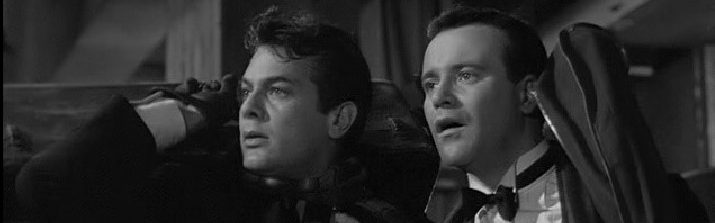
Noir City DC 2025: “Tomorrow is Another Day” (1951) starring Steve Cochran & Ruth Roman


They take their lives in their hands… when they take each other in their arms! -Tagline

Prison Warden: Your generation grew up, married, raised families, went to war. But nothing happened to you, Bill. You just got older.

Bill Clark (Steve Cochran) leaves prison after 18 yrs; he has the thinking of an awkward teen (he was sentenced at age 13) and a grown man’s body. Feeling lonely, he visits a dance hall (Dream Land), where he meets a jaded/platinum blonde, Cathy Higgins (Ruth Roman). Taking pity on the earnest/persistent man, Cay shows Bill around town. After the sudden shooting of a police detective (her “sugar daddy”), the odd couple decides to hit the road. Along the the way, they hitch a ride w/ a family, Stella (Lurene Tuttle) and Henry Dawson (Ray Teal), and their young son who’re going to pick lettuce in California.

Cay: I came to New York from upstate. I was gonna be a dancer. I was a brunette. Started on my toes and wound up on my heels.

The amount ($222.35) that Bill receives from his warden would equal about $2,700 (2024). Less than 10 taxi dance halls existed in NYC (1951), compared to 100+ about 20 yrs earlier. Cay’s comment (quoted above) is a reference to an older slang term for a promiscuous woman (having round heels). Perhaps the censors let it go, b/c of the noir nature of the film. As critics have pointed out, this is the rare noir w/ a (male) virgin. I had NOT heard of this movie until I saw it at the film fest; it was well-made and kept me interested. Film scholars noted that WB tacked on the (happy) ending, BUT I didn’t mind it! This movie delves into issues we’re facing today (in a sometimes lonely/uncertain/disillusioned world): the need for autonomy, intimate/romantic connection, friendship/community, and a sense of purpose.

[1] I can’t think of any other film from the pre-Moon Is Blue period that deals with so many tough social issues (without, of course, QUITE breeching the Production Code): prostitution, rape, pimping, and even premarital sex.

[2] Roman’s the revelation; in her best-known role… Here she modulates persuasively from bottle-blonde taxi dancer to sacrificing wife and mother-to-be (and a brunette, to boot). Cochran’s almost as good, waffling between the suspicion of a wounded child and the explosive reactions of an under-socialized male.

[3] There’s a whole sub genre of noir that involves flights from big cities into the open spaces of America and how those open spaces are no longer safe; the decay of urban environments will follow relentlessly, and the open spaces are even more dangerous because there are fewer places to hide.

-Excerpts from IMDb reviews

“Border Incident” (1949) starring Ricardo Montalban & George Murphy

The Bracero Program (1942-1964) was a series of agreements btwn Mexico and the US that allowed millions of Mexican men to work (legally) in the U.S. on short-term agricultural/railroad contracts. It was created to address labor shortages during WWII; it was the largest guest worker program in U.S. history. However, braceros often faced exploitation (promised wages, housing, and working conditions NOT met by growers). This movie (available on Amazon Prime video) centers on federal agents trying to protect Mexican braceros (someone who works w/ their arms/hands) from being robbed/killed along the U.S.-Mexico border. Pablo Rodriguez (Ricardo Montalban; aged 29 and looking FAB in 1st MGM lead role) teams up w/ FBI agent, Jack Bearnes (George Murphy) to tackle illegal immigrant smuggling. This is one of the few roles where Montalban played a Mexican (his real ancestry)! Pablo goes undercover as a bracero; Jack poses as a criminal (who smuggles work permits). There is a documentary feel in the framing (beginning and end) scenes. This movie (filmed mostly on location: Mexicali, Mexico; Calexico and El Centro, CA) is a blend of noir and Western.

Border Incident (a courageous movie for its day) was directed by Anthony Mann (before his iconic Westerns starring James Stewart). The budget needed ($650K) would’ve been TOO high for the “Poverty Row” studios he’d toiled in for 7 yrs. Mann was invited to MGM studios, which was headed by Dore Schary, a liberal/Democrat committed to making meaningful movies. Schary had been a playwright, director, and producer (for the stage), before transitioning to screenwriter and producer of moving pictures. Mann was apolitical; his main focus was making quality films. The director insisted that his frequent collaborator, John Alton, be hired on as DP/cinematographer. Fans of noir consider Alton to be a master of B&W photography; as Eddie Muller (TCM) noted, he somehow made the (wide open) spaces of the desert look claustrophobic!

There is no femme fatale (as this is a world populated by men); instead, we meet a bevy of baddies of different looks and (unhinged) personalities! Rancher Howard Plakson is played by Howard Da Silva; noir-istas may recognize him from The Blue Dahlia (1944) and They Live by Night (1948). Alfonso Bedoya plays “Cuchillo” (knife); he was the Mexican bandit “Gold Hat” in The Treasure of the Sierra Madre (1948). He famously told Bogie: “We don’t need no stinking badges!” Zopilote is played by Howard Moss, a Shakespearean stage actor who had played many “ethnic” roles (due to his ambiguous looks). Mann creates tension and does NOT shy away from depicting racism and violence (based on real cases from the INS).

[1] If you’ve only known Mr. Montalban as Mr. Roarke on “Fantasy Island” or as Khan on the “Star Trek” episode “Space Seed” not to mention “Star Trek II: The Wrath of Khan” you’ll probably be wonderfully surprised by his heroic role here.

[2] The pic is often vicious, sadistic even, landing violent scenes in the conscious that refuse to move until it’s all over and the screen goes blank. Suspense is never far away in Border Incident, with a mostly on form cast… bringing the material to life as the dream team cloak it all in pictorial assertiveness.

[3] John Alton’s photography is worth seeing alone, even without the sound it’s so good, not that you would want to avoid the fantastic score by Andre Previn. And the direction by Anthony Mann at the peak of his intensity is sharp and beautifully controlled.

-Excerpts from IMDb reviews

Movie Review: “Far From the Madding Crowd” (2015) starring Carey Mulligan, Matthias Schoenaerts, Michael Sheen, & Tom Sturridge

I re-watched this movie (Amazon Prime video) recently after listening to a (glowing) review on the Swoon Worthy pod. I recall NOT being V impressed w/ it when it was released in theaters; I saw it w/ my mom (when she lived nearby). I’m now more motivated to read the book; in my HS English classes, we read Tess of the D’Urbervilles and Jude the Obscure– two of Hardy’s other famous novels. I’m NOT sure how close this adaptation stays to the source novel, BUT I do think it makes for a successful romantic drama. The director (Thomas Vinterberg- Danish) and lead actor (Matthias Schoenaerts- Belgian) are NOT British; perhaps this contributes to the freshness and modern vibes. I’m also a fan of Carey Mulligan; I think she capably handles a LOT of types of roles.

Some of y’all regular readers will know of this (iconic) story: Bathsheba Everdene (Carey Mulligan) is a beautiful/independent/young woman who’s pursued by 3 different suitors: quiet/reliable sheep farmer- Gabriel Oak (Schoenaerts), charming/impulsive Army officer- Sgt. Frank Troy (Tom Sturridge), and a middle-aged/gentleman farmer- William Boldwood (Michael Sheen). As Mark Kermode noted, John Schlesinger (who directed the 1967 adaptation) was primarily interested in the relationship of Bathsheba (Julie Christie) and Sgt. Troy (Terence Stamp), the screenwriter here (David Nicholls) fleshes out the roles of all 3 men. Mulligan does a fine job in creating (different types of) chemistry w/ her co-stars. I noticed how hands-on Bathsheba got; she works alongside household servants, farmhands, etc. Her companion is a cheeky/observant young maid, Liddy (Jessica Barden); the actress has a prominent role in the series Dune: Prophecy (HBO MAX).

What is missing from the 1967 film (will review soon), is the (intro) segment w/ the growing friendship of Bathsheba and Gabriel during when she was working on her aunt’s farm. We get a sense that he admires her for her practical side, NOT only her beauty and friendly/open nature. At that time, Gabriel was of higher social status than Bathsheba (on the way to owning the farm he leased). There is a deleted scene (check YouTube) where Bathsheba saves Gabriel from (possible) death; that scene should’ve been kept in the final cut! After the (tragic) loss of his flock, Gabriel is forced to leave the farm and seek out work; by coincidence, he comes upon a barn on fire. He works (along w/ many farmhands) to save the barn; after the smoke clears, Bathsheba (the mistress of this farm) emerges!

Some viewers were confused as to how such a smart businesswoman could fall SO hard/fast for a man she barely knows. We have to remember that Bathsheba is only in her early 20s and inexperienced w/ men and love; Frank is NOT much older than her (and used to getting his way w/ women). They have a meet-cute, BUT it’s potentially problematic, as it occurs late at night while she is surveying her property. Frank appears in the fields soon after, saying that he’s there to help bring in the harvest. IF they’d lived in our (modern) times, this pair could’ve had a brief fling and gone their separate ways (astute viewers commented). In Victorian England, that was NOT an option!

I feel many elements combined to make this a captivating (though NOT an escapist) film; Hardy always contains dark themes after all. I was esp. impressed w/ the cinematography, music, and how Sheen brought (unexpected) empathy to the role of Mr. Boldwood. Book readers have commented that Mr. Boldwood is arrogant, entitled, and obsessive. I got (more) of an appreciation for Shoenaerts; he is tall/broad, w/ expressive eyes, and a strong screen presence (needed for a character who doesn’t say much). I think will have to look up more of his films; Mulligan picked him out for Gabriel after seeing him in Rust and Bone.

.

“Lions for Lambs” (2007) starring Robert Redford, Meryl Streep, & Tom Cruise

Injuries sustained by two Army rangers behind enemy lines in Afghanistan set off a sequence of events involving a senator, a journalist and a professor. -Synopsis

This out-of-the box film (directed by Robert Redford, who passed away recently at age 89) consists of 3 separate (yet interconnected) segments. The time is our (recent) past, Dubya is the prez, and there is (seemingly unending) war in the Middle East. Many viewers were most interested in the interview between the experienced political journo, Janine Roth (Meryl Streep), and a youthful Republican politician, Sen. Jasper Irving (Tom Cruise). They discuss foreign-policy in a war of choice, now running longer than WWII. The senator (a military adviser to the prez) is trying to convince Janine into “selling” a new plan of attack in Afghanistan. In a SoCal university, Prof. Stephen Malley (Redford), a Poly Sci prof has a meeting w/ a bright (yet recently slacking) student, Todd Hayes (Andrew Garfield).

Sen. Jasper Irving: [to Janine] In sense we’re both on the same team. We’re teammates. We’re both have a responsibility. You’ve already sold the war. Now I’m asking you to help me sell the solution.

The film is short and stays mostly to the point of a debate weighing the pros and cons of war, terrorism, and freedom. The photo on the senator’s office wall (Cruise dressed as a West Point cadet) is a still photo from Taps (1981). Alternating w/ the other segments are scenes in Afghanistan featuring two Army rangers, Arian Finch (Derek Luke) and his BFF, Ernest Rodriguez (Michael Peña). They’re POC and recent college grads who chose to enlist. What lives are most at risk in times of war? It’s the youth, esp. men of color and/or those living in poverty, as Prof. Malley explains to Todd (white, raised w/ privilege, and from an upper-middle class neighborhood). Check it out (on Amazon Prime video) if you’re looking for something different.

Prof. Stephen Malley: The decisions you make now, bud, can’t be changed but with years and years of hard work to redo it… And in those years you become something different. Everybody does as the time passes. You get married, you get into debt… But you’re never gonna be the same person you are right now. And promise and potential… It’s very fickle, and it just might not be there anymore.
Todd Hayes: Are you assuming I already made a decision? And also that I’ll live to regret it?
Prof. Stephen Malley: All I’m saying is that you’re an adult now… And the tough thing about adulthood is that it starts before you even know it starts, when you’re already a dozen decisions into it. But what you need to know, Todd, no lifeguard is watching anymore. You’re on your own. You’re your own man, and the decisions you make now are yours and yours alone from here until the end.

[1] It is not a perfect film in some regards, but it is not preaching but rather challenging all viewers, no matter what you think, to get involved, to take part, to question things, to think for one’s self. It is thought-provoking and challenging and for that it is well worth seeing for yourself.

[2] …the movie is not about a heroic battle or an indelible mistake by a over zealous, self absorbed government. It is about understanding a mindset. If any of you have ever read Francis Fukuyama… its about history repeating itself.

-Excerpts from IMDb reviews

Spoiler-Free Review: “Jane Austen Wrecked My Life” (2025)

A young woman in Paris, who dreams of becoming a successful writer and experiencing true love, may finally have her Jane Austen moment… -Tagline

Writer-director (Laura Piani) was inspired to write this story during her time working at Shakespeare and Company, a famed bookstore in Paris. Agathe (Camille Rutherford) is a 30-something/Parisian/single bookseller who shares banter w/ her pal/co-worker Felix (Pablo Pauly). As Austen may’ve said, she is at the risk of being an “old maid” and he is a scoundrel (prone to hookups/situation-ships). Agathe accuses Felix of “breadcrumbing,” yet you still can imagine attraction btwn the two friends. Felix (secretly) submits the first few chapters of Agathe’s novel; to her shock, she is selected to attend a writer’s retreat (The Jane Austen Residency)! When she gets to England, she meets Oliver (Charlie Anson), a Lit prof whose parents run the residency.

This is type of mid-budget/rom com that rarely gets made (in the US) today! FYI: This film is in BOTH French and English. It deals w/ real-world issues, yet has quiet humor. None of the characters are glam, young, or look like “typical” movie stars. I recommend it for those who’re NOT only Austen fans, BUT enjoy quiet movies and (slow burn/brainy) types of romances. A neighborhood gal pal and I had a good time!

[1] The acting works for the screenplay. While short, nothing is forced. Nothing is contrived, either. Everything that happens here doesn’t elicit any disbelief.

[2] This movie has the capacity to make you smile and laugh and feel contentment with its conclusion. I’d recommend a watch.

[3] It was nice to get a fresh take on an Austin-like writer, rather than as a retelling of one of her characters. As Agathe observes, Austen was the first writer to write women as humans, and idea which absolutely needs to be revisited in the current media world. This film successfully does that in making Agathe a messy and imperfect human in the best way.

-Excerpts from IMDb reviews