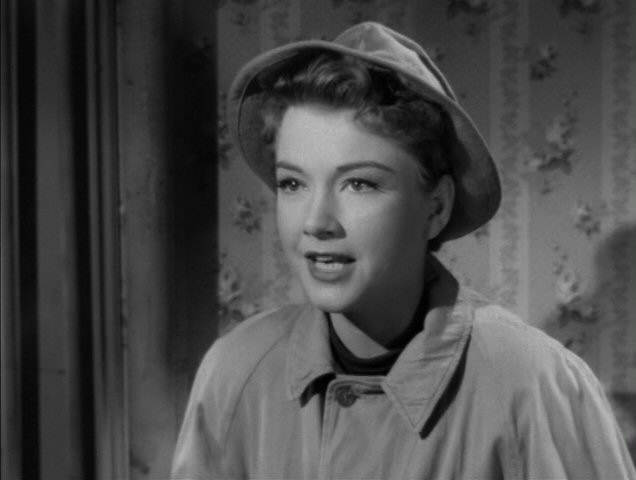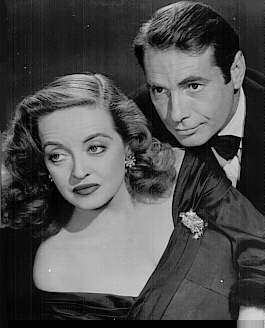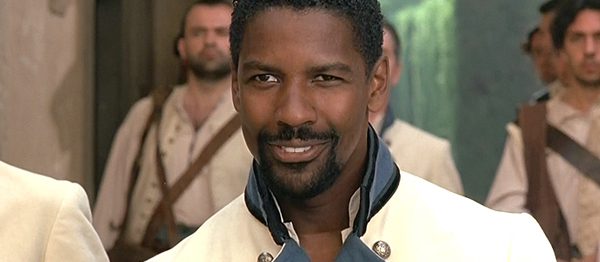
It Happened One Night (1934)
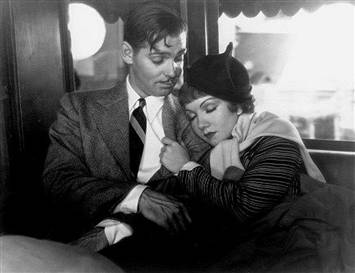
This is one of Hollywood’s earliest rom coms… but it ALWAYS seems fun, fresh, and witty whenever I see it. (I’ve probably seen it 4X so far.) It was directed by Frank Capra. Basically, it’s about two VERY different people who fall in love (over a few days) while traveling from Miami to NYC. My fave part is when the would-be couple is getting ready to sleep in the haystack. You can see that Ellie is falling in love w/ Peter, and he ALMOST gives her a kiss as he tucks her into “bed.” The lighting is VERY romantic in that scene!

See, people used to wear pjs- LOL! This may NOT be a PC movie (to viewers today), but it’s still a GREAT one! Watch how grumpy news reporter Peter cares for heiress Ellie- she’s a sheltered young woman who has never been alone for many days or w/o money. He acts tough/brusque to hide the fact that he’s interested in her. Peter is prejudiced against the super-wealthy, as we learn from several scenes.

Who can forget the hitchiking/leg-revealing scene? Peter is mad about her bold move; Ellie says “the limb is mightier than the thumb.” Many fans of this film regret the fact that there is no kiss at the end. The finale was rushed b/c both actors were scheduled to do other movies. This film was shot w/in 4 wks- WOW!!!
Did you know that there is a 1956 update to this movie (w/ song/dance added in)? It’s called You Can’t Run Away From It (w/ Jack Lemmon and June Allyson).
Cape Fear (1962)

I’ve seen this film before, as well as the remake Scorcese did w/ DeNiro and Nolte. The original is thought of as the better version by fans, though I think Nolte was quite good as the father/lawyer, Sam Bowden. To be senisitive to viewers, there is nothing more troubling than “assault” to describe the violation of women. Some scenes were cut to make the film less troubling. But after seeing Law & Order: SVU, the main issue in this thriller isn’t controversial (to modern eyes).

The best acting here is done by Mitchum- he TOTALLY inhabits Max Cady, an EVIL man out for revenge against the witness who helped put him in prison. He can be charming, compelling AND menacing! While in prison, Cady studied law, so he knows how to use it to his advantage. After he beats/assaults the young female traveler he met at a bar, she is reluctant to file a report (b/c everything will be exposed in public.) Times have changed, thank goodness!
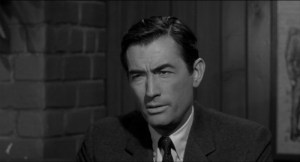
Peck has some nice moments in this film, esp w/ his wife and teen daughter. After all, he’s one of Hollywood’s most solid/trustworthy heroes. However, I thought his demeanor was sometimes a BIT too cool/controlled. There are nice parts here for helpful police chief (Martin Balsam) and clever PI (Telly Savalas). But as many fans have said, Mithchum stole the show!
Miller’s Crossing (1990)

I didn’t know anything about this Coen bros film before I saw it. This film has a small (but VERY loyal) fan base. It’s a gangster pic filmed in New Orleans (b/c that city has blocks of untouched ’20s bldngs.) At first, I thought the city was Chicago (but it goes unnamed in the film). Now, it MAY take you a mins to get used to the dialogue, esp b/c Gabriel Byrne had a much thicker Irish accent then. You’ll also hear insults/slang from the Prohibition era.
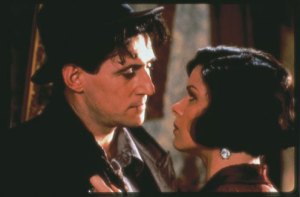
Tom is a complicated/tough/clever anti-hero. He’s loyal to his boss Leo, but having an affair w/ Leo’s gf, Verna. John Turturro plays Verna’s bookie brother, Bernie. He’s the one who stirs things up in this film! The Italian mob boss is played by Jon Polito w/ loads of gusto.

All the main characters are GREAT in their roles, esp Byrne. (You’ve rarely seen a character like Tom!) I was VERY impressed by how effortlessly Marcia Gay Harden (in her 1st movie role) stands up to Byrne. IMHO, this film doesn’t always flow very well. I watched it b/c the characters were compelling, and I wanted to know what Tom’s final move would be. Will he kill for the 1st time in his life?
White Palace (1992)

Opposites attract in this simple/formulaic Hollywood romance. Max Baron (James Spader) is a 27 y.o. Jewish ad exec. Since losing his wife in a car accident 2 yrs ago, he hasn’t looked at another woman. His friends/fam keep badgering him to start dating. (They have a list of pretty/Jewish/single gals ready for him.) Nora Baker (Susan Sarandon) is a 43 y.o. lapsed Catholic who waitresses at White Palace, a popular burger joint in the inner city. She lives in a little house (that she decorates w/ pics of Marilyn Monroe) in an area known as Dogtown.

After his best pal’s bachelor party one night, Max doesn’t feel like going home. He decides to stop at a bar and have a drink. Nora approaches him, wondering what a guy like him (wearing a tux, no less) is doing there. He isn’t in the mood for talking, but she compliments him w/ “you have a beautiful face” and “you remind me of Tony Curtis.” Then they both reveal a painful secret from their respective pasts.

In no time, Max and Nora are involved in a steamy relationship. Nora wants to keep him at arm’s length (emotionally), but Max says “I can’t get you out of my head.” But is this love? And even so, can they overcome their differences: age, education, social status, etc? The dialogue in this film is rather simple, but what keeps it from being boring is the fine acting by the two leads. (The fact that they look GORGEOUS doesn’t hurt either!)
Shattered Glass (2003)

This small indie film is based on a true news scandal, not unlike that of NYT reporter Jayson Blair (who was exposed in 2003). It involves Stephen Glass, a 25 y.o reporter for the small (yet VERY prestigious) magazine, The New Republic. The year is 1998, and Stephen is juggling his stressful job AND law school (to please his parents). He goes out of his way to please his co-workers, some of whom are also his friends. It becomes clear to the viewer that Stephen is VERY nervous and insecure, thanks to the characterization by Christensen. (Like many viewers said, he’s NOT wooden like in the Star Wars films.)

When one of his stories “doesn’t check out,” Stephen frantically tries to cover it up. A reporter from Forbes Online in NYC discovers holes w/in the story, too. The New Republic editor, Chuck Lane (Peter Sarsgaard), grows more suspicious w/ each new piece of info that’s unverifiable. He wonders if Stephen is merely a “scared kid” who failed to check his sources. When he questions the reporter, Stephen feels unfairly persecuted.
Sarsgaard plays his (understated) role VERY well, and steals the last 1/3 of the movie. He’s a natural/believable actor who can fit into ANY role! Chloe Sevigny plays a friend/fellow reporter who feels Stephen did no wrong. If you want to see a smart movie about an interesting topic, check this movie out.