Tag: Gender
Young Joan Rivers on the single life
Looks like Beyonce just got owned by a desi girl
“The Buried Life” by Matthew Arnold
Light flows our war of mocking words, and yet,
Behold, with tears mine eyes are wet!
I feel a nameless sadness o’er me roll.
Yes, yes, we know that we can jest,
We know, we know that we can smile;
But there ‘s a something in this breast,
To which thy light words bring no rest,
And thy gay smiles no anodyne;
Give me thy hand, and hush awhile,
And turn those limpid eyes on mine,
And let me read there, love! thy inmost soul.
Alas! is even love too weak
To unlock the heart, and let it speak?
Are even lovers powerless to reveal
To one another what indeed they feel?
I knew the mass of men conceal’d
Their thoughts, for fear that if reveal’d
They would by other men be met
With blank indifference, or with blame reprov’d;
I knew they liv’d and mov’d
Trick’d in disguises, alien to the rest
Of men, and alien to themselves—and yet
The same heart beats in every human breast.
But we, my love—does a like spell benumb
Our hearts—our voices?—must we too be dumb?
Ah, well for us, if even we,
Even for a moment, can get free
Our heart, and have our lips unchain’d;
For that which seals them hath been deep-ordain’d!
Fate, which foresaw
How frivolous a baby man would be,
By what distractions he would be possess’d,
How he would pour himself in every strife,
And well-nigh change his own identity;
That it might keep from his capricious play
His genuine self, and force him to obey,
Even in his own despite his being’s law,
Bade through the deep recesses of our breast
The unregarded River of our Life
Pursue with indiscernible flow its way;
And that we should not see
The buried stream, and seem to be
Eddying at large in blind uncertainty,
Though driving on with it eternally.
But often, in the world’s most crowded streets,
But often, in the din of strife,
There rises an unspeakable desire
After the knowledge of our buried life,
A thirst to spend our fire and restless force
In tracking out our true, original course;
A longing to inquire
Into the mystery of this heart which beats
So wild, so deep in us, to know
Whence our lives come and where they go.
And many a man in his own breast then delves,
But deep enough, alas, none ever mines!
And we have been on many thousand lines,
And we have shown, on each, spirit and power,
But hardly have we, for one little hour,
Been on our own line, have we been ourselves;
Hardly had skill to utter one of all
The nameless feelings that course through our breast,
But they course on for ever unexpress’d.
And long we try in vain to speak and act
Our hidden self, and what we say and do
Is eloquent, is well—but ‘tis not true!
And then we will no more be rack’d
With inward striving, and demand
Of all the thousand nothings of the hour
Their stupefying power;
Ah yes, and they benumb us at our call!
Yet still, from time to time, vague and forlorn,
From the soul’s subterranean depth upborne
As from an infinitely distant land,
Come airs, and floating echoes, and convey
A melancholy into all our day.
Only—but this is rare—
When a belovèd hand is laid in ours,
When, jaded with the rush and glare
Of the interminable hours,
Our eyes can in another’s eyes read clear,
When our world-deafen’d ear
Is by the tones of a lov’d voice caress’d—
A bolt is shot back somewhere in our breast
And a lost pulse of feeling stirs again!
The eye sinks inward, and the heart lies plain,
And what we mean, we say, and what we would, we know,
A man becomes aware of his life’s flow,
And hears its winding murmur, and he sees
The meadows where it glides, the sun, the breeze.
And there arrives a lull in the hot race
Wherein he doth for ever chase
The flying and elusive shadow, Rest.
An air of coolness plays upon his face,
And an unwonted calm pervades his breast.
And then he thinks he knows
The hills where his life rose,
And the Sea where it goes.
Belle (2014)
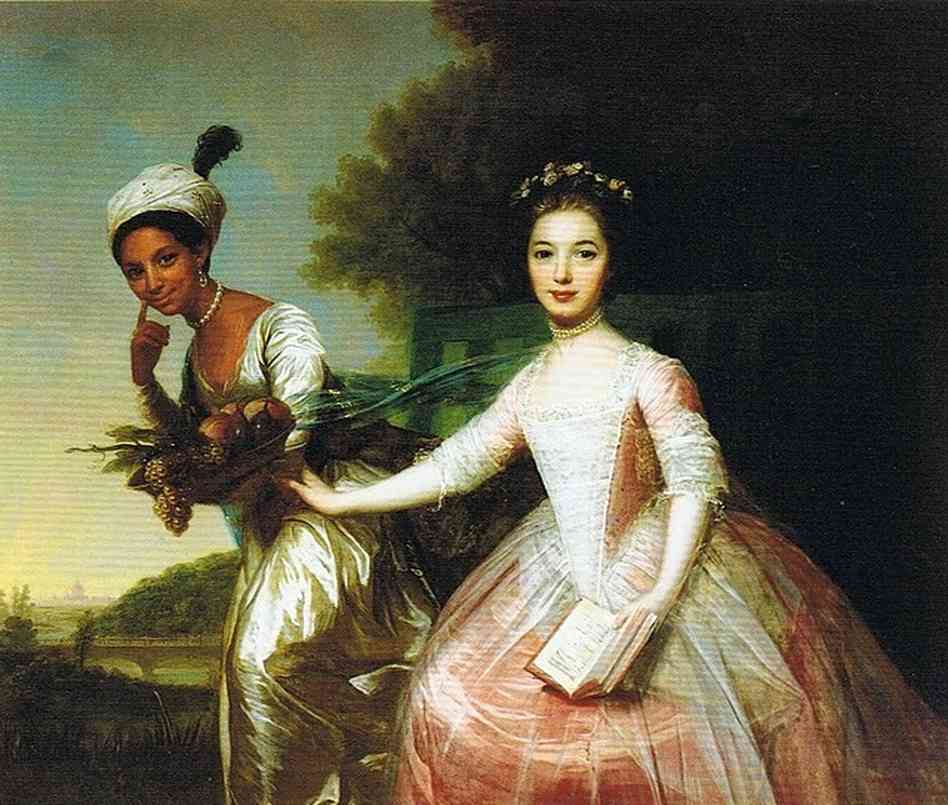
This film, released early in 2014 in the US, is a must-see, especially for fans of historical dramas and Jane Austen! Issues of class privilege, marriage/property, and slavery arise. In the portrait (above), the viewer’s eye is drawn to Dido, who seems full of vivacity, while her cousin seems more proper/sedate.

The poster itself intrigued many people walking through theater lobbies- a pretty biracial woman dressed in finery. The film was directed by Amma Asante, the daughter of Ghanian immigrants to England; she is also an actress and writer. The luminous lead actress is Gugu Mbatha Raw, the daughter of a black South African doctor and white British nurse. (FYI: That’s natural beauty- Gugu wore no makeup during filming, since there was none for Belle’s complexion.)
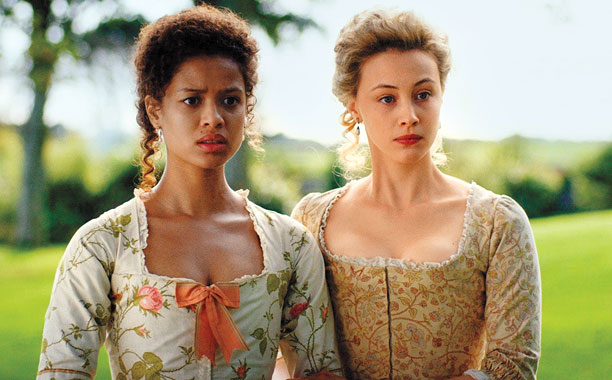
The young Belle is brought by her naval officer father (Matthew Goode) to live in the household of his childless uncle, William Murray, the first earl of Mansfield (Tom Wilkinson, superb as ever) and his wife (Emily Watson, in a low-key role). All we know is that the child’s mother was an African slave found aboard a Spanish vessel. Already living on the vast country estate is another girl, Elizabeth Murray (newcomer Sarah Gadon), the daughter of another of Lord Mansfield’s nephews. The girls grow up together, like sisters, though Belle is of a different status (too high to dine with the servants, yet too low to dine w/ the family).
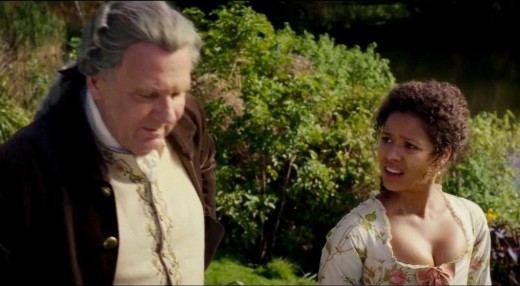
Lord Mansfield is also Chief Justice of the Royal Court, and as in the film, the real Dido assisted her great-uncle w/ his daily correspondence. I especially enjoyed the debate/discussion scenes between these two!

The idealistic son of the local parson, John Davinier (newcomer Sam Reid, a solid performance) comes to study law with Lord Mansfield. He mentions an important court case involving slave cargo, and she wants to learn more.
Related Links:
All Things Considered (NPR): Film review by critic Bob Mondello
 Knightleyemma