SPOILERS: Don’t read this post if you haven’t seen, or don’t want to know, details from this movie (now showing in wide release in the US).
[1] If you saw something similar in a high school world history class it would be interesting and effective. As a theatrical movie it misses the mark.
[2] ...as history, it is inevitably selective. Most glaring is the benign portrait of a compassionate departing colonial power.
[3] It’s interesting to see, but it’s by no means a cinematic masterclass.
[4] What could have been an epic, ends up being too pedestrian. It is this failure in character development which pulls the film down harder than all the other negative factors combined.
[5] A special mention needs to go to Gillian Anderson. Her performance as Lady Mountbatten is wonderful. The received pronunciation was perfect. Her character adds heart, she adds a moral core, to both Lord Mountbatten, and in my eyes, to the film in general.
-Excerpts from reviews on IMDB
I saw this movie (ONLY available in SD- ugh) last night on FIOS On Demand. I had been anticipating it for almost 3 mos, so was VERY excited. (American actor Manish Dayal was posting bits about it on his social media.) I was a big fan of Bend it Like Beckham, British director Gurinder Chadha’s breakout indie hit. I thought her Thanksgiving-themed film (What’s Cooking?) was pretty good. The posters didn’t appeal to me- TOO slick and stereotypical of a historical drama. I liked the trailers that I saw; the high production value was evident (which viewers expect from this caliber of film).
Sadly, Viceroy’s House was NOT what I expected. After it ended, I wondered: “There MUST have been MORE to this film!” It seems edited down (to a mere 1 hr 46 mins); however, it seems longer b/c of it’s plodding nature (at least in the first half). Maybe it needs to be seen on the big screen (for its sheer scope and spectacle)? Or maybe it would’ve been better as a miniseries or movie on HBO (where directors and writers have more creative control)? MANY critics/viewers felt that Hugh Bonneville was miscast as Lord Louis Mountbatten. Hmmm… maybe it’s TOO close to his role as head of Downton Abbey? Gillian Anderson (who plays Lady Edwina) is given some of the best lines in the movie; she does well w/ in her role. (You should check Anderson out in British work, incl. The Fall on Netflix.)
The veteran actors who play Nehru (Tanveer Ghani), Jinnah (Denzil Smith), and Gandhi (Neeraj Kabi) do what they can w/ what they are given. Basically, they sit around and debate w/ the Brits on if and how to divide India and the new Muslim majority nation- Pakistan. Some of you know that Gandhi didn’t want India divided; he imagined a land where ALL religions live together in peace (as before the Brits arrived and used their “divide and conquer” strategy to rule). Some Pakistanis were NOT pleased w/ the portrayal of Jinnah, who comes off as duplicitous.
Michael Gambon plays Gen. Ismay, a cold/intimidating man who doesn’t care what happens to the Indian people. He wants to get the boundaries created ASAP and get back to England. Simon Callow ‘s overwhelmed character, Radcliffe, says that it’s impossible to make these decisions in such a short time frame. Ismay finally shows him a plan from 1945 which already lays out exactly how India and Pakistan should be divided (NOT sure how accurate this is in reality)!
The recently deceased international Indian actor, Om Puri, has a small, yet effective/touching role. (He played Dayal’s father in The Hundred-Foot Journey). In this film, Puri plays Ali Rahim Noor, the blind/elderly father of Aalia (Pakistani actress Huma Qureshi), the Muslim woman who has captured the heart of Dayal’s character, Jeet Kumar. Ali Rahim was a political prisoner in the jail where Jeet worked for 2 yrs as a guard. Now, Jeet is a manservant (alongside his Sikh friend, Duleep Singh) for Mountbatten. As Dayal has said, Jeet represents the Hindu perspective in the film. He is an earnest/optimistic young man who feels that his destiny is to marry Aalia.
One of the servants (among 500+ in the viceroy’s household) who stirs up trouble is Mohsin (Samrat Chakraborti, an American actor/musician whose career I’ve been following since 2005). He also has a crucial role in Midnight’s Children (check Netflix to see if it’s still available). Another pleasant surprise is the original music by A.R. Rahman, an internationally recognized composer. I thought he did a esp. fine job in the last section of the film, when we see large crowds of refugees streaming into the palatial estate.
Today’s post comes from Kate Mersiovsky, National Archives Technician
Since I’ve become an archives technician in the Innovation Hub Scanning Room at the National Archives, I’ve seen my fair share of interesting records. Researchers have digitized the pension of presidential widow Lucretia Garfield, the pension of Harriet Tubman, and the Supreme Court cases In Re Gault and U.S. v. Edith Windsor. Recently one of my fellow technicians, Jesse Wilinski, found another unique record- the pension file for Mohammed Kahn, a Muslim soldier who served in the Civil War.
It is rare to find records of Muslim Civil War soldiers in our holdings. So far, Jesse has only encountered two pensions, and historians know of only about 250 Muslim Civil War soldiers in all. This record, therefore, sheds light on a unique perspective that is often overlooked. As a Muslim immigrant serving in a white unit, Kahn…
NOTE: This review contains SPOILERS for the streaming drama series, book, and 1990 movie version of The Handmaid’s Tale.
Introduction
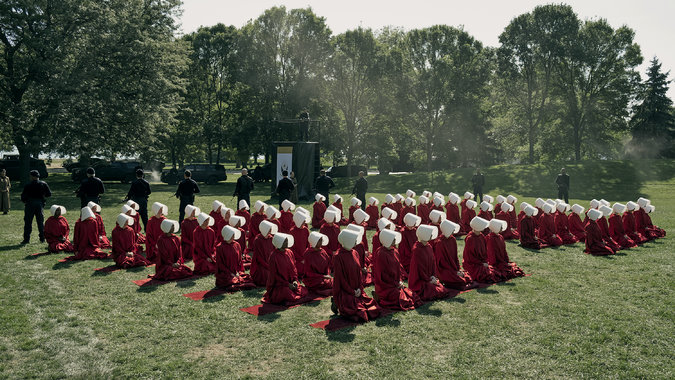
Handmaids kneeing at a gathering with Guardians surrounding the area
Atwood’s book has echoes of New England Puritanism, along with atrocities drawn from sources including Saudi Wahhabism, the Third Reich, American slavery, and the East German surveillance state. It’s constructed not as a realistic story, however, but as an eyewitness account… -Emily Nussbaum (The New Yorker)
Mankind is failing, most women are sterile because of industrial pollution (or Mother Nature just having enough of us). Birth rates are plummeting. An ultra religious cult see it as their God-given mission to “save mankind.” They seize power by staging a fake terrorist attack against the US government, impose marshal law, and set about rebuilding American society. (“War On Terror” anyone?) They use The Old Testament as their blueprint, but with some totally wack interpretations and distortions. Fertile women become the property of the state. Brainwashed and farmed out to the new ruling elite as baby makers, slavery and subjugation is all they can hope for. -Summary by IMDB reviewer
Serena Joy (Faye Dunaway) and Offred (Natasha Richardson) in the 1990 movie version of “The Handmaid’s Tale”
Canadian writer Margaret Atwood wrote her dystopian novel in 1985 (while she was living in Berlin, Germany); it was first published in 1986. She didn’t put anything in that hadn’t happened before at some place and time period in history. Her book is considered a blend of historical fiction and sci-fi; I read it in HS (I think). Many years later, I saw the 1990 movie starring Natasha Richardson, Robert Duvall, Faye Dunaway, and Aiden Quinn. Critics (mostly) hated that film, BUT I thought it was pretty decent. Veteran actors Duvall and Dunaway played the Waterfords; their ages were appropriate to the book. However, in this new Hulu series, the couple are much younger, energetic, and passionate.
Setting
A group of Handmaids clean blood from the wall by the river.
The Handmaid’s Tale looks extraordinary – stylised, choreographed almost, menacing. It sounds fabulous, too. -Sam Wollaston (The Guardian)
Even the light coming in through the windows has a soft luxury to it, a Vermeer-ish quality. -Sonia Saraiya (Variety)
Much has been written lately re: the importance of world-building in good drama series; after all, the look is what first draws the attention of viewers to a show. Offred wears a distinctive white bonnet (the 1990 film had a red veil) and scarlet-colored dress and hooded cape, as do ALL the other Handmaids. The commanders wear black suits w/ dark-colored ties; their wives wear blue dresses (covering the knees and and conservatively cut) and matching capes. There are also lower-ranked married women in this world; they are called Econowives and wear grayish striped dresses. The Guardians dress like modern-day SWAT teams- in black and gray colors.
There are also little/subtle touches which enrich the show. The Gilead-era flag (which is shown in Canada) only has two stars, b/c the U.S. ONLY has control over two states- Alaska and Hawaii. In the real world, the red tags attached to the Handmaids’ ears are used on livestock (such as cows); this is a reminder that the Handmaids are viewed as farm animals, NOT humans. There are mentions of Uber, Tinder, the SATs, and even a cute scene involving a food truck- things that we are familiar w/ in 2017.
Characters
In the book, Gilead is a white-supremacist culture. In the show, black actors play Moira and Luke. The result is an odd trade-off: we get brown faces, but the society is unconvincingly color-blind, as if race had never existed. -Emily Nussbaum (The New Yorker)
June/Offred (Elisabeth Moss)
The book uses a 1st person narrator, so the reader ONLY knows what Offred knows. This series also gives us POVs of other characters, BUT she is the lead. Moss has tackled meaty roles before (The West Wing; Mad Men; Top of the Lake). She is VERY good at expressing a lot of (conflicting) emotions w/ subtle/brief looks and body movements. In her previous life, Offred was a book editor and married mother to an adorable young daughter (Hannah). At the start of the series, her goal is to stay mentally strong and survive in order to someday find her little girl.
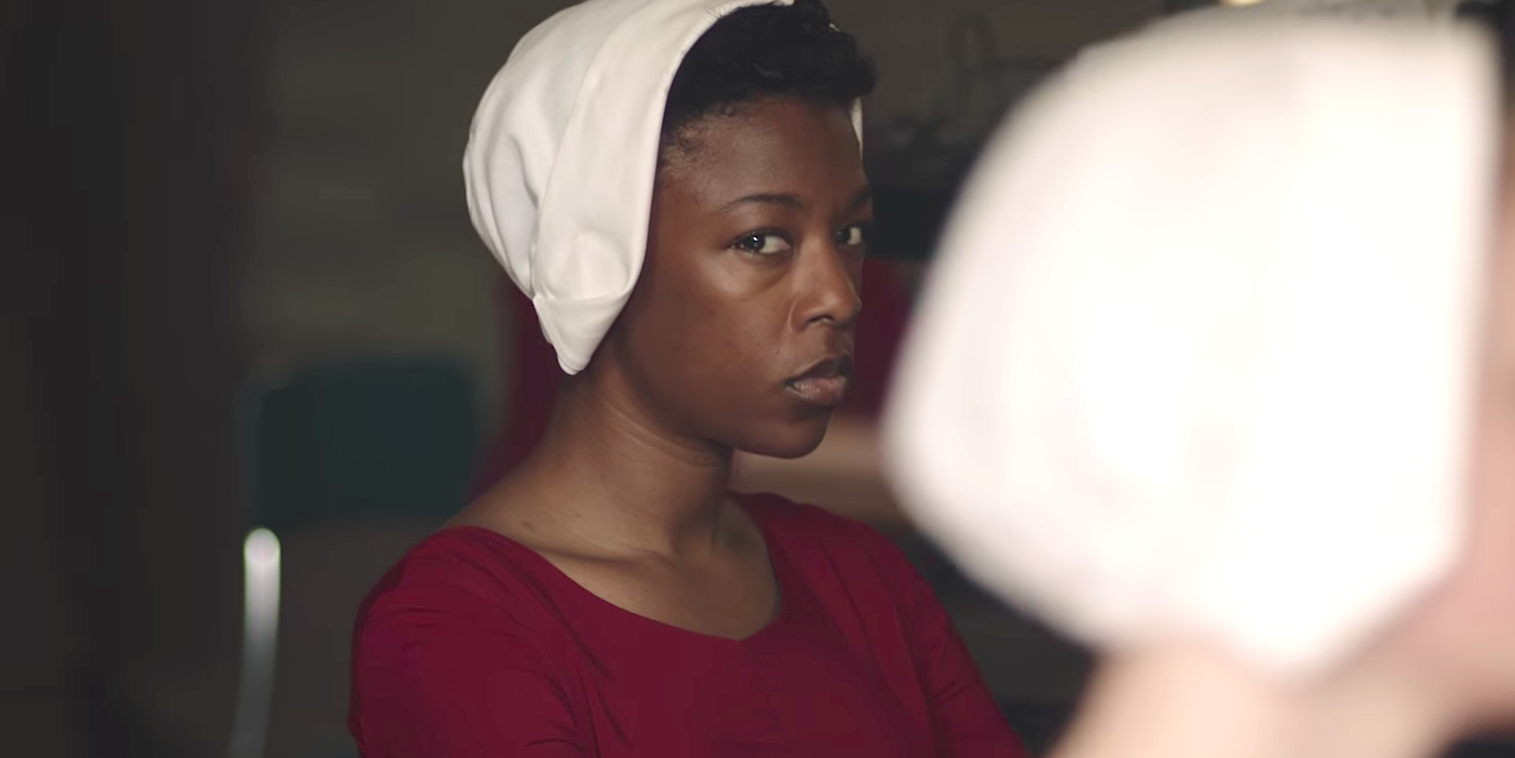
Moira (Samira Wiley)
Moira (Samira Wiley) at the training center
The petite, out and proud lesbian is June’s best friend. Moira, who is BOTH funny and strong-willed, manages to escape from the Rachel and Bilhah Center in the disguise of an Aunt. Offred gets left behind on the subway platform, BUT she understands the difficulty of the situation. Though there are rumors that Moira died, we see her (later in season) working at Jezebels, a club where commanders come to fulfill their fantasies w/ a diverse array of women (many of whom were intellectuals in the past). Just like the Handmaids, these women can’t say “no.” When they are reunited (by chance), Moira explains to June that Jezebels get good food, booze, and drugs. In the book, she says that she can read and have relationships w/ women. Fans of OITNB rejoice!
Luke Bankole (O-T Fagbenle)
Luke, June’s husband and father to Hannah, gets a backstory in this series; that is NOT in the book. When they first met, Luke was married to another woman; this adds to the shades of gray in the story. This actor is British-Nigerian and I had never seen him before; he does a great job in this role (incl. the more action-oriented scenes).
Emily/Ofglen (Alexis Bledel)
Ofglen (Alexis Bledel) and Offred (Elisabeth Moss) at the grocery store
In her previous life, Emily was a college prof, married (w/ a wife), and young son. Offred doesn’t really know much re: Ofglen until after 2 mos. of walking w/ her to do the grocery shopping; no Handmaid can travel alone. Later in the series, Ofglen goes through FGM (scary, yet still happening ALL over the world). This is a VERY meaty (and unusual) role for Bledel; she is best known for The Gilmore Girls.
Janine/Ofwarren (Madeline Brewer)
Janine, a fiery redhead, was mouthy at the training center; she was severely punished by one of the Aunts (losing an eye). Poor Janine has a tragic past; she was a survivor of a gang assault (resulting perhaps in PTSD). Moira is tough on her, BUT June has success in calming her down; the behavior of one Handmaid will affect ALL of them. Even after Ofwarren gives birth to the Putnam’s baby girl, her emotional turmoil continues.
Aunt Lydia (Ann Dowd)
Aunt Lydia (Ann Dowd) at a gathering of the Handmaids
Ordinary is just what you’re used to. This might not seem ordinary right now, but after a time it will. This will become ordinary.-Aunt Lydia to the Handmaids
Aunt Lydia is the head of the Rachel and Bilhah Center; she is a harsh taskmaster who seems to truly believe in the ways of Gilead. In time, we notice that she feels bad for Janine, BUT she can’t let things slide for ANY of her “girls.” Ann Dowd, a veteran character actress, brings a BIT of ambiguity to the role- she is NOT a total villain.
Cmdr. Fred Waterford (Joseph Fiennes)
Offred (Elisabeth Moss) plays Scrabble with The Commander (Joseph Fiennes) in his study
Better never means better for everyone. It always means worse for some. -Cmdr. Waterford explains to Offred
He is usually called “The Commander” by everyone; his wife (Serena Joy) only calls him Fred. Some of the other Handmaids tell Offred that he is “really high up” and “very important” in the government of Gilead. At first, The Cmdr. is merely going by the book during ceremony nights; later, he wants to connect w/ Offred. He requests that Offred come down to his study (a no-no); they chat (even flirt a BIT), play Scrabble (which they are BOTH good at), and he gives her fashion magazines to read (another no-no).
To show her just how much power he holds over her, The Cmdr. takes Offred (wearing one of Serena Joy’s blue capes) out to the club- Jezebels. Notice that he chose a sparkly mini-dress and matching heels for Offred to wear; this shows us what type of woman he desires (someone to show off). Fiennes does a great job w/ his American accent; I don’t think I’ve seen him using one before. The actor creates a man who is complicated, yearning for connection (esp. to Offred), and enjoys flaunting the rules (which he helped establish).
Serena Joy Waterford (Yvonne Strahovski)
Serena Joy (Yvonne Strahovski) listens to the prayer in her parlor
Never mistake a woman’s meekness for weakness. -Serena says to the Mexican ambassador, Mrs. Castillo
Serena Joy is portrayed by an Australian actress (former model) who somewhat resembles Grace Kelly, BUT w/ a more taller/athletic body. She gets a backstory in this series that is NOT in the book (like Luke). In flashbacks, we see how Serena Joy was a part of the establishment of Gilead; she wrote a book about the role of women. (Atwood modeled Serena Joy on the historical anti-feminist figure, Phyllis Schlafly, an outspoken opponent of the ERA in the ’70s.) The world she helped create has left her feeling alone, bitter, and (eventually) cruel. Serena Joy eventually turns on Fred, saying that he is NOT “worthy” of fathering a child, so God has denied him one.
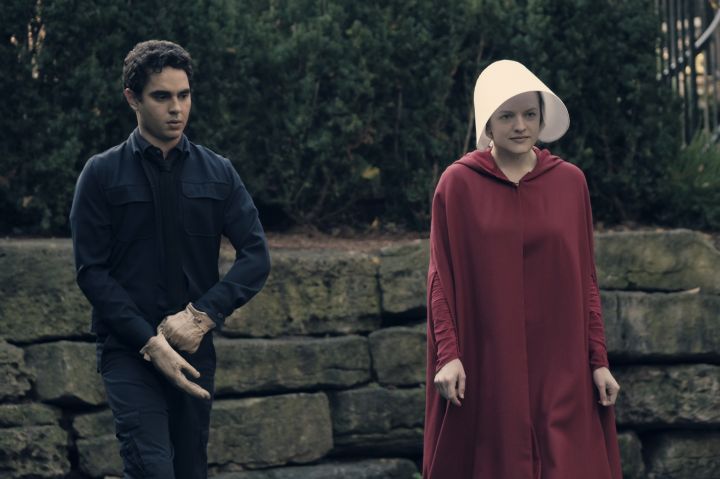
Nick (Max Minghella)
Nick (Max Minghella) and Offred (Moss) in the yard
Max Minghella’s performance gets more interesting every week. You never know what he’s going to say until he says it—that face is unreadable in the best and most unsettling way. -Allison Shoemaker (A.V. Club)
Nick is The Commander’s driver; he lives in a humble room above the Waterford’s garage. In the pilot, Offred explains that he is “low rank” and “has not even been assigned a woman.” At first, Nick just watches Offred (w/o speaking); this makes her a BIT nervous, BUT also curious. They begin to secretly flirt; BOTH are feeling lonely and need someone to talk to. Mrs. Waterford gets them together b/c, MOST likely, The Commander is shooting blanks. It takes time, BUT Nick is revealed to be a protector, NOT merely a coward or survivor. He was recruited rather young as one of the Sons of Jacob, a secret group of men who are the Eyes in the households of the commanders.
Rita (Amanda Brugel)
Rita is one of the Marthas; she has worked for the Waterfords for a few yrs (like Nick). She is brusque, at first, BUT then treats Offred w/ kindness (making her healthy meals). After all, the birth of a baby would be great for ALL of the household. We learn that she lost her grown son in the war; most likely, he was fighting against the establishment of Gilead. I hope that she gets a backstory in Season 2; she is one of the few Latina women on the show.
Themes
Identity/Individualism
The Handmaids’ uniform denies the women individuality until the camera moves close enough so that we see their faces. In Gilead, the group is MORE important than the individual, as the Aunts and Commanders often say. Those women who don’t fall in line, like Ofwarren (who went through emotional turmoil after pregnancy) and Ofglen (who fell in love w/ one of the Marthas), are dealt w/ VERY harshly.
Children
And she said, Behold my maid Bilhah, go in unto her; and she shall bear upon my knees, that I may also have children by her.-Genesis 30:3 (King James Bible)
In this world, a healthy birth happens 1 out of 5 times. June/Offred is in her early 30s and already has a daughter, so there is a good chance that she can have another child. Janine/Ofwarren gives birth to a fine baby girl, gets to breastfeed her, BUT then is ceremoniously put out of the Putnam’s household. Like MANY other viewers, I am NOT convinced that Serena Joy wants a child; she has bought into this society, BUT that doesn’t mean that she’s happy w/ it.
Love & Marriage
Unlike in any number of other gender dystopias, most men don’t oppress women because they hate or fear them, but because they can’t empathize enough to love them when it becomes inconvenient.
…And women gave up everything by empathizing too much and turning on each other to support the men they loved. -Adi Robertson (The Verge) re: the book
Serena Joy is rejected (coldly) by her husband after one halted ceremony scene; after all, intimate relations in Gilead are solely for the purpose of procreation. Maybe some viewers felt sympathy for her then? I was a BIT shocked when The Cmdr. admitted to Offred that he didn’t believe in love; in flashbacks, it seems like he and his wife were once deeply in love. (In the book, Atwood explains that some couples were already married before the establishment of Gilead; others were placed in arranged marriages to spouses of equal status.)
Offred goes to Nick’s room b/c she wants to spend the night w/ him; this happens after Mrs. Waterford has them perform the ceremony. As for love, Offred likes Nick, BUT is still in love w/ Luke. As for Nick, I think that he does fall in love w/ Offred; he can’t express himself, as it could get them BOTH killed.
Women & Femininity
“Women have too much freedom here,” a foreign undergrad student commented when I asked him how he liked America. A few months ago, I mentioned to a friend how it’s too bad that apt. buildings in some countries (EX: Japan and India) didn’t rent to unmarried couples. “They should have a choice, at least,” I said. She replied quickly: “Oh, all those rules are for protection of women. What if the boyfriend leaves her? And if she gets pregnant?” The founders of Gilead take this type of thinking to another (extreme) level; they think they are protecting the Handmaids and the (possible) future children. How is legally sanctioned rape protection!? In one scene, The Cmdr. tells Offred that it’s the “destiny” of women to bear children. So, where does that leave his wife?
Freedom & Confinement
Offred (Moss) sees Moira in the club
“You’re free here,” The Cmdr. tells Offred in their room at the club. We know that no woman is free in this world! In the flashbacks, we see June (and other women in Boston) being let go from their jobs, then their bank accounts frozen, before being sent to the training center. Moira lashes out at Luke when he tells June “I’ll take care of you.” Ugh, that’s NOT the point- it’s about choice! One can argue that Offred finds a sort of freedom in her relationship w/ Nick, which is a (dangerous) rebellion.
Reading, Writing, & Storytelling
Since reading is forbidden for Handmaids, ALL the items in the grocery store are marked by pictures instead of words. Before Moira’s escape scene, we see workmen chipping away at the signs in the subway. You know what reading promotes- thinking! Before each ceremony, the household gathers in the parlor while The Cmdr. reads the story of Rachel, Jacob, and Bilhah from the family Bible. Offred discovers a Latin phrase written inside the closet in her room; she finds out (from The Cmdr.) that it translates to “don’t let the bastards grind you down.” The Mexican ambassador’s assistant proves that he can be an ally to Offred when he hands a pad of paper and pencil, asking her to write a message for her husband (who is alive). The mysterious package Moira mails from the club to the butcher (another male ally) turns out to be letters and photos from a diverse group of women (some mothers); they are desperate to tell the wider world their story.
…it feels as if it were made yesterday. Not a moment of “The Manchurian Candidate” lacks edge and tension and a cynical spin. And what’s even more surprising is how the film now plays as a political comedy, as well as a thriller.
-Roger Ebert
I love this movie & find it disturbing. It’s a thriller but at times it even seems a satire.
Sinatra is so great here, you hardly notice how good Laurence Harvey is.
#TCMParty (selected tweets)
I keep telling you not to think! You’re very, very good at a great many things, but thinking, hon’, just simply isn’t one of them. -Mrs. Iselin explains to her husband
There is something timeless, yet also eerily timely about this classic film (in Trump’s America). Though it was released in 1962, it is set in 1952 in New York and DC; the use of black and white makes it look older. I think the novelist (Richard Condon) was influenced by Hamlet; note Sgt. Raymond Shaw’s (Laurence Harvey) deep hatred for his stepfather, Senator John Iselin (James Greogory), who married his domineering mother, Eleanor Shaw Iselin (Angela Lansbury). We are NOT told anything re: Raymond’s birth father; I imagine that he was a wealthy/intelligent/influential man. In the youthful romance of Raymond and Jocelyn Jordan (Leslie Parrish), there is an echo of the feud between noble families as in Romeo & Juliet.
Maj. Bennett Marco and Rosie chat on the train in a mysterious manner.
Janet (Psycho) Leigh plays a shady, Robert Walker-like femme fatale whose cryptic language may or may not indicate she’s a member of the Communist Ring… The most celebrated (and widely discussed) meet-cute in film history occurs aboard a train, as Janet Leigh and Sinatra whisper sweet-somethings in the most roundabout, I’ve-never-heard-people-talk-like-this way imaginable.
-Stanford Arts Review
Women are (in several scenes) depicted as capable, smart, and active agents in their romantic lives. Obviously, Mrs. Iselin is the power behind her loud-mouthed/dim-witted husband. A young Josie comes to Raymond’s rescue after he’s bitten by a snake. Rosie (Janet Leigh) approaches Maj. Bennett Marco (Frank Sinatra) during their train ride, shows him that she’s VERY interested, then tells him her address and phone number.
Mrs. Iselin (Angela Lansbury) and Raymond (Laurence Harvey)
It’s a terrible thing to hate your mother. But I didn’t always hate her. When I was a child, I only kind of disliked her. -Raymond explains to Bennett Marco
This is the type of film that you MUST pay attention to, or you’ll miss something! It showcases Sinatra’s acting range; many critics/classic movie fans consider this performance to be the best of his career. The Manchurian Candidate proves us just how scary Lansbury can be, if the script calls for it; I wished there was more of her performance. The way that she controlled Raymond’s life has contributed to how his life is like at that start of the story: humorless, friendless, and loveless. He attempts to get away by taking a job w/ a newspaper editor he admires, BUT alas, his life is NOT his own.
Mrs. Iselin (Angela Lansbury) faces off against Senator Tom Jordan (James McGiver).
There are people who think of Johnny as a clown and a buffoon, but I do not. I despise John Iselin and everything that Iselinism has come to stand for. I think, if John Iselin were a paid Soviet agent, he could not do more to harm this country than he’s doing now. -Senator Jordan says to Mrs. Iselin
Little details add to the richness of the story. There is a scene where an African-American soldier is having a nightmare/flashback (VERY similar to that of Marco), BUT we see that the ladies in the tea party are African-American. That’s b/c it’s happening w/in the context of his life, NOT that of a white man. There are two supporting East Asian characters, including Dr. Yen Lo (Khigh Dhiegh) and Korean translator-turned-cook, Chunjin (Henry Silva- of Puerto Rican heritage). In one exciting scene, Marco and Chunjin fight using karate.
Indeed, it’s difficult to separate the “real Olivier” and the “real Leigh” from their parts here—and the parts that had made them who they now were: he the more conservative and guilt-ridden son of a parson, she the reckless flibbertigibbet who nevertheless had a shrewd eye for power and manipulation.
-Molly Haskell, The Criterion Collection
Closeup of Emma (Vivien Leigh) and Nelson (Laurence Olivier)
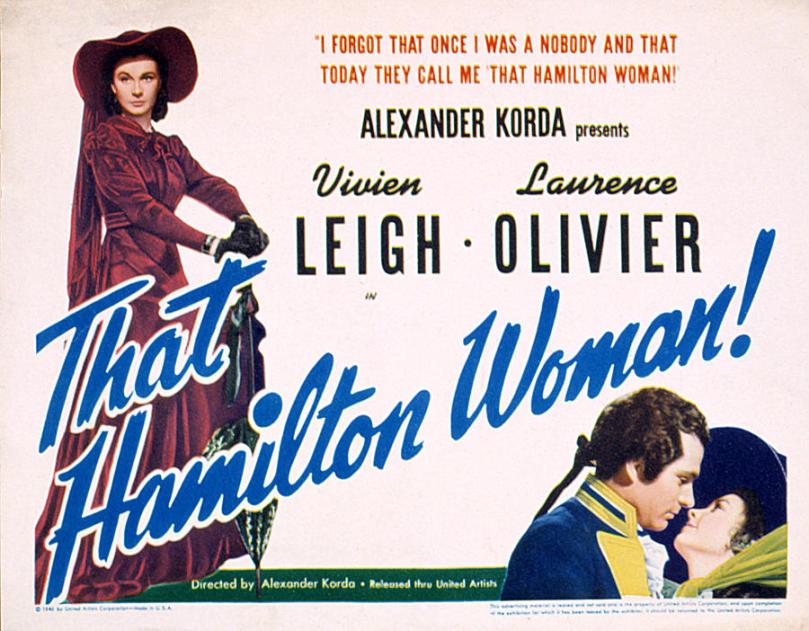
It was 1940, Britain was in peril. Hoping to enlist the Americans in the fight against Hitler, producer/director Alexander Korda hatched the idea for this film. Cables went back and forth between London and Hollywood (where the soon-to-be Mr. and Mrs. Olivier were living temporarily, awaiting the finalization of their respective divorces). Korda had both actors under contract; he offered them bonuses, as well as the opportunity to recoup some of the money lost after their failed stage production of Romeo and Juliet. The production had to be done quickly- five weeks. Churchill would later say that it was his favorite movie.
So, your nephew sent me to you with his paintings and the bric-à-brac because he’s broke! -Emma exclaims to Sir William Hamilton
A housemaid turned wannabe fiance to one British gentleman, Emma Hart (Leigh), is suddenly shipped off to Sir William Hamilton (Alan Mowbray). He is a middle-aged widower, even-tempered, and a collector of great works of art. Sir William admires beauty. As he wishes, Emma learns languages, singing, dancing, etc. Her doting mother, Mrs. Cardogan-Lyon (Sara Allgood), is her loyal companion through it all. In time, Sir William marries Emma (making an honest woman out of her); they live in a palatial seaside home in Naples, since he is Ambassador to Italy. Though she could not be presented at court in England, the clever/vivacious Emma becomes a close confidante of the Queen of Naples.
Nelson (Olivier) and Emma (Leigh) meet for the first time
One day, a British battleship arrives in Naples, and Cmdr. Horatio Nelson (Olivier) meets with Sir William re: docking and affairs of state. Emma bursts in on them, worried about a party she is planning. Her husband doesn’t mind, BUT Nelson insists on speaking to the ambassador in private. Emma starts to wonder if her life of is frivolous.
Emma (Leigh) and Nelson (Olivier) at the opera
They told us of your victories but not of the price you paid! -Emma exclaims to Nelson (after seeing his wounds)
Five years later, Emma meets Nelson (now a lord, thanks to his MANY victories in the Napoleonic Wars) again. She is glad to see him alive, BUT also shocked by the fact that he has lost the sight in one eye and an arm. Emma wants to help, she tells Nelson, and uses her influence w/ the queen to get more troops for the war. They talk, plan, attend plays, and become close friends. Rumors start to spread…
[1] …when it comes to the cinema, her acting technique on screen is every bit as expert as Laurence Olivier’s. (In fact, Olivier himself admitted this when he saw her as Scarlett O’Hara.)
[2] Vivien Leigh and Laurence Olivier make a terrific pair and of course have great chemistry together, which really complements this true story. The actors give great performances, and I think the film really tries hard not judge the actions of Lady Hamilton and Lord Nelson which caused a tremendous scandal in their own time. Anyone who likes historical drama and wants to escape into another world for a few hours is bound to enjoy.
[3] Although the film was made by Hollywood, it is British to its core and fiercely patriotic. It was intended as an anti-Nazi propaganda piece… The Nazi allegory is most clearly seen in the scene when Sir William explains to his wife that the British Empire is periodically attacked by military adventurers, in Nelson’s line “We are alone but unafraid” and his speech denouncing the idea of negotiating with dictators… I imagine that it was quite a stirring film for the Britons of the day.









 Knightleyemma