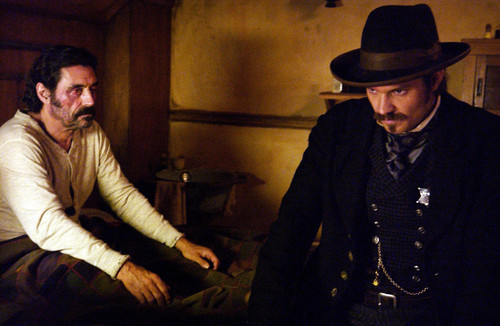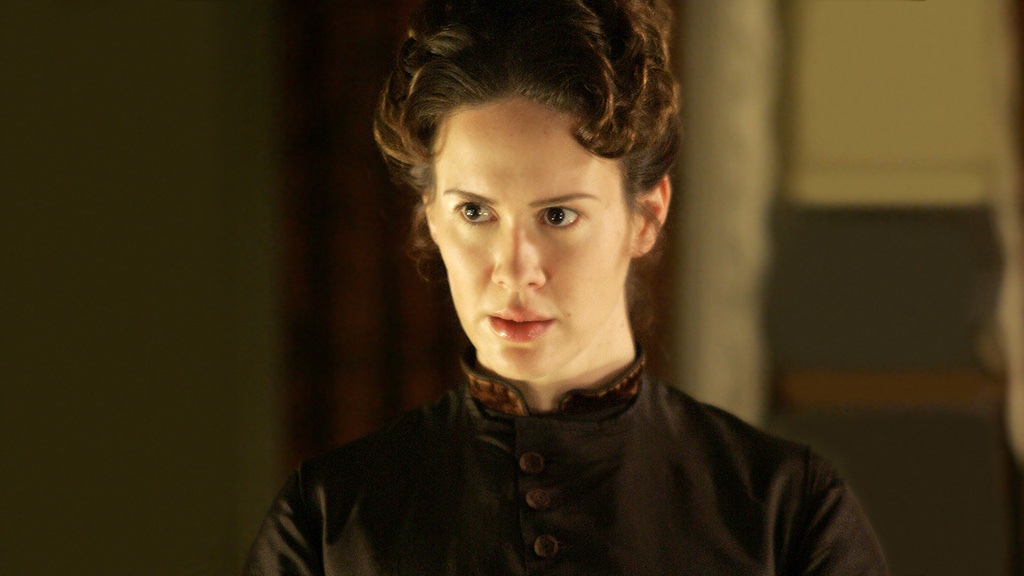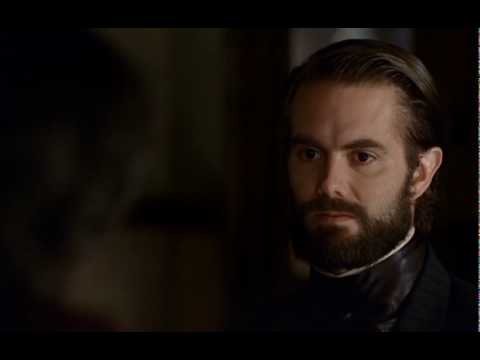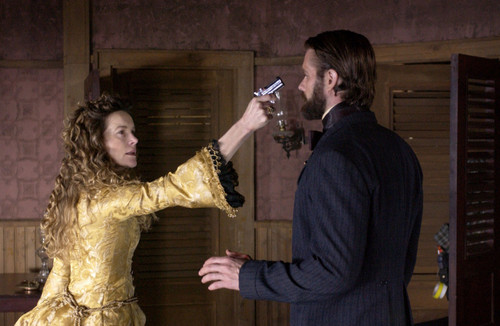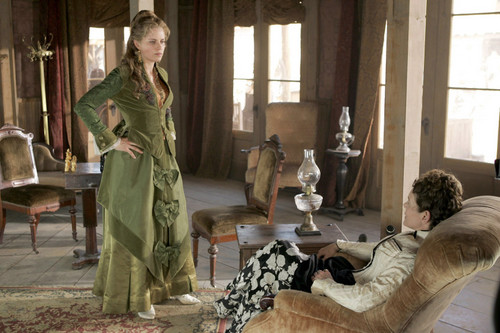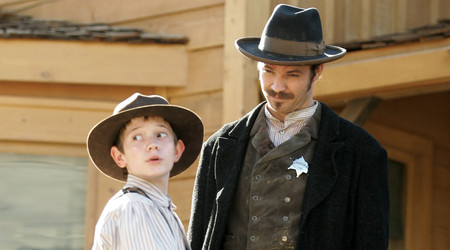
Al Swearengen (Ian McShane) faces off against Sheriff Seth Bullock (Timothy Olyphant).
After a LONG time (almost a year), I’ve returned to Deadwood! FYI: It’s available on Amazon Prime. The big issue- Al (Ian McShane) knows re: Alma Garret (Molly Parker) and Sheriff Seth Bullock (Timothy Olyphant) hooking up on the regular (as the kids say), and insults him about it. Maybe in Al’s mind, a man of the law should NOT be in an illicit relationship? Or maybe he just wants a fight? Being the stubborn man that he is, Bullock can’t let that slide.
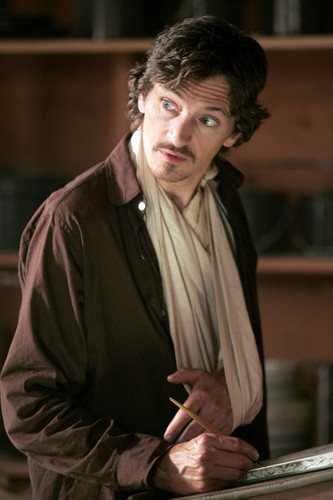
Theses two town titans get into a VERY nasty fight inside The Gem which eventually flows out onto the street. Instead of shooting Bullock, Al hits Bullock’s bestie/business partner, Sol Stark (John Hawkes), in the shoulder. Trixie (Paula Malcolmson) is horrified and rushes to Sol’s side, which I REALLY liked. YAY for potential romance (hey, w/ a show like this, you take the little scraps of positive emotions when you can)!
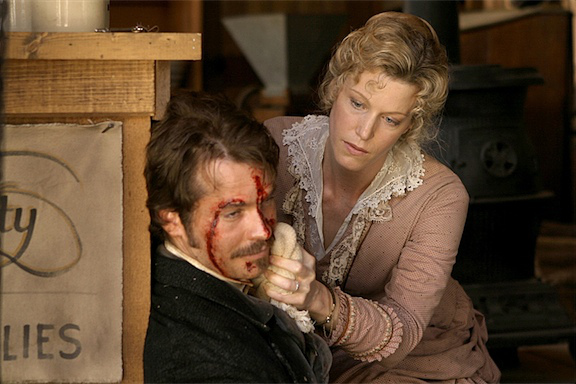
After the big fight, Martha (Anna Gunn) sees to Bullock’s injuries.
We see (once again) that Al is NOT 100% evil; after he saw young William (Bullock’s nephew-turned-adopted-son), he didn’t kill Bullock. Al takes his badge and gun though. I was a BIT surprised to see how calm/collected William’s mom, Martha (Anna Gunn), was during the rowdy tussle. Hmmm… there MUST be more to her than meets the eye! Martha (widow of Seth’s older brother) and William look like they are straight out of central casting (cleanly dressed, well-behaved, and polite).
HOW awkward was that scene where Alma (escorted by trusty Ellsworth) went to see re: Bullock’s injuries, and also check out Martha!? Ahhh yes, love makes fools of us all, even a financially-independent/beautiful/cultured widow! I just hope that Alma does NOT go back to laudanum IF things get rough.
Maddie (Alice Krieg)
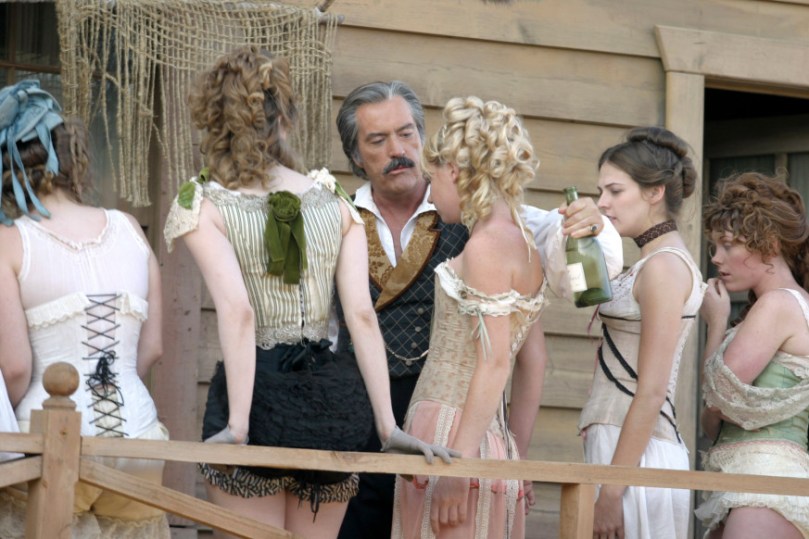
There’s a new madam in town- Maddie (Alice Krieg); she comes from back East w/ a few new girls (prostitutes). Krieg (who hails from South Africa) is BEST known as the Borg Queen in the Star Trek: The Next Generation universe. Her flawless pale skin, intense eyes, and mysterious face seem like an odd fit for Deadwood, BUT I can’t wait to see what her character will get up to in the future!
Cy bitterly celebrates Joanie’s new place w/ his girls at the Bella Union.
Cy Tolliver (Powers Boothe) is VERY shocked/angered when he learns that Joanie (Kim Dickey) is going into business w/ Maddie at the new whorehouse (Chez Ami). Joanie has been w/ Cy since she was 14 y.o. and I think that he REALLY loves her (in his way, of course). I was a BIT concerned for Joanie when she confronted Cy though!
Joanie (Kim Dickey) inspects Chez Amis.
Bullock gets his badge and gun back. Surprise- Al returns the items w/o a fight! Bullock also makes his choice re: his personal life. He won’t run away w/ Alma, BUT will live in the new house he had built for his family. They need a man’s protection, after all. But what kind of marraige will this be (they have a bundle bed)?
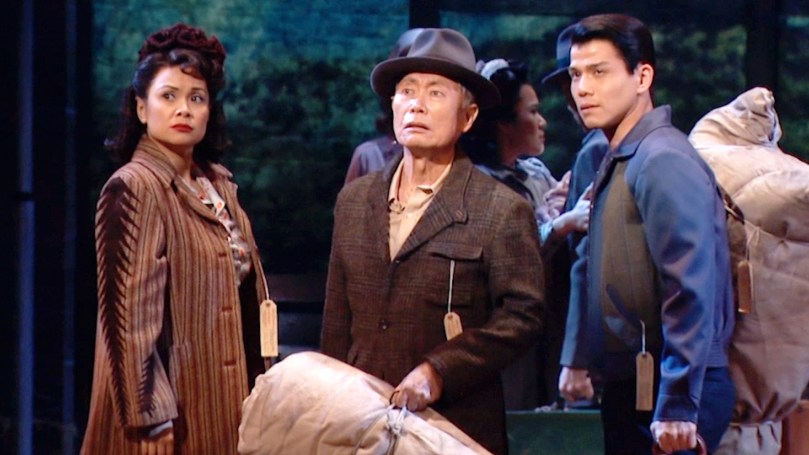
Kei, Grandpa, & Sammy arrive at the Heart Mountain internment camp
Those who cannot remember the past are condemned to repeat it. -George Santayana (1905), philosopher/writer
Allegiance ran on Broadway for 3 mos. during the Winter of 2015/2016, and was seen by 120,000 (which was the same number of Japanese-Americans rounded up and put in internment camps during WWII). The story is partly based on George Takei’s real life experience as a young child raised for 4 yrs in an Arkansas internment camp. Each night of its Broadway run, the veteran actor/activist/social media star, reserved a seat for (then presidential candidate) Donald Trump. Of course, Trump NEVER came to see the show!
The Kimura family at the dinner table.
This musical drama centers on the Kimuras, who are a close-knit farming family, yet individuals in their own right (who grow and change over the course of the play). They are sent to the Heart Mountain, Wyoming camp, which is the main setting of this story. There are armed men guarding them 24/7, a curfew is in effect at night, and the living conditions are VERY poor.
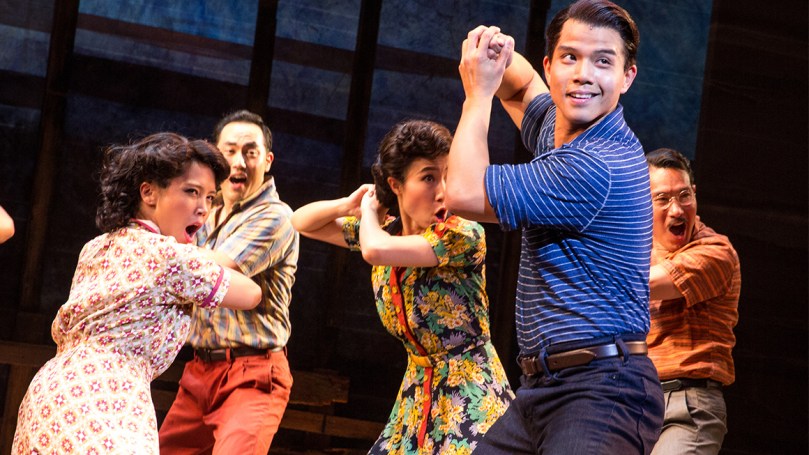
Sammy encourages the young people to think of ways to have fun in “Get in the Game.”
Sammy (Telly Leung, who has been chosen as the lead in Alladin) desperately wants to enlist in the army and show his allegiance to the U.S. His father says that this can never be, since they “have the face of the enemy.” BOTH men are quite stubborn! Sammy’s older sister, Kei (short for Keiko), serves as a mother-figure for him also. Kei (Lea Salonga, veteran actor/singer best known as Eponine in the original Les Mis) worries about Sammy’s future and takes care of Grandpa (Takei), who is missing his garden back home.
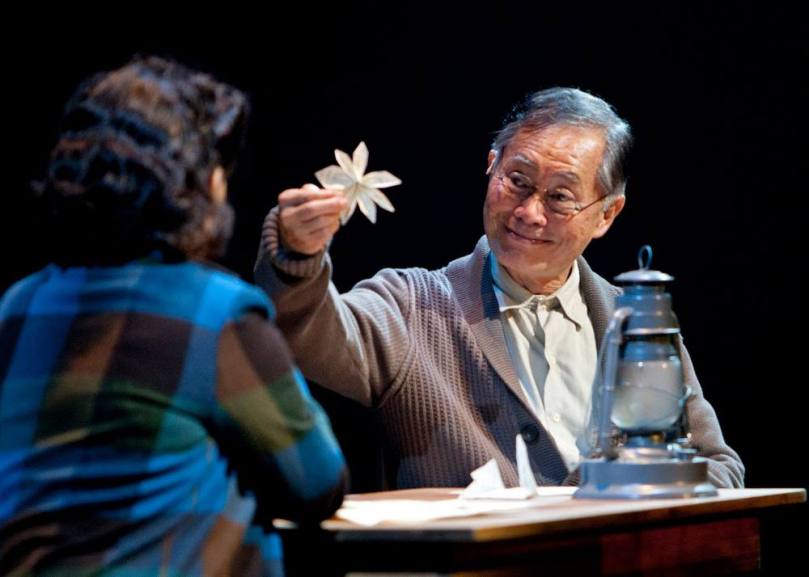
Grandpa creates an origami flower from the offensive loyalty questionnaire.
…after graduating from college, studying Asian American history, knowing about the civil rights era now– in a post-Vietnam War era– I think I would have done what Frankie did: You want me to fight as an American? Then treat me like an American! -Michael K. Lee
Kei (though she considers herself an “old maid”) forms a connection w/ Frankie Suzuki (Michael K. Lee), a law student from LA. Since he’s a bachelor, Frankie has to share a cabin w/ 10 other men. His dark humor and sly wit are revealed in the rousing big band number Paradise. Frankie’s allegiance is to the Constitution; this character is based on (real life) activist Frank Emi. I was quite impressed w/ this character; he seemed VERY fresh and modern!
Sammy and Hannah joke and about their budding (forbidden) relationship.
Sammy and Hannah (a blonde, young Army nurse from Nebraska) become close while trying to get more medicine and supplies for the camp. They have a sweet duet (With You) which expresses their love, which is NOT safe to express. The lyrics are simple, yet poignant; below is a sample.
If I were with you, no one else could see us this way. -Sammy imagines
If I were with you, we would fight the world every day. -Hannah replies
Sammy (center) with some of the men of the 442nd Combat Regiment
What can be done to end this imprisonment? Mike Masaoka (Greg Watanabe) of the Japanese Americans Citizens League (JACL) has been petitioning Congress to get his people freed. Perhaps in desperation, he proposes a loyalty test (“to root out the troublemakers”). Also, the able-bodied men MUST enlist (in a segregated unit, like the African-Americans) and take on the deadliest missions. (Masaoka was an actual person during this period in history.) Watanabe had older relatives in internment camps, as he noted in one of the behind-the-scenes interviews. I wanted to know MORE about this character!
Women weren’t just sitting around while the men faced danger. Kei and the camp’s women write letters to major newspapers and magazines to let the public know what’s going on. Kei goes after what she wants and becomes a stronger woman, as we see in Higher- a pivotal song for her character and showcasing Salonga’s powerful vocals.
A banner ad featuring Sammy, Hannah, and a quote from the Washington Post review
In SOME ways, this play is quite traditional for Broadway- love stories, generational conflicts, song and dance. In other ways, it is groundbreaking- a cast of mainly Asian-Americans (incl. those of Chinese, Japanese, Filipino, and Korean ancestry); a Japanese-Canadian director (who had relatives in similar camps in Canada); a Chinese-American co-writer; a female orchestra leader, etc. In this current political climate, this story is a cautionary tale, NOT merely entertainment. Should we prove our worth by standing by our country, no matter what (like Sammy)? Or should we resist the unfair laws being proposed, even risking prison (like Frankie)?
NOTE: This review contains MILD SPOILERS for the film.
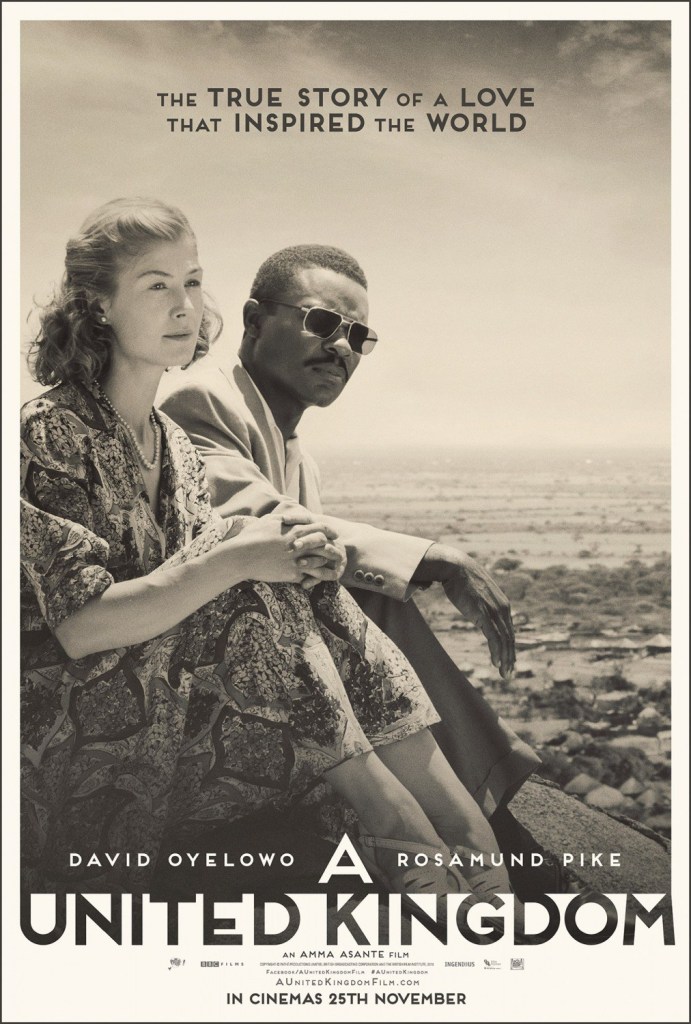
A poster for the film.
The personal IS political in this (based on a true story) film now playing widely in the US. I went to a screening last MON night (thanks to free passes via a movie Meetup). The director is Amma Asante; she previously made a big splash w/ Belle. This film has some of the same themes, BUT is set on a much broader/grander stage. The setting is 1947 in London, a place and time when interracial relationships were legal, yet NOT widely viewed positively. You’ll see old-school racism in some scenes, which could be uncomfortable for a modern audience.
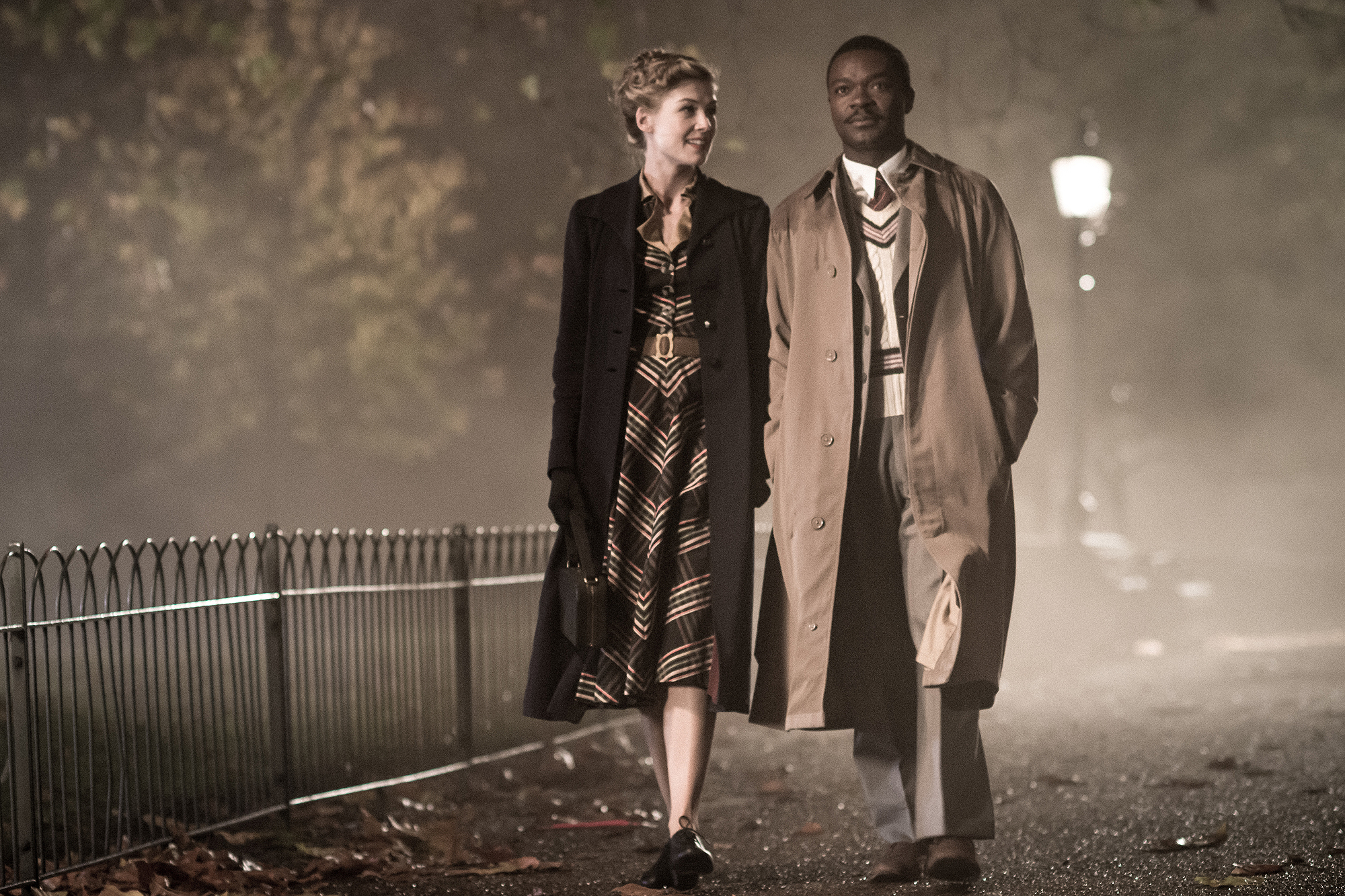
Ruth (Rosamund Pike) and Seretse (David Oyelowo) walk and talk the night away in foggy London.
Seretse Khama (Oyelowo), the crown prince of Bechunaland (modern-day Botswana), has recently finished his law studies at Oxford. He is articulate, cultured, and a good boxer (which comes in handy in one scene). One night, Seretse meets Ruth Williams (Rosamund Pike), a clerk for an insurance company. She wasn’t expecting to meet anyone special when she tagged along w/ her little sister, Muriel (Laura Carmichael- Lady Edith in Downton Abbey), to a dance at a missionary hall. Ruth is a former WAAF ambulance driver and has a curious mind. They bond first over their idealistic views and love of jazz.
Ruth and Seretse after their civil (city hall) wedding.
No man is free who is not master of himself. –Seretse Khama says to his tribe (when he returns home from England)
At that time, Bechunaland (a small, peaceful, yet poor nation) was a protectorate of England. The British government (incl. its reps, like Alistair Canning, played by Jack Davenport) was against the union of the Khamas, which went against the wishes of Seretse’s uncle (the prince regent) and South Africa (which had recently put apartheid into law). Seretse and his African friends consider apartheid as a “disease” which should NOT be allowed to spread.
Alistair Canning (Jack Davenport) and his wife (Jessica Oyelowe, real-life wife of David).
There is exposition woven into the film; that can be clunky, BUT is needed to give the audience pertinent info. Anton Lesser’s Labour Party minister does a GREAT job w/ it in his (brief) scene, thanks to his deft way of conveying the words. I wanted to see a BIT more of the British minor characters, such as the journalist (Mr. Nash) and the liberal Labour Party members. As for the African actors, the woman playing Seretse’s sister did an especially good job.
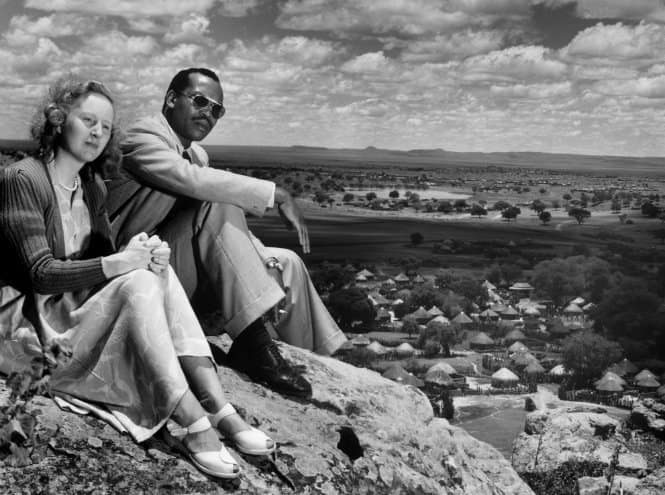
A picture of the real Seretse and Ruth Khama in what is now modern-day Botswana.
As with Belle, the film is beautiful to look at visually. In the first section of the film (set-up/courtship), we see fog, clouds, and less saturation (b/c of the filter used). This is quite different from what we see when we go to Africa; the colors are much more vibrant and the sun (of course) shines brightly.
In my mind, this is NOT only a story of love, BUT one of commitment, which is becoming more and more rare in today’s world (no matter what race/national origin of a couple). In Seretse’s life, his marriage w/ Ruth was what propelled him into a fight with the British government, securing mineral rights for his people, and eventually- forming a democracy. Wow, this is SO much cooler than what went down w/ Edward and Wallis Simpson, right?
This is a crowd-pleasing Hollywood movie (which I saw w/ my mom 2 wks ago), BUT about a subject we’ve NEVER heard about- three professional African-American (then referred to as “Negro”) women at NASA in the ’60s. ALL the ladies give strong performances here; they have strong chemistry that makes their long-time friendship seem real. At the center is Katherine Coleman (Taraji P. Henson of Empire)- a former child prodigy, widow, mom of 3 young daughters, and mathematician. Her mind works fast, BUT working w/ the team of engineers (under Al Harrison- Kevin Costner in a low-key performance) prepping for the first manned rocket launch IS a challenge. Katherine grows in her job, gaining confidence and respect (even from racist senior engineer Paul Stafford- Jim Parsons of The Big Bang Theory).
Katherine works out the math for a future rocket launch.
In some ways, the film is traditional, esp. how the problems are wrapped up quite nicely. We get the feeling that MAYBE Mary Jackson’s (Janelle Monae) hubby, Levi (Aldis Hodge- star of Underground), is NOT all in for his wife working such long hours and becoming an engineer. However, there are moments where you want to cheer, b/c these ladies are succeeding w/ SO much stacked against them (in a segregated South- Langley, VA). Even going to the bathroom is a hassle, since the “colored” restroom is located on the other side of the large campus!
Katherine surrounded by her coworkers (all white and male) engineers.
This story would NOT have been told w/o the 2014 book upon which it’s based by Margot Lee Shetterly. She is the daughter of a NASA engineer (her dad); she also grew up in the same town as these “human computers.” As a youngster, Shetterley knew these ladies as neighbors and fellow churchgoers. Yes, we are in the time before IBM was a household name, though eventually Dorothy Vaughn (Octavia Spencer) learns FORTRAN to program the new computer.
Col. John Glenn (Glen Powell) meets Katherine Johnson.
Don’t worry, you don’t have to be a math/science/history nerd to LOVE this film. (I personally liked the historical elements, esp. the clothes and cars.) One of my fave elements was the slow burn romance between Katherine and a National Guardsman, Major Jim Johnson (Mahershala Ali- also in Moonlight). “It’s very rare to see a black man pursuing a black woman” (as was discussed on the JAN 25th Slate Culture Gabfest). Henson and Ali have great chemistry. The surprise proposal/family dinner scene had me in tears!
The “computers” gather around the TV to watch Col. Glenn’s historic launch.
Films like this are important, esp. today when certain world leaders are trying to close-up borders, restrict (legal) immigration, and creating unease (in anyone who isn’t straight/ white/Republican/ male). Why NOT take the example of astronaut John Glenn (Glen Powell) in this film? According to historians (and his contemporaries), Glenn was considered “ahead of his time” when it came to race relations. Though one of the white women supervisors tried to rush him inside, Glenn (who later became an Ohio senator) walked over to where the black computers were standing in the welcome line; they shook hands and chatted briefly. Without the combined work on dozens of black women, he would never have gone into space!
What would you like young audiences, esp. young black men, to get from this story? -Sunny Hostin (CNN)
That your history did not begin with slavery.-Malachi Kirby, actor
You may be asking- WHY do we need a retelling of this story? MANY in the US (and worldwide) already read the book and watched the 1977 series. But once you start watching, you realize how important it is that Roots reaches a new generation of viewers.Faith (NOT necessarily religion), family (incl. marriage- “jumping the broom”), and traditions (from Africa) become even MORE important under slavery.
Mark Wolper, son of David Wolper (who developed the 1977 miniseries) decided on the remake after his kids couldn’t sit still to watch it. The main issue- it was TOO slow! NOT only does this show have more action, it’s much more colorful, richly detailed (thanks to technology and knowledge filmmakers didn’t have 40 yrs. ago), and very watchable (thanks to veteran and newcomer actors, as well as skilled directors). I was esp. happy to see that LeVar Burton (who played the original Kunta Kinte when he was only 19 y.o.) was an executive producer on the series; he also has a brief cameo in Part 1. The music is one of the BEST elements, thanks to Ahmir “Questlove” Johnson, a member of The Roots.
Part 1
Kunta Kinte (Malachi Kirby) rides his horse through the woods in West Africa.
This is (undoubtedly) the strongest 2 hrs. of the 8 hr. series! Time is given for us to know re: the West African city of Jufuree (which was NOT a little village, BUT had a pop. of nearly 10,000). The sets are quite intricate and large-scale. There is the gorgeous turquoise dyed cloth that is worn by many people. Women use dark color on BOTH their lips and around their eyes. Tribal practices are blended w/ the religion of Islam (a fact which was jarring to SOME viewers, from reviews I read). Yes, people do use the term “Allah” and prostrate themselves to pray! About 30% of the African slaves brought to “the New World” were Muslims.
The Kinte Family in Jufuree
Kunta Kinte (British newcomer Malachi Kirby in a standout role), the son of Binte Kinte and Omoro Kinte, is a bright, observant teenager who is training to be a warrior (w/ his male peers). He also has a crush on a local girl, and she seems to like him, too. But his parents say that they’ll arrange a marriage for him (when the time comes). Kunta has great respect for his parents, tradition, religion, yet he ALSO possesses a strong will (which will BOTH help and hurt him later in life). We will see things more from his eyes in MANY cases (thanks to camera-work). If great acting is in the eyes, then Kirby is definitely one to watch in the future.
The next segment of the story which impressed me was The Middle Passage; a huge ship was built to accommodate actors, cameras, and crew! If you saw 12 Years a Slave, then you can handle this part (maybe a BIT better than more sensitive viewers). We get a glimpse of JUST how cramped, crowded, and downright horrific conditions were for the men (and some boys)!
A slave is not bought; a slave has to be created! -The overseer explains to Kunta
When we get to America, it’s Revolutionary War era, and Kunta is purchased by a surly/middle-aged planter from Virginia, John Waller (British actor James Purefoy). He has a British wife, Elizabeth, who has settled easily into the life under slavery, though their marriage doesn’t look happy. His more sensitive and younger brother, Dr. William Waller (British actor Matthew Goode), lives in a neighboring plantation and is also the local physician. But the worst of this lot is the red-headed (and bearded) Irish overseer who REALLY enjoys his work!
Fiddler (Forrest Whitaker) and Kunta/Toby (Malachi Kirby) on the Waller plantation
Kunta (who is named Toby by Elizabeth) DOES find an (at first hesitant) ally in Fiddler (American veteran actor Forrest Whitaker), who has special role in the Waller household (thanks to his musical talent) and is a favorite slave of the mistress. Whitaker does a GREAT job in his role (as you’d expect); he also gets some of the BEST lines in the entire series! In one esp. poignant scene, Fiddler stops in his tracks, recognizing a lullaby that Kunta sings. He swears that HIS grandmother sang that song, too.
Belle is a female slave who feels sympathy for Kunta. She convinces Dr. Waller to get Kunta to care for his horses and drive him around to patients. Belle looks after him when he’s near death, and they grow to love each other (over the span of 10 yrs.) Belle (though still youthful) has a painful past, BUT decides to marry Kunta and start a new life. They have a daughter, who Kunta names “Kizzie.” Now he is firmly rooted in America, yet still VERY much an African in his heart and mind.
Part 2
Never let them take your mind. -Kunta tells his daughter
Kizzie becomes a companion to the Waller’s daughter, who insists on teaching her to read. BUT (of course) this is the SAME reason that she is sold “down the river” when she reaches adolescence. Kizzie ends ups at a small farm in South Carolina owned by an alcoholic, violent gambler- Tom Lea (British actor Jonathan Rhys Myers). The first time, Kizzie fights w/ ALL her strength to stop her new master, BUT to no avail.In time, she has a son, who Tom names “George” (after his father). Kizzie, who gathers up the strength of Kunta, Belle, and her ancestors, decides that she’ll endure for her son to have a better life.
Part 3
Kunta’s daughter, Kizzie (Anika Noni Rose), worries for the future of her son on Tom Lea’s farm.
In some odd way, Tom seeks to be closer to his (unclaimed) young son, which causes Kizzie (American theater/TV actress Anika Noni Rose) great pain. Tom announces that the older slave, Mingo (who handles the cocks and goes to fights w/ him), will teach George. It turns out that Chicken George (as he is called) has a natural gift w/ these animals!
Chicken George (Rege-Jean Page)
Chicken George (British newcomer Rege-Jean Page) grows up and falls in love w/ Matilda, a slave from a neighboring plantation. Her father is a no-nonsense minister (on his day off), while Kizzie doesn’t believe in the Christian god. Chicken George keeps making money for Tom, gets respect for his talent/hard work from the local cockfighters (of all colors), and eventually marries Matilda.
You have no honor, Tom Lea! -Chicken George shouts to his master/father
In time, the gentlemen planters even warm to the Leas, though they are from low birth and Tom is of Irish heritage. Kizzie fears that things can go wrong at ANY moment, b/c of Tom’s volatile temper. There is an explosive scene between Chicken George and Tom, where we realize how low a master can go (even when the matter at hand is his OWN blood). BOTH Page and Rhys Meyers shine in this scene; however, these men are eclipsed by Rose, who is a standout in this series.
Part 4
There’s no wrong way to be a slave.-Chicken George explains to his son, Tom
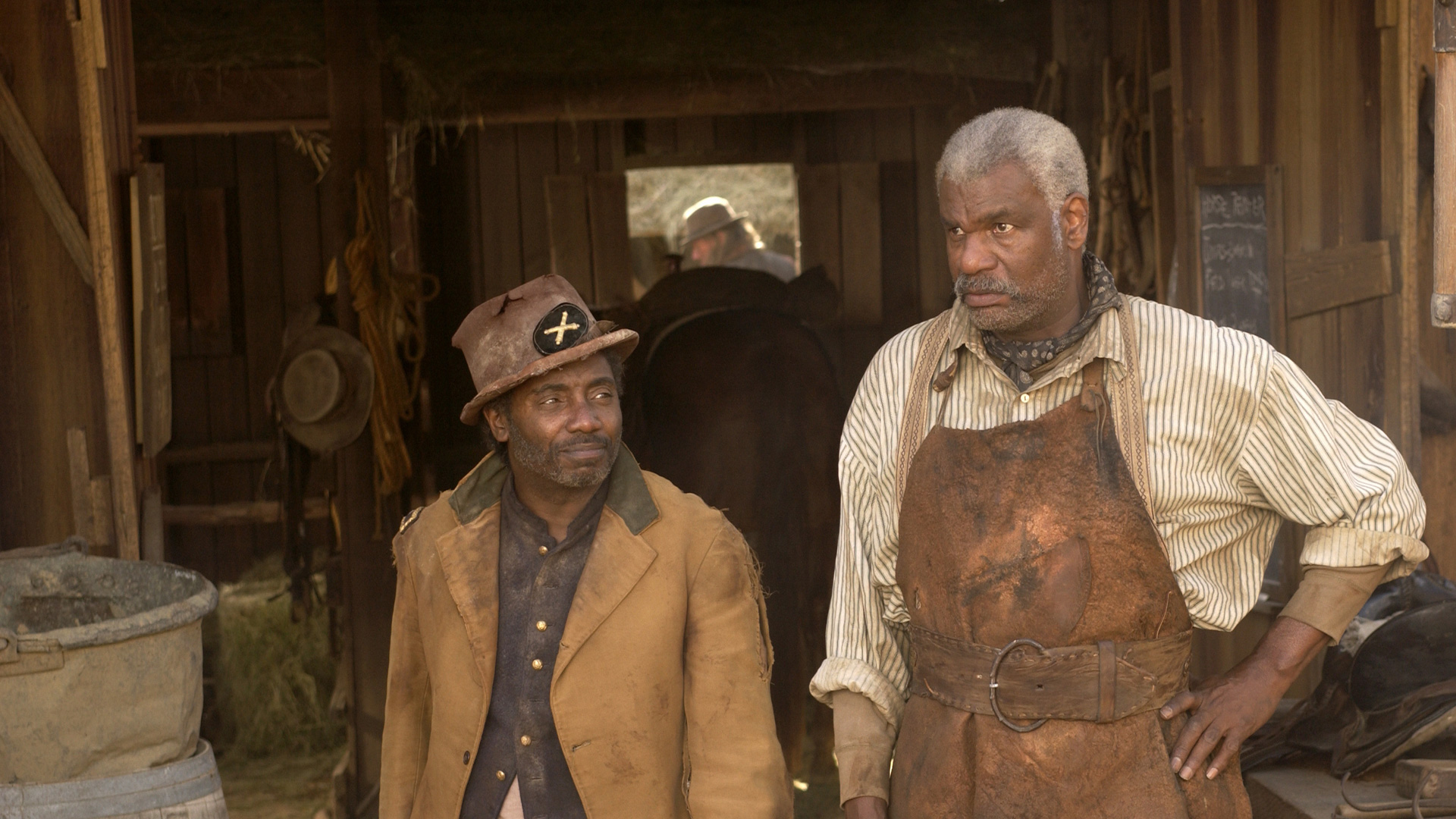
This is the weakest of the episodes, BUT does have some good moments. We see Chicken George join up w/ one of the “African” regiments of the Union army. One of his son’s, Tom, becomes a skilled blacksmith. Like his father, he earns money for his master, and raises a family w/ his part-Cherokee wife.
The free descendants of Kunta Kinte leave the Murray plantation in South Carolina to start their new lives.
Tom straddles that conflicting (yet exhilarating) time between slavery and Emancipation, working hard to keep his anger and resentment in check. The descendants of Kunta Kinte grow in number and take their place as free black Americans. There is a LOT more (which I haven’t discussed above)- check this show out for yourself!