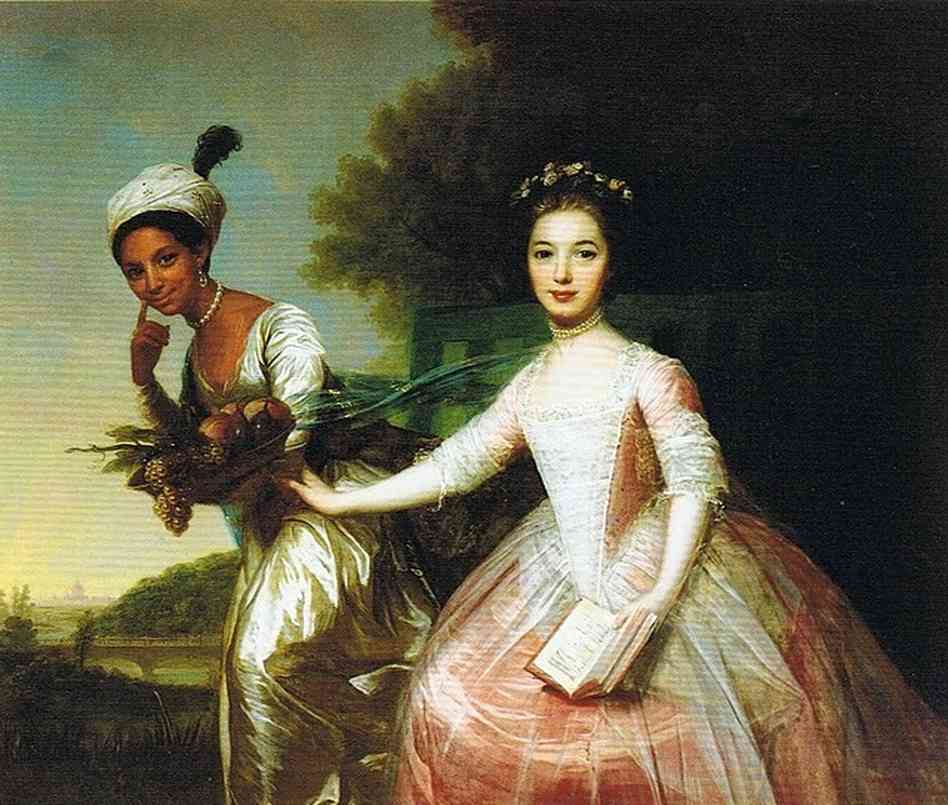
Portrait of Dido Elizabeth Belle and her cousin Lady Elizabeth Murray
This film, released early in 2014 in the US, is a must-see, especially for fans of historical dramas and Jane Austen! Issues of class privilege, marriage/property, and slavery arise. In the portrait (above), the viewer’s eye is drawn to Dido, who seems full of vivacity, while her cousin seems more proper/sedate.
The poster for the film
The poster itself intrigued many people walking through theater lobbies- a pretty biracial woman dressed in finery. The film was directed by Amma Asante, the daughter of Ghanian immigrants to England; she is also an actress and writer. The luminous lead actress is Gugu Mbatha Raw, the daughter of a black South African doctor and white British nurse. (FYI: That’s natural beauty- Gugu wore no makeup during filming, since there was none for Belle’s complexion.)
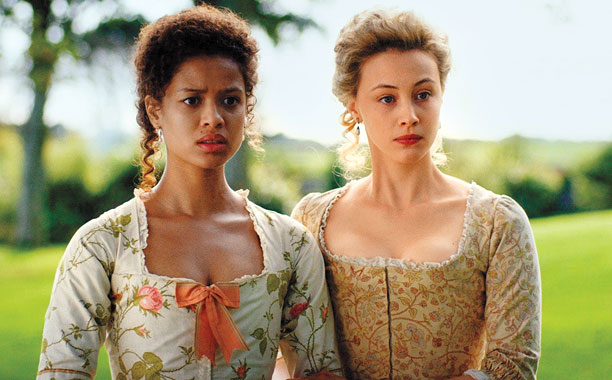
Belle & Elizabeth all grown up
The young Belle is brought by her naval officer father (Matthew Goode) to live in the household of his childless uncle, William Murray, the first earl of Mansfield (Tom Wilkinson, superb as ever) and his wife (Emily Watson, in a low-key role). All we know is that the child’s mother was an African slave found aboard a Spanish vessel. Already living on the vast country estate is another girl, Elizabeth Murray (newcomer Sarah Gadon), the daughter of another of Lord Mansfield’s nephews. The girls grow up together, like sisters, though Belle is of a different status (too high to dine with the servants, yet too low to dine w/ the family).
Lord Mansfield & Belle talk
Lord Mansfield is also Chief Justice of the Royal Court, and as in the film, the real Dido assisted her great-uncle w/ his daily correspondence. I especially enjoyed the debate/discussion scenes between these two!
Belle & John
The idealistic son of the local parson, John Davinier (newcomer Sam Reid, a solid performance) comes to study law with Lord Mansfield. He mentions an important court case involving slave cargo, and she wants to learn more.
This is a gorgeous film directed by Barry Levinson (Diner, Homicide, Liberty Heights, etc.) It’s a talent-laden (Armin Mueller-Stahl, Aiden Quinn, and a very young Elijah Wood play the male leads) drama set in ’50s Baltimore. The film explores 3 generations of a tightly-knit, middle-class, Jewish-American family. My dad really liked this story; it’s suitable for all ages!
Mississippi Masala (1999)
I tell all my desi friends (and anyone who likes good films) about this one! I first saw it as an undergrad. This small-budget/educational/realistic film was directed by Mira Nair; she also plays a small role as a catty auntie. The screenwriter, Nair’s close friend/collaborator Sooni Taraporevela, said the basis for the love story between Meena (Sarita Choudhury) and Demetrius (Denzel Washington) was partly inspired by a fellow Indian gal pal at Harvard who fell in love with a black (Jamaican) man. The dialogue is spot-on and the sweet romance between Meena and Demetrius is as hot as the setting (small towns of Mississippi). There is another kind of love in this story- Jay (veteran Indian actor Roshan Seth), Meena’s father/lawyer-turned-motel manager, desperately trying to get back property/citizenship in his native Uganda (scenes were filmed in Nair’s own Kampala house).
Sidenote: I saw Sarita at a staged play reading in NYC (back in 2006). Film does NOT do her justice; she’s stunning in real life!
My Family/Mi Familia (1995)
Unfair deportation, police aggression, gangs/crime, Catholicism, and the ties that bind families are explored in one of my all-time favorite films. I saw this first during my 12th grade American History class; later I saw it w/ my family (they all liked it a lot, too). It was directed superbly by a Californian of Mexican heritage, Gregory Nava (Selena, Frida). The music is an integral part of the story, as is the moral compass/strength of matriarch Maria Sanchez, who is played by Jennifer Lopez (younger) and Jenny Gago (older). The male leads are played by Jacob Vargas (Jose), Esai Morales (Chucho), and Jimmy Smits (Jimmy). Edward James Olmos plays the aspiring writer, also the narrator. Scott Bakula plays the husband of Toni (Constance Marie). The setting is primarily East L.A. (a long-established Latino neighborhood).
Nuovomundo/Golden Door (1996)
Don’t let the language (primarily Italian) deter you from this unique/educational film; it contains some magical realism. It was produced by the famed Martin Scorcese, himself a proud Italian-American. The (nearly unspoken) love story in the film is between kind-hearted Italian peasant Salvatore (Vincenzo Amato) and mysterious/redheaded Englishwoman Lucy (Charlotte Gainsbourg). Salvatore decides to sail to the U.S. so his family, which includes two teen sons and mother, can survive. Crops won’t grow on his land, and his brother is already settled in NYC. However, after their ship lands on Ellis Island, there are more tests/tribulations ahead!
Liberty Heights (1999)
Another of Levinson’s fine films- this time focusing on brothers who live in a Jewish-American enclave of ’50s Baltimore. The narrator, 17 y.o. Van (Ben Foster), and his college-going brother, Ben (Adrien Brody) are good kids trying to figure themselves out. You will relate to this film, especially if you are a 1st generation American, as the Kurtzman brothers navigate around heritage, parents, and wider racial issues of the ’50s. Van befriends Sylvia (Rebekah Johnson), the only black girl in his class. Ben makes new friends at a party and eventually falls for Dubbie (Carolyn Murphy), a gorgeous/troubled WASP. Yussel (David Krumholtz), Ben’s best pal/smart-aleck, provides a lot of the comedy. The parents in the film are portrayed by Joe Mantegna and Bebe Neuwirth.
The Namesake (2006)
This is the first film exploring two generations of an Indian-American family (Bengali in heritage); it is based on Jhumpa Lahiri’s novel and directed by Mira Nair. I saw it in 3 different theaters w/ different groups of family/friends (who all loved it). Gogol/Nikhil (Kal Penn) and his little sister, Sonia, grow up on Long Island, the children of successful/overprotective immigrant parents, professor Ashok (Irrfan Khan) and homemaker Ashima Ganguli (Tabu). Though the novel’s main focus was Gogol, Nair takes a deeper focus into the slow-burn love story between Ashok and Ashima (I enjoyed their scenes most). Irrfan Khan is amazing; too bad he decided not to come to Hollywood!