NOTE: This review contains MILD SPOILERS for the film.
The brutal and harrowing atrocities depicted are diluted by the affairs of the heart leaving the film unbalanced as it strives to be both an epic war drama and a tragic love story.
Terry George [the director] has aspirations of “Doctor Zhivago” but the end result is akin to an attempt at turning “Schindler’s List” into a romance film.
-Joseph Friar (FLIX!)
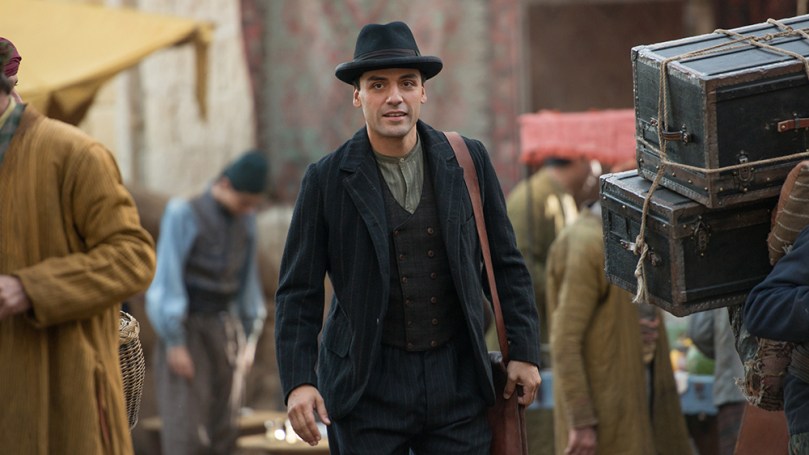
Mikael (Oscar Isaac) arrives in Constantinople, Turkey to begin his medical studies.
Mikael Boghosian (Oscar Isaac) is a small-town “apothecary” (like a modern-day pharmacist) w/ the dream of becoming a doctor. He becomes engaged to Maral (Angela Sarafyan)- a woman w/ wealth in his community. We see that he’s NOT in love with Maral, BUT he needs her dowry (400 gold coins) to finance med school. As their parents hope, maybe love will come later?
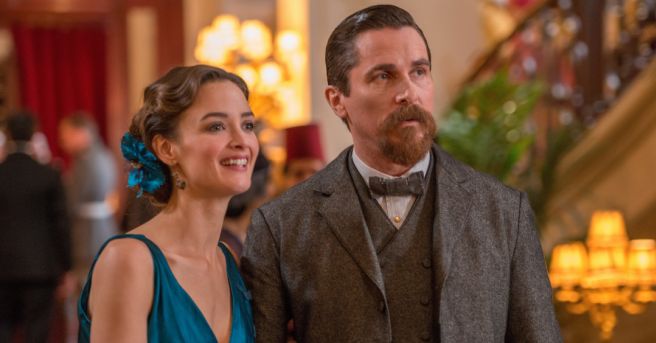
Ana (Charlotte Le Bon) and Chris (Christian Bale)
Once Mikael begins school in the big city (Constantinople) in 1914, he makes friends w/ Emre (Marwan Kenzari)- a jovial, world-traveling “party boy” who’d rather flirt than study. Emre’s father is a big shot (pasha), who’s NOT amused by his son’s behavior, which includes hanging w/ foreigners. Emre is a Turkish Muslim male who has privilege in this society.
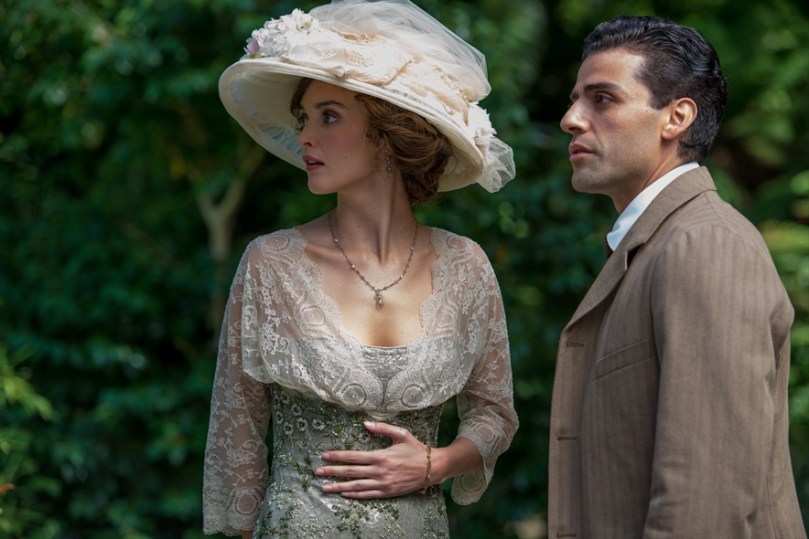
Ana (Le Bon) and Mikael (Isaac) at Emre’s birthday party.
In his uncle’s house, Mikael meets Ana Khesarian (Charlotte Le Bon), a beautiful dancer-turned-teacher to his cute young nieces. Ana is living w/ Chris Myers (Christian Bale), a famous/hard-drinking American reporter for the AP. She met him after the sudden death of her musician father in Paris. Ana has a French accent (b/c she grew up mainly in Paris), BUT also a an affinity for her people- the Armenians. While Chris is busy covering the growing tension between the Turks and Armenians, Ana and Mikael begin falling in love. After all, they’re of similar ages, personalities, and have a shared heritage. And also b/c Hollywood MUST put a love story in the middle of (almost) every movie!
Chris (Bale) takes photos of a nationalistic parade.
Isaac is one of my fave actors; NOT only does he have GREAT hair (hey, it’s true), he has the range to pull-off MANY different types of characters. With Mikael, he creates a wide-eyed, goodhearted, yet (quietly) passionate young man who yearns to know more and contribute to his corner of the world. Bale does a good job- he’s the privileged American (outsider) who is a witness to history. He sends the story out to the wider world. It was a nice surprise to see some strong (veteran) actors in the cast: Shohreh Agdashloo, James Cromwell, and Jean Reno.
Ana (Le Bon) and Chris (Bale) share a quiet moment.
The Promise looks and feels like a big budget film; there is some gorgeous cinematography. There are moments of intense sadness and acts of bravery (incl. by characters who DO NOT use guns), which take the film to the epic scale. I recommend the film, BUT it wasn’t as GREAT as I’d expected. Yes, it was emotional, BUT I wanted more backstory (history/politics) and characterization.
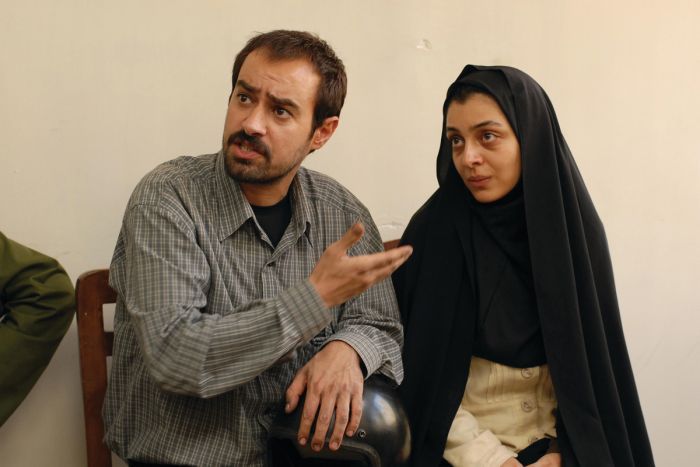
Actress Taraneh Alidoosti and director Asghar Farhadi
For years on both sides of the ocean, groups of hardliners have tried to present to their people unrealistic and fearful images of various nations and cultures in order to turn their differences into disagreements, their disagreements into enmities and their enmities into fears. Instilling fear in the people is an important tool used to justify extremist and fanatic behavior by narrow-minded individuals.
However, I believe that the similarities among the human beings on this earth and its various lands, and among its cultures and its faiths, far outweigh their differences.
-Excerpt from Iranian director Asghar Farhadi’s official statement re: not attending the 2017 Oscars (where this film has been nominated Best Foreign Language Film of the Year)
NOTE: This review contains SPOILERS for the film.
The film is openly an allegory about social, urban and marital decay. But way beyond it, it is about the costs of masculine pride. …this is a superb statement about the unbearable consequences of trying to live up to codes of honour that centre on the female body.
-Excerpt from IMDB review
Shahab Hosseini in A Separation
This is the new film from the famed/respected Iranian director who brought us A Separation. I went to see it two weeks ago (it was a sold-out screening) at AFI in Silver Spring, MD. This movie is NOT as interesting as A Separation (which also co-stars Shahab Hosseini), BUT it’s worth a look (esp. if you like naturalistic cinema). It would’ve been more effective if had been shorter; the running time is a BIT over 2 hrs. There is a much left unsaid (b/c of censors); the limits put on artists are referred to also in the play (A Death of A Salesman) w/in the film.
Raana (Taraneh Alidoosti) and Emad (Shahab Hosseini) in The Salesman
A married couple in Tehran, Emad (Hosseini- an engineer turned actor) and Raana (Taraneh Alidoosti), recently moved into a new apt (thanks to their older friend, Babak). They are irritated to discover that one room is locked b/c the previous tenant (“a woman who had many male visitors”) hasn’t come to get her stuff. Babak’s calls go unanswered by the former tenant, so Emad’s friends pry open the door and empty out her stuff. We learn that this woman (no one ever mentions the word “prostitute”) had a young son; his drawings are in one corner of the room.
Shahab Hosseini at the Cannes Film Festival
WHAT exactly happened to Raana the night she was mistaken for this prostitute and assaulted? It’s left up to the audience to decide, b/c we don’t hear SVU-style details. Hosseini (winner of the Best Actor award at Cannes Film Festival) is in almost every scene; he characterizes an Everyman who slowly breaks down. He can’t communicate well w/ Raana, get help from the law (she wants to forget about it), so gets obsessed w/ finding the attacker (revenge).
…words of truth are spoken not in the real life, but on a theater stage while playing roles.
-Excerpt from IMDB review
Now, this is NOT the type of man you’d expect to act irrationally, being a mild-mannered teacher at a boy’s high school (day job) and actor (in the theater after work). Raana is also acting alongside him and their friends. One of the actresses in the troupe is a divorced single mom w/ an adorable young son. Though Raana and Emad don’t have kids, they are good w/ this boy when they babysit him one evening.
Emad (Shahab Hosseini) gets his makeup done before the play.
How does Arthur Miller’s Death of a Salesman relate to their lives? Sorry, I can’t answer that, b/c I haven’t read/seen that play yet. Farhadi said in an interview that the play is VERY popular in Iran, where modern audiences have embraced it.
The last twenty minutes of film are really breathtaking and the spectators associate with Emad more than anytime and I think they regularly ask themselves “if I were him, what would I do?”
-Excerpt from IMDB review
If you’re looking for suspense and tension, then wait until the last quarter of this film. There are intense moments, for sure! By then, Emad is VERY on edge, and getting close to becoming the villain in his own story. Maybe he’s NOT that far from the domineering, volatile, working-class man he played in A Separation? Raana, who has been in a fog of depression, is shocked when she sees his behavior. We wonder: What will happen w/ their marriage?
What would you like young audiences, esp. young black men, to get from this story? -Sunny Hostin (CNN)
That your history did not begin with slavery.-Malachi Kirby, actor
You may be asking- WHY do we need a retelling of this story? MANY in the US (and worldwide) already read the book and watched the 1977 series. But once you start watching, you realize how important it is that Roots reaches a new generation of viewers.Faith (NOT necessarily religion), family (incl. marriage- “jumping the broom”), and traditions (from Africa) become even MORE important under slavery.
Mark Wolper, son of David Wolper (who developed the 1977 miniseries) decided on the remake after his kids couldn’t sit still to watch it. The main issue- it was TOO slow! NOT only does this show have more action, it’s much more colorful, richly detailed (thanks to technology and knowledge filmmakers didn’t have 40 yrs. ago), and very watchable (thanks to veteran and newcomer actors, as well as skilled directors). I was esp. happy to see that LeVar Burton (who played the original Kunta Kinte when he was only 19 y.o.) was an executive producer on the series; he also has a brief cameo in Part 1. The music is one of the BEST elements, thanks to Ahmir “Questlove” Johnson, a member of The Roots.
Part 1
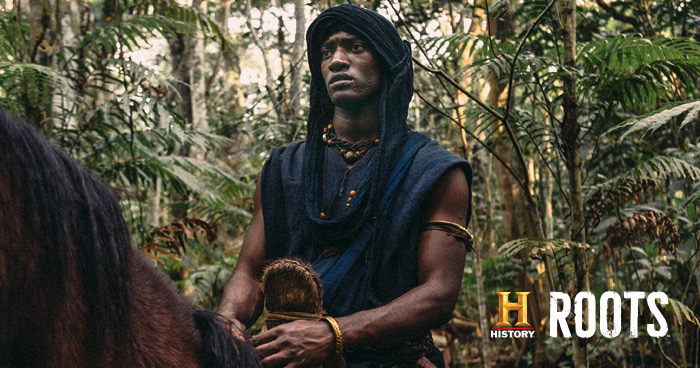
Kunta Kinte (Malachi Kirby) rides his horse through the woods in West Africa.
This is (undoubtedly) the strongest 2 hrs. of the 8 hr. series! Time is given for us to know re: the West African city of Jufuree (which was NOT a little village, BUT had a pop. of nearly 10,000). The sets are quite intricate and large-scale. There is the gorgeous turquoise dyed cloth that is worn by many people. Women use dark color on BOTH their lips and around their eyes. Tribal practices are blended w/ the religion of Islam (a fact which was jarring to SOME viewers, from reviews I read). Yes, people do use the term “Allah” and prostrate themselves to pray! About 30% of the African slaves brought to “the New World” were Muslims.
The Kinte Family in Jufuree
Kunta Kinte (British newcomer Malachi Kirby in a standout role), the son of Binte Kinte and Omoro Kinte, is a bright, observant teenager who is training to be a warrior (w/ his male peers). He also has a crush on a local girl, and she seems to like him, too. But his parents say that they’ll arrange a marriage for him (when the time comes). Kunta has great respect for his parents, tradition, religion, yet he ALSO possesses a strong will (which will BOTH help and hurt him later in life). We will see things more from his eyes in MANY cases (thanks to camera-work). If great acting is in the eyes, then Kirby is definitely one to watch in the future.
The next segment of the story which impressed me was The Middle Passage; a huge ship was built to accommodate actors, cameras, and crew! If you saw 12 Years a Slave, then you can handle this part (maybe a BIT better than more sensitive viewers). We get a glimpse of JUST how cramped, crowded, and downright horrific conditions were for the men (and some boys)!
A slave is not bought; a slave has to be created! -The overseer explains to Kunta
When we get to America, it’s Revolutionary War era, and Kunta is purchased by a surly/middle-aged planter from Virginia, John Waller (British actor James Purefoy). He has a British wife, Elizabeth, who has settled easily into the life under slavery, though their marriage doesn’t look happy. His more sensitive and younger brother, Dr. William Waller (British actor Matthew Goode), lives in a neighboring plantation and is also the local physician. But the worst of this lot is the red-headed (and bearded) Irish overseer who REALLY enjoys his work!
Fiddler (Forrest Whitaker) and Kunta/Toby (Malachi Kirby) on the Waller plantation
Kunta (who is named Toby by Elizabeth) DOES find an (at first hesitant) ally in Fiddler (American veteran actor Forrest Whitaker), who has special role in the Waller household (thanks to his musical talent) and is a favorite slave of the mistress. Whitaker does a GREAT job in his role (as you’d expect); he also gets some of the BEST lines in the entire series! In one esp. poignant scene, Fiddler stops in his tracks, recognizing a lullaby that Kunta sings. He swears that HIS grandmother sang that song, too.
Belle is a female slave who feels sympathy for Kunta. She convinces Dr. Waller to get Kunta to care for his horses and drive him around to patients. Belle looks after him when he’s near death, and they grow to love each other (over the span of 10 yrs.) Belle (though still youthful) has a painful past, BUT decides to marry Kunta and start a new life. They have a daughter, who Kunta names “Kizzie.” Now he is firmly rooted in America, yet still VERY much an African in his heart and mind.
Part 2
Never let them take your mind. -Kunta tells his daughter
Kizzie becomes a companion to the Waller’s daughter, who insists on teaching her to read. BUT (of course) this is the SAME reason that she is sold “down the river” when she reaches adolescence. Kizzie ends ups at a small farm in South Carolina owned by an alcoholic, violent gambler- Tom Lea (British actor Jonathan Rhys Myers). The first time, Kizzie fights w/ ALL her strength to stop her new master, BUT to no avail.In time, she has a son, who Tom names “George” (after his father). Kizzie, who gathers up the strength of Kunta, Belle, and her ancestors, decides that she’ll endure for her son to have a better life.
Part 3
Kunta’s daughter, Kizzie (Anika Noni Rose), worries for the future of her son on Tom Lea’s farm.
In some odd way, Tom seeks to be closer to his (unclaimed) young son, which causes Kizzie (American theater/TV actress Anika Noni Rose) great pain. Tom announces that the older slave, Mingo (who handles the cocks and goes to fights w/ him), will teach George. It turns out that Chicken George (as he is called) has a natural gift w/ these animals!
Chicken George (Rege-Jean Page)
Chicken George (British newcomer Rege-Jean Page) grows up and falls in love w/ Matilda, a slave from a neighboring plantation. Her father is a no-nonsense minister (on his day off), while Kizzie doesn’t believe in the Christian god. Chicken George keeps making money for Tom, gets respect for his talent/hard work from the local cockfighters (of all colors), and eventually marries Matilda.
You have no honor, Tom Lea! -Chicken George shouts to his master/father
In time, the gentlemen planters even warm to the Leas, though they are from low birth and Tom is of Irish heritage. Kizzie fears that things can go wrong at ANY moment, b/c of Tom’s volatile temper. There is an explosive scene between Chicken George and Tom, where we realize how low a master can go (even when the matter at hand is his OWN blood). BOTH Page and Rhys Meyers shine in this scene; however, these men are eclipsed by Rose, who is a standout in this series.
Part 4
There’s no wrong way to be a slave.-Chicken George explains to his son, Tom
This is the weakest of the episodes, BUT does have some good moments. We see Chicken George join up w/ one of the “African” regiments of the Union army. One of his son’s, Tom, becomes a skilled blacksmith. Like his father, he earns money for his master, and raises a family w/ his part-Cherokee wife.
The free descendants of Kunta Kinte leave the Murray plantation in South Carolina to start their new lives.
Tom straddles that conflicting (yet exhilarating) time between slavery and Emancipation, working hard to keep his anger and resentment in check. The descendants of Kunta Kinte grow in number and take their place as free black Americans. There is a LOT more (which I haven’t discussed above)- check this show out for yourself!
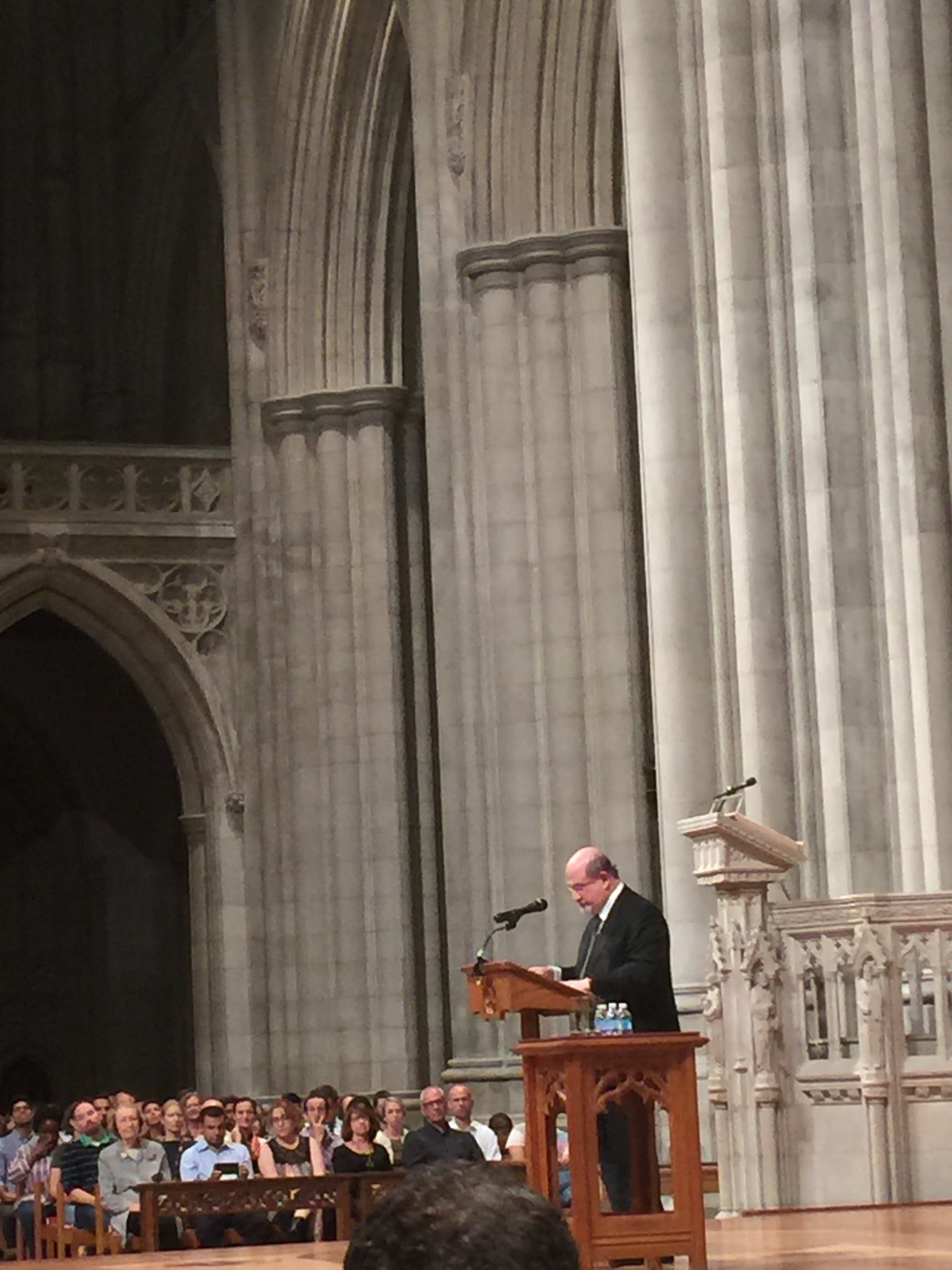
Salman Rushdie continues to be a controversial figure, but in today’s world, I feel that voices like his (British, Indian, and atheist) need to be heard MORE than ever! Depending on your age, you may know Rushdie from the fatwa (which was placed on him by Ayatollah Khomeini of Iran), his cameo on Bridget Jones’ Diary, or his short-lived marriage to Padma Lakhshmi (of Top Chef fame). Or maybe you have a FEW of his books (BUT are intimidated to read)? A few years ago, a book club I organized both read Haroun and the Sea of Stories, which is Rushdie’s YA book.
*NOTE: Special thanks to my friend Lana for above photo and taking notes.
The Beginning of Rushdie’s Life as a Writer:
He realized that he would never write a good book until he knew who he was (not English, but Indian).
He was part of first generation of free Indian Children.
His father told bedtime stories (oral tradition strong in his family)- animal stories; tales of heroes. His mother told local tales: gossip, scandal, secrets (when he included in stories, she said he “got in trouble”). One of his academic grandfathers took him to university library, where he discovered Agatha Christie. His other grandfather was a very religious man (prayed 5X/day, fasted, etc.) He was also open to any/all ideas; Rushdie admitted that he didn’t believe in God (age 10).
Read comics from early age. He was lucky to have a lending library/bookstore nearby where he got into Perry Mason mysteries, Alice in Wonderland.
The Wizard of Oz (film) inspired him to write his first story at age 10.
His family had a tradition of kissing books and bread to apologize to it and place someplace where wouldn’t happen again (food for mind; food for the body).
Left Bombay 1961 for English boarding school at age 13 (his idea, not his parents’). Maybe he had an”unnoticed love of adventure” b/c was quiet as a child?
Got into Cambridge, but didn’t want to go b/ c of racism faced at boarding school earlier. He went and enjoyed it a lot; studied history; wrote for student newspaper. He also got into Borges and Joyce at this time, and learned about incident of satanic verses (in his last semester).
His parents moved to Karachi, Pakistan; this was not an appealing place for him. His father initially disapproved, but then supported his return to England after he graduated from Cambridge.
Wrote TV commercials and scripts in London for an ad agency (where he worked part-time). In the early 1970s, he wrote and published, but these works were not successful because he hadn’t known himself enough. He decided to understand what he was doing wrong and traveled to India, which entered state of emergency (1977).
Midnight’s Children: Started in 3rd person, but then told from Salim’s voice and it was better (voice not my own, but gave me voice). Kept working in advertising again to pay bills. This book took 5 years to write it because was learning how to write. He also needed to blend news with fiction.
Quotes:
Geography is key [to a person’s writing]. Writers (like Faulkner): Have roots/history and can mine the earth for a lifetime of stories.
Work we do about the past, changes the future.
As we discover, we remember, as we remember, we discover.
Stories are not true- but can make you know truths that truths cannot tell.
Can’t write until you hear people speak, because can’t tell their story if you don’t hear their voice.
I think the greatest gift my family gave me was freethinking.
[On his trip to India when writing Midnight’s Children]: From childhood, dig out memories from attics of mind. Healing of rift within myself that separated me from my past… drank deeply from well of India.
Write what you know, but only if what you know is interesting.






 Knightleyemma