Ayad discusses Disgraced (on Broadway), Aasif Mandvi, etc. w/ NYC theater critics. This convo goes from the 2:00 min mark until 17:10.
This is a lengthy, yet V interesting vid! Ayad is in convo w/ a Lebanese writer (Rabih Almeddine- never heard of him before) while Indian writer (Amitava Kumar) serves as moderator. There is a smart/funny Q&A section w/ interesting points made by BOTH the audience & writers!
Aasif played Amir in Disgraced at Lincoln Center Theater. Josh played Isaac on Broadway (opposite Hari Dhillon). These guys are ALL friends- pretty cool!
WARNING: This next 2 videos contain SPOILERS for Disgraced.
Another long, yet very recent, interview (January 14, 2016)- it includes the meaning of the title, which is explained by Abe, the young nephew of Amir (who has “legitimate historical anger,” as Akthar comments in the vid).
For 300 years, they’ve come to out part of the world, made- drawn new borders, taken our land, made us want to be like them, look like them, and marry their women. They disgraced us. They disgraced us. Then they pretend they don’t understand the rage we’ve got.
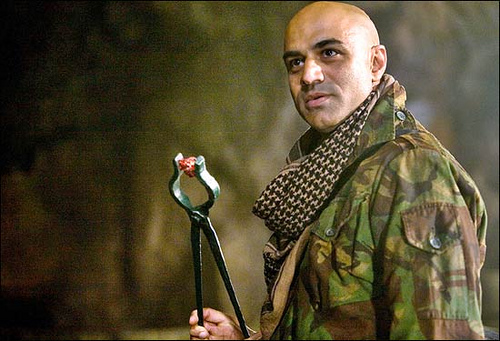
This is my favorite Shakespeare tragedy; I love it even MORE than Hamlet! In this production Othello will be played by a Pakistani-American actor- Faran Tahir. VERY exciting… I’m going to be seeing it SUN, FEB 28 (7:30PM).
Some of you will recognize him from the first Iron Man movie and the J.J. Abrams Star Trek reboot films.
I’m VERY excited to go see this play; one of my gal pals and I got tickets as part of a package! Actor-turned novelist and playwright, Ayad Akthar (who I blogged about before) won the 2013 Pulitzer Prize for this play, which was also his first.
This play is being produced in 40 different theaters in the 2015-2016 season- WOW! In some ways, it looks to be a simple domestic play, as it has only one set and five actors. The play is set in the Upper West Side Manhattan apartment of South Asian American corporate lawyer, Amir, and his artist wife, Emily. They hold a small dinner party w/ Amir’s work friend Johri, an African-American woman, and her secular Jewish husband, Isaac. As the night goes on, more and more alcohol is consumed, the conversation gets heated- the mood of the play turns serious. Amir, who seems to have totally separated himself from his Pakistani and Muslim identities, is revealed as a complex and troubled man.
I read this play less than 2 years ago, after seeing clips about the Lincoln Center production (which starred The Daily Show’s Aasif Mandvi). One of my acquaintances saw it when it premiered on Broadway; Hari Dhillon (an Indian-American of Sikh heritage) played the lead role. The PBS Newshour piece (see video below) features Dhillon and How I Met Your Mother actor Josh Radnor (who played Isaac).
Akthar said that he wrote this play “for the global Muslim audience” (many of whom will never see it, given restrictions on freedom of speech) and the “typical (mostly white) theatergoing audience here in the U.S.” Something important to keep in mind- the major influences for Disgraced were Othello and Death of A Salesman by Arthur Miller.
The Who & The What(Round House Theatre – Bethesda: MAY 25 -JUNE 16)
“The Who & the What” (the title of Zarina’s novel)… explores intergenerational and interfaith conflicts with fluid eloquence and intelligence. Mr. Akhtar writes dialogue that, while often funny and always natural, crackles with ideas and continually reveals undercurrents of tension that ratchet up the emotional stakes. -Charles Isherwood (NYT) re: 2014 Lincoln Center production
I read this play soon after Disgraced. It focuses on an upper-class Pakistani-American family in Atlanta, which includes the father, a widower and religious Muslim- Afzal (who runs successful donut shops) and his two daughters- complicated and intellectual Zarina and the more simple and beautiful Mahwish. Since his younger daughter is almost done w/ grad school and unofficially engaged to her (father-approved, Pakistani-American) beau, Afzal is eager to find a husband for Zarina, who is around 30 at the start of the story. (It may remind you a bit of The Taming of the Shrew.) Like MANY people, Afzal turns to an online platform for Muslim singles; he meets a smart and caring man who is a white convert. Eli, who grew up in Detroit with liberal parents and many Muslim friends, is the imam of a small and humble masjid. Zarina decides to give Eli a chance, but her main focus is a book on the life and times of Prophet Muhammad. The topic of this book is VERY controversial- it could jeopardize her closest relationships!
I first learned about playwright Rajiv Joseph (pictured above) from a brief theater piece on PBS. Though only in his early 40s, he has achieved much in his brief career, including being a finalist for the 2010 Pulitzer Prize.
Yes, that is comic genius Robin Williams (above w/ castmates)- he appeared a few years back as the tiger in Joseph’s critically-acclaimed play, Bengal Tiger at the Baghdad Zoo.
Mr. Joseph dramatizes a dark myth about its building that stands as a grim allegory of the supreme divide between the powerful and the powerless in 17th-century India and, perhaps by extension, many places today.
Babur’s lively imagination drives the conversation, as he fantasizes about elaborate flying machines and wonders about the provenance of the stars. “I think God wants us to learn more and more things,” he says.
-Charles Isherwood (NYT Review: June 11, 2015)
This play can be seen from FEB 1-28 at the Woolly Mammoth Theater in DC. It consists of only 2 characters, Humayun and Babur, lowly imperial guards in the city of Agra, India (referred to then as Hindustan). Their duty it is to stand in front of the building site of the Taj Mahal, facing away from it. Babur has the energy of an overgrown kid. He arrives late and keeps breaking the silence that the guards are supposed to maintain, to the disapproval of Humayun. Obeying the rules is something Humayun takes seriously. There are severe punishments for various levels of civil disobedience.
I saw an existential allegory about the struggle of incompatible universal impulses within human nature. –Comment from NYT reader
We will probably never know what was done to the artisans who built the Taj, but we do know, like those who slaved for years to build the Pyramids, the Taj artists have remained invisible. –Comment from another NYT reader
The Taj is a memorial tomb for Shah Jahan’s favorite wife, has been hidden by a wall during its 16 years of construction. The guards, longtime friends (who call each others “bhai,” meaning brother) are awaiting dawn, when the tomb will be unveiled to the public.
It’s Monday, so maybe you could use a laugh (or a dozen)? I just came across this comedian a few days ago (recommended videos on YouTube). Hope you enjoy!
I’m English 2.0:
British Citizenship Test:
Kokni/Cockney Muslims & Pilgrimage to Al-Aqsa Mosque:
The film was first announced in 2003. Sanjay Leela Bhansali initially wanted to cast Salman Khan and Aishwarya Rai Bachchan, but plans fell through when the real life couple had a messy, highly publicized breakup. Bhansali then kept Khan on and approached Kareena Kapoor to play Mastani and Rani Mukerji to play Kashibai, but shelved his plans and moved on to other projects. Over the following decade, several major actors were rumored to be linked to the project (Shahrukh Khan, Ajay Devgan, Hrithik Roshan and Katrina Kaif).
Coming out on the same day as Dilwale(2015), this marks the third time that a Sanjay Leela Bhansali directed film and Shahrukh Khan starring vehicle were released on the same day after their common Devdas (2002) in July 2002, and later the competing Saawariya (2007) and Om Shanti Om (2007), both released on Diwali 2007.
Production designers created more than 21 sets, which required extensive research.
Priyanka Chopra (star of the ABC drama Quantico) followed a 15 day coaching course to learn the Marathi language as spoken during the time of Peshwas.
The narrator of this film (Irrfan Khan) may sound familiar to some viewers; he has appeared in many American/English language films (including Life of Pi; The Namesake; New York, I Love You).
Disclaimer
This film begins and ends with a lengthy disclaimer:
The Filmmaker fully acknowledges and respects other perspectives and viewpoints with regard to the subject of the film. The Filmmaker does not intend in any manner to belittle, disrespect, impair or disparage the beliefs, feelings, sentiments and susceptibilities of any person(s), community(ies), society(ies) and their culture(s), custom(s), practice(s) and tradition(s).
SPOILERS: Don’t read from this point if you don’t want to know details from this film.
Set-Up of the Film
Love is its own religion.
In early 18th century India, a proud/respected/ young warrior Bajirao (Ranveer Singh) is chosen as the new Peshwa (the equivalent of a modern day prime minister) by a Maratha king.
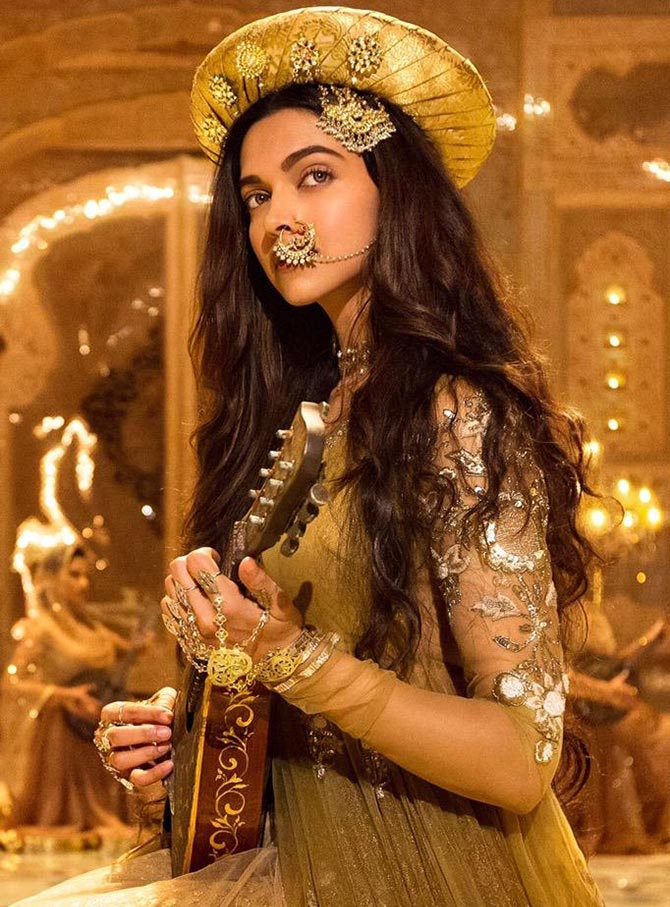
While traveling, an emissary (dressed as a soldier) infiltrates Bajirao’s tent and demands his help in fighting invaders to her land. She is a bold/gorgeous/warrior princess called Mastani (Deepika Padukone). The audience soon learns that she is the daughter of a (Hindu) Rajput King and his (Muslim) consort. Since her parents are of different faiths, their union is illegitimate, as is Mastani herself. Also, she is considered a Muslim, like her mother. (Here lies the crux of the controversy of this film- Muslims and Hindus in love relationships.)
Impressed by her skills as a warrior, Bajirao assists her with his army and defeats the invaders to her land. Mastani and Bajirao develop feelings for each other and he presents her his dagger, which is always at his waist. This is also a symbol of marriage among her people, the Rajputs. Of course, Bajirao doesn’t know this tradition!
After this battle, Bajirao departs for his opulent estate in Pune, where his beautiful/childlike/adoring wife Kashibai (Priyanka Chopra) awaits him. When they joke about her husband being away so much, she proudly declares to her servants that “he has never looked at another woman.” No wilting wallflower, Mastani (with only one complaining young handmaiden), decides to pursue Bajirao- a love triangle is formed!
My Thoughts
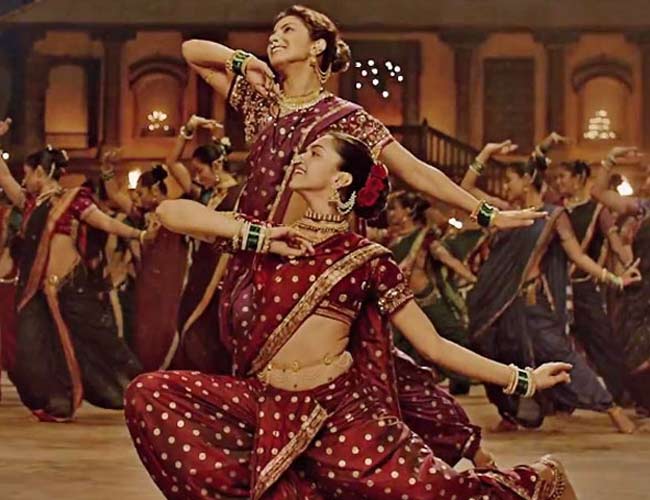
I went to see this film in my neighborhood Regal theater (rare to see Bollywood films there) w/ one of my gal pals (also Bangladeshi-American and near my age) and my mom (who rarely watches these types of films; she prefers Indian indies). The theater was nearly packed- a BIG surprise to us! Being desis, we knew it was going to be long (duh!) and have dance/singing (a staple), BUT were still impressed w/ the scale of the production, costuming, and even the acting (Chopra can’t ruin this). I’d never seen Singh or Padukone before, but they did a good job w/ the material. Padukone is very graceful and strong in her role, but also has a VERY innocent/other-wordly aura about her (maybe it’s her FAB skin).
One of my other gal pals (South Indian heritage) LOVED the film and all the 3 leads; she saw it the week after it debuted on DEC 18th. This is one of those epic films that knows it’s an epic, so the music can be bombastic and lines are proclaimed (not merely spoken in a natural manner). However, I think that it’s a LOT better than Bollywood films I’ve seen in the past (several years ago, so may NOT be the best judge). I liked the dances, BUT my friend wasn’t impressed w/ the songs (she watches Bollywood films once in a while). I suggest you check it out IF you have an interest in Bollywood (BUT take it for what it IS, don’t put TOO much interpretation into this genre)!




 Knightleyemma