Two (Lesser Known) Films Starring Rita Hayworth

Miss Sadie Thompson (1953)

[1] It’s always interesting to stumble on old movies like these that resonate more than 50 years later. How much and how little has changed when it comes to religious zealots…hhmmm?

[2] Sadie Thompson is a woman of questionable repute… trying to re-make her life. The Jose Ferrer character is effectively odious. A man hung up on projecting his moral issues on the nearest target. This happens to be Miss Sadie. 

[3] Look for a studly young Charles Bronson in a minor role, listed in the credits as Charles Buchinsky.

-Excerpts from IMDB reviews

At a remote military outpost on American Samoa, it’s either hot/humid or raining. A ship quarantine strands a small group of Americans, incl. Sadie Thompson (Hayworth), on the way to a new job on another island. She’s a “breezy dame” who ALL the Marines want to get to know, including Phil O’Hara (Aldo Ray). As she steps on the dock, men clamor for a bit of her company. As Sadie sings, some of the natives (even little kids) leave church to go to the bar next door, ignoring their preacher. Mr. Davidson (Jose Ferrer), the powerful/wealthy head of the Mission Board, suspects Sadie is one of the women who worked at the Emerald Club in Honolulu. He calls her a bad influence (on the Marines and local natives), who must be shunned. 

This island looks volcanic. -Dr. MacPhail comments 

It is – in more ways than one. All these isolated islands where our servicemen are stationed are volcanic. It takes constant vigilance to keep them under control. -Mr. Davidson replies

Hayworth looks gorgeous (as usual); she’s a redhead here who wears a lot of red (associated w/ evil, love, and during this era- Communism). Sadie is independent, tough, unapologetic, and quite jaded (though she puts on a fun-loving front). Phil, who will soon be finished w/ his service, suggests going to live in Australia. He quickly falls in love w/ Sadie and asks her to marry him; she is surprised, but pleasantly. Meanwhile, Davidson has put the gears into motion to get Sadie deported back to the States. 

This is a “Personal Pick” of Robert Osborne, who was host for TCM. It starts off as light and comedic (w/ songs), but takes a serious (and quite dark) turn. While it’s an uneven film, there are timeless themes w/in (based on a short story by W. Somerset Maugham).

The Story on Page One (1959)

[1] You’ll never see a movie with such long scenes again. It’s a shame, because they were very absorbing, with Franciosa really ratcheting up the fireworks.

[2] People who knew her say she was much like the character of Josephine – quiet, shy, insecure and sweet. Hayworth doesn’t exhibit much personality in this, but then, probably the unhappy Josephine wouldn’t have either.

-Excerpts from IMDB reviews

An elderly woman, Mrs. Brown (Katherine Squire), approaches a surly, down-on-his-luck  lawyer, Victor Santini (Anthony Franciosa), desperate for representation for her daughter. Mrs. Brown knew Victor’s (deceased) mother, who told her that he was a Harvard grad and experienced w/ trials. Victor (who’s more interested in drinking) tries to dissuade the woman, but she’s insists on him hearing out her story. 

L.A. housewife/mother, Jo Morris (Hayworth- then 40 y.o.), is very unhappy; her husband/police detective, Mike (Alfred Ryder), is emotionally abusive. Hayworth’s looks are underplayed in this film; she comes off as a bit tired, anxious, and isn’t dressed glamorously. Jo feels sympathy for an accountant/widower, Larry Ellis (Gig Young), and they start seeing each other. They break up, but Jo’s mother (Mrs. Brown) urges her to reach out again. Larry and Jo meet; she learns that his young son was killed in an accident. They finally spend one night at his hotel, and realize that they still love each other. Larry’s  mother, Mrs. Ellis (Mildred Dunnock), shows up on Jo’s doorstep one day, just as Mike is going to work. Jo is stunned when Mrs. Ellis explains that she hired a private detective to follow Larry; she threatens to reveal all to Mike (unless Jo stays away). One weekend, the family goes to a wedding, where Mike gets very drunk. When they get home, Larry is waiting to speak to Jo (after the others are asleep). She lets him into the kitchen and Larry explains/apologizes about his mother. Mike comes down the stairs (holding his gun), thinking there could be a burglar. When he sees Jo embracing Larry, Mike fights w/ Larry and the gun goes off. Mike is dead; the adulterous couple find themselves on trial for their lives (yet refuse to turn against each other). 

It turns out that Victor (who cleans up nice) is a fine lawyer; he’s confident in the courtroom and passionate about getting justice for his client. He faces some tough opposition from a tough/elderly prosecutor (played by Sanford Meisner, known as an acting coach). While Meisner was exposed to method acting (w/ its emphasis on “affective memory”), his approach was based on “the reality of doing.” Since most of this film is the trial, it will appeal to those who like courtroom dramas (and a lot of dialogue). There isn’t any flair w/ the direction; it was done by the writer, Clifford Odets. As several viewers have noticed, the supporting characters, esp. Victor and the two mothers, are more interesting than the leads. 

SPOILER-FREE Review: White Boy Rick (opening 9/14/18) starring Matthew McConaughey

[1] I hadn’t read up on this story, because I wanted to watch the movie not knowing any details. I was pleasantly surprised. This movie was not what I was expecting. I went in thinking it would be a Pablo Escobar kinda movie, but it was not. 

[2] Although the story is meant to be light-hearted in most moments (due to the nature of this crazy story), there are quite a few dramatically effective scenes to go along with them, but it almost felt like the movie was getting a little too serious for the writers, so they had to take away from some of the emotion by adding jokes. 

Matthew McConaughey gives one of his best efforts in a while and a particular scene actually had me in tears. This really shouldn’t come as a surprise, though, seeing as everyone expects him to bring a lot to the table nowadays. Newcomer Richie Merritt is the one to talk about, however. While his performance isn’t something that people will be talking about for decades to come, this was quite the impressive first impression. 

-Excerpts from IMDB reviews

This is likely to be one of the MOST serious (and unflinchingly violent) films of 2018. I saw it at a free pre-screening w/ a Meetup earlier this week; it’s out this FRI. The gritty indie drama is based on a true story and filmed in Cleveland (which stands in for Detroit). In 1984, Ricky Wershe, Jr. (newcomer Richie Merritt) is a 15 y.o. H.S. dropout who helps his gun dealing father, Rick Sr. (Matthew McConaughey), hustle for a living. In the opener, they attend a gun show. The Wershes haven’t left Detroit (“a lion doesn’t leave the Serengeti”) b/c Rick thinks that they can still make something of themselves. Rick’s older sis, Dawn (British actress Bel Powley) is angry, rebellious, and (possibly) on drugs. The grandparents are played by veteran actors (Bruce Dern and Piper Laurie); their scenes are few, yet memorable. 

There is an epidemic of gun violence and crack cocaine in the area; local cops seem to turn a blind eye and the FBI has a presence. Two FBI agents- Snyder and Byrd (Jennifer Jason Leigh and Rory Cochrane) and local undercover cop, Det. Jackson (Brian Tyree Henry) have their eye on a young dealer, Johnny ‘Lil Man’ Curry (Jonathan Majors), who has connections in high places. Ricky knows Johnny, having done some business w/ him, so the FBI starts following him (to encourage him to assist them). 

RBG (2018)

People ask me “Don’t you feel uncomfortable being compared to a rapper?” Why would I? We have a lot in common like being born and raised in Brooklyn. -Ruth Bader Ginsburg

If you’re not watching #RBGMovie you are missing one of the great multi layered love stories. Love of the law, love of knowledge, love of equality and above all, love of marriage as a true partnership, bursting with mutual respect. Ruth Bader Ginsburg is an American original. -Tom Harrington (CBC Radio)

The love story between Ruth and Martin Ginsburg is nothing less than awe-inspiring. I love how she tells about her undergraduate years at Cornell where there was a four to one ratio of boys to girls. “Every mother wanted to send their daughter there because, if you couldn’t find a husband there, you were hopeless.” She reveals that during her freshman year, she never dated the same boy twice. That is, until she met Marty, who was the first guy that recognized she had a brain. -Excerpt from IMDB review

He was okay playing second fiddle. In fact, he joked about it… -Nina Totenberg (NPR legal correspondent) on Marty, a very successful tax attorney in NYC, who moved to DC when his wife’s career took off. 

The film traces RBG’s life from her childhood in Brooklyn through her years struggling to be taken seriously as a young female law student  and practicing attorney, and through her tenure on the SCOTUS and emergence as a pop culture icon. The storyline is mostly linear, but includes frequent jumps backward, forward, and even sideways as it examines different aspects of her life, personality, and public image. There’s a mix of historical photos, videos, but the main draw are the interviews. We hear from Ginsburg’s children, childhood friends, colleagues, admirers and a few detractors, as well as fellow feminist icon Gloria Steinem, former Pres. Bill Clinton, and Ginsburg herself.

Some of the cases RBG argued before the SCOTUS:

  • Frontiero vs. Richardson (1973): A young newly-married woman from Alabama, Sharron Frontiero, working in the U.S. Air Force, sues for gender discrimination when the housing stipend is denied her (unlike male co-workers).
  • Weinberger vs. Wiesenfeld (1975): A widower and father to baby boy, Simon Wiesenfeld, sues the Social Security Administration for sole-survivor benefits (then called “a mother’s benefit” and only avaiable to women). When the case reached SCOTUS, RBG had Simon come sit w/ the lawyers (putting a masculine face in front of the all-male justices).
  • Califano vs. Goldfarb: Leon Goldfarb, a widower, who applied for survivor’s benefits under the Social Security Act had his application denied (even though his wife Hannah had paid Social Security taxes for 25 years).
  • Edwards vs. Healy: Challenging the Louisiana law that allowed women to opt-out of jury service.

You may remember these (high-profile) cases that RBG presided over:

  • U.S. vs. Virginia Military Institute (1996): VMI boasted a long and proud tradition as Virginia’s only exclusively male public undergraduate higher learning institution. The U.S. brought suit against Virginia and VMI alleging that the school’s male-only admissions policy was unconstitutional insofar as it violated the 14th Amendment’s equal protection clause.
  • Ledbetter vs. Goodyear Tire & Rubber Co. (2007): Over her 19 yr. career at Goodyear, Lilly Ledbetter was consistently given low rankings in annual performance-and-salary reviews and low raises relative to other employees. Ledbetter sued for gender discrimination in violation of Title VII of the Civil Rights Act of 1964, alleging that the company had given her a low salary because of her gender.

A granddaughter, Clara Spera, who recently graduated from Harvard Law School, explains that this was the first year that the graduating class was 50% male and 50% female (WOW). Jane and James (her adult children) recall how their mother rarely laughed, stressed education and personal responsibility, and was a horrible cook (LOL). Her husband, Marty, worked hard by contacting people from the business and legal communities to get RBG (then aged 61) to the top of the list for Supreme Court justice in 1993. Pres. Clinton was very impressed by her interview. RBG, who even won the admiration of Sen. Orrin Hatch (R-UT), was confirmed 96-3 in a quite partisan time. This is a MUST-SEE documentary (for people of ALL ages)!

Detective Story (1951) starring Kirk Douglas & Eleanor Parker

[1] The writing is a bit too well-structured, almost like clockwork, the characters are a bit too symbolic and easy to categorise. The comic relief kicks in just on schedule. The psychological diagnosis is too precise. And yet, this is one of the greatest films ever made. It has a sense of respect for the totality of life, and makes tragedy almost poetic. 

[2] Kirk Douglas carries the burden of McLeod and makes the tormented policeman painfully believable–it is almost a nonstop, swirling performance… 

[3] The abortion angle of the original play was taken to the screen, partly because of censorship, and partly because the close-up, immediacy of the camera requires rage to be clearly more explained than on the stage…

-Excerpts from various reviews (Amazon & IMDB)

detective story poster.jpg
A poster for the film

Evil’s got a smell of its own. A child could spot it. -McLeod says, before giving some info re: his father/parents’ relationship

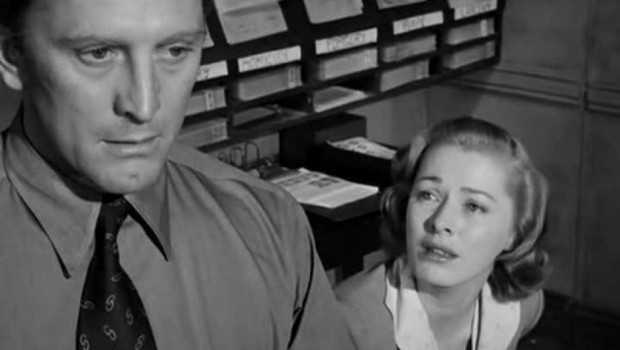
In this film, abortion is sinful, criminal, horrifying (personally and socially)- a tragedy. It appears from different angles: the Dutch abortion doctor (w/ his clever lawyer), the detective’s wife, her ex-boyfriend (who got her pregnant), and eventually, the detective. When Mary (Eleanor Parker) finally tells her husband (Kirk Douglas) about it, his worldview is too black and white to handle it. He calls her a “tramp”- she’s wasn’t expecting that reaction. All that matters is that she was intimate with someone before being married to him. She says she’s leaving him forever. He doesn’t go after her, as his fellow detectives urge. Mary gets her freedom.

detective4-620x350.jpg

Mary (Eleanor Parker) begs and cries, but McCleod (Kirk Douglas) doesn’t see her virtues.

This may be one of the early “typical day” genre- several different stories occurring over one day in the same location, but melded into a whole (as on the TV shows, Hill Street Blues and Barney Miller). A key ongoing side plot involves an unlikely/lovelorn first offender and the younger sister of his former girlfriend. He stole from his employer to win back his (model) girlfriend who has moved on to a different circle. McCleod’s partner, Det. Brody (William Bendix) is more gentle/understanding; this man reminds him of his dead (WWII hero) son.

Oscar nominations were given out for William Wyler’s direction, the screenplay, and for Parker and Lee Grant, lead and supporting actresses respectively. At a little over 20 minutes, Parker’s performance in this movie is the shortest to ever be nominated for a Best Actress Oscar.

I built my whole life on hating my father. All the time he was inside me, laughing. -McLeod finally realizes the truth about his personality 

Since it was impossible to film the movie without portraying the killing of Detective McLeod, so this movie resulted in another amendment to the Production Code. From December 20, 1938 to March 27, 1951, there was a rule forbidding the display of law enforcement officers (EX: detectives, security guards, etc.) dying at the hands of criminals. From March 27, 1951 onward, the Production Code allowed such portrayals, if they were “absolutely necessary to the development of the plot” (as noted in the book The Dame in the Kimono by Leonard Jeff and Jerold Simmons).

Want a Thrill?: Jagged Edge & No Way Out

Jagged Edge (1985)

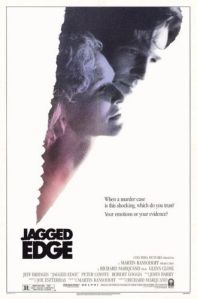
jagged edge_poster

This is a film I didn’t know much about until I saw it last wk.  It’s not TOO gory or scary, but the opening scene might be hard to take for some viewers.  There is some trial testimony that MAY make you cringe, too.  The acting of the main players is quite strong.  There are twists and turns in this thriller, but I’m sure viewers will figure out some of them.

The defender: Teddy Barnes (Glenn Close)

Glenn Close looks VERY pretty in this movie, and plays Teddy Barnes, a lawyer/divorcee/mother of 2 young kids.  I thought she did well in the courtroom scenes, but I REALLY liked her vulnerable and motherly sides here (she doesn’t often get to show that in her roles).  She interacts VERY well w/ the kids and w/ Robert Loggia (who plays a mussed-up/ cynical/elderly former cop).  Teddy and the cop went through a tough criminal case before, and were VERY affected by it.

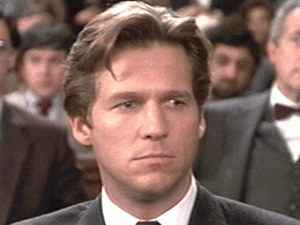
The defendant: Jeff Bridges

The handsome/charming/newspaper editor Teddy defends is Jack Forrester (Jeff Bridges).  His wife Paige, whose family ran a San Francisco paper, was brutally assaulted and murdered in their beach house.  It turns out that the money was ALL in Paige’s name, so Jack would’ve lost it all if there was a divorce (job, status, etc.)  Though Teddy doesn’t want the hassle, her boss convinces her to take on the high-profile case.

From their first meeting, we see that Teddy and Jack have GREAT chemistry (as do the actors).  And he keeps insisting he’s innocent.  (It’s tough NOT to like Jeff Bridges, right?  He’s a VERY natural actor.)  There is a memorable romantic sequence where Jack takes Teddy horseback riding on his ranch.  Though she tries to keep things professional, the lawyer gets involved w/ her client!


No Way Out (1987)

no way out_dvd

This is another popular ’80s thriller, but set in the world of politics in DC.   This film made Kevin Costner (who plays career navy man Lt. Cmdr. Tom Farrell) a major player in Hollywood.  (I’m NOT a fan of Costner, but he fits his role VERY well here.)  Gene Hackman plays Farrell’s boss in the Pentagon, Defense Sect. David Brice.  After a heroic rescue of a crewmate at sea, Farrell is brought in (by old college pal) to work for Sect. Brice.  That pal, Scott Pritchard (Will Patton), is an enigmatic and ambitious man who serves as Brice’s “right hand.”  Will Patton NEARLY steals almost every scene he’s in!

Lt. Cmdr. Tom Farrell (Kevin Costner) & Susan (Sean Young)
Tom Farrell (Kevin Costner) & Susan (Sean Young)


kev_white

Did you know?

Kevin Costner turned down the role of Jack Forrester in Jagged Edge.

"The Big Chill" (1983)
“The Big Chill” (1983)

Costner played the dead body in the opening of The Big Chill (1983). Director Lawrence Kasdan, who liked Costner’s work, shot some scenes involving his character (the friend who commited suicide), but edited them out later to fit the mood of the film.