“Trial by Jury” (1994) & “The Juror” (1996)

Trial by Jury (1994) starring Joanne Whalley-Kilmer, Armand Assante, Gabriel Byrne, & William Hurt

For one juror, the question of guilt or innocence is a matter of life or death… her own. -Tag line

For those who’ve seen The Juror (see below), this film (which was released first) will seem very familiar! However, this story focuses more on the trial, rather than what happens outside the courtroom. Both individuals are (oddly) happy to appear for jury duty, as many viewers have chuckled at. The son here is younger and there is a supportive grandfather character (who lives upstate on a small farm). The fathers (ex-husbands to the protagonists) are barely mentioned; they’re absent from the daily lives of the sons. Both moms must survive under tremendous pressures and eventually take actions into their own hands (rather than relying on the authorities).

In NYC, Valerie Alston (Whalley-Kilmer) is a single mom/owner of a vintage clothing store called to participate in the jury of the trial of mobster Rusty Pirone (Assante). Just before the trail begins, the key witness for the prosecution is executed, along w/ the four police officers who were protecting him. The lead prosecutor, Daniel Graham (Byrne), is on a mission to get Pirone, and also the media’s attention. An alcoholic ex-cop, Tommy Vesey (Hurt), threatens to hurt Valerie’s son unless she says “not guilty.”

I enjoyed the parts w/ Byrne and his team of eager/ambitious prosecutors. Assante made a smooth/compelling villain (w/ a love of classic films and everything old-fashioned). Playing against type, freelance baddies Hurt (w/ waves in his blonde hair) and Kathleen Quinlan share a dysfunctional dynamic. The third act of the story is (obviously) inspired by the noir genre. I wasn’t a fan of the editing; this movie could’ve been shorter and more tightly put together.

You will feel Gabriel Byrne’s frustration as he tries to catch the mob boss and and work within the law only to have the legal system perverted by the influence of that mob. You will see how his character… could easily have gone in that direction.

-Excerpt from IMDB review

The Juror (1996) starring Demi Moore, Alec Baldwin, Joseph Gordon-Leavitt, James Gandolfini, & Anne Heche

In upstate NY, Annie Laird (Moore) is a sculptor (clerk by day) raising a smart/observant 13 y.o. son, Oliver (Gordon-Leavitt) on her own. Annie is cautious, responsible, and busy (though doesn’t mind going to jury duty). She even comments to Oliver: “I need some excitement in my life!” Her closest friend is a carefree/single doctor, Juliet (Heche), who also shares a great rapport w/ Oliver. I liked the female friendship element in this story, thought the women seemed like opposites. Annie is one of the jurors chosen for the trial of Louie Boffano, who is accused of the murders of a rival mob family (incl. a 10 y.o. boy). A mysterious man dressed in black (Baldwin) bugs Annie’s (eclectic-looking) farmhouse; his friend/colleague Eddie (Gandolfini) keeps a lookout.

The next day at a gallery in NYC, Annie receives a check for $12,000, as she has finally sold some of her work. Outside this gallery, a man introduces himself to Annie as “Mark”- the art dealer who purchased the sculptures. He humbly asks her to go have coffee; they have a chat re: art vs. business (which I liked). When Mark explains that “art is used as a kind of currency” in Japan, Annie becomes indignant, saying: “I don’t want my work treated as currency!” Some critics/viewers said this was naive of Annie; after all, she is trying to transition to becoming an artist full-time. Annie decides to go out on a date with Mark, encouraged by Juliet, who thinks her friend is too reserved. Well, Mark (who had some serious issues- we will learn) reveals his true intent for getting close to Annie- she must declare that Boffano is “not guilty.”

To keep the viewer guessing, Baldwin’s face is kept mostly in shadow during the early scenes. There is a good amount of tension in this film, which keeps the viewer’s attention. There are some implausible moments and the editing could’ve been tighter. I thought Gandolfini did an esp. fine job; he was probably the most “normal” character (though still a baddie) in the movie. There are twists and turns, so you won’t be bored. I liked the (pivotal/intense) action scene between Baldwin and several mobsters. Like many viewers, I didn’t see the point in taking the story to Guatemala. We also never learn much re: Dr. Boone (Matt Craven)- is he Annie’s ex/Oliver’s father or just an old (platonic) pal? The final face-off is exciting, but also rather cliched (as seen in other action movies).

The role she [Demi Moore] plays here is, in a sense, the feminine counterpart of many Harrison Ford roles, the ordinary person elevated to heroic action by compelling circumstances.

Alec Baldwin… He fills the screen with his presence like something you can’t get rid of. He is so compelling you want to push him away or just give up. And he is charming-evil, but charming.

-Excerpt from IMDB review

“Malice” (1992) starring Alec Baldwin, Nicole Kidman, & Bill Pullman

Deception. Betrayal. Murder. Some things you never see coming. -Tag line

This is one of several thrillers made during the early 1990s set around husband and wife characters. The films incl. Deceived (1991), Shattered (1991), Mortal Thoughts (1991), Consenting Adults (1992), Unlawful Entry (1992), Presumed Innocent (1990), Guilty as Sin (1993), Sleeping with the Enemy (1991), and A Kiss Before Dying (1991). So far, I’ve only seen Consenting Adults (starring Kevin Kline, Kevin Spacey, Mary Elizabeth Mastrantonio, and Rebecca Miller- wife of Daniel Day Lewis) and Sleeping with the Enemy (one of Julia Roberts’ first movies; it spawned 14 remakes internationally). I saw Malice (first time) last week; I never knew it was co-written by Aaron Sorkin (who also wrote A Few Good Men and created one of my fave TV shows- The West Wing)! It was originally intended to be filmed at Mount Holyoke College in South Hadley, MA (not Smith College). After reviewing the script, the college president declined, due to the serial rapist subplot. The movie was moved to Smith in Northampton; they only agreed as long as the college name was changed. In the opening, the little house that the young student lives in is the former residence of Pres. Coolidge.

This is the type of film that you have to see twice to get all that’s going on. On the first watch, it’s a compelling psychological thriller w/ twists and turns; the plot contains rape, murder, life-and-death trauma, and a deadly fight (all w/ in the first 45 mins). On the re-watch, you find the things you might’ve missed; it’s a chance to enjoy the terrific performances from the three leads- Alec Baldwin, Nicole Kidman, and Bill Pullman. There are brief appearances by Gwyneth Paltrow (a slacker student/one of her early roles) and Joshua Malina (a medical resident/old friend of Sorkin). Veteran actors George C. Scott and Anne Bancroft have small, yet pivotal, roles. Peter Gallagher plays the lawyer who holds some clues to Tracy’s (mysterious) past.

I’m the new guy around here and I want to make friends, so I’ll say this to you and we’ll start fresh. If you don’t like my jokes, don’t laugh. If you have a medical opinion, then please speak up and speak up loud. But if you ever again tell me or my surgical staff that we’re going to lose a patient, I’m gonna take out your lungs with a fuckin’ ice cream scoop. Do you understand me? -Jed explains to Dr. Robertson (after they operate on the college student/rape survivor)

Andy Safian (Pullman- looking youthful at 40) is an associate dean at a small college outside Boston that’s being terrorized by a serial rapist. Tracy (Kidman- looking gorgeous as usual) is his younger wife who volunteers as an art teacher in the Pediatrics ward of the local hospital, St. Agnes. They’re newlyweds renovating a Victorian house and need $14K to overhaul its plumbing. Dr. Jed Hill (Baldwin- looking gorgeous also) is the hotshot new surgeon at St. Agnes and a former HS classmate of Andy’s. Jed needs a place to stay; Andy and Tracy need the extra money. Soon, Jed is living on the 3rd floor; his noisy date w/ his surgical nurse, Tanya (Debrah Farentino), is grating on Tracy’s nerves. The rapes continue; Andy is even considered a suspect! Andy’s detective friend, Dana (Bebe Neuwirth), convinces him to come to the police station to eliminate himself as a suspect. Meanwhile, Tracy comes home and collapses from pains to her abdomen (a possible ovarian cyst)!

I have an M.D. from Harvard, I am board certified in cardio-thoracic medicine and trauma surgery. I have been awarded citations from seven different medical boards in New England, and I am never, ever sick at sea. So I ask you: when someone goes into that chapel and they fall on their knees and they pray to God that their wife doesn’t miscarry or that their daughter doesn’t bleed to death or that their mother doesn’t suffer acute neural trama from postoperative shock, who do you think they’re praying to? Now, go ahead and read your Bible, Dennis, and you go to your church, and, with any luck, you might win the annual raffle, but if you’re looking for God, he was in operating room number two on November 17th, and he doesn’t like to be second guessed. You ask me if I have a God complex. Let me tell you something: I am God. -Jed declares during the deposition

On my second watch, I saw that there were hints that Jed and Tracy knew each other from before. Jed and Tracy meet in the bathroom when Tracy drops her meds; she angrily asks: “What the hell are you doing here?” (in a tone that one doesn’t use w/ new acquaintances). Also, notice the looks of anger and jealousy when Tracy sees Tanya coming out of Jed’s room late at night. Fans of the noir genre will notice the noir-inspired choices made by the director (Harold Becker), esp. in the second half. This film is classified as a “neo-noir thriller,” according to Wikipedia. The sometimes haunting music (composed by Jerry Goldsmith) really sets the mood. This film harkens back- at times- to the Golden Age of Hollywood.

[1] …Baldwin’s mesmerizing performance is what stands out. Jed is charismatic, seductive, and as charming as a cobra as he weaves his spell over the Safians. Baldwin’s ability to jump from utterly charming to incredibly chilling in the blink of an eye is on full display here; it is truly the performance of a lifetime.

[2] It’s the uncertainties in the movie that make it one to remember. See it, you will not be disappointed! The background musical score is one of the most memorable that I have heard in any movie. Malice is a tale of arrogance, power, mystery, and deception, that must be seen and will be long remembered after the final credits roll.

[3] Alec Baldwin… is splendid as the doctor/villain [and what a smoothie he is]. His God “complex” speech is one of the highlights. Then there’s the delicious Nicole Kidman… What makes her performance stand out to me is that, as wild and evil as she can be, there’s also a vulnerability in her portrayal. You actually care what happens to her, even though you know she deserves to get caught. […] And Bill Pullman, being given a sort of wimpish character to play, brings it way up to the same level as the stronger characters with his performance. He does an outstanding job in this flick. 

[4] She’s [Anne Bancroft] like the spider with the fly with she’s talking with Kidman’s hubby who just doesn’t get the situation. Bancroft brings enormous power to this character.

-Excerpts from IMDB reviews

“Star Trek: DS9” – Season 2 (Episodes 22-25)

Episode 22: The Wire

Garak (Andrew Robinson) and Bashir (Alexander Siddig) are waiting in line at the mess hall, when suddenly, Garak gets an intense headache. An exam reveals an implant in his brain, which was put there years ago to prevent him from giving away secrets while being interrogated. Garak’s time may be running out; Bashir looks for a way to save his friend’s life.

Garak: Has it ever occurred to you that I might be getting exactly what I deserve?

Bashir: No one deserves this.

Garak: Oh, please, Doctor. I’m suffering enough without having to listen to your smug Federation sympathy. And you think that because we have lunch together once a week you know me? You couldn’t even begin to fathom what I’m capable of.

Bashir: I am a doctor. You’re my patient. That’s all I need to know.

The teleplay was written/edited by Robert Hewitt Wolfe, who came over from TNG. It’s the first DS9 ep to be directed by a woman (Kim Friedman); producers brought her back for several crucial eps. This is the first time that Cardassia Prime is mentioned and also the first mention of the secretive group- the Obsidian Order. Garak admits that he was involved with the Order then explains how he came to be exiled. Each story is different.

Garak can be likeable and sympathetic, yet also pathetic and even aggressive (when suffering from withdrawal). When Bashir goes to see the former head of the Order, Enabran Tain (veteran actor Paul Dooley), he hears yet another story. Tain was grooming Garak to be his successor, but Garak was banished from Cardassian society for not murdering Bajoran children! Bashir gets the info that will save Garak, but only b/c Tain wants him to live long… and suffer.

Bashir: What I want to know is, out of all the stories you told me, which ones were true and which ones weren’t?

Garak: My dear Doctor, they’re all true.

Bashir: Even the lies?

Elim Garak: Especially the lies.

Episode 23: Crossover

Kira (Nana Visitor) and Bashir are returning from the opening of a hospital on New Bajor (the first Bajoran colony in the Gamma Quadrant). Just as they to enter the wormhole, a sudden problem arises. Kira is able to solve it, but when they arrive in the Alpha Quadrant, things have changed. DS9 is now orbiting Bajor and the runabout is entered by Klingons, who apologize when they see Kira. This is an alternate universe! In the opening teaser, the wormhole opens upside down. Klingons, Cardassians and Bajorans have formed an alliance against Earth; humans (“Terrans”) are forced to process ore. The station is led by Intendant Kira; she speaks of Kirk who traveled from the other side years ago. While Bashir is sent to labor away, Intendant Kira wants to know her other self.

Intendant Kira: You don’t trust me.

Major Kira: I’m… a little afraid of you.

Intendant Kira: Then you fear yourself. I don’t want your fear; I want your love. If you can’t love me, who can?

The teleplay was written by veterans of TNG (Wolfe; Peter Allan Fields), as well as Piller (EP). Wolfe wrote the fall of the Terran Empire as an analogy for the fall of the Roman Empire to barbarians and the Chinese Dynasty to the Mongols. He wanted to illustrate that if an Empire is as brutal as the Terran Empire was in TOS (Mirror, Mirror), there were probably reasons why it was so brutal. Wolfe wanted to convey that one cannot change things overnight, and even the actions of Capt. Kirk can have serious consequences. This episode is listed as being one of the “Ten Essential Episodes” of DS9 in Star Trek 101 by Terry J. Erdmann and Paula M. Block.

Sisko: What do you care about Terrans’ freedom?

Kira: I care about freedom! What I don’t understand is why you *don’t* care. Why the only one on this station I have met who seemed to give a damn was a Ferengi toad named Quark!

Sisko: You’re looking in the wrong place for a hero, ma’am. I’ve made the best of a bad life for my crew. That’s my contribution.

Kira: Yes – you charmed your way out of the mines. But you and I both know, you’re no less a victim than anyone else here.

Much has been said by critics/fans of the tight/leather outfit Intendent Kira wears. One podcast host called it “a G-rated version of what a dominatrix would wear” – LOL! Blackman (costume designer on various ST shows) credited the outfit for giving Visitor a more alluring image. For the milk bath scene, the crew made sure that the bath was nice and hot for Visitor; they put a few drops of orange oil on it, so the water had a nice smell and would soften her skin. During rehearsals, she felt the cones hiding her nudity started to pop off! When she asked her makeup artist what takes the glue off, it turned out to be the orange oil.

Smiley O’Brien: [referring to Bashir] This man… this man… is a doctor where he comes from. And there’s an O’Brien there just like me. Except he’s some kind of… high up Chief of Operations. And they’re Terrans. Can you believe that? Maybe it’s a fairy tale he made up, but… it started me thinking, how… how each of us might’ve turned out, if history had been just a little different.

Mirror Odo’s uniform has a belt, which Rene Auberjonois liked so much that he began using it in for his regular Odo uniform in S3. Odo doesn’t like weapons, but Mirror Odo carries a Bajoran phaser pistol. O’Brien isn’t a family man in this world; also Jake doesn’t appear. In the mirror universe, Quark tells Garak he is “a simple bartender” when accused of illegal acts; this is a joke based on Garak’s common saying that he’s only “a simple tailor.” Quark is not as flamboyant or confident in the mirror universe.

Viewers have pointed out that Kira plays an evil commander of Terok Nor, which is the same role that Gul Dukat had. Also, the mirror Kira’s personality is the same as Dukat, as she blames those under her for being too harsh. She tries to seduce others to get what she wants and plays political games to get an advantage, just as Dukat did in the series.

[1] This was a fun episode… Nana Visitor did a good job as the two very different versions of Kira however I think Avery Brooks is much better as the serious Commander Sisko than here where he seemed rather hammy laughing…

[2] Too often the Trek shows are extremely nice and astoundingly perfect–often TOO perfect. With episodes like this one and the Maquis, you finally see a different sort of future–a dark, twisted and darkly funny one. Well worth seeing, though the original episode is a touch better.

[3] …the Klingons have not changed in the Mirror universe at all. In relation to character they remain essentially the same as Klingons have throughout the franchise.

Although Garak acts ruthless in contrast to his normal character on DS9, the Cardassians have not changed in the Mirror universe as one can detect… their use of torture during prisoner interrogations has been well documented in multiple episodes.

-Excerpts from IMDB reviews

Episode 24: The Collaborator

The election day for Kai (main spiritual leader of Bajor) is approaching and both Vedek Bareil (Philip Anglim) and Vedek Winn (Louise Fletcher) are on DS9. Bareil is esp. interested in Kira’s vote, but Winn has a different agenda. She’s awaiting the arrival of secretary Kubus Oak, who was liaison between the Cardassians and the Bajoran government during the occupation. Kubus fled to Cardassia afterwards. Kira and Odo want to make sure he gets a proper trial; Winn wants to leave the station w/ him. There was a Prylar Bek (another Bajoran collaborator) who hanged himself after allegedly giving up the location of a rebel base. Winn claims that Kubus gave her the name of the person really responsible for the massacre: Bareil!

This was the final ep of DS9 to air during the run of TNG. This ep was written by Behr, Wolfe, and (regular staff writer) Gary Holland. It turned out that Holland was surprised by how Odo reacted to finding out that Kira was in love w/ Bareil (as he hadn’t written the scene that way)! It’s a subtle reaction which some viewers may’ve missed. The (obvious) tension between Winn and the crew of DS9 harkens back to Winn’s attempt to stop Keiko teaching secular science. Winn coerced a young engineer to try to kill Bareil. However, there was no evidence to prove her involvement. According to the Star Trek: Deep Space Nine Companion, there are Watergate parallels here: Quark helps Kira bypass the security lockouts and the Prylar Bek character (based on John Dean).

Episode 25: Tribunal

O’Brien (Colm Meaney) is preparing for a vacation w/ Keiko (Rosalind Chao), but has a hard time leaving work to others. As he is leaving DS9, runs into an old friend, Raymond Boone, who he served w/ on the Rutledge. Boone left Starfleet 8 yrs ago and moved to a colony on the Cardassian side of the Demilitarized Zone. O’Brien leaves with his wife in a runabout; a ship suddenly approaches and he is arrested by the Cardassians! They refuse to tell him what crime he is accused of and transport him to undergo a trial. After he is processed, a Juror (judge)- Archon Makbar- makes it clear his guilt is already established and the trial is a formality. Odo (an officer of the court) gets himself on O’Brien’s defense team as Nestor (representative). The crew on the station do their best to come up w/ info to free O’Brien.

Kovat: Once again, justice will be done. Our lives will be reaffirmed, safe and secure. Here on Cardassia, all crimes are solved, all criminals are punished, all endings are happy. Even the poorest of our subjects can walk the streets in the dead of night in perfect safety. You’re only one man; but your conviction will be a salutary experience for millions.

This ep was written by Bill Dial, who also wrote S2 E12: The Alternate; it was directed by Brooks (the first cast member to direct). Production designer Herman F. Zimmerman took inspiration in the set design from George Orwell’s 1948 book Nineteen Eighty-Four. Zimmerman explains: “Spartan, uncompromising and merciless are all adjectives that you could use to describe Cardassia.” Robert Stromberg of Illusion Arts, Inc. created the matte painting of the city on Cardassia Prime; he went on to win Oscars for art direction on Avatar (2009) and Alice in Wonderland (2010). If you watch Law & Order (or other courtroom shows) and don’t mind dark humor, then you’ll like this story.

O’Brien: I’ve been in service to the Federation – Starfleet – all my adult life. No one has ever questioned my loyalty. No one in my entire life has ever had cause to ask “Miles O’Brien, are you a criminal?” I took an oath to defend the Federation, and what it stands for…

[1] Good keeps getting better; evil stays the same. Any era, any generation can appreciate the truth in this episode. Fantastic exploration of authoritarianism, justice, and the human journey. Season 2 really ratcheted up the writing and direction of the actors.

[2] This episode has a couple nice guest stars. The best is Fritz Weaver as a defender. With defense attorneys like him, you cannot help but laugh… He is hilariously inept, cowardly and worthless- and funny, In fact, I think he’s the best thing about this show! Additionally, John Beck (Moonpie from the original “Rollerball”) is on hand as a secret agent working for the cause of injustice. Well worth seeing, as well as dark and foreboding.

-Excerpts from IMDB reviews
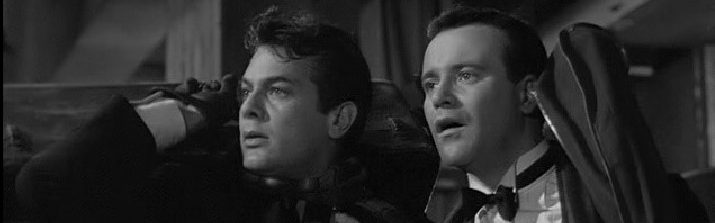
“3:10 to Yuma” (1957) starring Glenn Ford & Van Heflin

Alice: It seems terrible that something bad can happen and all anybody can do is stand by and watch.

Dan Evans: Lots of things happen where all you can do is stand by and watch.

After a stagecoach robbery/shootout, notorious outlaw Ben Wade (Glenn Ford) is captured in a small town by a sheriff and few locals. One of them is a struggling rancher/family man, Dan Evans (Van Heflin), who volunteers to escort Wade to the nearest town w/ a railway station. Dan desperately needs the $200 which the stagecoach company’s owner offered as a reward. Once the two men are holed up in the hotel to await the 3:10 to Yuma, a battle of wills ensues. All the while, Ben’s gang is gathering to break him out.

Emmy: Funny, some men you see every day for ten years and you never notice; some men you see once and they’re with you for the rest of your life.

Even if you’re not a big fan of Westerns, you’ll find a lot to enjoy in this must-see film! The screenplay (which includes sly moments of humor) was adapted from a story by Elmore Leonard. There are gorgeous shots of the desert, intimate close-ups, music, exciting action sequences w/ horses and guns. Although most Westerns by this time were being produced in color, director (Delmer Daves) and cinematographer (Charles Lawton Jr.) chose to shoot in black and white.

I thought all the actors (including the supporting ones and two boys) hit the right notes. Ford was originally offered the role of Dan Evans; he refused and suggested himself for the role of Ben Wade. This is one of Ford’s (rare) bad guy roles; he’s still charming and likable. Heflin (who worked on many Westerns) and Ford play off each other very well. Ford has sparkling chemistry w/ Felicia Farr (the beautiful/lonely barmaid, Emmy). There are touching scenes between Heflin and Leora Dana (his devoted/refined wife, Alice).

Ben Wade: I mean, I don’t go around just shootin’ people down… I work quiet, like you.

Dan Evans: All right, so you’re quiet like me. Well then, shut up like me.

The scenes of Contention City were shot in Old Tucson, which is not far from where I grew up. Some critics/viewers consider this a film of a man reclaiming his masculinity. I also see it as a community struggling to do the right thing, though under enormous threat. This film, along w/ High Noon (1952), was a deciding factor in Howard Hawks deciding to make Rio Bravo (1959), a return to more optimistic Westerns. This is one of Patton Oswalt’s favorite movies; he introduced it on TCM several years ago.


“Beyond a Reasonable Doubt” (1956) starring Dana Andrews & Joan Fontaine

Tom Garrett (Dana Andrews) is a reporter on leave from his newspaper to write his second book. Since he has writer’s block, his publisher/friend, Austin Spencer (Sidney Blackmer), suggests an idea for a non-fiction book on capital punishment. Austin thinks the local DA, Roy Thompson (Philip Bourneuf), is using the death penalty in the hopes of getting into the governor’s mansion. Tom and Austin decide to frame Tom for a murder he didn’t commit, in the hopes of showing how easily a man could be found guilty (w/ only circumstantial evidence). They decide to keep Tom’s fiancee/Austin’s daughter, Susan (Joan Fontaine), out of the loop.

Austin: You get engaged to my daughter, and all you can think about is capital punishment?

This was the last American film made by Fritz Lang (an iconic noir director) before returning to his native Germany; he fled in 1934 b/c of the rise of the Nazis (being Jewish). Lang chafed against the Hollywood studio system when producers wanted to impose their ideas on his vision. This film (shot in only 20 days- wow) is a legal drama and noir rolled into one. Instead of a cop, we follow a journalist (which was common for the noir genre). Though it’s not in Lang’s usual style, I thought it was riveting from the start. Some viewers said the movie looked more like a TV show; TV was on the verge of becoming big in the mid-1950s. The dialogue is smart, pacing well-done, and the acting is good (down to the small roles).

Dolly: This guy’s got a lot of class.

Terry: Yeah? If he’s got so much class, what’s he doin’ with you?

Andrews and Fontaine make an elegant couple; they’re also fine actors who understand subtlety. Fontaine gets some classy outfits to wear, too. I think she looked more interesting in her 30s and somewhat baby-faced in her 20s. I wish she had more to do. One of the burlesque dancers, Dolly Moore (Barbara Nichols), brings some humor to the story. Moore looks/acts like a taller a and more streetwise version of Marilyn Monroe; she was in Sweet Smell of Success (1957) opposite Tony Curtis and Burt Lancaster.


[1] The main strengths of this movie… its lively pace, its wonderfully bizarre plot and the unexpected twists which make it so intriguing and enjoyable to watch.

[2] Andrews and Fontaine are not a bad pair—both are matched in calm and sophistication, and beauty, even, though Fontaine seems like an accessory until the very end. Andrews rules the plot, which makes him out to be a writer desperate for a new story.

[3] This is perhaps Lang’s best assault on the American justice system; he has created a story that is interesting and very plausible and it works a treat in that it gets you thinking about the fact that with this kind of law; someone really could be killed for something they didn’t do.

It is efficient story telling at it’s best and this is one of the highlights of the film noir era.

-Excerpts from IMDB reviews