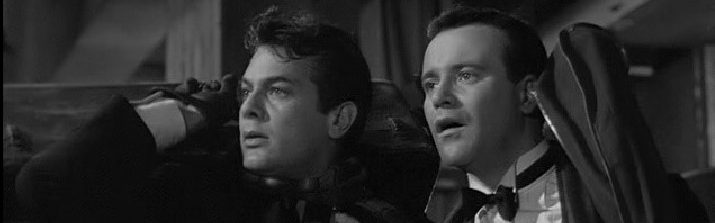
“Moon Over Parador” (1988) starring Richard Dreyfuss, Raul Julia, & Sonia Braga

A sort of annoying and also kind of charming actor, Jack Noah (Richard Dreyfuss), is shooting a film on location in the (fictional) country of Parador when its seemingly benevolent dictator, Alphonse Simms, suddenly dies. The dictator’s right-hand man, Roberto Strausman (Puerto Rican actor Raul Julia), makes Jack an offer he can’t refuse-impersonate Simms… or die! Jack’s acting skills fool the masses, but not the palace staff; they play along to keep their jobs. Simms’ mistress/nightclub dancer, Madonna Mendez (Brazilian actress Sonia Braga), decides to help Jack play his role convincingly.

Jack: [after being asked to be the dead dictator’s imposter] Why couldn’t you get Bobby DeNiro or Dustin Hoffman?

Roberto: Not available! I would have given my right arm to work with Bobby DeNiro and Dustin Hoffman!

Jack: [under his breath] They always say that about DeNiro and Hoffman.

The plot of this comedy was re-used for the movie Dave (1993) starring Kevin Kline and Sigourney Weaver. In the age of Trump (often called a wanna be dictator), it’s not far-fetched to see a leader w/ dark makeup, who makes appearances at beauty pageants, and avoids questions from the press. However, this dictator cares for the regular people! Dreyfuss played dual roles of both Jack and the double of Pres. Alphonse Simms; the real Simms was played by his brother Lorin. When Jack is applying make-up to look like Simms in the meat locker, Dreyfuss’ brother is playing the part of the corpse. This movie received two Golden Globe Award noms in 1989- Best Performance by an Actress in a Supporting Role for Braga and Best Performance by an Actor in a Supporting Role for Julia. Even w/ big hair and wild/revealing outfits, Braga’s soulful characterization shines through. Julia (sporting blonde hair) creates a sadistic/power-hungry villain w/ a maniacal laugh… and a brain (he went to Harvard).

The country’s name of Parador is a mash-up of Paraguay (PARA) and Ecuador (DOR). The 14 families that control Parador refer to the 14 families that (in reality) controlled El Salvador in the early 1970s. Ralph (Jonathan Winters) tells a long story re: an English pirate who founded the country of Parador (to explain why Simms has an Anglo-Saxon name). The real reason is that the film was shot in Brazil, and director Paul Mazursky needed a shot of a crowd of extras chanting the dictator’s name. When the crowd is chanting “Simms,” they are actually saying “Sim” (“yes” in Portuguese). There are scenes from Carnivale; people of all ages w/ various skin tones dance and party.

Moon Over Parador pokes fun at government and show business, which is filled w/ many neurotic/egotistical actors. It contains many references to pop culture, incl. A Streetcar Named Desire, Casablanca, Dynasty, and Hollywood Squares. Jack is dressed like Don Johnson during his Miami Vice years (complete w/ a blonde mullet wig) when filming the movie in the first act; a young Dana Delaney plays his leading lady. During a scene where Jack has to address the crowd as Simms, he ad-libs and uses lines from The Impossible Dream from Man of La Mancha. Only Roberto (a theater buff) gets this reference, which is a call-back to Julia’s leading role (Don Quixote) in the Broadway musical. Fans of SVU- look out for Dann Florek (one of Jack’s NYC actor pals). The earlier national anthem (O Parador) is sung to the tune of O Christmas Tree. After Jack changes the song, Sammy Davis Jr. (wow) sings it to the tune of Besame Mucho. Dick Cavett (playing himself) interviews Simms and Madonna in the third act of the film.

[1] …this movie is funny, yet has a serious side as well… the main character, who at the start of the movie is a struggling actor and somewhat of a buffoon, evolves too and by the end of the movie commands respect.

[2] Paul Mazursky’s film is under-rated in my opinion; maybe because the film never takes itself seriously.

…quite clever issues are brought out, as Noah begins to enjoy his role and tries to bring in social reforms.

[3] Is it appropriate to turn the tense situation in Latin America into comedy? Well, “Moon Over Parador” does a good job with it. No matter what they do in this movie, they pull it off.

-Excerpts from IMDB reviews

“Samson and Delilah” (1949) starring Hedy Lamarr, Victor Mature, George Sanders, & Angela Lansbury

Samson: You came to this house as wedding guests. Fire and death are your gifts to my bride. For all that I do against you now, I shall be blameless. I’ll give you back fire for fire, and death for death!

Samson (Victor Mature) plans to marry Semadar (Angela Lansbury), though the Danites (his tribe) are ruled by the Philistines (her tribe). Also, the Danites believe in one god, while the Philistines worship many gods. Samson jumps over the wall of her house to spend time w/ Semadar, interrupting Ahtur (Henry Wilcoxon), the prince who called to court. Semadar’s younger sister, Delilah (Hedy Lamarr), is secretly in love w/ Samson; he doesn’t pay her much attention. Samson asks the local ruler, The Saran of Gaza (George Sanders), for Semadar’s hand in marriage after defeating a warrior in a test of strength. At their wedding banquet, Semadar betrays Samson, and a violent brawl breaks out among the men. Semadar is killed, as is her father; their house and lands are burned! Delilah vows revenge on Samson; she’ll find out why he’s so strong, then betray him to The Saran.

Prince Ahtur: This Samson has some unknown power, some secret that gives him superhuman strength. No man can stand against him.

Delilah: Perhaps he’ll fall before a woman. Even Samson’s strength must have a weakness. There isn’t a man in the world who would not share his secrets with some woman.

Victor Mature won the role of Samson over Burt Lancaster, who was dealing with a back injury and also considered too young. According to Scott Eyman’s biography of Cecil B. DeMille, the real reason that Lancaster did not get the role of Samson was due to his politics; Lancaster was liberal while DeMille was a conservative (as was Mature). Wilcoxon, Robert Ryan, and Robert Mitchum were also considered for Samson. Mature refused to wrestle a tame Hollywood lion; a stuntman is intercut w/ close-ups of the actor wrestling w/ fur.

Her performance was definitely the main asset of the film, one for which she deserved an Academy Award nomination. -Christopher Young, Hedy Lamarr’s biographer

Though cast as the older sister, Lansbury (23 y.o.) was 10 yrs younger than Lamarr (33 y.o.)- who hailed from Austria and was Jewish. Other candidates for the role of Delilah were Jean Simmons, Lana Turner, and Rita Hayworth. Yvonne De Carlo (who later starred in DeMille’s The Ten Commandments) also wanted to play Delilah. Lamarr wears 10 costumes (designed by Edith Head); the peacock gown and cape included 2,000 peacock feathers. Before the scene where Samson kisses Delilah, much discussion took place as to whether a man would kiss a woman w/ his eyes closed or open. Mature commented “a fellow would be a chump to close his eyes” when kissing Lamarr. In the final shot, Mature closed, opened, and then closed his eyes again.

Samson: Your arms were quicksand. Your kiss was death. The name Delilah will be an everlasting curse on the lips of men.

Samson and Delilah was the top-grossing movie of 1949 ($28M). DeMille wanted to shoot the background scenes in Israel, but couldn’t b/c of the 1948 Arab-Israeli War. He decided to send a camera crew to North Africa for 2 mos; they brought back footage shot in Morocco and Algeria, as well as props. Despite this Biblical account of their battle against the Philistines, the oppressed people were never referred to as “Israelites”, “Hebrews”, or “Jewish” people. This omission (or avoidance) occurred in an era when studio chiefs were very sensitive to the fact that Hollywood was generally considered to be “run by Jews.” This movie was in post-production when Sunset Blvd. (1950) was being shot at Paramount. In the scene where Norma Desmond (Gloria Swanson) visits a soundstage to meet w/ DeMille, the set of Delilah’s tent was reassembled to show the director/producer at work. 

I find the American public fairly true to corn. It grows all across the great Midwest. It’s on the ground and in the hearts of the people. I’m very proud to say you’ll find a good deal of it my pictures. -Cecille B. DeMille, commenting on the “corny” reputation of this movie

[1] Victor Mature, a fine physical specimen of the male physique, seems to fit perfectly into the role of the brooding and oft-troubled Samson. George Sanders is superb as the Saran of Gaza. The absolute star of the show is the movie’s other lead actor, Hedy Lamarr… sets the screen on fire as the sensual and wicked Delilah…

[2] Acting honors in this go to George Sanders as the Saran of Gaza, Philistine ruler and sophisticated cad. This was the height of Sanders career, he received a Best Supporting Actor Oscar for All About Eve the same year. I think the Saran and Addison DeWitt would have understood each other very well.

[3] Hedy Lamarr took the title role of Delilah and made it her own… She was full and sparkling as the Philistine temptress, the central figure of Samson’s last love story…

-Excerpts from IMDB reviews

“Brute Force” (1947) starring Burt Lancaster & Hume Cronyn

Gallagher [after learning that parole board hearings have been cancelled]: Those gates only open three times. When you come in, when you’ve served your time, or when you’re dead!

Joe Collins (Burt Lancaster) is a serving a life sentence at a maximum security prison (Westgate Penitentiary). After being held in solitary, then hearing of a friend’s sudden death, he has had enough! Collins and Gallagher (Charles Bickford), the prison’s newspaper editor, plan an elaborate escape. The men in his cell say they’ll follow along. The head guard, Capt. Munsey (Hume Cronyn in his only villainous role), suspects something is up; he has informants all over. Warden Barnes (Roman Bohnen) holds authority on paper only; Dr. Walters (Art Smith) is a decent man who has been driven to alcoholism. These veteran actors came from NYC’s Group Theater (1931-1940) which followed the principles of Stanislavski. The film ends in a huge fight between guards and inmates, w/ gunfire, explosions, and many deaths!

Dr. Walters: Yes, Capt. Munsey. I’m just a very ordinary man. I get drunk on whiskey but you sir – you get drunk on power.

The acting is top notch; this is Lancaster’s 2nd movie after his debut opposite Ava Gardner in The Killers (1946). He had height, looks (traffic-stopping), and screen presence; he was discovered by producer Mark Hallinger (who died at just 44 y.o. from a heart attack). Cronyn (who hailed from the theater, like his wife Jessica Tandy) chews up the scenery as a sadistic wanna-be dictator. In one standout scene, he interrogates and beats the prison reporter, Louie (Sam Levene), while the music of Wagner (Hitler’s favorite composer) plays in the background. The musical score (composed by Miklos Rozsa) is considered to be even more compelling than the one he wrote for The Killers.

Spencer: Driving along with such a dream doll beside me, I figured myself a pretty lucky guy. Flossie had looks, brains, and all the accessories. She was better than a deck with six aces.

Yes, there are women here (unlike most jail-related movies); they appear in flashbacks. Spencer (John Hoyt- best known as Dr. Boyce in the series pilot of Star Trek: TOS) recounts a story of picking up a beautiful gambler, Flossie (Anita Colby). A mild-mannered bookeeper is in jail b/c he stole to please his wife (Ella Raines- who appeared in several noir films). Becker (Howard Duff) is former soldier dreaming of going back to Italy, where he left his lady love (Yvonne De Carlo). She co-starred w/ Lancaster in Criss Cross, which is a can’t miss noir. The woman in Collins’ life, Ruth (Ann Blyth), is as far from a femme fatale as you can get! This movie is on Amazon and YouTube (can see for free).

[1] Director Jules Dassin is brilliant with light, and sets the example for the French “new wave” of cinema. Lighting Burt Lancaster from the side, or from underneath, makes him and the other actors look almost surreal.

[2] The violence is not explicitly disclosed like in the present days, but the cruelty of Captain Munsey can be understood even by the most naive viewer.

[3] This powerful drama is totally uncompromising and provides a convincing account of what life is like in a prison which is being run in a particularly brutal and autocratic manner. The consequence for the inmates is that they live in an oppressive and overcrowded environment where hard labour, poor quality food and harsh treatment are the norm. Furthermore, they are also subjected to a cruel system which leads to many of them being abused, tortured or even killed

-Excerpts from IMDB reviews

“Scandal Sheet” (1952) starring Broderick Crawford, John Derek, & Donna Reed

An ambitious/tough-talking editor, Mark Chapman (Broderick Crawford), meets the wife he abandoned 20+ yrs ago at a “Lonely Hearts Club” ball sponsored by his NYC newspaper. Charlotte Grant (Rosemary DeCamp), threatens to expose him as a wife-deserter and impostor (he changed his name). In a fit of rage, he pushes and accidentally kills her! When Mrs. Grant’s body is found, Chapman assigns his young protégé reporter, Steve McCleary (John Derek), to the story. It could be a juicy follow-up story to the ball and raise circulation. Julie Allison (Donna Reed), a features writer/Steve’s girlfriend, gets a phone call which could crack the case.

This film noir is based on the 1944 novel, The Dark Page, by Samuel Fuller. The wise-cracking photographer, Biddle, is played by Harry Morgan (who gained fame in the TV show M.A.S.H.) Less than a year ago, Chapman was brought on board to save the paper, as it was losing money. Now, some of the shareholders don’t approve of the scandalous stories which he chooses to cover, though the paper is nearing a circulation of 750,000. Julie can barely hide her disdain for Chapman; she’s disappointed that Steve looks up to him. Derek is (as expected) uber-handsome w/ long lashes and thick dark hair; his character makes some sexist comments (reflecting the era). A few viewers were a bit shocked that Reed (who does a fine job) smokes in this movie- LOL!

Top notch suspense as Crawford gambles that he can keep his cool and get away with it, even as the walls close in and the odds look worse and worse. Crawford is at his no-nonsense, take no prisoners, mince-no-words best…

Reed plays a woman who is like the voice of conscience in the movie–always appalled at Crawford’s methods and making it clear that she wants no part of this degradation of the paper.

-Excerpts from IMDB reviews

“The Big Combo” (1955) starring Cornel Wilde & Richard Conte

Capt. Peterson: You’re a cop, Leonard. There’s 17,000 laws on the books to be enforced. You haven’t got time to reform wayward girls. She’s been with Brown three and a half years. That’s a lot of days… and nights.

This is a lesser-known/low-budget noir w/ snappy dialogue, a jazz score (rare for that period), and fine B&W cinematography. It has its good points, but the femme fatale isn’t compelling, and a few scenes seem slow. A determined cop, Lt. Leonard Diamond (Cornel Wilde from Leave Her to Heaven), is told to stop surveillance of suave mob boss, Mr. Brown (Richard Conte from Thieves’ Highway). Leonard’s captain says it’s costing the police department too much money w/ no results after 6 mos. Diamond makes one last attempt to uncover evidence against Brown by going to Brown’s girlfriend, Susan Lowell (Jean Wallace- wife of Wilde and resembling Grace Kelly), who is chaperoned by two henchmen- Fante (Lee Van Cleef) and Mingo (Earl Holliman).

Mr. Brown: I’m trying to run an impersonal business. Killing is very personal. Once it gets started, it’s hard to stop.

This was one of the very first American films to imply a man going down on a woman; I was a bit surprised! Brown maneuvers around Susan, stopping briefly at her lips, but then dropping out of frame, seemingly down past her waist. Leonard is clearly having a “friends w/ benefits” relationship w/ the burlesque dancer, Rita (Helene Stanton). Her show outfit is sparkly and skimpy, even by today’s standards. Also, the film openly infers that Fante and Mingo are a gay couple who live together, kill together, and seem to love each other (note the basement scene).

 In a performance brimming with cool menace, Conte is fond of saying `First is first and second is nobody.’

And Brown is obsessed with his prowess with women as Diamond is with capturing him and wooing his moll. The film is filled with risque sexual allusions…

What almost ruined this picture for me was the hideously annoying performance of actress Jean Wallace…

-Excerpts from IMDB reviews