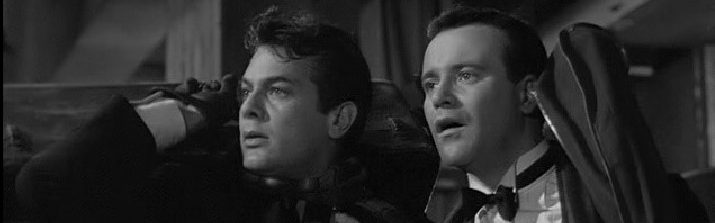
#Noirvember: “On Dangerous Ground” (1951) starring Ida Lupino & Robert Ryan

A Woman With an Empty Heart… A Man With a Loaded Gun whose only chaperone was MURDER! -A tagline for the film

We start with the cop in the big city being called up for his violence. He’s a vicious cop, vicious to criminals because he can rationalize it. Criminals are criminals to him, they’re not people. So he’s sent out of the city, into the mountains. -A.I. Bezzerides, screenwriter

A cop from the city, Jim Wilson (Robert Ryan), is disciplined for his violent behavior by his boss, Capt. Brawley (Ed Begley). He’s sent to a small/mountain town where the local sheriff needs help to solve the case of a murdered girl. The father of the victim, Walter Brent (Ward Bond), is determined to find/kill whoever is responsible. While on the trail of the suspect, Jim and Mr. Brent come to the home of Mary Malden (Ida Lupino). She is keeping a secret, and though nearly blind, Mary can “see” that Jim has a troubled/lonely soul.

Mary: Tell me, how is it to be a cop?
Jim: You get so you don’t trust anybody.
Mary: [who is blind] You’re lucky. You don’t have to trust anyone. I do. I have to trust everybody.

Director Nicholas Ray and screenwriter A.I. Bezzerides researched the daily life and procedures of police in prep, incl. riding w/ detectives in Boston’s South End. The screenplay was developed from the novel Mad with Much Heart by Gerald Butler. The urban scenes were shot in L.A. while the country scenes (in real snow) were shot outside Denver in 2 small towns. Savvy viewers may’ve noticed that a hand-held camera was used to give a “live action” feel to some sequences (rare for the time)! Composer Bernard Hermann (one of the best of his field) wrote the score (which is V memorable). At around 30 mins (when Jim is driving upstate), the music heard was also used 8 yrs. later in Hitchcock’s North by Northwest (1959).

I hate film-makers who want long discussions with actors over a scene. An actor who doesn’t know what a scene he’s going to play is in the wrong profession. -Robert Ryan, actor

This is an unusual/compelling noir which delves into the dark side and the light side of man’s nature. This is also a fave of Scorsese and one of the influences for Taxi Driver (which I haven’t seen yet). I’ve watched this movie a few times in recent yrs; it’s like 2 movies in one- a gritty police procedural and a touching melodrama. Lupino (who directed for a few days when Ray got sick) doesn’t appear until 39 mins. into the story. Ryan and Lupino got along well on set; they create quiet tension onscreen (romantic potential). You can rent this on Amazon Prime Video.

[1] The process of humanization of Jim Wilson is depicted through his relationship with Mary and is very touching. Ida Lupino and Robert Ryan have great performances under the direction of Nicholas Ray in this credible story.

[2] Right from the outset, we are in no doubt that Nicholas Ray is about to take us on a noir journey. Herrmann’s pulse like score accompanies its nighttime opening, Diskant’s photography immediately painting a harsh city where life on the streets is tough.

[3] Ryan is terrific, a real powerhouse and believable performance, while Lupino beautifully realises Mary’s serene impact on Wilson and the counter opposite to the darkness within the picture. It’s a given really, but Herrmann’s score is potent, listen out for the opening, the crossover section from city to countryside and the rock face pursuit. While Ray directs with his customary knack of blending the grim with the almost poetic.

-Excerpts from IMDb reviews

#Noirvember: “Crime Wave” (1953) starring Gene Wilson, Sterling Hayden, & Phyllis Kirk

Before your shocked eyes- the city blasted SIN-SIDE OUT! -Tagline for the movie

Ellen Lacey: But you haven’t done anything! You’re innocent!

Steve Lacey: Once you do a stretch, you’re never clean again! You’re never free! They’ve always got a string on you, and they tug, tug, tug! Before you know it, you’re back again!

Three men: “Doc” Penny (Ted de Corsia), Ben Hastings (Charles Bronson- in his 1st credited role), and Gat Morgan (Nedrick Young) escape from San Quentin and kill a cop during a gas station robbery. Wounded by the cop’s bullet, Morgan runs through dark streets of L.A. until reaching the apt. of a former cellmate, Steve Lacey (Gene Nelson- known as a dancer in comedies), Steve is one parole for 2 yrs, works as an airplane repairman, and is supported by a loving wife, Ellen (Phyllis Kirk). He can’t afford to be found associating w/ criminals. However, a homicide detective, Lt. Sims (Sterling Hayden), wants to use Steve to catch Penny and Hastings.

Life is goddam black, and I photograph life. -Andre De Toth, director

Jack L. Warner wanted Humphrey Bogart and Ava Gardner to star, BUT director André De Toth (who was married to Veronica Lake from 1944-1952) strongly protested this. De Toth realized that w/ such famous stars, he’s lose control of the film. After a long argument, Warner decided that De Toth could make the movie any way he wanted, BUT it had to be done in 2 wks! De Toth finished under schedule (13 days) and under budget w/ his chosen lead- Hayden. Although he got a law degree from the Univ. of Budapest, De Toth decided to become an actor (against the wishes of his father); he spent several yrs. on the stage. He then entered the Hungarian film industry, working as writer, editor, 2nd unit director and actor before becoming a director. De Toth directed a few films just before WWII, then fled to England; Alexander Korda gave him a job. When he emigrated to the US in 1942, Korda got him a job as 2nd unit director on The Jungle Book. De Toth made his debut in America in 1944; he became known for hard-edged movies depicting violence in a realistic manner.

Lt. Sims: You know, it isn’t what a man wants to do, Lacey, but what he has to do. Now take me – I love to smoke cigarettes, but the doctors say I can’t have them. So what do I do? I chew toothpicks, tons of them.

Eddie Muller (TCM) explained that the sets were constructed on a small scale w/ low ceilings to make Hayden (6’5″) appear even larger/more imposing when next to other actors. Also, De Toth forbid Hayden from smoking during filming; that helped create the tense/angry attitude needed for Lt. Sims. James Ellroy names this as one of his fave films; he used Hayden’s performance as the model for Bud White in his novel L.A. Confidential. Bronson (then known by his real last name- Buchinsky) was an unknown; he’d go on to fame in the ’60s. Bronson grew up in a poor, Lithuanian immigrant family; after HS, he worked in the coal mines (like his father), then went into the Army. He has screen presence and makes a believable baddie here.

[1] “Crime Wave” is a very good example of a forgotten film noir picture that deserves to be seen. Its strengths are its directness–it is compactly told, brutally violent and lacking in the glamor and glitz you find in some of the “pretty” examples of noir.

[2] Aces all around. Too bad this crime drama came along in the twilight of B b&w because it’s in the best tradition—fast, tough, and unsentimental. Director De Toth is a perfect shaper with his cynical European style.

[3] There’s much more attention to character in the film’s 1 hr. 25 mins. running time than in many full-length features of the era; Jay Novello, as an alcoholic veterinarian who doubles as an underworld sawbones, is especially memorable.

-Excerpts from IMDb reviews

#Noirvember: “The Turning Point” (1952) starring William Holden, Edmond O’Brien, & Alexis Smith

Today’s most sensational story of racket-busting! -A tagline for the movie

In a Midwestern city, Jerry McKibbon (William Holden), a cynical/no-nonsense newspaperman reconnects w/ a childhood pal, John Conroy (Edmond O’Brien) who was just promoted to special prosecutor. Johnny is engaged to a smart/elegant socialite, Amanda Waycross (Alexis Smith), who thinks he should aim for higher office. As a plain-spoken/idealist, Johnny insists that he has “no political ambitions” and is only concerned re: rooting out corruption. He starts investigating rich/influential businessman, Neil Echelberger (Ed Begley), as well as the police force; Johnny’s father, Matt Conroy (Tom Tully), is also a cop.

The director of this film, Wilhelm Dieterle, joined a traveling theater at age 16 in his native Germany. After 6 yrs, the ambitious/handsome young actor was noticed by producer/director Max Reinhardt (a big proponent of Expressionism in theater). Dieterle acted in nearly 20 movies before he also began directing in 1923. His 1st female lead was a young Marlene Dietrich- wow! In Hollywood, he directed for Warner Bros. from 1931-1934. Dieterle directed The Hunchback of Notre Dame (1939) at RKO starring Charles Laughton (Quasimodo); this was the 1st film for O’Brien and (future star) Maureen O’Hara. (I still need to watch this movie!) The dream-like romance/drama, Portrait of Jennie (1948) stars Joseph Cotten (a frequent collaborator).

Eddie Muller (TCM) called this is “an A-picture inspired by the Senate’s Committee to Investigate Organized Crime.” He felt that Carolyn Jones (in her 1st film) “steals the scene” playing a parody of Bugsy Siegel’s moll- Virginia Hill. I watched this film 2x; I was tired/sleepy on my 1st watch. There is a LOT of fast-paced/clever dialogue, so you have to pay close attention. O’Brien (a reliable character actor) and Holden (up-and-coming in Hollywood) are quite believable as friends. As Muller pointed out, there is steamy romantic chemistry btwn. Holden (one of my mom’s faves) and Smith (“perhaps ahead of her time”). The large supporting cast does a fine job; they add flavor to enrich the story. Check this out; it’s free on YouTube.

[1] Based on a Horace McCoy story, this is a fine, complex noir feature rooted in the events of its time. William Dieterle directs with his usual sure hand, pulling out fine performances.

[2] The corrupt city angle is pretty familiar. Quite a few noir films have such a premise. But, it’s all handled pretty well and I loved the VERY snappy and tough dialog. It’s a fine film for lovers of the genre and worth your time.

[3] The 85-minutes amounts to a surprisingly good blend of a complexly constructed narrative. The personal, romantic, and political all combine here in what’s clearly an effort to tap into Kefauver anti-racketeering hearings of the time. […]

While dual leads, Holden and O’Brien, low-key their parts effectively. Together, the cast makes the material more plausible than it should be.

-Excerpts from IMDb reviews

“Larceny” (1948) starring John Payne, Joan Caulfield, Dan Duryea, & Shelley Winters

A con man sets out to swindle a widow out of the money she’s received to build a memorial to her war-hero husband, but winds up falling in love with her instead. -Synopsis

Rick Maxon (John Payne) works w/ a small group of con men, lead by run by Silky Randall (Dan Duryea- a character actor often in noir genre). Silky’s gf, Tory (Shelley Winters- in a early role), is high maintenance and (maybe) emotionally imbalanced. Silky suspects that Tory may prefer Rick to him; Rick denies that he’s interested. After pulling a $250,000 score in Miami, the gang’s next con involves a young/rich widow in SoCal, Deborah Owens Clark (Joan Caulfield). Rick pretends that he was close pals w/ Deborah’s hubby while he was in his last days of WWII. With his smooth-talking lies, he quickly charms her and the local community. The con is to sell Deborah on creating a memorial dedicated to her hubby, then pocketing the funds. However, as the days go by, Rick finds that he’s falling in love w/ her!

Tory [to Rick]: Stop twisting my arm! People will think we’re married!

Payne was one of the actors who transitioned from ’30s musicals (where he also sang/danced) to the gritty world of crime pictures in the late ’40s. As he was tall (6’2″), dark-haired, and rugged, the noir genre suited him. In his noirs, Payne was able to straddle both sides of the law; I recommend that you check out Kansas City Confidential (1952). The directing and editing are all over the place, BUT this could appeal to those of who like to dive deep into B-movies; it is free on YouTube. There are (timeless) Qs which come to mind. Is there “honor among thieves” (or con men- in this case)? Can a “bad man” (criminal) be “redeemed” by the love of a “good woman?” What I found interesting was the dynamic btwn Rick and Tory; they’re NOT hesitant to get nasty (incl. physically violent) w/ each other. IF any young’uns happen to watch this movie, this is how NOT to behave in a romantic relationship! I think Nobody Lives Forever (1946) dealt better w/ the themes found here; I recommend that movie to noir-istas.

“Ain’t Them Bodies Saints” (2013) starring Casey Affleck, Rooney Mara, & Ben Foster

The tale of an outlaw who escapes from prison and sets out across the Texas hills to reunite with his wife and the daughter he has never met. –Synopsis

This is the (ambitious) debut of a young American director/writer, David Lowery; it was shot in less than one month on location (Texas; Louisiana). Yes, he cast Ruth Guthrie (Rooney Mara) just before she shot to fame! I think the true “star” of the film is Bradford Young; he’s a Black American (which is a rarity in the field of cinematography). Much of this movie was shot during “Golden Hour” (the hour before sunset). I was reminded of Days of Heaven (1978) from another indie director, Terrence Malick. Lowery knows how to set a tone and create a mood; however, this movie is NOT just about “vibes” (as the Youngbloods say). There is simple (or sometimes no) dialogue; we hear voiceover from the emotional letters sent by Bob Muldoon (Casey Affleck) while he is in jail. Music is an important element here; the songs seem like they are lifted directly from the late 1960s/early 1970s in the South.

I had a gut instinct of who would be perfect for these roles. It was those actors. Luckily for me, they said yes. -David Lowery (director) on casting

I watched this free on streaming (Tubi TV) recently; you should check it out IF looking for something original. I was interested b/c Ben Foster has a supporting role; Patrick Wheeler (Foster- sporting a mustache) is a deputy who draws Ruth out of her shell. They grew up in the same little town and attend church together. It’s obvious that the soft-spoken cop has a crush on Ruth, BUT Patrick approaches her in a gentle/respectful manner. In one touching scene, Patrick plays guitar and sings to Ruth’s young daughter (Sylvie). Foster (now 43 y.o.) may be more known for his unhinged/villain roles in recent yrs, such as 3:10 to Yuma and Hell or High Water. He has done a LOT of theater and indies over the yrs. I’ve been a fan of his since Liberty Heights (1999), a coming-of-age drama centered on a working-class/Jewish family in 1960s Baltimore (dir. by Barry Levinson). Foster (who has Jewish heritage on his father’s side) has an older brother in that movie, Adrien Brody (before he became famous).

David Lowery has constructed a beautiful, atmospheric, little indie film with this 1970s Texas crime melodrama. At every point where Lowery could have added Hollywood flourishes and gimmicks to make the film more commercial, he refuses to do so. […]

…Bradford Young deserves all the praise he has earned for his cinematography.

-Excerpt from IMDb review