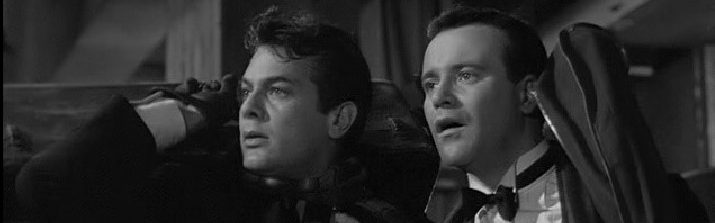
“Whirlpool” (1949) starring Richard Conte, Gene Tierney, Jose Ferrer, & Charles Bickford

Tomorrow she will know what she did tonight! -A tagline (on the movie poster)

Ann Sutton (Gene Tierney), the wife of a well-known psychoanalyst, Dr. William Sutton (Richard Conte), falls prey to a smooth-talking hypnotist, David Korvo (Jose Ferrer), when he discovers she’s a shoplifter. Ann is V ashamed and refuses to reveal her problem (“kleptomania”) to her husband, BUT thinks Korvo may be able to help her out. What are this man’s true intentions? Soon, one of Korvo’s former patients, Teresa Randolph (Barbara O’Neill)- now being treated by Dr. Sutton- is found murdered. When police find Ann at the scene of the crime, suspicion points her way! The man in charge of the case is Lt. James Colton (Charles Bickford), a grizzled cop and recent widower.

David Korvo: You were wise not to tell your husband, Mrs. Sutton. A successful marriage is usually based on what a husband and wife don’t know about each other.

This movie was directed by Otto Preminger, known for his talent and also V difficult personality. However, there is no doubt that he could get fine performances from actors (though his style was NOT pleasant). I think Preminger used close-ups well to build tension in this movie. The screenplay was written by Ben Hecht and Andrew Solt; it was adapted from the novel Methinks the Lady by Guy Endore. The cinematography was by Arthur C. Miller. The music was composed by David Raksin (a protege of Alfred Newman). Noir-istas MAY have noticed, as in the movie Laura (also directed by Preminger/starring Tierney), some of the same works of art appear as here (a standing Buddha and a collection of masks).

Some viewers commented that though the script was weak, the acting was good. Tierney (as always) looks beautiful, acts graceful, and has a sophisticated air. Conte does well, though this isn’t the type of (intense/exciting) role he usually plays; you’ll hear his New York slip out sometimes. I liked the scene where William confronted Korvo in the hospital; we see anger mixed w/ sadness (suppressed tears) in Conte’s eyes. Director Elia Kazan and actor John Garfield “discovered” Conte while he was working at a resort in the Catskills (frequented by members of The Group Theater). They saw his potential and encouraged him to study acting.

Jose Ferrer (no relation to actor Mel Ferrer) was a Puerto Rican actor/director; he won the Best Actor Oscar for playing the title role in Cyrano de Bergerac (1950). He was the 1st Puerto Rican actor to win an Academy Award, and also the 1st Hispanic actor to do so. Ferrer was married for many yrs to singer/actress Rosemary Clooney (aunt of George). Like many of his era, Ferrer came from the theater; he appeared in many Broadway plays (most notably as Iago in Othello: 1943-1944). Here he plays another compelling villain; Korvo navigates high society w/ charm/manners (but is dangerous to know). Who doesn’t like (or like watching) a “bad boy?”

[1] …Preminger’s movie is a compelling little piece of cinema. The central theme of hypnosis as a weapon gives the film a dark edge and Preminger nicely portrays a world containing sympathetically flawed characters.

[2] There’s a lot of pop psychology hokum floating around in the story, which needn’t be gone into, except to say that hypnosis is a curious altered state of consciousness that isn’t well understood at all. Some people are good subjects and some not. The good ones are really good. […] Sometimes, with some people, it really WORKS. I’m not so sure about self hypnosis though. We’ll know more, I guess, in another generation or so.

The surprises are real enough and the story is engaging. Ferrer stands out as the heavy, Tierney with her little girl voice doesn’t have to do much, and Richard Conte as the psychoanalyst is stolid, which is what the role calls for. Worth seeing.

-Excerpts from IMDb reviews

“You Belong to Me” (1941) starring Barbara Stanwyck & Henry Fonda

A JOYOUS REUNION OF THE STARS OF “THE LADY EVE” -Tag line on original movie poster

A young general practitioner, Dr. Helen Hunt (Barbara Stanwyck), meets a millionaire/playboy, Peter Kirk (Henry Fonda) when he crashes at her feet during her vacay at a California ski resort. He insists ONLY she can treat his (minor) injuries; it’s obvious he has a crush on her. After knowing each other for a few days, Peter suddenly proposes marriage- Helen accepts! They marry and settle in his (huge) estate somewhere in LA. On their wedding night, Helen is called away on a medical emergency. When she returns, Peter has fallen asleep. Soon, Peter becomes jealous of her career, getting into physical altercations w/ two male patients (yikes)!

Peter: Are there many lady doctors?

Helen: A few.

Peter: As beautiful as you?

Helen: No doubt.

Peter: The time I’ve wasted being well.

There are (serious) underlying themes in this movie. Remember that this was a time (here in the US) when women (who could afford it) quit their jobs immediately after they got married. Professional women (incl. doctors) made up a small percentage of the workplace. Fonda and Stanwyck make a believable couple, as they have (obvious) romantic chemistry. Stanwyck had great comic timing; Fonda was good at using his physicality for humor. There are some close-up shots of both actors that are gorgeous. Peter is no doubt “problematic” (as the young’uns say today); he goes from sweet/chill to irrational/jealous! As one astute viewer commented: “The Stanwyck character would’ve dumped this guy in 24 hrs in real life.”

The script has some snappy dialogue, as well as a few fine scenes for the supportive players. Billings (Edgar Buchanan) is the grumpy gardener who offers down-to-earth advice to Peter. Moody (Melville Cooper) is the stuffy butler full of sly comments for the entire household. Ella (Maude Eburne) is the understanding nurse/secretary to Helen. I learned that a young Lloyd Bridges (uncredited) plays one of the ski patrol (early in the film).

[1] …feminists would probably be aghast at it.

In fact, Barbara Stanwyck herself didn’t like it at all. She liked working with Henry Fonda right enough, but thought this film was ridiculous. As well she should have.

[2] The first portion at the ski lodge and the next did NOT fit well together, nor did the final “Horatio Alger” inspired section…

[3] In a year where Stanwyck was really busy, three out of four films have become classics. One of them had to be a disappointment, and this is it, albeit a minor one. She was a sexy gold-digger (opposite Fonda) in “The Lady Eve,” a sequin-wearing gangster’s moll nightclub entertainer in “Ball of Fire”, and a hard-as-nails reporter in “Meet John Doe.” Those films all have outstanding screenplays, something this one lacks. The comedy moments are infrequent…

-Excerpts from IMDb comments

Paul Newman’s 1st Movie: “The Silver Chalice” (1954)

A young Greek artist, Basil (Paul Newman), is commissioned to cast the cup of Jesus in silver, and sculpt around its rim, the faces of the disciples and Jesus. He travels to Jerusalem, then eventually, to Rome to complete the task. Meanwhile, a magician, Simon (Jack Palance), is trying to convince Caesar and the Romans that he is the new Messiah. James Dean was offered the role of Basil, but he and his agent thought the script was poor. Newman, who was a finalist for the role of Cal Trask in East of Eden (1955) that eventually was played by Dean, and made him a star, took the role, which Newman later regretted. While shooting East of Eden, Dean went over to visit Newman on the set of this film, where he met the love of his short life, a young Italian actress- Pier Angeli (Deborra, a Jewish merchant’s daughter/convert to Christianity).

I had a cocktail dress. Nero had a cocktail gown. -Newman (joking re: costumes in this movie)

Let’s begin with the good points; it got 2 Oscar noms- one for William Skall’s color cinematography and the other for Franz Waxman’s musical score. A teen Natalie Wood makes a brief appearance. That’s it- sorry to say! The story is boring, it drags b/c of its long running time, and the dialogue is bad (which caused some viewers to laugh). There are some sad-looking (minimalist) sets which were obviously built on a soundstage. No one can call a movie “epic” w/ sets like that! Newman is looking gorgeous (as usual); his legs aren’t “too skinny for a toga,” as he later commented. You can tell he had no direction; he doesn’t seem to know where to turn or how to say a line! As a young actor, Newman said that he was “cerebral, rather than intuitive.” I’ve never heard of this director, Victor Saville, so maybe he left Hollywood? Mayo seems to be sleepwalking, while Palance is SO campy at times (that some viewers admitted they were entertained). Of course there are worse movies than this, BUT you don’t need to watch!


[1] The Silver Chalice is best remembered for a Variety ad that Paul Newman took out after he got famous and apologized for, not only his performance in this film, but also the film itself. Of course, doing something like this is only going to get people interested in the film, so I’m sure many people have watched this because of Newman’s plea for you not to.

[2] They [actors] are hindered by very sketchily written characters and as dreary and stilted a script as you can get… Victor Saville’s direction never comes to life and the story feels overlong, stodgy and over-stretched with scenes that are either stagey, superfluous or unintentionally funny…

[3] Mayo looks as though she just left the chorus line of The Goldwyn Girls and had the artists paint her eyebrows in what someone must have assumed would resemble women of antiquity. She saunters around in her veiled costumes as though she is about to break out into a burlesque queen’s rendition of a bump and grind song number.

-Excerpts from IMDb reviews

“Hollow Triumph” (1948) starring Paul Henreid & Joan Bennett

His scar marked them both!!! -A tagline for the film

John Muller (Paul Henreid) is an educated man-turned-criminal (he dropped out of med school yrs ago) who plans a holdup that goes wrong. Soon, he’s being followed by goons who work for a powerful/vindictive gambler (to whom he owes money). Hiding out, John stumbles onto a chance to assume a new identity, that of respected psychiatrist Victor Bartok, who happens to be his virtual double (aside from a scar on the left cheek). John gets close to Bartok’s secretary, Evelyn Hahn (Joan Bennett), in order to learn more about her employer.

[regaining her composure after mistakenly kissing Muller, thinking he was Dr. Bartok]

Evelyn: What can I do for you?

John: What more could any reasonable man ask?

I learned about this movie on the film noir pod- Out of the Podcast. This is a “Poverty Row” production; this is a slang term used to refer to Hollywood films produced from the 1920s-1950s by small B movie studios (as my noir-istas will know). While some Poverty Row studios had a brief existence, releasing ONLY a few films, others operated on more-or-less the same terms as- if on a smaller scales from- major film studios (MGM, Warner Bros, and Paramount). Though Steve Sekely is credited as the director, Henreid (uncredited) ended up directing the film mostly on his own! Director of Photography John Alton had a prolific career; he wrote one of the 1st book on cinematography. Alton worked on many noir films, incl: He Walked by Night, Witness to Murder, and The Big Combo. He collaborated w/ Spencer Tracy on several films: Father of the Bride, Father’s Little Dividend, and (most notably) The People Against O’Hara.

John: What happened? Did he hurt you?

Evelyn: Do I look hurt?

John: I should say you do.

Evelyn: Well, don’t fool yourself. You don’t get hurt these days.

John: No?

Evelyn: No. It’s very simple. You never expect anything, so you’re never disappointed.

John: You’re a bitter little lady.

Evelyn: It’s a bitter little world full of sad surprises, and you don’t go around letting people hurt you.

When you imagine film noir villain, Paul Henreid is probably NOT in your list -LOL! Henreid (blonde, 6’2″ tall, and best known for Casablanca) decided to produce this film himself, so that he could play a bad guy for once. As my classic film fans will know, Henreid was an immigrant to the US who became a success in Hollywood; he was born in the Austro-Hungarian empire (now a part of northern Italy). I recently learned that his father was an aristocratic banker of Jewish heritage; he changed their last name from “Hirsch” to “Hernreid.” I was skeptical, BUT he makes a compelling character. Henreid (looking posh in his suits) reveals a cold/dangerous side, BUT also keeps some charm/sophistication. You can watch this movie free on YouTube, as it is now in the public domain; the alternative title is The Scar.

Jerry [to John at the garage re: his dream to become a ballroom dancer]: My height, right? Being short isn’t as insuperable a handicap as you might think. If your personality is powerful, you can project the illusion of height.

[1] This is a well-directed, sometimes brutal, atmospheric thriller which is something of a lost classic. It is now available on DVD under its alternative title of ‘The Scar’… Joan Bennett was really made for these films, as she proved in ‘The Woman in the Window’ and ‘Scarlet Street’ for instance. There is something ambiguous about her, something hard that is soft, you can’t quite figure her. That’s just right for noir. You should never be able to figure noir, everything should stay in the shadows where it belongs.

[2] …it sure does raise my opinion of Henreid, who I’ve seen to somewhat underwhelming effect in “Of Human Bondage,” “Casablanca,” and “Meet Me in Las Vegas.” I’ve always felt like he’s just eye candy for the ladies, but in this film he really carries the story with a lot of screen presence and authority. He’s in a very different role from some of those milquetoasts- here he’s a daring, ruthless criminal who steals another man’s identity after a botched casino robbery…

-Excerpts from IMDb reviews

“Born to Be Bad” (1950) starring Joan Fontaine, Robert Ryan, Zachary Scott, Joan Leslie, & Mel Ferrer

Baby-faced Savage in a jungle of intrigue! -A tagline for the movie (featured on the poster)

Donna Foster (Joan Leslie), assistant to publisher John Caine, has agreed that his niece/small-town gal, Christabel Caine (Joan Fontaine), can stay in her apt while she attends business school in San Fran. Donna won’t need the place much longer; she and her philanthropist fiance, Curtis Carey (Zachary Scott), will soon be married. Also, Mr. Caine is preparing Christabel for Donna’s current job. While living w/ Donna, Christabel befriends NOT only Donna and Curtis, but two of her artist pals- struggling painter, Gabriel “Gobby” Broome (Mel Ferrer), and aspiring writer, Nick Bradley (Robert Ryan), who lives next door.

Christabel: You don’t care very much for women, do you?

Gobby: My dear girl, apart from painting my major occupation is convincing women’s husbands that I’m harmless.

RKO had originally scheduled this film to be made 2x previously. This film (directed by Nicholas Ray) was shot in 1949, BUT released a year later. Now, I’m NOT a fan of Fontaine (though my mom likes her in certain roles); I prefer her sister (Olivia de Havilland). I decided to watch this b/c it had Ryan (an actor I’ve admired from several fine noir films). Jeff Bridges said that Ryan was his fave actor- wow! Fontaine isn’t a femme fatale, BUT a conniver who projects the persona of a humble, soft-spoken, guile-less woman. As one astute viewer commented: “she’s reminiscent in her way of a non-show biz Eve Harrington” (All About Eve). Unlike Donna (the hard-working career gal), Christabel has zero interest in work; she quits business school (much to her uncle’s disappointment). Just how bad is she though!?

Nick: [to Gobby, as they both look at Gobby’s painting of Christabel] Looks like a cross between Lucrezia Borgia and Peg o’ My Heart. Even with two heads you couldn’t look like this – or do you know something I don’t?

What does this (above) comment mean? I looked up the references. Lucrezia Borgia (1480–1519) was a Spanish-Italian noblewoman of the House of Borgia who was the daughter of Pope Alexander VI and Vannozza dei Cattanei. According to Mandell Creighton in History of the Papacy, “Lucrezia… was personally popular through her beauty and her affability. Her long golden hair, her sweet childish face, her pleasant expression and her graceful ways, seem to have struck all who saw her.” Lucrezia was known for her cunning and became notorious for suspicious deaths and political intrigue in 16th c. Italy. Peg o’ My Heart was a 1933 Pre-Code film adaptation (there are earlier versions also) of a play by J. Hartley Manners. Marion Davies plays a poor/orphan/Irish girl who stands to inherit a fortune from her wealthy English relatives, if she satisfies certain conditions.

Donna: [to Christabel] I can just hear you, being so helpful – and so helpless. Helping to mess up people’s lives for your own selfish purposes. And just about as “helpless” as a wildcat. Somebody should have told the birds and bees about YOU!

The other reason to see this film (aside from Ryan) is the terrific dialogue; the best (and sometimes biting) lines are given to Gobby (the observer) and Nick. This movie was considered controversial; Gobby is (subtly) characterized as gay and there are (obvious) hints at extramarital sex. Ann Parrish wrote the source novel, All Kneeling, which was adapted by Charles Schnee. The screenplay was by Edith Sommar w/ additional dialogue contributed by Robert Soderberg and George Oppenheimer (who had a prolific writing career in movies/TV shows).

Robert Ryan was an actor first, a star second. He could play the good guy. He could play the bad guy. You name it, he could play it. That’s what good acting is all about. -Ernest Borgnine, co-star of Ryan in 3 movies (TCM tribute)

Nick: [to Christabel] You little fake. Don’t you know what you really want? Make up your mind, and make it up now, because I’m a restless guy.

I liked ALL the scenes between Fontaine (about 5’3″ tall w/ slight build) and Ryan (6’4″/former collegiate boxer), though physically they make an unlikely couple. In the “meet cute” in Donna’s kitchen, Nick jokes w/ Christabel, BUT she’s a little intimidated. At Donna’s party later that night, he’s eager to get to know her and puts on the charm, BUT she doesn’t stay by his side too long. Notice how Ryan’s hand totally swallows up Fontaine’s? Some time passes and Christabel (finally) goes to have dinner at Nick’s place. Ryan’s chest is heaving as they talk just before their 1st kiss. As the romance begins to sour, we see the undercurrent of danger emerge from Ryan (perhaps his trademark). Nick is the one man that Christabel can’t fool!

There is nothing exceptional re: the directing, though Nicholas Ray went to work on some big movies. Though it is set in San Fran, we don’t get many exterior shots of the city or its landmarks (too bad). I liked most of dresses worn by Fontaine and Leslie. One viewer commented: “Ray must’ve had a sense of humor,” as BOTH Nick and Curtis tightly hold and kiss Christabel in the same way- LOL! Much is done w/ sly/knowing looks, though a few viewers commented that they found Fontaine “campy.” The story moved along at a good pace. I got a big kick out of seeing Ryan in domestic settings, being a friend, and esp. – a love interest. Though he gets to play romance in Clash by Night (1952), Nick here is a more fun/intelligent/sophisticated character. However, the romance (w/ Stanwyck) is darker/hotter in the other film. There was another ending shot by Ray for this movie, but the studio rejected it based on moral grounds. You can rent this movie on Amazon Prime.