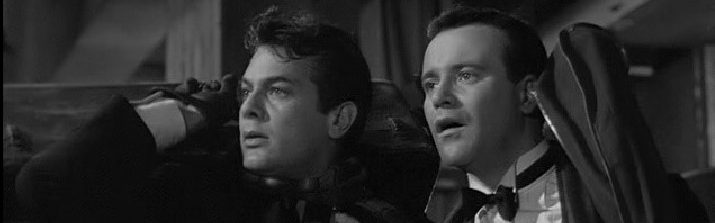
“A Double Life” (1947) starring Ronald Colman, Signe Hasso, Edmond O’Brien, & Shelley Winters

[1] Electrifying suspense, laced with crackling dialogue and melodrama. Winters, in one of her earliest roles, is divine… This film gives new meaning to the phrase “disappearing into a character.”

[2] Milton Krasner’s dark cinematography and Miklos Rozsa’s dissonant score supports George Cukor’s pessimistic direction.

[3] …can an actor get that wrapped up in a role? I heard different things about this. Some actors have admitted taking a role home with them from the theater or movie set. Others have found a role they have to be stimulating, influencing them on a new cause of action regarding their lives or some aspect of life.

-Excerpts from IMDB reviews

Anthony John (Ronald Colman in an Oscar winning role) is a successful/middle-aged/British actor whose life is influenced by the characters he plays. When he’s acting in a comedy, he’s light-hearted and fun to be around. When he’s acting in a tragedy, he becomes brooding and very difficult to handle. That’s the reason why his Swedish ex-wife, Brita (Signe Hasso), divorced him 2 years ago. They still love each other, respectfully work together, but can’t live together. One night, Anthony ends up at a restaurant in Little Italy; he meets a young waitress, Pat (Shelley Winters). He accepts the title role in Shakespeare’s Othello and devotes himself entirely to the challenging part. Anthony begins to suspect that Brita is involved w/ a press agent, Bill (Edmond O’Brien), and grows jealous!

Anthony: You want to know my name- Martin.

Pat: Thank you!

Anthony: Also Ernest and Paul, and Hamlet and Jo and, maybe, Othello. I’m French and Russian and English and Norwegian.

Pat: I got mixed blood too!

The role of Anthony John was written for Laurence Olivier, but he was unavailable when the film went into production. In real life, actor Paul Robeson (the first black actor to star in Othello on Broadway) had just completed the longest run of the play. In the movie, Anthony and Brita act in more than 300 performances of the tragedy; I assumed this was highly unlikely. I learned that most Shakespeare productions on Broadway are lucky to run several months; Richard Burton had a 4 month stint in a 1964 production of Hamlet. Director George Cukor (best-known as a “women’s director”) does a fine job w/ darker subject matter than he usually handles. The script was written by the husband-and-wife team of Garson Kanin and Ruth Gordon. This talented duo also wrote Adam’s Rib (1949) and Pat and Mike (1952), which became films starring two iconic actors (Katharine Hepburn and Spencer Tracy).

Anthony [narrating]: The part begins to seep into your life, and the battle begins. Reality against imagination.

When an actor has to play an actor, I’m sure it’s a challenge. Colman shows the character’s tortured double personality, using costumes, facial expressions, body language, and tone of voice. He reveals what Anthony is going through as himself and as Othello. I esp. liked the witty banter between Anthony and Brita; they seem like a real former couple who turned into close friends. Winters looks sweet, vulnerable, yet also has a bit of toughness; this was her breakout role (after small roles in 20 movies). I learned that she was roommates w/ Marilyn Monroe when they were new to Hollywood. Though they went to a lot of parties, Winters commented that Marilyn always gravitated toward the intellectuals. If you like Shakespeare and film noir (like me), check this unique movie out!

“Fallen Angel” (1945) starring Alice Faye, Dana Andrews, & Linda Darnell

[1] The tainted, ambiguous relationships that Dana Andrews forges… make this film a dark study in romantic pathology. It also features Linda Darnell at her most sultry and mercenary… Andrews’ very layered tension between rich good gal Faye and gold-digging bad girl Darnell keeps the viewer off balance all the way through.

[2] Preminger’s fluid camera work and long takes here reach perfection… Each scene is shot and elaborated with precision, with minimum amount of edits to elucidate the emotions of the characters.

The magnificent chiaroscuro photography by Joseph LaShelle has certain crispness and lucidity…

-Excerpts from IMDB reviews

Stella: What do you do when you don’t tell fortunes?

Eric: I help make ’em for others.

Eric Stanton (Dana Andrews) is thrown off a Greyhound bus for not having enough fare to reach San Francisco. With just a dollar in his pocket, he lands in Walton, a small coastal town. Eric goes to a little diner by the beach and meets the owner, Pop (Perry Kilbride), retired NYC cop Mark Judd (Charles Bickford), and young waitress Stella (Linda Darnell- then only 21 y.o.) An “old friend” of Eric’s, Professor Madley (John Carradine- in a brief supporting role), is coming to the local hotel to hold a “spiritual” (psychic) show. Madley’s assistant, Ellis, laments that there may not be a show, since the former mayor’s daughter (a respected leader) disapproves of “spooks.” Eric (“a promoter”) goes to the Mills house to speak w/ this woman, Clara (Anne Revere- a character actress descended from Paul Revere). She’s unimpressed by his words, but her younger sister, June (Alice Faye), later convinces her to support the show. Then the drama begins!

Stella [to Eric on the beach]: You talk different, sure. But you drive just like the rest. Well, you’ve got the wrong girl.

TCM’s Eddie Muller noted that it’s a shame that this film suffered, as it was compared to director Otto Preminger’s previous film- Laura (1944)- which was a big hit. I saw Fallen Angel recently and really enjoyed it! The story comes from a novel written by a young woman (Mary Hallen); she wrote under a male pen name. Preminger (known for his demanding personality) was one of the best directors of his time; he made Angel Face (1953) and Anatomy of a Murder (1954)- two notable noir movies. He used much of the crew from Laura; we also see Dorothy Adams (Laura’s loyal “domestic”) as Stella’s neighbor. Andrews (who played a straight-shooting NYC cop in Laura) didn’t want to do Fallen Angel, as he disliked his character. I thought he did a fine job playing a charming con man (who can be shady or sweet). He and Darnell have terrific chemistry when they banter and are esp. good at playing the romance angle.

Eric [to June after their first date]: No. One kiss goes a long way with you. You need a guy who will take it the same way. Who will give you marriage, with all the trimmings. Home and kids. Who will walk to church with you every Sunday. Save all your good nights for him.

Faye (at age 28 y.o.) was already a big star in Hollywood; this is why she has top billing. After taking a break to start a family, she was very disappointed w/ how 20th Century Fox finally cut this film. Faye left the studio once she saw that her best scenes were edited out. Instead of balancing out the love triangle, producer Daryl Zanuck put the focus more on Eric and Stella; he was involved in a romantic relationship w/ Darnell during filming. Thus, Eric and June’s relationship comes off as rushed. There is a great scene between Andrews and Faye in the third act. You can see the movie (in HD) below!

“I Wake Up Screaming” (1941) starring Betty Grable, Victor Mature, Carole Landis, & Laird Cregar

Vicky: [waiting on Frankie and his friends: Larry Evans- a columnist and Robin Ray- a Broadway actor] Is that all?

Larry: No, but the rest of it isn’t on the menu.

Vicky: You couldn’t afford it if it was.

NYC promoter Frankie Christopher (Victor Mature), being interrogated by police in the death of model Vicky Lynn (Carole Landis), recalls in flashback: meeting her as a waitress in a Times Square diner, Frankie is sure that her beauty will launch her into high society and a modeling career. Frankie succeeds, perhaps too well; after a few months and many magazine covers, Vicky is about to fly to Hollywood for a screen test, when someone kills her! Now, Frankie gets the feeling that a detective, Ed Cornell (Laird Cregar), is determined to frame him for murder. It turns out that he’s right; he seeks out Vicky’s older sister, Jill (Betty Grable), for help.

Jill: [referring to Cornell, who has been watching Vicky outside the diner] He gives me the creeps.

Vicky: You’ll have to get used to that. We’ve got more wolves in New York than they have in Siberia.

Elisha Cook Jr. (the pint-sized actor who became a staple of noir) plays Harry, the clerk at the hotel where the Lynn sisters live. Grable and Landis do look like they could be related. They have different philosophies about life- Jill is humble and practical; Vicky is ambitious and and thinks big. The cops and newspapers assume and Frankie is upset re: being dumped by Vicky (professionally and personally).

TCM’s Eddie Muller explained that this movie (released by 20th C. Fox and originally Hot Spot) is one of the earliest examples of what came to be known as film noir. Screenwriter Dwight Taylor and the source novel’s author, Steve Fisher, wrote the screenplay. The music in this movie is memorable; “Somewhere Over The Rainbow” (from the 1939 hit The Wizard of Oz) is recycled (maybe too much) as Frankie and Jill’s theme. Vicky’s signature tune is a catchy jazz melody. Watch the full movie below!

[1] Bruce Humberstone directs this attractive early noir with a strong sense of visual style. His Director of Photography, Edward Cronjager, works wonders with elongated shadows and labyrinths of lattice.

Her character has psychological depth, and Grable does justice to the part.

Carole Landis… deserves a special mention. She gives a confident performance and sings beautifully.

[2] A formidable, menacing presence, Cregar rocks in the role. His silky voice and charming smile somehow make him even scarier…

Always an appealing presence, Mature was a better actor than he got credit for, making it look easy. He was hot, too…

-Excerpts from IMDB reviews

“The Man Who Cheated Himself” (1950) starring Lee J. Cobb, Jane Wyatt, & John Dall

Lois: I didn’t know what I was doing! You know the truth!

Ed: The truth can get you twenty years!

In San Francisco, Lois Frazer (Jane Wyatt AKA Spock’s mom in Star Trek), is set to divorce her fortune-hunter husband, Howard. Once he leaves for the airport, she finds out that he bought a gun, and thinks he plans to kill her. Lois frantically calls her lover, who happens to be an experienced homicide detective, Lt. Ed Cullen (Lee J. Cobb). Ed arrives at her house to calm Lois down. Soon after, Howard unexpectedly returns, and she shoots him dead! Ed (though he knows better) feels compelled to cover up the killing. Soon, he’s assigned to investigate the case. His younger brother/new detective, Andy (John Dall), is also assigned and anxious to prove his merit. Andy is getting married in a few days.

Ed: [to Andy] Better learn one thing: never take a case to bed.

We see locations in and around the Golden Gate Bridge, Fisherman’s Wharf, Telegraph Hill and Fort Point (which was used in Hitchcock’s Vertigo). There are some colorful supporting characters who add to the drama. The action (incl. car chase) scenes are done well. TCM’s Eddie Muller explained that this film was made on a small budget and produced by Jack M. Warner, who was fighting w/ his father, the Jack Warner. The son wanted to make films on his own. The director, Felix Feist, was a freelancer (not tied to any studio); he was married to Lisa Howard (who plays Janet- Andy’s wife).

Unlike Dall, Howard’s performance is natural and easy. Andy needed more characterization; he comes off as too dreamy-eyed for a cop. You also have to ignore the fact that Dall (tall/blonde/slim) and Cobb (short/dark-haired/stocky) look and sound nothing alike! It’s rare to see Cobb as a leading man; he tones down the brooding intensity and growling voice (which we know/love from his character roles). Sadly, Cobb and Wyatt (cast against type as the femme fatale) lack romantic chemistry. I did like their last scene together, which was enigmatic and had some smolder! Cobb got this role after a successful run on Broadway in Death of a Salesman. Arthur Miller wrote the role of Willy Loman w/ Cobb in mind -WOW!

[1] …it is relentless and edgy, with no time for polish or emotional depth. Cameraman Russell Harlan (Blackboard Jungle; To Kill a Mockingbird) does a brilliant job with great angles and framing. It isn’t elegant, but it’s visually sharp.

[2] A fast, curious, edgy crime film that depends on a fabulous, simple twist, which you learn right at the start and keeps you on the edge of your seat the whole time. The clash of two cops who are brothers begins innocently, and turns and builds in a very believable way

Lee J. Cobb… just perfect in his role, right to the last scene when you see him look down the hall with the same feeling he has at the beginning of the film.

-Excerpts from IMDB movies

“Pitfall” (1948) starring Dick Powell, Lizabeth Scott, Jane Wyatt, & Raymond Burr

Sue Forbes: Oh, your breakfast is on the table, darling.

John Forbes: Where else would it be?

John Forbes (Dick Powell) is a middle-aged man bored w/ his predictable life and job as an insurance adjuster. His lovely wife, Sue (Jane Wyatt- later Spock’s mom), and adoring son, Tommy, make up his family. Forbes meets a young/blonde aspiring model, Mona Stevens (Lizabeth Scott), whose fiance embezzled from a store insured by Forbes’ company. He finds Mona through J.B. MacDonald (Raymond Burr- later the iconic Perry Mason), a private detective freelancing for the insurance company. Forbes goes to collect the stolen gifts and soon falls for Mona (who says she rarely meets nice men like him). MacDonald (w/ an obsessive personality and violent temper) also has his eyes on Mona, though she wants nothing to do w/ him!

MacDonald: She probably doesn’t appeal to you but for me, she’s just what I told the doctor to order.

This film (see video below) is a combination of domestic drama and film noir set in L.A. and its surrounding suburbs. Powell took this role after reconciling w/ his wife (June Allyson) after he had an affair, TCM’s Eddie Muller noted. To get past the Hayes Code office, that would normally not allow a good guy to be an adulterer (and suffer no consequences), director Andre De Toth (an immigrant from Hungary) met w/ two prominent officials. De Toth let these (married) men know that he knew of their mistresses; the production didn’t have any problems after that meeting- LOL! Muller also explained that though the director was married to Veronica Lake, he had a reputation as a philanderer.

[1] Powell, Wyatt, Scott and Raymond Burr are effective and believable — and the film is paced, photographed, and scripted with intelligence — so that the viewer easily goes along for the ride.

[2] Jay Dratler’s script (from his own novel) shows a progressive streak in dealing with the short and unpredictable fuses of controlling, potentially violent males- stalkers.

Powell gets to tap deeply into his key emotion, snappish discontent… Scott… an actress with limits, finds a comfortable part as a bewildered and vulnerable victim of the men who come into her life, bidden and unbidden. Burr …lets a bit of yearning, of desperation, show under all his intimidating bulk…

De Toth… made, in Pitfall, one of the more distinctive titles of the noir cycle. …it has the effrontery to situate deceit and duplicity and betrayal where it surely ought not to belong- not in road houses or tenement flats- but right at the heart of a storybook American family (it’s one of the more subversive films of the era).

-Excerpts from IMDB reviews