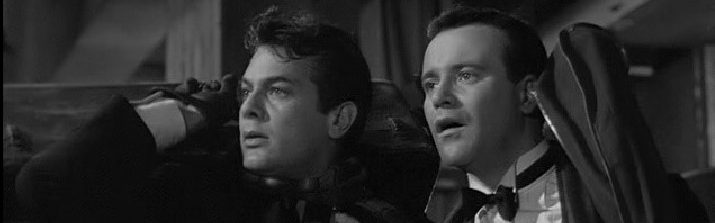
Hitchcock’s 50th Film: “Torn Curtain” (1966) starring Paul Newman & Julie Andrews

Prof. Michael Armstrong (Paul Newman- the hottest scientist ever) is heading via boat to Copenhagen to attend a conference w/ his assistant/fiancée, Sarah Sherman (Julie Andrews). Once they arrive, Michael informs her that he’ll be staying for a while and she should go home. Sarah follows him and realizes Michael is actually going to East Germany (behind the Iron Curtain). She is shocked when Michael announces that he’s defecting; the U.S. government cancelled his project after 6 yrs. In truth, Michael is there to get info (which a professional spy couldn’t understand) from another nuclear physicist!

I did not have to act in ‘Torn Curtain’. I merely went along for the ride. I don’t feel that the part demanded much of me, other than to look glamorous, which Mr. Hitchcock can always arrange better than anyone. I did have reservations about this film, but I wasn’t agonized by it. The kick of it was working for Hitchcock. That’s what I did it for, and that’s what I got out of it. -Julie Andrews

The idea behind this film came from the defections of British diplomats (Guy Burgess and Donald Maclean) to the Soviet Union in 1951. Sir Alfred Hitchcock was very intrigued re: Maclean’s life in the Soviet Union, incl. about Melinda Marling (his wife) who followed her husband a year later w/ their three children. In the end, Hitch was so unhappy w/ this movie that he didn’t make a trailer w/ his appearance in it (as was his habit). Bernard Herrmann (composer) wrote an original score, but Universal execs convinced the director on something more upbeat. Hitchcock and Herrmann had a big fight and never worked together again! Steven Spielberg admitted on Inside the Actors Studio (1994) that as a young man he snuck onto the soundstage; he was there for 45 mins. before an assistant producer asked him to leave.

I think Hitch and I could have really hit it off, but the script kept getting in the way. -Paul Newman

The working relationship between Hitch and Newman was problematic; the actor came from a different generation than Cary Grant and James Stewart. He questioned the director re: the script and his characterization, which Hitch later said he found “unacceptable and disrespectful.” As a Method actor, Newman consulted Hitch about his character’s motivations; Hitch replied that his “motivation is your salary.” Also, no romantic chemistry developed between Newman and Andrews (another disappointment to the director). Though the screenplay drags along, the colorful Eastern European supporting actors do fine w/ what they are given. Many critics/viewers recalled the (memorable) killing scene where Gromek fights Armstrong and a housekeeper in the farmhouse.

[1] Pity. I love Hitchcock. There is a detachment here never seen before in a Hitch flick. As if the master was tired or uninterested.

[2] The main thing about Torn Curtain is the photography. It’s full of pretty pictures- one of the most beautifully filmed of all Hitchcock’s films, with lots bold swaths of primary colors and attractive and constantly changing locations…

[3] This was Alfred Hitchcock’s last star vehicle. At the time this was made Julie Andrews was fresh from Mary Poppins and had all kinds of roles offered her. …she and Newman really have no chemistry at all.

-Excerpts from IMDB reviews

Two Early Noir Films starring Alan Ladd & Veronica Lake

This Gun for Hire (1942)

Gates: Raven… how do you feel when you’re doing…

[indicates murder headlines]

Gates: this?

Raven: I feel fine.

Hit man Philip Raven (Alan Ladd), who’s kind to kids and stray cats, kills a blackmailer and is paid off by Willard Gates (Laird Cregar) in “hot” $10 bills. A magician and girlfriend of a cop, Ellen Graham (Veronica Lake), is enlisted by a Senator to help investigate Gates, who is an exec at the Nitro Chemical Company. Raven, following Gates to get revenge, meets Ellen on a train from San Fran to LA. They eventually go from killer and potential victim to working together against a common enemy.

Ruby: What’s the matter? You look like you’ve been on a hayride with Dracula.

This tightly edited (81 mins.) early noir is loosely based on This Gun For Hire by Graham Greene. This was one of the earliest American films released in the years of WWII which specifically takes place in wartime; it opened 5 mos. after the bombing of Pearl Harbor. The petite/delicate-featured Lake was paired up w/ boyish newcomer Ladd (who was a good match at only 5’6″). The movie bills Lake and Robert Preston above the title, Cregar just below the title, and Ladd last in big type as “Introducing Alan Ladd.” However, Ladd had appeared in 40+ films in unbilled and minor parts.

[1] This is a straight-forward, linear, quick-moving story… …it’s still an entertaining movie, and probably close to required viewing if you enjoy noir and/or Forties movies.

[2] While many period pieces are “appreciated”, this one still provides a jolt of adrenaline right from the opening scene… He’s a bad man, no doubt about it, and his portrayal throughout most of the movie is surprisingly dark, even by today’s standards.

[3] This was Ladd’s breakthrough movie and he’s very good in it. I don’t think he was much of an actor, but he had a lot of star presence, especially in the movies he made in the Forties. There was always something passive but potentially dangerous about him. His looks could have kept him in the pretty boy category, but for whatever reason didn’t.

-Excerpts from IMDB reviews

The Blue Dahlia (1946)

Johnny: [after being picked up] You gotta have more sense than to take chances with strangers like this.

Joyce: It’s funny but practically all the people were strangers when I met them.

When naval officer Johnny Morrison (Ladd) comes home to LA, he finds his wife, Helen (Doris Dowling), partying and kissing another man, Eddie Harwood (Howard Da Silva), the owner of The Blue Dahlia nightclub. Helen admits her drunkenness caused a car accident which resulted in the death of their young son. Johnny pushes her around some, then pulls a gun on her, but then runs out. Johnny is picked up by a young woman (Lake) in the rain. Later, Helen is found dead and Johnny becomes the prime suspect. Meanwhile, Johnny’s two war buddies get an apt in town, and then are questioned by the cops.

Elizabeth Short (a young aspiring actress) got the nickname “The Black Dahlia” from a bartender at a Long Beach bar she frequented. This film was playing at a theater down the street, and the bartender got the name wrong. Elizabeth kept the nickname, adding a flower to her hair to complete the transformation. She was murdered the next year (1947). The local newspapers dubbed the case the “Black Dahlia” (the murder case is still unsolved).

Johnny: Every guy’s seen you before somewhere. The trick is to find you.

The screenplay was written by Raymond Chandler; he claimed that producer John Houseman was in “the doghouse” and director George Marshall “was a stale old hack”, so Chandler went on to the Paramount set to direct some of the scenes himself. Chandler was unhappy with Lake’s performance; he called her “Miss Moronica Lake” and complained in a letter: “The only times she’s good is when she keeps her mouth shut and looks mysterious. The moment she tries to behave as if she had a brain she falls flat on her face.” A few scenes were cut b/c he claimed Lake messed up too badly. The ending was changed b/c the Naval War Office objected.

[1]… Bendix steals the show as a G.I. who suffered brain damage in World War II. He is something to see and his wise-cracking lines are some of the best ever delivered in a film noir.

[2] … strikes all the right ultra-tough chords, and although Veronica Lake is a rather wooden actress she is remarkably beautiful and as a team the pair has considerable chemistry [w/ Ladd].

The film cracks along at a rapid pace with plenty of action and a surprise twist or two that will keep you guessing to the very end.

[3] It’s a very bleak tale of returning war veterans’ findings when they reach “home.” Unfaithful wife, hoodlums, and just general corruption and bleakness. The scenes with Veronica Lake are the shafts of light in this one’s blackness.. all in all it conjours up dark images in one’s mind.

-Excerpts from IMDB reviews

“3:10 to Yuma” (1957) starring Glenn Ford & Van Heflin

Alice: It seems terrible that something bad can happen and all anybody can do is stand by and watch.

Dan Evans: Lots of things happen where all you can do is stand by and watch.

After a stagecoach robbery/shootout, notorious outlaw Ben Wade (Glenn Ford) is captured in a small town by a sheriff and few locals. One of them is a struggling rancher/family man, Dan Evans (Van Heflin), who volunteers to escort Wade to the nearest town w/ a railway station. Dan desperately needs the $200 which the stagecoach company’s owner offered as a reward. Once the two men are holed up in the hotel to await the 3:10 to Yuma, a battle of wills ensues. All the while, Ben’s gang is gathering to break him out.

Emmy: Funny, some men you see every day for ten years and you never notice; some men you see once and they’re with you for the rest of your life.

Even if you’re not a big fan of Westerns, you’ll find a lot to enjoy in this must-see film! The screenplay (which includes sly moments of humor) was adapted from a story by Elmore Leonard. There are gorgeous shots of the desert, intimate close-ups, music, exciting action sequences w/ horses and guns. Although most Westerns by this time were being produced in color, director (Delmer Daves) and cinematographer (Charles Lawton Jr.) chose to shoot in black and white.

I thought all the actors (including the supporting ones and two boys) hit the right notes. Ford was originally offered the role of Dan Evans; he refused and suggested himself for the role of Ben Wade. This is one of Ford’s (rare) bad guy roles; he’s still charming and likable. Heflin (who worked on many Westerns) and Ford play off each other very well. Ford has sparkling chemistry w/ Felicia Farr (the beautiful/lonely barmaid, Emmy). There are touching scenes between Heflin and Leora Dana (his devoted/refined wife, Alice).

Ben Wade: I mean, I don’t go around just shootin’ people down… I work quiet, like you.

Dan Evans: All right, so you’re quiet like me. Well then, shut up like me.

The scenes of Contention City were shot in Old Tucson, which is not far from where I grew up. Some critics/viewers consider this a film of a man reclaiming his masculinity. I also see it as a community struggling to do the right thing, though under enormous threat. This film, along w/ High Noon (1952), was a deciding factor in Howard Hawks deciding to make Rio Bravo (1959), a return to more optimistic Westerns. This is one of Patton Oswalt’s favorite movies; he introduced it on TCM several years ago.


“Beyond a Reasonable Doubt” (1956) starring Dana Andrews & Joan Fontaine

Tom Garrett (Dana Andrews) is a reporter on leave from his newspaper to write his second book. Since he has writer’s block, his publisher/friend, Austin Spencer (Sidney Blackmer), suggests an idea for a non-fiction book on capital punishment. Austin thinks the local DA, Roy Thompson (Philip Bourneuf), is using the death penalty in the hopes of getting into the governor’s mansion. Tom and Austin decide to frame Tom for a murder he didn’t commit, in the hopes of showing how easily a man could be found guilty (w/ only circumstantial evidence). They decide to keep Tom’s fiancee/Austin’s daughter, Susan (Joan Fontaine), out of the loop.

Austin: You get engaged to my daughter, and all you can think about is capital punishment?

This was the last American film made by Fritz Lang (an iconic noir director) before returning to his native Germany; he fled in 1934 b/c of the rise of the Nazis (being Jewish). Lang chafed against the Hollywood studio system when producers wanted to impose their ideas on his vision. This film (shot in only 20 days- wow) is a legal drama and noir rolled into one. Instead of a cop, we follow a journalist (which was common for the noir genre). Though it’s not in Lang’s usual style, I thought it was riveting from the start. Some viewers said the movie looked more like a TV show; TV was on the verge of becoming big in the mid-1950s. The dialogue is smart, pacing well-done, and the acting is good (down to the small roles).

Dolly: This guy’s got a lot of class.

Terry: Yeah? If he’s got so much class, what’s he doin’ with you?

Andrews and Fontaine make an elegant couple; they’re also fine actors who understand subtlety. Fontaine gets some classy outfits to wear, too. I think she looked more interesting in her 30s and somewhat baby-faced in her 20s. I wish she had more to do. One of the burlesque dancers, Dolly Moore (Barbara Nichols), brings some humor to the story. Moore looks/acts like a taller a and more streetwise version of Marilyn Monroe; she was in Sweet Smell of Success (1957) opposite Tony Curtis and Burt Lancaster.


[1] The main strengths of this movie… its lively pace, its wonderfully bizarre plot and the unexpected twists which make it so intriguing and enjoyable to watch.

[2] Andrews and Fontaine are not a bad pair—both are matched in calm and sophistication, and beauty, even, though Fontaine seems like an accessory until the very end. Andrews rules the plot, which makes him out to be a writer desperate for a new story.

[3] This is perhaps Lang’s best assault on the American justice system; he has created a story that is interesting and very plausible and it works a treat in that it gets you thinking about the fact that with this kind of law; someone really could be killed for something they didn’t do.

It is efficient story telling at it’s best and this is one of the highlights of the film noir era.

-Excerpts from IMDB reviews

“The Naked Street” (1955) starring Farley Granger, Anthony Quinn, Anne Bancroft, & Peter Graves

Expect a fast progression, some good solid filming, and acting that holds its own. The director, Maxwell Shane, is really more of a screenwriter, and so it figures the writing here is pretty good (he co-wrote, too).

Quinn is wonderful as the tough gangster who isn’t afraid to push people around to get what he wants. For 1955 his performance is pretty raw and rough…

…Quinn delivers a scary and riveting performance. The actor’s just back from Italy where he starred in the powerful classic La Strada (1954). So maybe he was trying to show Hollywood a thing or two, since he delivers a lot more than the role requires. Then there’s Bancroft, already a magnetic personality, and on her way to an Oscar-studded career.

-Excerpts from IMDB reviews

In this short/lesser-known noir film, Brooklyn-raised gangster, Phil Regal (Anthony Quinn), finds out that his younger sister, Rosalie (Anne Bancroft), is pregnant by a local punk, Nicky Bradna (Farley Granger). She insists that she loves this man, though he’s on death row for a murder committed during a robbery. Regal’s henchmen scare all the witnesses to change their testimony, so Nicky is released, and free to marry Rosalie. Soon, Phil regrets what he did for Nicky, who isn’t content to be an honest working man/devoted husband. A young journalist, Joe McFarlan (Peter Graves), is also investigating Regal’s business activities.

We see how criminals don’t just come out of the blue, but are a product of their environment (which must’ve been risky to show in the mid-50s). The story itself is far-fetched, but the acting and dialogue will keep you interested. Quinn (around 40 y.o.) creates a compelling underworld character who’ll go to any length to protect his sweet immigrant mom and naive little sister. I got a kick out of seeing 23 y.o. Bancroft; she was striking w/ large expressive eyes. I learned that both her parents were Italian immigrants to NYC; Quinn’s heritage is Mexican (mother) and Irish (father). Graves (younger brother of Gunsmoke‘s James Armess) looks handsome in a conventional way (athletic/square-jawed/thick hair); later he’d become famous on TV also (Mission: Impossible). This was one of Granger’s last (movie) roles; he decided to focus on theater soon after (which was his first love). Fans of soap operas may also recognize a sassy/young Jeanne Cooper (in a small/uncredited role); she was also the mother of L.A. Law star Corbin Bernsen.