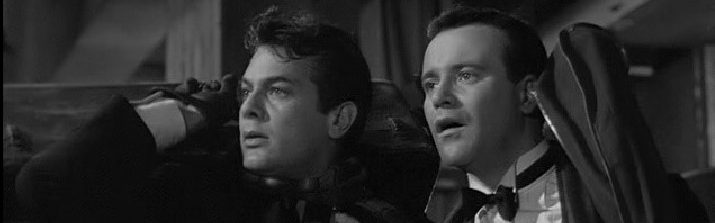
“Murder by Contract” (1958)

Claude (Vince Edwards) is a young man who recently held a regular job and has no history of trouble w/ the law. He also has the arrogance, intelligence, and emotional detachment to become a hit man, as he proves to Mr. Moon (a go-between to a crime boss). A string of successful hits on the East Coast gets Claude sent to LA for his latest job. He is accompanied by two minders (George and Marc): one is often nervous (Herschel Bernardi) and the other comes to admire Claude for his cool demeanor (Phillip Pine). Though self-assured in his previous kills, Claude becomes unglued learning that the target is a woman. She’s a witness set to testify against Clause’s boss, so under police protection 24/7. Claude is worried b/c women are unpredictable- they don’t do what you expect!

Claude: The only type killing that’s safe is when a stranger kills a stranger. No motive. Nothing to link the victim to the executioner. Now why would a stranger kill a stranger? Because somebody’s willing to pay. It’s business. Same as any other business.

I’m sure that the writer was thinking of Hitchcock’s Strangers on a Train (1951) when he came up w/ the above lines! You have to be in a certain mood to enjoy this type of movie; it has a lot of style, though not much dialogue. Edwards looks a bit dangerous, yet also handsome, and is comfortable in his role. He is tall (6’2″), athletic (a former swimmer), w/ thick dark hair and dark eyes. The film has some comic moments when Claude unsettles the two men sent to accompany him. Scorcese and Tarantino consider this to be one of their favorite B-movies.

[1] Is he worried about killing her because he has more moral fiber than he would like to admit or is it genuinely harder to kill a woman? Whatever the case, this is a fascinating look into a dangerous mind.

[2] Stylish direction and some interesting camera work compliment a thoughtful script. Be watching for one particularly unsettling scene which unfolds in a barber shop.

[3] Vince Edwards’ character… was also fun to enjoy. His dialogue, and just the way he carried himself through this film, was fascinating.

-Excerpts from IMDB reviews

Hitchcock Takes on Psychoanalysis: “Spellbound” (1945) starring Ingrid Bergman & Gregory Peck

Title Card: The fault… is not in our stars, but in ourselves… – Shakespeare

Dr. Constance Petersen (Ingrid Bergman) is a young psychiatrist who has been working for 6 mos. at Green Manors mental institute in Vermont. In between dealing w/ her patients and reading the latest theories, she has to deal w/ a doctor incessantly hitting on her. The director of Green Manors, Dr. Murchison (Leo G. Carroll), has just been replaced; his replacement is the young Dr. Anthony Edwardes (Gregory Peck), who has published several books (incl. one focused on “the guilt complex”). Romance quickly develops between Dr. Petersen and Dr. Edwardes, but then he starts to show strange aversions and personality traits. It turns out that he has amnesia! Could he be guilty of a crime, or is it all in his head? What happened to the real Dr. Edwardes?

Dr. Petersen: I think the greatest harm done the human race has been done by the poets. …They keep filling people’s heads with delusions about love… writing about it as if it were a symphony orchestra or a flight of angels.

Suspicion was of the first Hollywood films to deal w/ the (then popular) subject of psychoanalysis; screenwriter Ben Hecht consulted w/ several psychoanalysts of that time. Producer David O. Selznick wanted the movie to be based on his experiences, even bringing in his psychotherapist as a technical advisor. When she argued w/ Sir Alfred Hitchcock on the set, the director replied, “My dear, it’s only a movie.” Later, Hitch summed up the movie as “just another manhunt wrapped up in pseudo-psychoanalysis.” If the psychology angle doesn’t interest you, the love story certainly will! Bergman and Peck have terrific chemistry; as a kid, I wondered if they really were in love. In 1987 (5 yrs after she died), Peck revealed to People magazine that he “had a great love for Bergman.” They had an affair for a few weeks during filming (though both were married)!

Dr. Alex Brulov: Apparently the mind is never too sick to make jokes about psychoanalysis.

The much-discussed dream sequence (designed by painter Salvador Dali) was originally 20 mins long, but ended up being 2 mins. Hitch handed over that segment to director William Cameron Menzies, who is not credited (as he didn’t like the final edit). The music (composed by Miklos Rozsa) is also a prominent aspect enhancing the story. Jerry Goldsmith said he loved the score; it inspired his own music. Some Star Wars fans have pointed out the Anakin and Padme’s love theme (composed by John Williams) sounds similar to the love theme here!

I couldn’t produce the facial expressions that Hitch wanted turned on. I didn’t have that facility. He already had a preconception of what the expression ought to be on your face, he planned that as carefully as the camera angles. Hitchcock was an outside fellow, and I had the Stanislavski training from the Neighborhood Playhouse, which means you work from the inside. –Gregory Peck

[1] Now the best thing about ‘Spellbound’ and what really makes it into a wonderfully entertaining mystery/romance is Ingrid Bergman and Gregory Peck. These two Golden Age superstars are both absolutely wonderful individually, but together they are magical

[2] The scenes with Bergman, Peck and Chekhov are the highlight of the film, and I have to admit that I’m even kind of fond of the hotel lobby scene, with the appealingly breezy Bill Goodwin (of “Burns and Allen” radio fame) as the house detective. Peck has never been more handsome, in a strangely fragile way.

[3] Most of the picture is thrown Bergman’s way and she is such an accomplished actress and lights up the screen with such a charismatic inner radiance

-Excerpts from IMDB reviews

“Kiss Me Deadly” (1955)

Christina: You have only one real lasting love.

Mike: Now who could that be?

Christina: You. You’re one of those self-indulgent males who thinks about nothing but his clothes, his car, himself. Bet you do push-ups every morning just to keep your belly hard.

A scared young woman in a raincoat is running barefoot on the highway, trying to flag down a car. After some cars pass her by, the woman sees a fancy sports car approaching and stands directly in its path! PI Mike Hammer (Ralph Meeker) is behind the wheel, and after almost hitting the woman, he tells her to get in. The woman’s name is Christina Bailey (Cloris Leachman in her first movie role); she’s on the run from a mental institution (“laughing house”). Whoever was after her eventually catches up w/ them! Christina dies while being questioned under some sort of torture. The killers fake an accident by pushing Hammer’s car off the road; he survives and wakes up in hospital. Mike starts to investigate Christina’s death, even after told by the police (and FBI) to stay out of it.

In the hands of the director Robert Aldrich, the film becomes a starting point for a delirious expression of 1950s anxiety and paranoia, starting with opening credits that run backwards…

Noir b&w has never been photographed (Earnest Laszlo) more effectively than some of those night scenes… plus the long, dark hallways and staircases that suggest an enclosed world without redemption.

Right from the electric opening scene and the audacious opening credit sequence, the audience is drawn into Hammer’s seedy world, where morality is suspended, and the credo of the end justifying the means dominates Hammer’s actions.

 The “great whatsit” which Hammer searches for is one of the great movie gimmicks…

-Excerpts from IMDB movies

Based on Mickey Spillane’s novel and adapted by Al Bezzerides, the movie has an unique style and it’s recommended for fans of film noir. The story is transported from NYC to LA; the suitcase filled w/ drugs (too controversial) becomes something more dangerous.This is one of the first instances where a car in traffic looks realistic. Aldrich strapped a camera to the back of Hammer’s car. Martin Scorcese and Quentin Tarantino were influenced by this B movie.

Velda: Do me a favor, will you? Keep away from the windows. Somebody might… blow you a kiss.

It’s implied the characters have a sex life. Some of the camera angles are modern and unusual. The supporting characters are diverse; we see Greek and Italian immigrants, a black boxing coach (Juano Hernandez from The Breaking Point), and a nightclub singer and bartender (who are also black). The acting is a mixed bag, but Meeker does a fine job as the tough, unflinching protagonist; he was a theater actor. We hear a song by Nat King Cole in the opening (“I’d Rather Have the Blues”). You can watch the movie on YouTube (for free)!

Hitchcock’s “Dial M for Murder” (1954) starring Ray Milland, Grace Kelly, & Robert Cummings

In London, wealthy Margot Wendice (Grace Kelly) had an affair w/ an American mystery writer, Mark Halliday (Robert Cummings), while her husband/pro tennis player, Tony Wendice (Ray Milland), was on tour. Tony quit playing to dedicate more time to his wife and work at a regular job. A year later, Mark arrives from NYC to visit the couple. Margot tells him that she destroyed all his letters, but one was stolen. She was blackmailed, but she had never got that letter back. Tony arrives home and says he needs to finish up a report; he tells Margot and Mark to attend the theater w/o him. Tony calls Capt. Lesgate (AKA Charles Alexander Swann), a man who went to college w/ him. (Sir Alfred Hitchcock can be seen on the left side of the college reunion photo.) When Lesgate arrives, Tony blackmails him to murder Margot, so that he can inherit her money. Tony has a plan, but (of course)- there is no such thing as a perfect crime!

Margot: Do you really believe in the perfect murder?

Mark: Mmm, yes, absolutely. On paper, that is. And I think I could, uh, plan one better than most people; but I doubt if I could carry it out.

Tony: Oh? Why not?

Mark: Well, because in stories things usually turn out the way the author wants them to; and in real life they don’t… always.

The film is adapted from a Broadway play that opened in the Fall of 1952; it ran for 500+ performances. John Williams (who almost steals the movie) and Anthony Dawson re-created their stage roles of Chief Inspector Hubbard and Capt. Lesgate. Hitch wanted Cary Grant in the role of Tony, but Warner Brothers felt that he’d be wrong as a villain (as did the actor himself). Deborah Kerr, Olivia de Havilland, and William Holden were also considered for roles. Hitchcock made a special effort to shoot indoors; only a few shots take place outside the London apt. (which is small, but expensive). The director created a sense of claustrophobia (which we’re familiar w/ in this COVID-19 crisis when quarantining in our homes)!

Kelly wears some great clothes, incl. a gorgeous red evening dress w/ a lace shrug and matching red heels. In the pivotal scene where Margot gets out of bed to answer the phone, she was originally suppose to wear a red velvet robe. Kelly explained to Hitch: “This robe would be perfect in Lady Macbeth’s sleepwalking scene, but not something I would wear just to answer the phone.” He then asked her what she would wear; the actress replied: “just a light nightgown.” Hitch agreed to the change, so Margot wears a white nightgown w/ some lace detail.

Dial M for Murder has inspired remakes/re-imaginings, incl. A Perfect Murder (1998) starring Michael Douglas, Gwyneth Paltrow, and Viggo Mortensen. A Perfect Murder influenced Humraaz (a 2002 Bollywood film). Tony admits that he married for money; however in the movies mentioned above, the wives are the ones who are gold-diggers (as well as unfaithful). Hmmm… I wonder why that change was made? You can watch the film (for free) on YouTube; see link below!

[1] I had forgotten that most if not all of it happens in one single room. The planning of it is a display of extraordinary craftsmanship. Not a lagging moment.

[2] Dial M for Murder succeeds on many levels, and it is largely thanks to some superb dialogue… The cast are a treat. Ray Milland is an absolute gem, extremely sly and dispassionate, yet a character so full of self-assurance that one almost sides with him. Grace Kelly… emanating the poised, beautiful being, that is vulnerable, yet oddly unassailable. And John Williams, as the police detective, is quite wonderful.

[3] …Mr. Hitchcock’s camera dutifully follows everything as the scheme goes along. And, before we realize it, if something starts to go wrong, we become scared and tense.

-Excerpts from IMDB reviews

“A Double Life” (1947) starring Ronald Colman, Signe Hasso, Edmond O’Brien, & Shelley Winters

[1] Electrifying suspense, laced with crackling dialogue and melodrama. Winters, in one of her earliest roles, is divine… This film gives new meaning to the phrase “disappearing into a character.”

[2] Milton Krasner’s dark cinematography and Miklos Rozsa’s dissonant score supports George Cukor’s pessimistic direction.

[3] …can an actor get that wrapped up in a role? I heard different things about this. Some actors have admitted taking a role home with them from the theater or movie set. Others have found a role they have to be stimulating, influencing them on a new cause of action regarding their lives or some aspect of life.

-Excerpts from IMDB reviews

Anthony John (Ronald Colman in an Oscar winning role) is a successful/middle-aged/British actor whose life is influenced by the characters he plays. When he’s acting in a comedy, he’s light-hearted and fun to be around. When he’s acting in a tragedy, he becomes brooding and very difficult to handle. That’s the reason why his Swedish ex-wife, Brita (Signe Hasso), divorced him 2 years ago. They still love each other, respectfully work together, but can’t live together. One night, Anthony ends up at a restaurant in Little Italy; he meets a young waitress, Pat (Shelley Winters). He accepts the title role in Shakespeare’s Othello and devotes himself entirely to the challenging part. Anthony begins to suspect that Brita is involved w/ a press agent, Bill (Edmond O’Brien), and grows jealous!

Anthony: You want to know my name- Martin.

Pat: Thank you!

Anthony: Also Ernest and Paul, and Hamlet and Jo and, maybe, Othello. I’m French and Russian and English and Norwegian.

Pat: I got mixed blood too!

The role of Anthony John was written for Laurence Olivier, but he was unavailable when the film went into production. In real life, actor Paul Robeson (the first black actor to star in Othello on Broadway) had just completed the longest run of the play. In the movie, Anthony and Brita act in more than 300 performances of the tragedy; I assumed this was highly unlikely. I learned that most Shakespeare productions on Broadway are lucky to run several months; Richard Burton had a 4 month stint in a 1964 production of Hamlet. Director George Cukor (best-known as a “women’s director”) does a fine job w/ darker subject matter than he usually handles. The script was written by the husband-and-wife team of Garson Kanin and Ruth Gordon. This talented duo also wrote Adam’s Rib (1949) and Pat and Mike (1952), which became films starring two iconic actors (Katharine Hepburn and Spencer Tracy).

Anthony [narrating]: The part begins to seep into your life, and the battle begins. Reality against imagination.

When an actor has to play an actor, I’m sure it’s a challenge. Colman shows the character’s tortured double personality, using costumes, facial expressions, body language, and tone of voice. He reveals what Anthony is going through as himself and as Othello. I esp. liked the witty banter between Anthony and Brita; they seem like a real former couple who turned into close friends. Winters looks sweet, vulnerable, yet also has a bit of toughness; this was her breakout role (after small roles in 20 movies). I learned that she was roommates w/ Marilyn Monroe when they were new to Hollywood. Though they went to a lot of parties, Winters commented that Marilyn always gravitated toward the intellectuals. If you like Shakespeare and film noir (like me), check this unique movie out!