“The Phantom of the Opera at the Royal Albert Hall” (2011)

In 1986, Andrew Lloyd Webber’s The Phantom of the Opera arrived on the West End stage. After 25 years, the musical achieved global success, millions of viewers, a film adaptation in 2004 (which I don’t recommend) and a sequel. Filmed at the Royal Albert Hall, this performance (which you can rent on YouTube) brings the show to a bigger stage and celebrates its role as one of the biggest shows in theater history, w/ speeches, performances, and appearances by the original cast (and some notable Phantoms). Starring Ramin Karimloo and Sierra Boggess, POTO tells the story of a deformed musical genius who lives underneath the Paris Opera House. Shunned by society, the Phantom seeks revenge (w/ cruel and violent acts). He’s in love w/ a chorus girl, Christine Daaé, who he has been secretly training to replace the leading lady.

Karimloo (who is Canadian) is engaging and very effective w/ his gorgeous voice and imposing physical presence. One side of his face looks genuinely scary; this was done by the original makeup artist. Boggess (who is American) is charming and her stage presence is as strong as Karimloo’s. Her soprano voice is bright and clear. She esp. does a terrific job w/ Wishing You Were Somehow Here Again. Past of the Point No Return was very compelling; two leads show that they have great chemistry together (even though The Phantom has on a hooded cloak). I learned that Boggess was the original Ariel in Broadway’s The Little Mermaid.

The encore featured 4 different Phantoms from around the world and was the debut for one of them: Peter Jöback from Sweden. He was scheduled to play the Phantom after the concert in London. The other 3 Phantoms who sing are: Colm Wilkinson (who is Irish; the original Canadian Phantom and Jean Valjean in Les Mis in London and NYC), John Owen-Jones (London’s longest running Phantom). and Anthony Warlow (Australia’s most famous Phantom). The original Phantom, Michael Crawford, was also there, as was the incomparable Sarah Brightman (the original Christine; former wife of Webber). I remember buying her CDs in HS.

The camera work allows you to admire the production design and does so unobtrusively, often it has a very cinematic look…

Hadley Fraser has a different take on the childhood sweetheart of Christine. Fraser brings an energy and eagerness to the character. I loved Fraser because he brings a new energy and charisma to the character.

[Karimloo] is both very threatening and very vulnerable. He is both aggressor and victim. He captures the fragility of the Phantom’s mind and the strength of the Phantom’s will.

-Excerpts from IMDB reviews

“Star Trek: DS9”: Season 1, Episode 11 (“Vortex”)

Quark:  You think the whole galaxy is plotting around you, don’t you? Paranoia must run in your species, Odo. Maybe that’s why no one has ever seen a changeling. They’re all hiding!

A Mindaran ship arrives on DS9 w/ twin brothers, Ah-Kel and Ro-Kel (Randy Ogelsby), known as smugglers. Another mysterious alien, Croden (Cliff De Young), has been spending time in Quark’s bar. He comes from the Gamma Quadrant, so is one of a kind on DS9. There are reports of he and Quark (Armin Shimerman) having long convos. Odo (Rene Auberjonois) disguises himself and catches Quark negotiating w/ the Mindarans about an artifact (probably stolen). Odo can’t prevent Croden from killing Ro-Kel while trying to steal the artifact. Ah-Kel vows revenge, as twins of his species are like two halves of one being.

[Croden has killed Ah-Kel’s brother in self defense]

Ah-Kel: My only purpose in life from here on… is to see him dead!

Croden, who is roguish and talkative, tells Odo that he has seen shape-shifters before (he uses the term “Changeling”- a first for DS9). He claims they once lived on his home planet, but were driven out. He saw them on another planet a few years ago and can take Odo there. Croden opens a locket containing a shape-shifting fluid; Dr. Bashir (Alexander Siddig) declares this is partly organic (living) matter! Sisko (Avery Brooks) and Dax (Terry Farrell) go through the wormhole to inform Croden’s people that he has been arrested. They want no contact w/ outsiders and demand his return. Sisko agrees; Odo is tasked to fly Croden back.

This is a strong ep which was inspired by a Western. New viewers, as well as fans who are re-watching, will enjoy this story. It turns out that the prisoner is not what we assumed. We may wonder if he deserves death, as his planet has no trials. The security chief is faced w/ a conflict between his duty and his desire to learn more about his people. We get to see Odo unsettled (very rare); he and Croden have to rely on each other to survive. In the end, we realize that (unlike Federation officers), Odo has his own sense of justice!

Odo: [to the stone changeling] Home… Where is it? Someday we’ll know… cousin.

In the shot in which Rom places the drink bottle onto the tray, we see that there are five glasses instead of four. The camera focuses on the fifth glass in homage to Hitchcock’s Notorious. According to writer Robert Hewitt Wolfe, Odo’s line: “I’m a security chief, not a combat pilot” is a tribute to Dr. McCoy’s running line in TOS: “I’m a doctor, not a….” The exterior visuals of the vortex are re-used shots of from Star Trek II: The Wrath of Khan, w/ color slightly changed and flipped upside-down.

[1]…gives us more insight into him [Odo], especially his efficiency and integrity as a law enforcement officer, while at the same time giving us a peek past his cold exterior to see his inner loneliness and vulnerability.

[2] The resolution to this story is highly satisfactory and tells us something important about Odo. As we’ve come to expect, Auberjonois and Shimerman give stellar performances.

-Excerpts from IMDB reviews

“Star Trek: DS9” – Season 1, Episode 7 (“Dax”)

The teleplay for this ep was co-written by the fabulous Dorothy (D.C.) Fontana; she wrote several eps of TOS and improved many others as script editor. Fontana (only in her mid-to-late 20s) was pivotal in developing the character of Spock and Vulcan culture in TOS; she later wrote some TNG eps. If you like courtroom drama and strong character development, then you’ll enjoy this story. I think it’s the strongest ep (so far) in S1.

After having Klingon coffee (raktajino) and getting hit on (yup, again) by Dr. Bashir (Alexander Siddig), Lt. Jadzia Dax (Terry Farrell) walks toward her quarters. On the way, she is attacked by three hooded aliens in a corridor. Bashir tries to intercede, but gets knocked out in a fight. These aliens know how to get around the station’s security controls, so they quickly reach their ship and set off. Luckily, Major Kira (Nana Visitor) pulls it back w/ a tractor beam (yay). Cmdr. Sisko (Avery Brooks) demands answers for the assault and attempted kidnapping of his science officer. Ilon Tandro (Gregory Itzin) insists he has the right to take Dax back to Klaestron IV, as Dax is accused of murder and treason! According to Ilon, his father Gen. Tandro (a martyred hero to his people) was murdered and betrayed by Curzon 30 yrs ago.

Cmdr. Sisko: I want you to find all the medical evidence you can to support the theory that Jadzia Dax and Curzon Dax are two entirely separate people. Major…

Dr. Bashir: Excuse me, sir, I-I don’t know that there is any medical evidence on that.

Cmdr. Sisko: Assume there is, then find it.

[Sisko has asked Kira to search for precedents involving Trills]

Major Kira: Is a Trill responsible for the conduct – for the acts – of its antecedent selves?

Cmdr. Sisko: Right, that kind of thing.

Major Kira: What if I find the answer is yes?

Cmdr. Sisko: Then that answer is wrong. From this minute on, our answer is “no.”

After the above scene (in Sisko’s office), we see that the world of DS9 is going to be different from that of TNG. Could you imagine Picard saying these lines? No way, life is black or white on the Enterprise! A no-nonsense/sassy Bajoran arbitrator, Renora (veteran character actress Anne Haney), holds a hearing to determine if Jadzia (only 28 y.o.) can be held responsible for a crime supposedly committed by Curzon (the previous host of the Dax symbiont). Constable Odo (Rene Auberjonois) travels to Klaestron IV to look for some evidence that could help Jadzia; he meets w/ Gen. Tandro’s widow, Enina (veteran Irish actress Fionnula Flanagan). This actress (who also has a strong theater background, like Auberjonois) did a terrific job w/ her role!

Renora: This will be an informal hearing, so I’m going to start with some informal advice: I am one hundred years old. I do not have time to squander listening to superfluous language. In short, I intend to be in here until supper, not senility.

As the hearing goes on, Sisko is frustrated by the fact that Dax says nothing in her own defense. I really liked the scene in her quarters; we learn more re: both characters and see their developing (friend) chemistry. Like many fans and critics, I wish Dax had more lines in this ep; Farrell does a good job. The actress admitted to being intimidated (at first) w/ portraying a character over 300 yrs old who had lived many lives.

…finally get an episode centered on Dax. She has been seriously neglected as a character up to this point, including the aspects of her complicated relationship to Sisko, and this episode does a bit to explore that relationship.

It nicely explores the morality of holding holding one host responsible for the sins of the previous host and whether it is the host or the symbiont which is responsible.

-Excerpts from IMDB reviews

Hitchcock on Catholic Guilt: “I Confess” (1953) starring Montgomery Clift, Anne Baxter, & Karl Malden

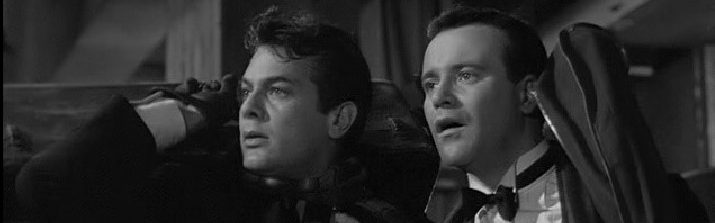
German refugees, Otto Keller (O.E. Hasse) and his wife Alma (Dolly Haas), work as caretaker and housekeeper at a Catholic rectory in Québec City, Canada. While robbing the house of a lawyer (who he sometimes works for), Otto ends up killing the man. Racked w/ guilt, he heads to the church where Father Michael Logan (Montgomery Clift) is up late. Otto confesses to murder; he says he wore a cassock that night as a disguise. After two schoolgirls come forward as witnesses, the police question all the local priests. Inspector Larrue (Karl Malden) suspects Fr. Logan from the start, sensing that he’s hiding something. It turns out that the deceased was blackmailing Ruth (Anne Baxter), who grew up w/ Logan and loved him before he went off to fight in WWII. She loves him still, though is married to a politician.

Fr. Logan: I never thought of the priesthood as offering a hiding place.

Sir Alfred Hitchcock (who was raised Catholic) told a New York Times reporter in August 1952, that he chose Québec for filming because “in no American city do you find a priest walking down the street in a cassock.” This movie was based on the 1902 play “Nos deux consciences” by Paul Anthelme, a journalist. In the play, the priest and his lover had a baby, and the priest was hanged at the end. These elements had to be removed from the movie b/c of the Hays Code. I Confess was banned in Ireland b/c it showed a priest having a relationship w/ a woman (even though it took place before the character took orders). The screenwriter (George Tabori) wanted the script to be a subtle dig at the McCarthy hearings, as it centered on a man unable to tell the truth when questioned by authorities. Tabori found that Hitchcock only wanted to make a thriller. Peter Bogdanovich noted that this is a favorite of French New Wave directors.

Hitchcock created detailed storyboards for each scene, as was his custom. He couldn’t understand Clift’s Method acting technique; he became frustrated after the actor blew take after take, failing to follow instructions. Tension occurred over Clift’s insistence on having his acting coach (Maria Rostova) by his side. Hitchcock found that Clift didn’t listen to him at all. Karl Malden, who was friendly w/ Clift, found the process difficult. Clift would immediately turn to Rostova for feedback after each scene. Clift was drinking heavily also; he’d come on-set hungover (which wasn’t unusual for leading men in Hollywood’s Golden Age). As a closeted gay man, I’m sure he had a lot of pressure on his shoulders.

This isn’t your typical Hitchcock- it lacks the sly humor, memorable music, and (of course) the suspense he was known for. However, it’s atmospheric, moody, w/ a thread of foreboding running throughout. French is spoken a bit by supporting characters. There are towering old churches, crosses and crucifixes of all styles, marble statues, and houses of Parliament. There is a flashback section that’s quite engaging, where you see a lighter side of Clift and Baxter. I liked Clift and Malden together; they project very different energies. Malden famously played a priest in On the Waterfront; fans of The West Wing know him as President Bartlet’s priest. Baxter has her hair dyed blonde (which I thought was distracting) and wears some stylish outfits, thanks to Orry Kelly.

[1] Forced into complicity with the murderer, Father Logan behaves as though he is guilty despite his innocence…

[2] The movie is a somber psychological drama, and the story of a forbidden love, and perhaps a Christ allegory (the priest has to suffer for another man’s sins- he has to bear his own cross).

[3] When the camera sweeps up to a full screen view of Clift’s face and you see those glowing, brooding eyes, you fall under their collective spell.

-Excerpts from IMDB reviews

“Star Trek: DS9” – Season 1, Episode 3 (“A Man Alone”)

Jake (Cirroc Lofton) makes friends w/ a teenage Ferengi, Nog (Aron Eisenberg), Quark’s nephew and prone to act mischievous. Chief O’Brien (Colm Meaney) argues w/ his wife Keiko (Rosalind Chao- who co-starred in The Joy Luck Club also in 1993), who hasn’t adjusted to life on DS9. On the Enterprise (TNG), Keiko was a botanist, but now she has no work. Odo (Rene Auberjonois) doesn’t see what’s so great about being a couple, as he comments to Quark (Armin Shimerman). This is a fun scene w/ actors who can do both comedy and drama. You also see their chemistry w/ each other as frenemies. Lt. Dax (Terry Farrell) explains to Dr. Bashir (Alexander Siddig) that her species don’t go seeking romantic relationships. I like the charm and confidence Farrell shows, even in early eps. Siddig also brings the charm, yet his character has much more naivete.

Sisko: [to Odo] If you can’t work within the rules I’ll find someone who can.

The A-story focuses on Odo, the shape-shifting constable w/ a strong sense of justice who is caught up in a mystery. Odo sees a familiar face on the Promenade, the Bajoran smuggler Ibudan, and gives him a day (26 hours in this world) to get off the station. Sisko (Avery Brooks) says that the man hasn’t done anything wrong, so Odo can’t just kick him out. Odo tells of how Ibudan once let a child die b/c the parents couldn’t afford medicine. Ibudan also killed a Cardassian w/o provocation during the Occupation, so Odo turned him in. When Ibudan is murdered on one of the holodecks, Odo becomes the prime suspect. However, things are not as they seem!

Quark: [about Odo] He’s an ill-tempered, overbearing, cross-patch. But he was no Cardassian collaborator, and he’s no killer.

Zayra: I can’t believe you’re defending him, Quark. You’re his worst enemy.

Quark: Guess that’s the closest thing he has in this world to a friend.

There are a lines and scenes which wouldn’t be out of place on a cop show. Kira (Nana Visitor) says that Odo is “the most honorable man on the station.” The actress really seemed comfortable w/ her character from the start of the series. Dax and Bashir sift through evidence gathered at the murder scene and on the ship which Ibudan came on, trying to solve the crime. Some Bajorans on the station, incl. Zayra (Edward Laurence Albert- son of actor Eddie Albert) grow very suspicious of Odo. He is unlike anyone else in this community and worked under the Cardassians for some years. After Odo is relieved of duty by Sisko (for his own safety), he goes to his office. We see that it has been trashed; along one wall, the word “SHIFTER” can be seen. A mob gathers outside and Sisko calls in security to prevent damage and violence.

Keiko’s plan to start a school for the few kids on the station was a practical idea. Sisko liked the idea very much and Jake had grown bored of studying alone w/ a computer (which is what many kids are doing in quarantine). I liked the scene where Keiko convinced Nog’s father, Rom (Max Grodenchik), to allow him to attend. Rom is portrayed as confident and decisive, which changes drastically later in the show. There is an ep focused on Keiko’s teaching at the end of the season which fans esp. comment about.

[1] I enjoy how DS9 gets to work on establishing it’s characters right away– the payoff doesn’t come for quite a while but damn is it delicious when it does.

[2] …the conflict between Odo’s sense of justice and Starfleet rules will be done much better in later episodes…

[3] Odo – who really is a man alone – must learn to trust others to help him figure this one out and clear him of suspicion.

-Excerpts from IMDB reviews